

EML Bundle

Can EML Payments Sustain Its Fintech Comeback?
EML Payments, a rising star in the digital payments arena, is turning heads with impressive financial results. With a 15% revenue surge in 1HFY25 and a 50% jump in underlying EBITDA, the EML SWOT Analysis is more relevant than ever. But how does EML company translate these numbers into real-world value, and what's driving its impressive growth?

This deep dive explores how EML payments operates, examining its core payment solutions, including prepaid cards and digital payment platforms, and its strategic initiatives. Understanding How EML works, from its business model to its market position, is critical for anyone looking to navigate the complexities of the evolving digital payments landscape. We'll analyze EML company's revenue streams, its payment processing fees, and how it's innovating to stay ahead in a competitive industry.
What Are the Key Operations Driving EML’s Success?
The core operations of the EML company revolve around building payment infrastructure that facilitates transactions through prepaid cards and real-time payments. EML Payments offers a range of payment solutions, including prepaid cards, gift cards, and digital account solutions. These services cater to a diverse clientele, from major banks and retail brands to government entities and financial services companies.
EML's value proposition lies in its ability to provide customized payment solutions, especially for clients lacking in-house expertise. The company's business model is designed for scalability, supported by high gross profit margins and a relatively fixed cost base. This allows EML to efficiently serve various sectors by enabling innovative payment programs for disbursements, incentives, rewards, and payroll.
The operational processes at EML encompass an end-to-end payment chain, from implementation to customer service. The company's ability to self-issue cards in Australia and Europe highlights its direct control over key operational aspects. Technology development is a key focus, with ongoing initiatives like 'EML 2.0' and Project Arlo, aimed at creating a unified global technology platform to streamline operations and boost efficiency. The company's supply chain and distribution networks are designed to support its diverse product lines, which are categorized into Gift & Incentive, General Purpose Reloadable (GPR), and Digital Payments segments. For more insights, explore the Target Market of EML.
 EML's Payment Solutions
EML provides a range of payment solutions tailored for various business needs. These include prepaid cards, which are a core offering, and digital payment platforms. These solutions are designed to be flexible and adaptable, meeting the specific requirements of different clients and industries.
Operational Efficiency
EML focuses on operational efficiency through technology and strategic initiatives. The "EML 2.0" strategy and Project Arlo aim to create a unified global technology platform. This platform simplifies operations and enhances efficiency, which is crucial for scaling the business and maintaining profitability.
Value Proposition
The company's value proposition is centered around providing customized payment solutions. EML offers services to clients lacking in-house expertise to build their own payment systems. This approach allows EML to serve a wide array of clients, from retail to government sectors, enabling them to implement innovative payment programs.
Revenue Streams
EML generates revenue through various channels related to its payment solutions. These include fees from payment processing, card issuance, and other value-added services. The diverse revenue streams contribute to the company's overall financial performance and sustainability.

Key Features of EML Payments
EML's success is built on several key features that set it apart in the payment solutions market. These features include a strong focus on innovation, a commitment to regulatory compliance, and a customer-centric approach. EML's ability to adapt and scale its services is a key differentiator.
- Customizable Payment Solutions: Tailored services to meet specific client needs.
- Global Reach: Operations and services that span multiple countries.
- Technological Advancements: Continuous investment in technology to improve efficiency and security.
- Compliance and Security: Adherence to regulatory standards to ensure secure payment processing.
EML SWOT Analysis
- Complete SWOT Breakdown
- Fully Customizable
- Editable in Excel & Word
- Professional Formatting
- Investor-Ready Format

How Does EML Make Money?
Understanding the revenue streams and monetization strategies of the EML company is crucial for grasping its financial health and operational dynamics. The company, specializing in payment solutions, employs a multifaceted approach to generate income, primarily through transaction fees. This strategy, combined with other revenue sources, allows EML payments to maintain a robust financial model.
The core of How EML works involves a fee-based model on payment transactions. However, EML also taps into additional revenue streams, including fees from breakage (unspent card funds), inactive accounts, and cash establishments. A significant portion of its revenue comes from interest earned on the funds loaded onto cards, known as float.
In FY24, EML's continuing operations (excluding the liquidated PCSIL business) reported revenue of A$217.3 million, reflecting an 18% increase from FY23. This growth was fueled by customer revenue and a substantial increase in treasury yield performance. Interest income saw a significant boost, more than doubling from A$25.3 million in FY23 to A$49.8 million in FY24, contributing 13.3% to the continuing operations' revenue growth. For the first half of FY25 (1HFY25), revenue increased by 15% to A$115.1 million, with customer revenue up 6% and interest uplift up 49%. The annualized yield in 1HFY25 was approximately 3.7%, compared to 2.5% in 1HFY24.
Revenue Breakdown by Segment
The company's revenue mix across its segments in FY24 shows how EML diversifies its income streams across different business areas. This diversification helps in mitigating risks and capitalizing on various market opportunities within the payment solutions landscape.
- Gift & Incentive: This segment saw 9.4% growth in revenue to A$81.5 million, with corporate incentives increasing by 16% (A$4.2 million) while mall revenue declined by 5% (A$2.3 million). Interest income in this division more than doubled to A$9.8 million in FY24.
- General Purpose Reloadable (GPR): Excluding PCSIL, GPR revenue grew by 27.3% in FY24, with customer revenue increasing by 6.6% to A$72.4 million, driven by 15% growth from the human capital management sector and 23% from the government sector. Interest income for GPR doubled to A$39.1 million in FY24.
- Digital Payments: This division reported 12% revenue growth in FY24, with its Sentenial business contributing A$15.2 million in revenue and A$13.5 million in gross profit. The sale of Sentenial was completed in September 2024.
EML PESTLE Analysis
- Covers All 6 PESTLE Categories
- No Research Needed – Save Hours of Work
- Built by Experts, Trusted by Consultants
- Instant Download, Ready to Use
- 100% Editable, Fully Customizable

Which Strategic Decisions Have Shaped EML’s Business Model?
The journey of EML Payments has been marked by strategic shifts and significant milestones. The company has been actively reshaping its operations, focusing on strengthening its financial position and streamlining its business model. These efforts are geared towards enhancing its competitive edge in the dynamic payment solutions market. The company's ability to adapt and innovate is crucial for its continued success.
A key focus for EML Payments has been on optimizing its portfolio and addressing regulatory demands. The company has made strategic decisions to divest underperforming assets and capitalize on growth opportunities. These moves are designed to position EML Payments for sustainable growth and increased shareholder value. The company's commitment to innovation and customer satisfaction remains central to its strategy.
The company's 'EML 2.0' strategy, announced in November 2024, focuses on industrializing operations, energizing its commercial team, expanding into new customer verticals, and returning to sustainable double-digit growth. This includes the development of a unified global technology platform (Project Arlo) and simplifying its organizational structure. Leadership changes, including the appointment of Anthony Hynes as Executive Chair in December 2024, underscore the commitment to this new strategic direction.
Key Milestones
A major milestone was the liquidation of PFS Card Services Ireland Limited (PCSIL), which was treated as discontinued operations in FY24. The sale of Sentenial, including its Nuapay business, to GoCardless for €32.75 million (approximately A$53.4 million), completed in September 2024, was another significant move. This boosted the balance sheet, shifting from a net debt of A$48 million to a net cash position of approximately A$5 million post-FY24.
Strategic Moves
EML Payments has focused on streamlining its operations and improving financial performance. The lifting of growth cap restrictions in its UK General Purpose Reloadable (GPR) business in April 2024 allowed for expansion. The 'EML 2.0' strategy, announced in November 2024, is aimed at driving sustainable growth through operational improvements, commercial team enhancements, and expansion into new sectors.
Competitive Edge
EML Payments distinguishes itself through customized payment solutions, in-house card issuance capabilities in Australia and Europe, and comprehensive payment chain capabilities. The focus on cost optimization and securing new business, particularly in human capital management and government sectors, has enhanced performance. The company's ability to adapt and innovate in the payment solutions market is crucial.
Financial Performance
FY24 results showed an 18% increase in revenue to A$217.3 million and a 34% increase in underlying EBITDA to A$49.0 million (A$57.1 million including PCSIL). These figures demonstrate improved financial performance and a strong foundation for the 'EML 2.0' strategy. For more insights, you can explore the Competitors Landscape of EML.
How EML Works
EML Payments provides payment solutions that are tailored for various business needs, including prepaid cards and digital payments. The company's business model centers on offering flexible and secure payment options. EML processes transactions and manages payment solutions for businesses and consumers.
- Customized payment solutions for businesses.
- In-house card issuance capabilities.
- Focus on cost optimization and new business acquisition.
- Strategic divestments to strengthen financial position.
EML Business Model Canvas
- Complete 9-Block Business Model Canvas
- Effortlessly Communicate Your Business Strategy
- Investor-Ready BMC Format
- 100% Editable and Customizable
- Clear and Structured Layout

How Is EML Positioning Itself for Continued Success?
The EML company, operating in the payment solutions sector, competes in the prepaid and gift card market, alongside government financial services. EML Payments has shown a financial turnaround, though profitability has been inconsistent. As of December 31, 2024, EML Payments reported a trailing 12-month revenue of A$87.7 million. The 'EML 2.0' strategy aims to strengthen its market position across Australia, the UK, Europe, and North America.
Key risks for EML Payments include regulatory and ESG concerns, such as interchange caps and fraud prevention requirements. Changes in regulations could decrease revenue and increase costs. A potential economic downturn could impact gift and incentive card sales, and there is also the risk of overpayment for acquisitions and integration difficulties.
Industry Position
EML Payments is positioned within the competitive payment solutions industry. The company's focus is on prepaid cards and digital payments. It is working to enhance its market position in key regions.
Risks
EML faces risks from regulations, ESG factors, and economic downturns. Regulatory changes could reduce revenue and increase costs. The company must manage risks related to acquisitions and integration.
Future Outlook
The outlook for earnings growth is more supportive compared to previous years. EML aims for double-digit transaction revenue growth by FY27. The company's improved cash balance of A$50.6 million in 1HFY25 provides flexibility.
Strategic Initiatives
Strategic initiatives include strengthening customer relationships and entering new markets. Prioritizing investment in technology for operational efficiency is also key. The leadership is focused on building a high-performance culture.
Key Financial Metrics and Targets
EML Payments is targeting double-digit transaction revenue growth by FY27. The company's FY25 underlying EBITDA guidance is in the range of A$54-60 million, and its cash balance reached A$50.6 million in 1HFY25.
- Double-digit transaction revenue growth by FY27.
- FY25 underlying EBITDA guidance: A$54-60 million.
- Cash balance of A$50.6 million in 1HFY25.
- Focus on customer relationships and market expansion.
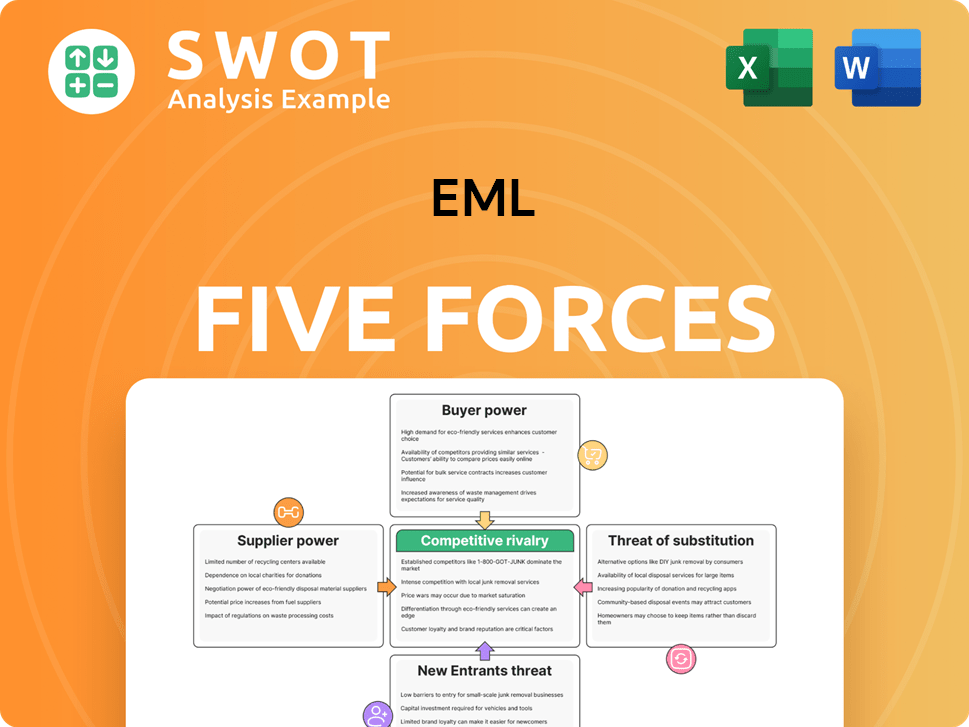
EML Porter's Five Forces Analysis
- Covers All 5 Competitive Forces in Detail
- Structured for Consultants, Students, and Founders
- 100% Editable in Microsoft Word & Excel
- Instant Digital Download – Use Immediately
- Compatible with Mac & PC – Fully Unlocked
Related Blogs

- What are Mission Vision & Core Values of EML Company?
- What is Competitive Landscape of EML Company?
- What is Growth Strategy and Future Prospects of EML Company?
- What is Sales and Marketing Strategy of EML Company?
- What is Brief History of EML Company?
- Who Owns EML Company?
- What is Customer Demographics and Target Market of EML Company?
Disclaimer
All information, articles, and product details provided on this website are for general informational and educational purposes only. We do not claim any ownership over, nor do we intend to infringe upon, any trademarks, copyrights, logos, brand names, or other intellectual property mentioned or depicted on this site. Such intellectual property remains the property of its respective owners, and any references here are made solely for identification or informational purposes, without implying any affiliation, endorsement, or partnership.
We make no representations or warranties, express or implied, regarding the accuracy, completeness, or suitability of any content or products presented. Nothing on this website should be construed as legal, tax, investment, financial, medical, or other professional advice. In addition, no part of this site—including articles or product references—constitutes a solicitation, recommendation, endorsement, advertisement, or offer to buy or sell any securities, franchises, or other financial instruments, particularly in jurisdictions where such activity would be unlawful.
All content is of a general nature and may not address the specific circumstances of any individual or entity. It is not a substitute for professional advice or services. Any actions you take based on the information provided here are strictly at your own risk. You accept full responsibility for any decisions or outcomes arising from your use of this website and agree to release us from any liability in connection with your use of, or reliance upon, the content or products found herein.