

EML Bundle

Can EML Payments Navigate the Fintech Frontier?
EML Payments, a global force in payment solutions, is at a critical juncture, making its EML SWOT Analysis and future prospects more crucial than ever. Founded in 2001, the company has evolved from prepaid cards to encompass digital account solutions, serving diverse clients across 32 countries. This evolution positions EML within a rapidly expanding digital payments market, demanding a robust growth strategy.

This EML company analysis delves into the "EML 2.0" strategy, which targets double-digit transaction revenue growth by FY27, offering a glimpse into EML's long-term growth outlook. We'll explore how EML's business model and EML market positioning support its expansion plans, particularly in Europe, and assess its potential risks and competitive advantages within the fintech industry. Understanding EML's financial performance and strategies for customer acquisition is key to evaluating its future market share projections and investment potential.
How Is EML Expanding Its Reach?
The company's expansion initiatives are primarily driven by its 'EML 2.0' strategy, focusing on both organic growth and strategic realignments. This includes a strong emphasis on deepening relationships with its existing customer base, which exceeds 1,000 clients, to unlock new revenue streams. The company is also actively entering new verticals to leverage its expertise in customized payment solutions.
Geographical expansion, particularly in the UK, is another key area of focus, with previous growth restrictions now lifted. The firm's capabilities span the entire payment chain, allowing it to self-issue cards in Australia and Europe. The company has historically used mergers and acquisitions to grow, but now it is prioritizing organic growth while exploring minority stakes in emerging firms.
A significant strategic move in late 2024 was the sale of Sentenial, its Digital Payments division, to GoCardless for €32.75 million (A$53.4 million). This allows the company to streamline operations and concentrate on its core business areas. This divestment, along with the wind-down of its Irish business PCSIL, aims to remove obstacles to profitable growth and support a more focused market-driven product strategy.
 Customer Base Growth
The company is focused on expanding its customer base, particularly in the UK, where previous growth restrictions have been lifted. This expansion is a key component of the overall EML growth strategy. The company aims to leverage its existing capabilities and market presence to attract new clients.
Vertical Market Entry
The company is accelerating its entry into new verticals that align with its existing capabilities. This includes sectors like human capital management, embedded finance, and government. This diversification is a key aspect of the firm's EML future prospects.
Strategic Divestitures
The sale of Sentenial for €32.75 million (A$53.4 million) and the wind-down of PCSIL are strategic moves. These actions allow the company to streamline operations and focus on core business areas. This is part of a broader plan to enhance EML's financial performance.
Geographical Expansion
The firm is expanding its customer base geographically, particularly in the UK. This expansion is supported by the company's ability to self-issue cards in Australia and Europe. This growth strategy is a key element of the EML market approach.

Key Expansion Strategies
The company is implementing several key strategies to drive growth. These include deepening relationships with existing clients and entering new verticals. The firm is also focusing on geographical expansion, particularly in the UK, and streamlining operations through strategic divestitures.
- Focus on existing customer base to unlock new revenue opportunities.
- Accelerated entry into new verticals such as human capital management and embedded finance.
- Geographical expansion, especially in the UK, to increase market share.
- Strategic divestitures to streamline operations and enhance profitability.
For a deeper understanding of the firm's target market, you might find this analysis of the Target Market of EML helpful.
EML SWOT Analysis
- Complete SWOT Breakdown
- Fully Customizable
- Editable in Excel & Word
- Professional Formatting
- Investor-Ready Format

How Does EML Invest in Innovation?
The company focuses on innovation and technology as key drivers for sustained growth, particularly through its 'EML 2.0' strategy. This strategy emphasizes a product-led innovation approach, ensuring that the company's offerings remain aligned with evolving customer needs. The company leverages data analytics and artificial intelligence to enhance its payment solutions, aiming to offer more innovative and efficient services.
The company develops its products in-house and integrates them with matching technologies, demonstrating a commitment to internal development and technological advancement. This approach allows for greater control over product quality and the ability to quickly adapt to market changes. The company's ability to extend capabilities from one product to many, expanding from gift cards to digital banking and real-time payments, highlights its continuous innovation and diversification efforts.
The company's strategic plan includes investments in leadership, talent, and its global operating model, along with go-to-market teams and supporting activities. This investment in a global operating model, a scaled revenue engine, and a unified tech platform is designed to underpin the execution of its strategy and position the company for a more prosperous future. For example, the company's focus on technological advancements and innovations is crucial for its EML growth strategy and EML future prospects.

Product Roadmap Alignment
The company actively aligns its product roadmap with evolving customer needs. This customer-centric approach ensures that new products and features meet market demands. This focus is critical for EML company analysis and understanding its market position.
Data Analytics and AI Integration
The company utilizes data analytics and artificial intelligence to enhance its payment solutions. This integration allows for more innovative and efficient services. These technologies help to improve customer experience and operational efficiency.
In-House Product Development
The company develops its products in-house and integrates them with matching technologies. This approach allows for greater control over product quality and the ability to quickly adapt to market changes. Internal development ensures alignment with the company's strategic goals.
Unified Tech Platform Investment
The company plans to invest in a unified tech platform, with a projected capital investment of A$12-15 million. This investment is expected to deliver annual savings of A$8-12 million starting in FY27. This platform is designed to support the execution of its strategy and enhance operational efficiency.
Global Operating Model
The company is investing in a global operating model to support its growth. This includes investments in leadership, talent, and go-to-market teams. A robust global operating model is essential for expanding into new markets and scaling operations.
Continuous Innovation
The company has a track record of extending capabilities from one product to many, such as expanding from gift cards to digital banking and real-time payments. This continuous innovation is crucial for maintaining a competitive edge. For more information, check out the insights provided by Owners & Shareholders of EML.
Key Technological Advancements and Innovations
The company's focus on technological advancements and innovations is a core part of its strategy. This includes investments in data analytics, AI, and a unified tech platform. These advancements are designed to drive efficiency and enhance customer experience.
- Data Analytics: Utilizing data to understand customer behavior and improve services.
- Artificial Intelligence: Implementing AI to automate processes and offer innovative payment solutions.
- Unified Tech Platform: Investing in a centralized platform to streamline operations and reduce costs.
- Product Diversification: Expanding product offerings, such as from gift cards to digital banking.
EML PESTLE Analysis
- Covers All 6 PESTLE Categories
- No Research Needed – Save Hours of Work
- Built by Experts, Trusted by Consultants
- Instant Download, Ready to Use
- 100% Editable, Fully Customizable

What Is EML’s Growth Forecast?
The financial outlook for EML Payments, as part of its EML growth strategy, indicates a focus on recovery and stabilization after a period of challenges. The company is implementing a turnaround strategy, which is expected to positively influence its financial performance. The FY25 guidance and recent financial reports suggest a path toward improved profitability and revenue growth.
For FY25, EML has provided underlying EBITDA guidance in the range of A$54 million to A$60 million. Forecasts point to an underlying EBITDA of A$54.8 million in FY25, with a 26.3% margin, increasing to A$58.5 million in FY26, with a 27.0% margin. This represents a considerable improvement compared to the underlying EBITDA of A$49.0 million in FY24 for its continuing business. This positive trajectory is a key aspect of the EML future prospects.
In the first quarter of FY25, EML reported a 12% increase in revenue, reaching approximately A$49 million, and a 64% jump in quarterly underlying EBITDA to A$11.6 million. These figures highlight the initial success of the company's turnaround efforts. The company's financial performance is also influenced by its business model and its position in the EML market.
Revenue and Profitability
For the fiscal year ending June 30, 2024, EML reported revenue of A$217.34 million, showing an 18% year-over-year growth. The net loss after tax from continuing operations was A$9.6 million, a significant improvement from A$260.3 million in FY23. This improvement in profitability is a positive sign for the EML company analysis.
Analyst Forecasts
Analysts anticipate 2025 revenues to be approximately A$214.1 million, with an expected statutory profit of A$0.049 per share. These forecasts suggest a continued, albeit moderate, growth trajectory. Investors should consider these projections when evaluating how to invest in EML stock.
Balance Sheet Recovery
The company's balance sheet is showing signs of recovery, with gearing (interest-bearing borrowings/equity) at 29% in December 2024, down from 57% in June 2024. This improvement indicates better financial health and stability, which is crucial for the EML's long-term growth outlook.
Revenue Growth Drivers
EML expects revenue growth from new customer wins, increased volumes from existing customers, and higher interest income. Interest income more than doubled in FY24, highlighting the importance of interest-bearing revenue streams. The company's strategies for customer acquisition are also key.
Strategic Plan and Targets
The company's strategic plan, EML 2.0, aims for double-digit transaction revenue growth by FY27. This plan is a key component of EML's growth strategy in the digital payments sector. Understanding EML's partnerships and collaborations is also crucial.
Price Target and Market Sentiment
The average one-year price target for EML Payments Limited is A$1.16, with forecasts ranging from a low of A$0.69 to a high of A$1.54. This range reflects the varying market sentiment and the potential risks for EML investors. Consider the Competitors Landscape of EML to understand the competitive environment.
EML Business Model Canvas
- Complete 9-Block Business Model Canvas
- Effortlessly Communicate Your Business Strategy
- Investor-Ready BMC Format
- 100% Editable and Customizable
- Clear and Structured Layout

What Risks Could Slow EML’s Growth?
The company faces several strategic and operational risks that could affect its growth plans. Intense competition in the prepaid and gift card sectors, along with government financial services, makes it difficult for the firm to differentiate itself. To win and keep clients, the firm may need to reduce fees, which could limit profitability. This impacts the overall EML growth strategy.
Regulatory changes pose a significant challenge. The company has previously dealt with substantial issues in its Irish operations, leading to significant losses and regulatory restrictions in the UK business, preventing new customer acquisitions until April 2024. Although the UK restrictions have been lifted and the Irish business (PCSIL) has been wound down, regulatory scrutiny and compliance remain crucial. The sale of Sentenial was partly due to the need to streamline operations and address past issues, directly influencing the EML future prospects.
Technological disruption is an ongoing risk in the fast-evolving digital payments landscape. While the company invests in technology, larger players with scale advantages could pose a threat. Internal resource constraints and the need for talent investment across various teams have also been identified, which also influences the EML company analysis.
Market Competition
The prepaid and gift card market is highly competitive, requiring the company to differentiate itself to maintain and grow its market share. Competitors may offer similar services at lower prices, impacting profitability. Strong competition is a significant factor in the EML market analysis.
Regulatory Risks
Regulatory changes, particularly concerning financial services, can lead to significant compliance costs and operational challenges. Past issues with the Irish operations and restrictions in the UK highlight the impact of regulatory scrutiny. The company must navigate complex regulations to ensure its EML business model remains compliant.
Technological Disruption
The rapid evolution of digital payments poses a constant threat. Larger companies with greater resources can introduce innovations that quickly make existing services obsolete. The company must continuously invest in technology to stay competitive and maintain its EML financial performance.
Interest Rate Fluctuations
Potential declines in interest rates could moderate interest income, affecting earnings. This external factor is beyond the company's direct control but can significantly impact its financial results. The impact of interest rates needs to be factored into the EML company's expansion plans in Europe.
Resource Constraints
Internal resource constraints and the need for talent investment across senior leadership, risk, treasury, and commercial teams can limit the company's ability to execute its growth strategies effectively. Addressing these constraints is critical for long-term success. Read more about the company's EML's competitive advantages in the fintech industry.
Economic Downturns
Economic downturns can reduce consumer spending and the demand for prepaid cards and payment solutions. This could negatively impact the company's revenue streams and profitability. Understanding the broader economic context is crucial for assessing the EML's future market share projections.
Strategic Initiatives
The company's management is focused on mitigating these risks through strategic reviews, leadership changes, and cost optimization. A shift to organic growth from an acquisition-led strategy is seen positively. This includes prioritizing expansion into adjacent markets and improving execution. For more insights, consider the Marketing Strategy of EML.
Financial Impact
External factors like potential declines in interest rates could moderate interest income, impacting earnings. Although the company has taken steps to address past issues, external economic and regulatory factors remain as potential challenges to its EML's long-term growth outlook.
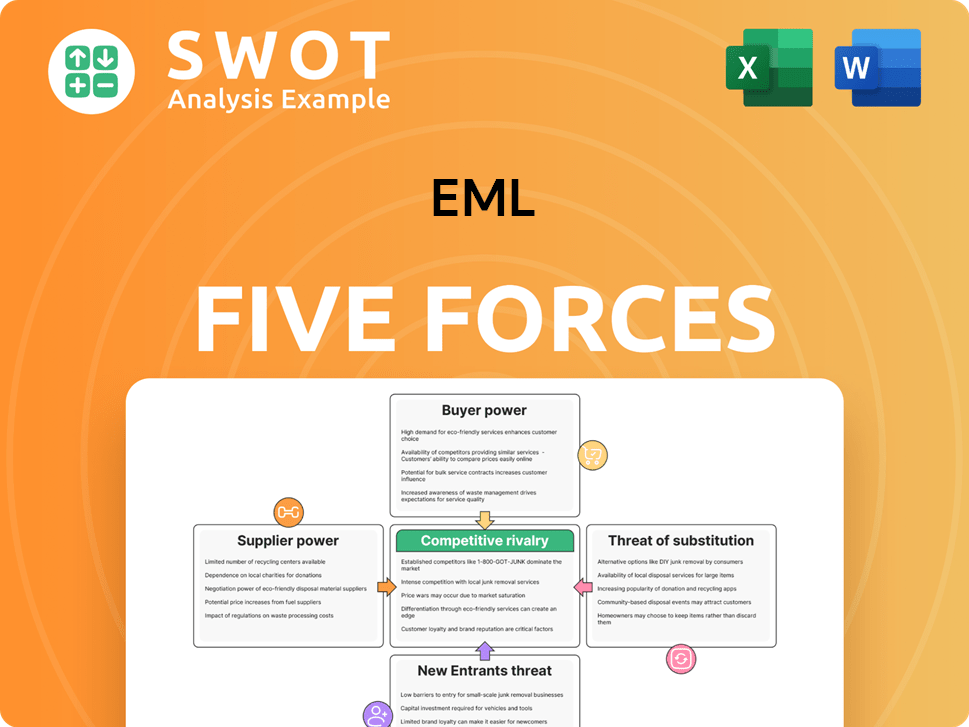
EML Porter's Five Forces Analysis
- Covers All 5 Competitive Forces in Detail
- Structured for Consultants, Students, and Founders
- 100% Editable in Microsoft Word & Excel
- Instant Digital Download – Use Immediately
- Compatible with Mac & PC – Fully Unlocked
Related Blogs

Disclaimer
All information, articles, and product details provided on this website are for general informational and educational purposes only. We do not claim any ownership over, nor do we intend to infringe upon, any trademarks, copyrights, logos, brand names, or other intellectual property mentioned or depicted on this site. Such intellectual property remains the property of its respective owners, and any references here are made solely for identification or informational purposes, without implying any affiliation, endorsement, or partnership.
We make no representations or warranties, express or implied, regarding the accuracy, completeness, or suitability of any content or products presented. Nothing on this website should be construed as legal, tax, investment, financial, medical, or other professional advice. In addition, no part of this site—including articles or product references—constitutes a solicitation, recommendation, endorsement, advertisement, or offer to buy or sell any securities, franchises, or other financial instruments, particularly in jurisdictions where such activity would be unlawful.
All content is of a general nature and may not address the specific circumstances of any individual or entity. It is not a substitute for professional advice or services. Any actions you take based on the information provided here are strictly at your own risk. You accept full responsibility for any decisions or outcomes arising from your use of this website and agree to release us from any liability in connection with your use of, or reliance upon, the content or products found herein.