

US Foods Bundle

Can US Foods Continue to Dominate the Foodservice Industry?
US Foods, a titan in the food distribution sector, has consistently evolved its US Foods SWOT Analysis to stay ahead in the competitive foodservice industry. Its strategic acquisitions, like the 2019 purchase of SGA's Food Group, demonstrate a commitment to expansion and market penetration. This journey from a merger of foodservice operations in 1993 to a leading distributor today showcases the power of a well-defined growth strategy.

Understanding US Foods' growth strategy is crucial for anyone analyzing the food distribution landscape. This exploration will examine the company's US Foods future prospects through strategic expansion, technological innovation, and financial management. We'll conduct a thorough market analysis to understand its position within the foodservice industry, including its US Foods market share, and the impact of its US Foods recent acquisitions on its US Foods revenue growth. This in-depth look will cover everything from US Foods company profile to its US Foods expansion plans, providing a comprehensive view of its trajectory.
How Is US Foods Expanding Its Reach?
The expansion initiatives of US Foods are designed to strengthen its market position and diversify its revenue streams. The company's growth strategy focuses on both organic expansion and strategic acquisitions. This multi-faceted approach is crucial in the competitive foodservice industry, where market share and customer loyalty are key drivers of success.
A significant part of US Foods' strategy involves mergers and acquisitions (M&A). While specific details for 2024-2025 acquisitions are not publicly available, the company has a history of using M&A to broaden its geographic reach and enhance its product and service offerings. This approach allows US Foods to quickly enter new regional markets and consolidate its position within the food distribution sector.
Beyond M&A, US Foods is pursuing organic growth through product launches and service enhancements. These initiatives, combined with strategic acquisitions, are vital for maintaining a competitive edge in the foodservice industry. The company's focus on innovation and customer-centric solutions is designed to drive long-term growth and profitability.
 Strategic Mergers and Acquisitions (M&A)
US Foods actively uses M&A to expand its geographic footprint and enhance its product offerings. The acquisition of SGA's Food Group of Companies in 2019 is a prime example, expanding its presence in the Pacific Northwest. This strategy allows US Foods to quickly enter new regional markets and consolidate its position in the food distribution network. The company's approach to M&A is a key component of its overall growth strategy.
Organic Growth Initiatives
US Foods focuses on organic growth through new product launches and service enhancements. The introduction of private brand products offers higher margins and meets evolving customer demands. Expanding e-commerce and technology solutions strengthens customer relationships and drives recurring revenue. These initiatives aim to capture a larger share of customer operational spending.

Key Expansion Strategies
US Foods' expansion plans include strategic acquisitions and organic growth initiatives. These strategies are designed to increase market share and enhance customer value. The company's focus on innovation and customer-centric solutions is designed to drive long-term growth and profitability.
- Mergers and Acquisitions: Expanding geographic reach and product offerings.
- Private Brands: Offering higher margins and meeting customer demands.
- E-commerce and Technology: Enhancing customer relationships and revenue.
- Supply Chain Optimization: Improving efficiency and customer experience.
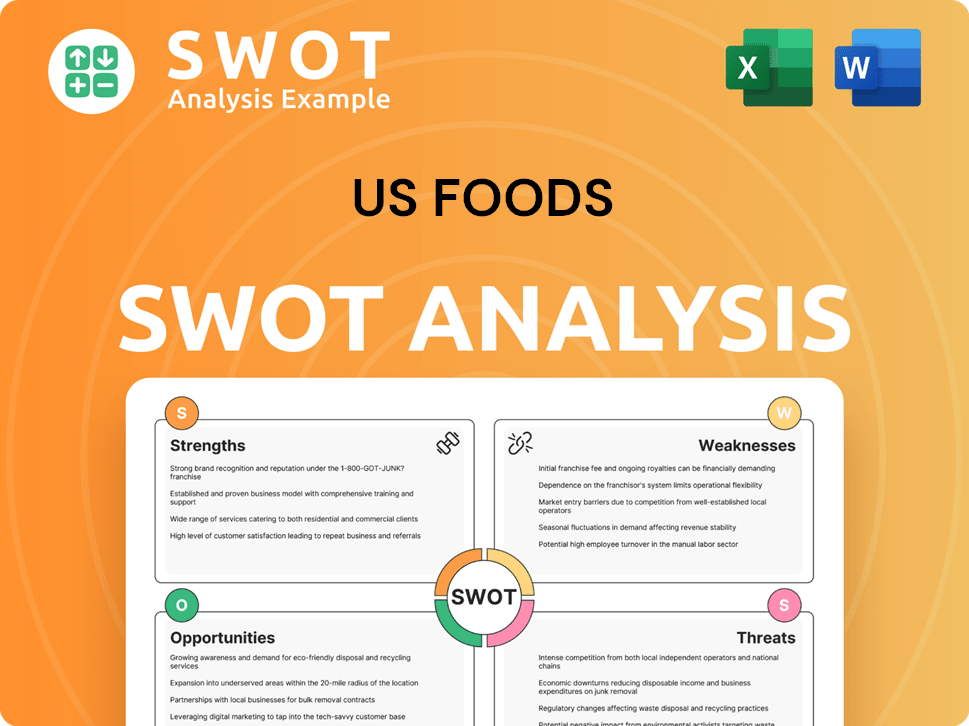
US Foods SWOT Analysis
- Complete SWOT Breakdown
- Fully Customizable
- Editable in Excel & Word
- Professional Formatting
- Investor-Ready Format
How Does US Foods Invest in Innovation?
The company, a key player in the food distribution and foodservice industry, utilizes technology and innovation to drive its growth strategy. This approach helps it meet the evolving needs of its customers, primarily restaurants and foodservice operators. By investing in digital solutions and supply chain technologies, the company aims to improve operational efficiency and enhance customer experience.
US Foods is committed to continuous improvement in its technology offerings to maintain a competitive edge. This involves regular updates to its online ordering systems and mobile applications, ensuring they remain user-friendly and efficient. The company's focus on technology is a direct response to changes in the foodservice industry and the need to provide superior service.
The company's innovation strategy also includes exploring advanced technologies to further refine its distribution network and predict customer demand. Initiatives in sustainability, such as optimizing delivery routes, are also part of this strategy. These efforts not only reduce environmental impact but also contribute to cost savings and appeal to environmentally conscious customers.

E-commerce and Digital Platforms
US Foods has invested heavily in e-commerce platforms to streamline the ordering process. These platforms are regularly updated to enhance user experience and efficiency for its customer base. This digital focus is crucial in the competitive food distribution market.
Supply Chain Optimization
Supply chain technologies are a core part of the company's strategy to improve inventory management. The goal is to optimize delivery logistics, ensuring timely and efficient service for its customers. This optimization is critical for maintaining operational excellence.
Advanced Technology Exploration
The company is exploring the use of data analytics and automation to refine its distribution network. This helps in predicting customer demand more accurately and reducing waste. These technologies are key to future growth.
Sustainability Initiatives
US Foods is focusing on sustainability initiatives, such as optimizing delivery routes. These efforts reduce the environmental footprint and can lead to cost savings. This approach appeals to environmentally conscious customers.
Customer-Centric Approach
The company's technology strategy is centered on improving service quality and increasing customer retention. This customer-centric approach is vital for attracting new business and maintaining market share. The company serves approximately 250,000 restaurant and foodservice operator partners.
Continuous Improvement
US Foods continuously updates its technology offerings and operational capabilities. This continuous improvement directly supports its growth objectives. It helps in providing a competitive edge in the rapidly evolving foodservice industry.
Key Technological Advancements
The company's focus on technological advancements is crucial for its growth strategy. These advancements aim to improve customer service, streamline operations, and enhance its competitive position within the food distribution and foodservice industry. For a deeper understanding of the company's history and evolution, consider exploring the Brief History of US Foods.
- E-commerce Platforms: Regular updates to online ordering systems and mobile applications to enhance user experience.
- Supply Chain Technologies: Investments in technologies to optimize inventory management and delivery logistics.
- Data Analytics: Exploration of data analytics for demand prediction and waste reduction.
- Automation: Implementation of automation to refine the distribution network.
- Sustainability Initiatives: Efforts to optimize delivery routes and reduce environmental impact.
US Foods PESTLE Analysis
- Covers All 6 PESTLE Categories
- No Research Needed – Save Hours of Work
- Built by Experts, Trusted by Consultants
- Instant Download, Ready to Use
- 100% Editable, Fully Customizable

What Is US Foods’s Growth Forecast?
The financial outlook for US Foods is centered on sustained growth, supported by its strong market position and strategic initiatives. The company's performance in the first quarter of 2024 sets a positive tone for the year, with reported net sales and adjusted EBITDA demonstrating healthy profitability. US Foods' growth strategy is underpinned by investments in technology, expansion, and operational efficiencies, positioning the company for continued success in the competitive foodservice industry.
US Foods' financial strategy emphasizes disciplined capital allocation to support both organic growth and strategic acquisitions. This approach is designed to expand market share and enhance shareholder value. The company's commitment to robust performance and strategic investment is evident in its financial targets and ongoing initiatives.
For the first quarter of 2024, US Foods reported net sales of $8.9 billion, reflecting a 3.8% increase compared to the prior year. This growth is a key indicator of the company's ability to capture market opportunities and drive revenue. The company's adjusted EBITDA for the same period was $367 million, demonstrating healthy profitability and operational efficiency. US Foods anticipates continued growth, with expectations for net sales in the range of $36.0 billion to $37.0 billion for the full fiscal year 2024. They also project adjusted EBITDA to be between $1.67 billion and $1.73 billion for the full fiscal year 2024.
Financial Performance Highlights
US Foods' financial performance in Q1 2024 showed positive trends, with a 3.8% increase in net sales. Adjusted EBITDA also demonstrated healthy profitability, reflecting efficient operations. These results highlight the company's strong position in the foodservice industry.
Strategic Investments
The company is investing in technology and infrastructure to support its growth strategy. Capital expenditures were $99 million in Q1 2024, showing a commitment to long-term growth. These investments are crucial for maintaining a competitive edge in the market.
Full Year 2024 Outlook
US Foods projects net sales between $36.0 billion and $37.0 billion for the full fiscal year 2024. Adjusted EBITDA is expected to be between $1.67 billion and $1.73 billion. These forecasts reflect the company's confidence in its growth trajectory.
Capital Allocation Strategy
US Foods focuses on disciplined capital allocation to support organic growth and strategic acquisitions. The company aims to expand its market share and enhance shareholder value through these strategic financial decisions. This approach supports the company's long-term goals.
Key Financial Metrics
US Foods' financial performance is a key indicator of its success in the foodservice industry. The company's ability to generate revenue and manage costs is crucial for its long-term growth. Understanding these metrics is essential for evaluating the company's financial health.
- Net Sales Growth: Reflects the company's ability to increase revenue.
- Adjusted EBITDA: Indicates profitability and operational efficiency.
- Capital Expenditures: Shows investments in infrastructure and technology.
- Full-Year Guidance: Provides insight into the company's future expectations.
For more details on how US Foods generates revenue, you can check out Revenue Streams & Business Model of US Foods.
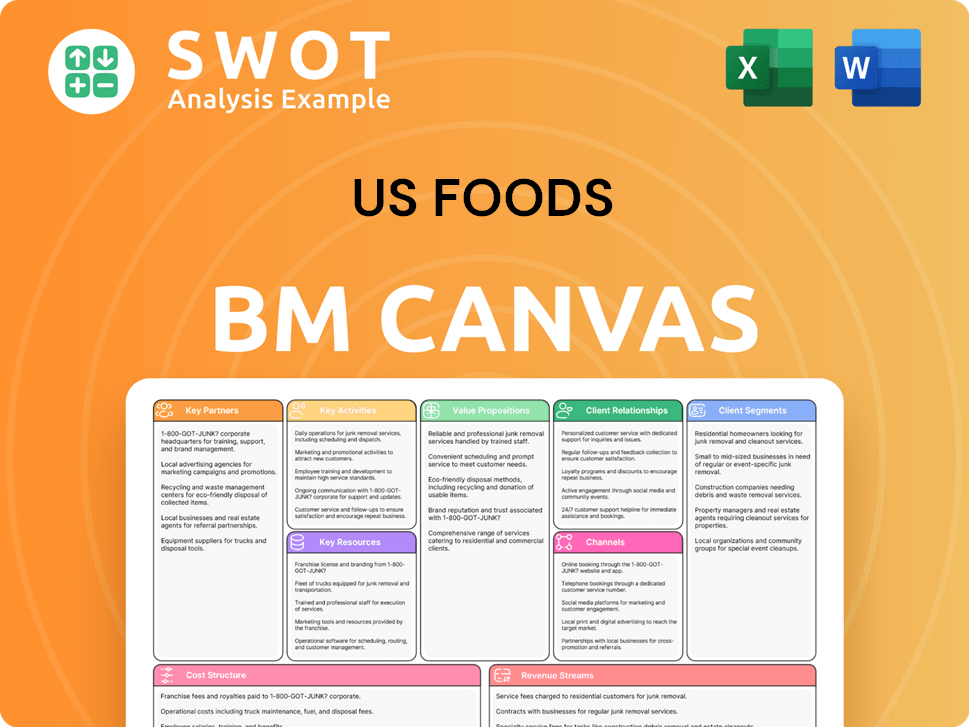
US Foods Business Model Canvas
- Complete 9-Block Business Model Canvas
- Effortlessly Communicate Your Business Strategy
- Investor-Ready BMC Format
- 100% Editable and Customizable
- Clear and Structured Layout
What Risks Could Slow US Foods’s Growth?
The path for US Foods' growth strategy is not without its potential pitfalls. Several risks and obstacles could affect the company's ability to achieve its expansion goals and maintain its strong position in the foodservice industry. Understanding these challenges is crucial for investors and stakeholders assessing the company's future prospects.
Market competition, regulatory changes, and supply chain vulnerabilities are key areas of concern. These factors demand careful management and strategic planning to ensure sustainable growth. Furthermore, internal challenges, such as managing a large workforce, can also impact operational efficiency and service quality.
The foodservice industry is highly competitive, which can squeeze profit margins. US Foods faces pressure to differentiate its offerings to stay ahead of competitors. Compliance costs related to food safety, labor laws, and environmental regulations also pose a continuous risk. These factors create a complex environment that requires constant adaptation and strategic foresight.
Market Competition
The food distribution market is fragmented, with numerous regional and national players vying for market share. Intense price competition and the need to differentiate offerings can pressure profit margins. This competitive landscape requires US Foods to continually innovate and optimize its operations to maintain its competitive edge.
Regulatory Risks
Changes in food safety regulations, labor laws, and environmental standards can lead to increased compliance costs. These regulations might also impose operational restrictions. US Foods must stay compliant to avoid penalties and maintain consumer trust.
Supply Chain Disruptions
Geopolitical events, natural disasters, or pandemics can cause product shortages, increased transportation costs, and delivery delays. These disruptions directly affect customer satisfaction and profitability. A resilient supply chain is critical for US Foods' success, as seen during the pandemic.
Technological Disruption
Evolving e-commerce models and new entrants could alter traditional distribution channels. US Foods needs to invest in digital platforms and assess emerging technologies to stay relevant. Adapting to technological changes is important for maintaining market share and operational efficiency.
Internal Operational Challenges
Managing a large workforce and ensuring consistent service quality across a vast network can be resource-intensive. US Foods must maintain high standards to retain customers and ensure operational excellence. This requires ongoing training, effective communication, and robust quality control measures.
Economic Headwinds
Economic downturns or inflationary pressures can affect consumer spending and the profitability of restaurants and other foodservice customers. These macroeconomic factors can indirectly impact US Foods' sales volumes and profit margins. The company must be prepared to navigate economic fluctuations.
Mitigation Strategies
US Foods employs several strategies to mitigate these risks. These include diversifying suppliers and robust logistics planning to address supply chain vulnerabilities. The company invests in digital platforms and continually assesses emerging technologies to counter technological disruption. Risk management frameworks, including scenario planning, are used to anticipate and prepare for challenges. For example, in 2024, US Foods is focused on improving its supply chain resilience and operational efficiency to maintain its competitive edge.
Recent Performance and Outlook
US Foods' ability to navigate supply chain disruptions during the pandemic highlighted its adaptability. The company's financial performance in 2024 will be influenced by its capacity to manage inflationary pressures and maintain customer relationships. The company's focus remains on organic growth, strategic acquisitions, and operational improvements to ensure long-term success. According to recent reports, US Foods is expected to continue its growth trajectory, but ongoing vigilance is required to maintain its momentum in a volatile market.
US Foods Porter's Five Forces Analysis
- Covers All 5 Competitive Forces in Detail
- Structured for Consultants, Students, and Founders
- 100% Editable in Microsoft Word & Excel
- Instant Digital Download – Use Immediately
- Compatible with Mac & PC – Fully Unlocked

Related Blogs

- What are Mission Vision & Core Values of US Foods Company?
- What is Competitive Landscape of US Foods Company?
- How Does US Foods Company Work?
- What is Sales and Marketing Strategy of US Foods Company?
- What is Brief History of US Foods Company?
- Who Owns US Foods Company?
- What is Customer Demographics and Target Market of US Foods Company?
Disclaimer
All information, articles, and product details provided on this website are for general informational and educational purposes only. We do not claim any ownership over, nor do we intend to infringe upon, any trademarks, copyrights, logos, brand names, or other intellectual property mentioned or depicted on this site. Such intellectual property remains the property of its respective owners, and any references here are made solely for identification or informational purposes, without implying any affiliation, endorsement, or partnership.
We make no representations or warranties, express or implied, regarding the accuracy, completeness, or suitability of any content or products presented. Nothing on this website should be construed as legal, tax, investment, financial, medical, or other professional advice. In addition, no part of this site—including articles or product references—constitutes a solicitation, recommendation, endorsement, advertisement, or offer to buy or sell any securities, franchises, or other financial instruments, particularly in jurisdictions where such activity would be unlawful.
All content is of a general nature and may not address the specific circumstances of any individual or entity. It is not a substitute for professional advice or services. Any actions you take based on the information provided here are strictly at your own risk. You accept full responsibility for any decisions or outcomes arising from your use of this website and agree to release us from any liability in connection with your use of, or reliance upon, the content or products found herein.