

US Foods Bundle

How Did US Foods Become a Foodservice Giant?
Embark on a journey through the fascinating US Foods SWOT Analysis, a company that has shaped the American culinary landscape. From its humble beginnings to its current status as a leading food distributor, the story of US Foods is a compelling narrative of strategic evolution and market dominance. Discover the key moments that transformed this foodservice provider into a vital part of the restaurant supply chain.

The US Foods company story is a compelling example of how a food distributor can adapt to the ever-changing demands of the foodservice industry. Understanding the US Foods history, from its early years to its current expansive network, provides valuable insights into the dynamics of the restaurant supply sector. This deep dive into US Foods will explore the strategic decisions that fueled its growth and solidified its position as a key player in the American food supply chain.
What is the US Foods Founding Story?
The story of US Foods begins not with a single founding date, but through the merging of several established food distribution companies. The roots of this major food distributor can be traced back to the late 1800s and early 1900s, with predecessors like Monarch Foods, which was established in 1853, laying the groundwork for what would become a significant player in the foodservice industry.
These early companies saw an opportunity to streamline the delivery of food products from producers to a growing network of restaurants, hotels, and institutions. This original business model centered on efficient logistics and reliable sourcing to ensure a consistent supply of quality food items. The economic environment of the late 19th and early 20th centuries, marked by industrialization and the expansion of commercial food establishments, greatly influenced the creation and growth of these foundational companies.
The formation of US Foods as it is known today is a result of strategic mergers and acquisitions over many years. The company's evolution highlights the changing landscape of the restaurant supply sector and the need for consolidation to meet the increasing demands of the market. For more information on the ownership structure, you can read about the Owners & Shareholders of US Foods.

Key Takeaways on US Foods Founding
US Foods' history is rooted in the late 19th and early 20th centuries, evolving through mergers of food distribution companies.
- Monarch Foods, established in 1853, is one of the earliest predecessors.
- The business model focused on efficient logistics and reliable sourcing for restaurants and institutions.
- The company's formation reflects the industrialization and growth of commercial food establishments.
- US Foods' timeline showcases strategic mergers and acquisitions to meet market demands.
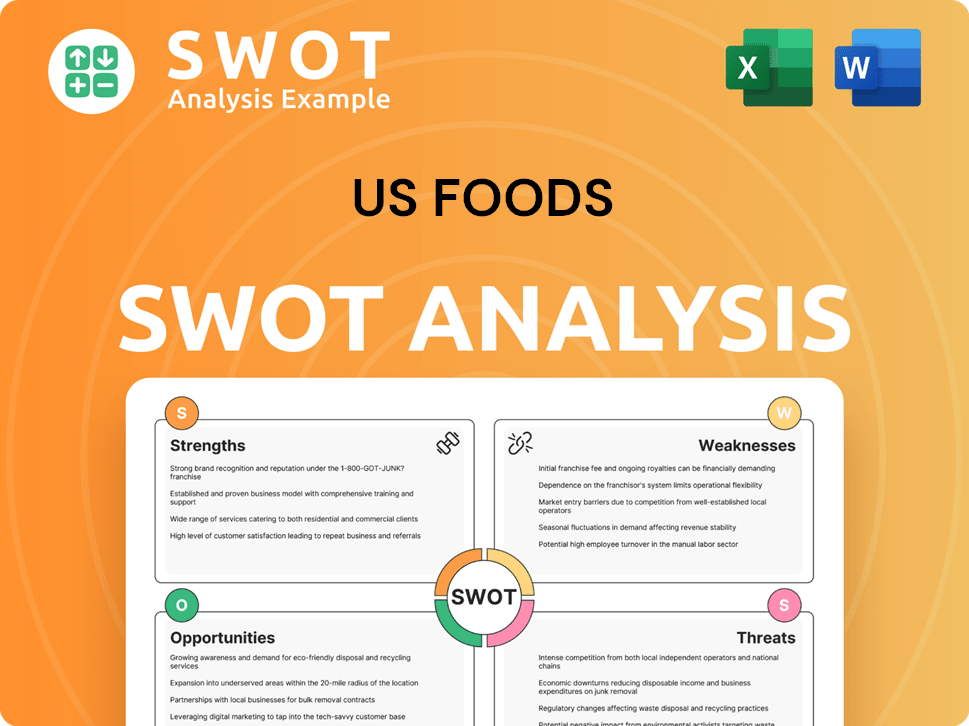
US Foods SWOT Analysis
- Complete SWOT Breakdown
- Fully Customizable
- Editable in Excel & Word
- Professional Formatting
- Investor-Ready Format
What Drove the Early Growth of US Foods?
The early growth and expansion of the entities that would become the modern US Foods involved regional expansions and strategic acquisitions. Companies broadened their product ranges beyond initial staples. Consolidation began as distributors sought greater economies of scale and national reach. Key developments included new distribution centers and the integration of transportation technologies.
 Regional Expansion
Early expansion focused on establishing distribution networks across different geographic areas. This involved setting up warehouses and logistical infrastructure. The goal was to increase the reach of the food distributor and serve a wider customer base. Expansion was crucial for capturing market share and increasing revenue.
Product Diversification
Companies started diversifying their product offerings to cater to a broader range of customers. They expanded beyond basic staples to include fresh produce, frozen items, and specialty products. This diversification allowed them to serve various segments within the foodservice industry. The expansion of product offerings was a key strategy.
Strategic Acquisitions
Mergers and acquisitions were a common strategy for growth and market penetration. These acquisitions allowed companies to quickly expand their geographic footprint. They also gained access to new product lines and customer bases. This strategy was essential for building a competitive advantage.
Technological Integration
The adoption of new technologies, such as improved transportation systems, played a crucial role. These advancements enhanced efficiency and reduced costs. They enabled faster delivery times and better inventory management. Technological integration was vital for streamlining operations.
US Foods PESTLE Analysis
- Covers All 6 PESTLE Categories
- No Research Needed – Save Hours of Work
- Built by Experts, Trusted by Consultants
- Instant Download, Ready to Use
- 100% Editable, Fully Customizable

What are the key Milestones in US Foods history?
The US Foods company, a major player in the food distributor industry, has a rich history marked by significant milestones. From its early beginnings to its current status as a leading foodservice distributor, the company's journey reflects the evolution of the restaurant supply sector. Understanding the US Foods history provides insight into its strategic adaptations and market positioning.
| Year | Milestone |
|---|---|
| 1853 | The company's origins trace back to the establishment of various predecessor companies. |
| 1906 | Several independent companies merged to form a larger entity in Chicago. |
| 1989 | Acquired by Kohlberg Kravis Roberts & Co. (KKR). |
| 1990s-2000s | Significant acquisitions and expansions occurred, growing its national footprint. |
| 2014 | Filed for an initial public offering (IPO) and began trading on the New York Stock Exchange. |
| 2024 | Continues to focus on strategic initiatives, including supply chain optimization and customer-centric solutions. |
US Foods has consistently pursued innovations to enhance its operations and customer service. A key focus has been on optimizing its supply chain, leveraging technology to improve logistics and inventory management. Furthermore, the company has invested in developing private label brands, offering a diverse range of products to its customers.

Supply Chain Optimization
Implementation of advanced logistics and distribution technologies to improve efficiency and reduce costs. This includes the use of data analytics for demand forecasting and route optimization.
Private Brand Development
Creation and expansion of exclusive product lines to offer differentiated value to customers. These brands often provide competitive pricing and unique product offerings.
E-commerce Platforms
Development of online platforms and digital tools to facilitate ordering and provide business solutions for customers. This enhances customer convenience and streamlines the ordering process.
Strategic Partnerships
Collaborations with food producers and technology providers to enhance market position and offer innovative solutions. These partnerships help in expanding product offerings and improving service capabilities.
Customer-Centric Solutions
Focus on providing value-added services and support to customers, including menu planning, business analytics, and operational consulting. This approach helps build stronger customer relationships.
Technology Integration
Adoption of advanced technologies, such as AI and automation, to improve operational efficiency and customer service. This includes the use of data analytics for demand forecasting and route optimization.
The US Foods company has faced several challenges throughout its history, including economic downturns that affect restaurant demand. Intense competition from other large distributors and smaller specialized players also presents a constant challenge. Regulatory changes within the food industry require continuous adaptation and compliance.
Economic Downturns
Economic recessions and fluctuations in consumer spending can significantly impact the demand for foodservice products, affecting revenue and profitability. The company must adapt to changing market conditions.
Competitive Pressures
Intense competition from other large distributors and smaller, specialized players puts pressure on pricing and market share. The company must continuously innovate to maintain a competitive edge.
Regulatory Compliance
Changes in food safety regulations and other industry standards require constant adaptation and investment in compliance measures. The company must stay updated with evolving legal requirements.
Supply Chain Disruptions
Disruptions in the supply chain, such as those caused by weather events, geopolitical issues, or transportation problems, can impact the availability of products and increase costs. The company needs robust risk management.
Changing Consumer Preferences
Evolving consumer preferences and dietary trends require the company to adapt its product offerings and marketing strategies. The company must stay attuned to changing consumer demands.
Operational Challenges
Managing a large and complex distribution network, including logistics, inventory, and workforce, presents ongoing operational challenges. The company must ensure operational efficiency.
To learn more about the financial aspects of US Foods, you can explore the Revenue Streams & Business Model of US Foods. The company's ability to adapt, innovate, and respond to challenges has been crucial to its long-term success.
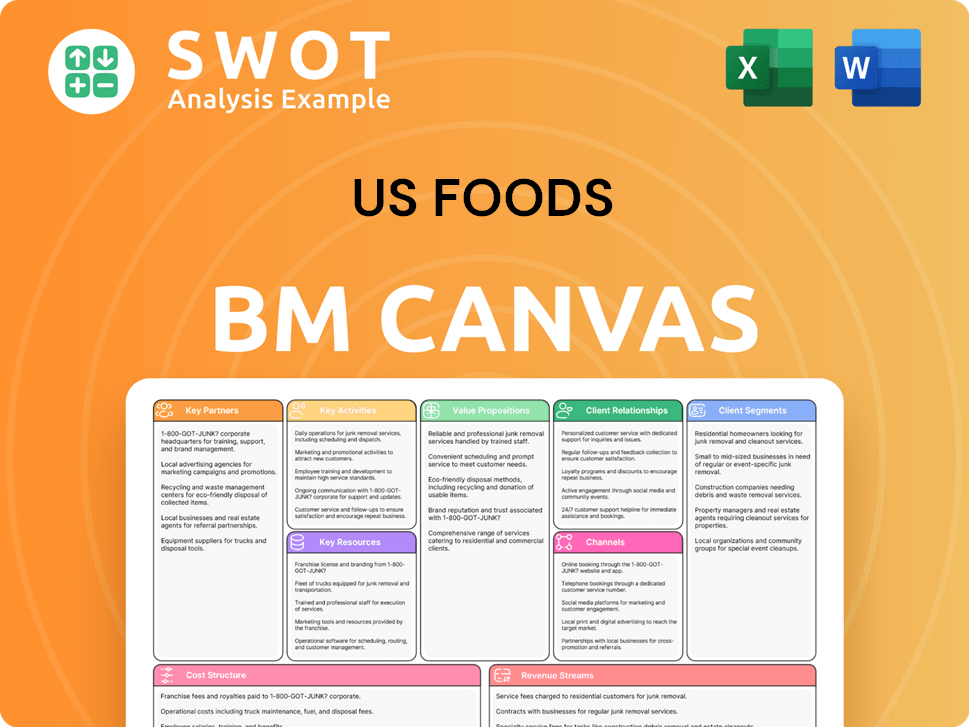
US Foods Business Model Canvas
- Complete 9-Block Business Model Canvas
- Effortlessly Communicate Your Business Strategy
- Investor-Ready BMC Format
- 100% Editable and Customizable
- Clear and Structured Layout
What is the Timeline of Key Events for US Foods?
The US Foods history is characterized by significant milestones. While its roots trace back to the 19th century through various predecessor companies, the modern US Foods emerged through consolidations. The company went public in 2016 on the New York Stock Exchange. A recent key development includes the 2024 acquisition of Saladino's Foodservice, a major independent food distributor in California, which expanded its West Coast presence.
| Year | Key Event |
|---|---|
| 2016 | US Foods became a publicly traded company, listed on the New York Stock Exchange. |
| 2024 | US Foods acquired Saladino's Foodservice, a leading independent food distributor in California. |
| Ongoing | Continuous expansion and optimization of distribution network and technology solutions. |
Strategic Acquisitions
US Foods continues to pursue strategic acquisitions to broaden its market reach and enhance its product offerings. The acquisition of Saladino's in 2024 is a prime example of this strategy. These acquisitions are aimed at improving the company's ability to serve the foodservice industry.
Technological Advancements
The company is investing in technology to improve supply chain management and customer service. Digital ordering platforms and data analytics are being used to optimize operations. These advancements are crucial for maintaining a competitive edge in the foodservice market.
Market Trends
US Foods is adapting to industry trends, such as the growing demand for sustainable and locally sourced products. This focus on sustainability and local sourcing aligns with consumer preferences. The company is also expanding its product offerings to meet diverse customer needs.
Financial Performance and Outlook
Analysts predict continued growth for US Foods, supported by its strong market position and strategic initiatives. The company's focus on innovation and customer solutions is expected to drive long-term value. The company's financial performance reflects its ability to adapt and thrive in the competitive foodservice market.
US Foods Porter's Five Forces Analysis
- Covers All 5 Competitive Forces in Detail
- Structured for Consultants, Students, and Founders
- 100% Editable in Microsoft Word & Excel
- Instant Digital Download – Use Immediately
- Compatible with Mac & PC – Fully Unlocked

Related Blogs

- What is Competitive Landscape of US Foods Company?
- What is Growth Strategy and Future Prospects of US Foods Company?
- How Does US Foods Company Work?
- What is Sales and Marketing Strategy of US Foods Company?
- What is Brief History of US Foods Company?
- Who Owns US Foods Company?
- What is Customer Demographics and Target Market of US Foods Company?
Disclaimer
All information, articles, and product details provided on this website are for general informational and educational purposes only. We do not claim any ownership over, nor do we intend to infringe upon, any trademarks, copyrights, logos, brand names, or other intellectual property mentioned or depicted on this site. Such intellectual property remains the property of its respective owners, and any references here are made solely for identification or informational purposes, without implying any affiliation, endorsement, or partnership.
We make no representations or warranties, express or implied, regarding the accuracy, completeness, or suitability of any content or products presented. Nothing on this website should be construed as legal, tax, investment, financial, medical, or other professional advice. In addition, no part of this site—including articles or product references—constitutes a solicitation, recommendation, endorsement, advertisement, or offer to buy or sell any securities, franchises, or other financial instruments, particularly in jurisdictions where such activity would be unlawful.
All content is of a general nature and may not address the specific circumstances of any individual or entity. It is not a substitute for professional advice or services. Any actions you take based on the information provided here are strictly at your own risk. You accept full responsibility for any decisions or outcomes arising from your use of this website and agree to release us from any liability in connection with your use of, or reliance upon, the content or products found herein.