

Maersk Line A/S Bundle

Can Maersk Line A/S Continue to Dominate the Maritime Industry?
From its humble beginnings as a small shipping company, Maersk has grown into a global powerhouse, fundamentally shaping the world of container shipping. But what does the future hold for this industry titan? This analysis dives deep into the Maersk Line A/S SWOT Analysis, exploring its growth strategy and the exciting, yet challenging, future prospects that lie ahead.

Understanding Maersk's strategic initiatives is crucial for anyone invested in the maritime industry. This comprehensive examination will dissect Maersk's expansion plans, digital transformation efforts, and sustainability efforts. We'll also explore the company's financial performance and competitive landscape to provide a clear picture of Maersk's long-term growth strategy and its impact on global trade, offering valuable insights into the future of container shipping.
How Is Maersk Line A/S Expanding Its Reach?
The growth strategy of Maersk Line A/S centers on strengthening its integrated logistics offerings and expanding its global footprint. This approach involves a shift towards providing end-to-end solutions, managing the entire transportation process from origin to destination. This strategic direction aims to diversify revenue streams and adapt to the evolving dynamics of the maritime industry.
A key element of Maersk's expansion involves entering new markets and enhancing its existing global network. This strategy includes a focus on offering a comprehensive suite of services, such as ocean and inland transportation, freight forwarding, supply chain management, warehousing, and customs services. By integrating these services, Maersk aims to provide more value to its customers and increase its market share in the container shipping and maritime industry.
In 2024, the company broadened its logistics infrastructure. This included the opening of the Ruakura Superhub in New Zealand, a facility designed for seamless goods transfer. The company also launched the Maersk Logistics Park in Jeddah, Saudi Arabia, a large-scale site featuring storage, distribution, air freight, and e-commerce capabilities.

Key Expansion Initiatives
Maersk's expansion plans include strategic acquisitions and partnerships to enhance its service offerings and global reach. These initiatives are designed to improve operational efficiency and provide comprehensive supply chain solutions to its customers.
- Acquisition of Panama Canal Railway Company (PCRC): In April 2025, Maersk acquired PCRC for USD 700 million, enhancing intermodal container movement. This acquisition will be reported under the Ocean segment.
- APM Terminals Elizabeth Lease Extension: Effective from April 2025, Maersk agreed to extend APM Terminals Elizabeth's lease through December 2062, with an expected additional invested capital of approximately USD 1 billion.
- Gemini Cooperation with Hapag-Lloyd: Early 2024, Maersk announced the 'Gemini cooperation' with Hapag-Lloyd, which will comprise almost 50% of its global network capacity, aiming to improve port schedule reliability and increase asset utilization.
- Focus on Offshore Wind and Support Vessels: Maersk Supply Service is building scale in offshore wind and offshore support vessels, recognizing these as attractive future markets.
Maersk Line A/S SWOT Analysis
- Complete SWOT Breakdown
- Fully Customizable
- Editable in Excel & Word
- Professional Formatting
- Investor-Ready Format

How Does Maersk Line A/S Invest in Innovation?
The Maersk Line A/S consistently employs technology and innovation as central pillars of its growth strategy. This approach is not merely about digitalization; it signifies a comprehensive digital transformation, integrating technology into every facet of its operations. This commitment is crucial in the dynamic maritime industry, enabling the shipping company to stay competitive and meet evolving market demands.
The company's strategic focus on technology underscores its commitment to enhancing efficiency, reducing costs, and improving customer service. By embracing cutting-edge technologies such as AI, robotics, and automation, Maersk Line A/S aims to optimize its supply chain solutions and maintain its leading position in container shipping. This forward-thinking approach is essential for navigating the complexities of global trade and ensuring sustainable growth.
The company has significantly expanded its technology organization, growing from around 1,500 people to over 6,000, with a target of more than 550 SAP tech profiles by 2024. This substantial investment in human capital highlights the importance of technology in the company's future. The company's focus on innovation is also evident in its sustainability efforts and expansion plans.

Digital Transformation
The shift from simple digitalization to a full digital transformation is a key element of Maersk Line A/S's strategy. This involves integrating technology into every aspect of the business, from operations to customer service.
AI and Automation
The company is heavily investing in AI, robotics, and automation to improve efficiency and optimize supply chain solutions. AI is being used for forecasting, capacity planning, and pricing optimization.
Sustainable Shipping
Maersk Line A/S is advancing its sustainable shipping initiatives by incorporating new vessels capable of running on green methanol. The company has secured long-term offtake agreements for biomethanol fuel.
Fleet Modernization
The company is renewing its fleet with over 50 vessels expected to begin service between 2026 and 2030. This modernization improves energy efficiency and reduces environmental impact.
Logistics Parks
The company is investing in sustainable logistics parks, such as the Jeddah facility, which uses solar power to cover a significant portion of its energy needs. This supports the company's sustainability efforts.
Autonomous Technologies
The company is testing autonomous trucks and developing robotic solutions to revolutionize ground freight and land operations. This addresses challenges like labor shortages and transportation disruptions.
Key Technological Initiatives
The Growth Strategy of Maersk Line A/S is heavily influenced by its technological advancements. These initiatives are critical for the company's long-term growth strategy and its ability to navigate the challenges and opportunities in the maritime industry.
- Sustainable Fuels: The company is actively incorporating vessels that run on green methanol and securing long-term fuel supply agreements. This is a key part of its sustainability efforts.
- AI Applications: AI is being used in forecasting, capacity planning, and pricing optimization, improving operational efficiency. Generative AI is expected to transform supply chains.
- Automation and Robotics: The company is developing robotic solutions and testing autonomous trucks to streamline ground freight and address labor shortages.
- Fleet Modernization: The renewal plan for its fleet with more than 50 vessels is expected to begin service between 2026 and 2030.
- Digital Platforms: The company is focusing on digital platforms to enhance customer experience and streamline operations.
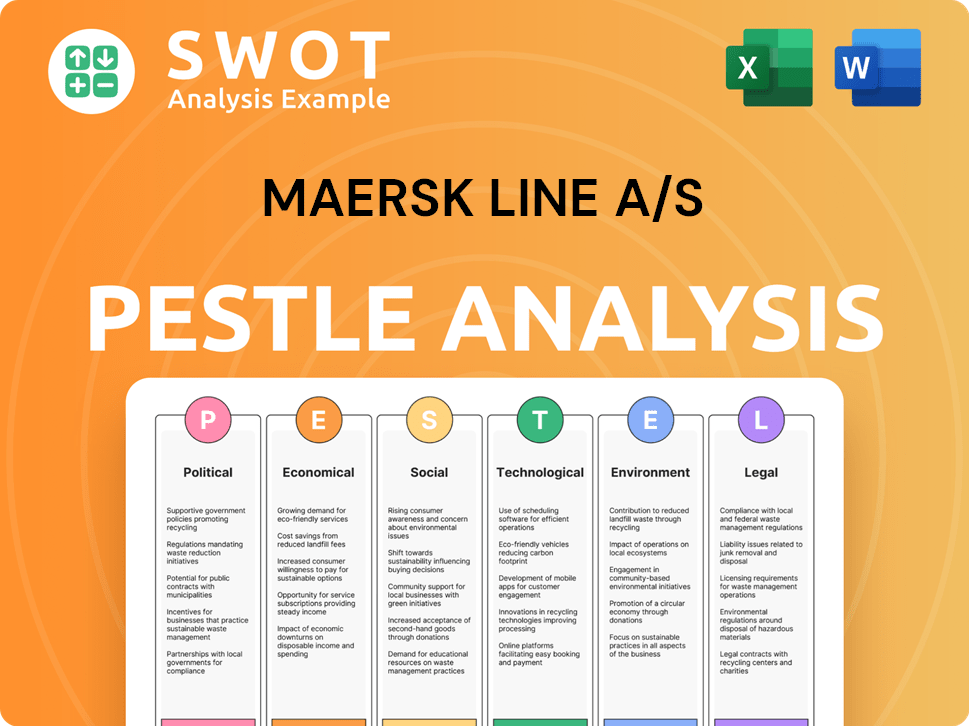
Maersk Line A/S PESTLE Analysis
- Covers All 6 PESTLE Categories
- No Research Needed – Save Hours of Work
- Built by Experts, Trusted by Consultants
- Instant Download, Ready to Use
- 100% Editable, Fully Customizable
What Is Maersk Line A/S’s Growth Forecast?
The financial outlook for Maersk Line A/S, a leading shipping company, shows promising developments and strategic initiatives. The company's performance in 2024 and the first quarter of 2025 highlights its ability to navigate the complexities of the maritime industry and capitalize on market opportunities. Understanding the financial health and future prospects of Maersk is crucial for stakeholders looking at the investment outlook.
Maersk's growth strategy is evident in its financial results, reflecting its adaptability and strategic foresight. The company's focus on operational efficiency, expansion plans, and customer-centric solutions positions it well for sustained success. For more insights into the ownership structure and its impact, consider exploring Owners & Shareholders of Maersk Line A/S.
Maersk's global presence and market position are key factors in its financial performance. The company's ability to manage its operations effectively and respond to market dynamics is reflected in its financial results and future projections.
 2024 Financial Highlights
In 2024, Maersk demonstrated strong financial performance. EBIT increased by 65% to USD 6.5 billion, driven by higher container demand and elevated freight rates in Ocean, top-line and volume growth in Terminals, and improvements in Logistics & Services.
Terminals Performance
Terminals delivered its best-ever financial performance in 2024, with EBITDA and EBIT reaching record highs, indicating the success of its strategic initiatives.
Q1 2025 Revenue and EBIT
For Q1 2025, Maersk reported revenue growth of 7.8% to USD 13.3 billion. EBIT increased to USD 1.3 billion from USD 177 million a year ago, showcasing the company's ability to maintain profitability.
Ocean and Logistics & Services Performance
Ocean's profitability improved, with EBIT increasing by USD 904 million to USD 743 million. Logistics & Services saw its EBIT margin improve to 4.1% in Q1 2025, up from 1.5% in Q1 2024, driven by growth in freight management services and operational improvements.
Maersk maintains its full-year 2025 financial guidance, projecting an underlying EBITDA of USD 6-9 billion, underlying EBIT of USD 0-3 billion, and free cash flow of at least negative USD 3.0 billion. The company anticipates global container market volume growth of approximately 4% in 2025 and expects to grow in line with the market. This outlook, however, is subject to macroeconomic and geopolitical uncertainties impacting container volume growth and freight rates.
Shareholder Returns
In 2024, Maersk returned USD 1.6 billion to shareholders through dividends and share buybacks, demonstrating its commitment to shareholder value.
Share Buyback Program
The board decided to launch a share buyback program of up to 14.4 billion Danish kroner (approximately USD 2 billion) to be completed within 12 months, indicating confidence in its financial position.
Market Volume Growth
Maersk anticipates global container market volume growth of approximately 4% in 2025, reflecting positive expectations for the container shipping sector.
Strategic Initiatives
The company's strategic initiatives, including operational improvements and growth in freight management, are key drivers of its financial performance.
Impact of Geopolitical and Macroeconomic Factors
The company acknowledges that its outlook is subject to macroeconomic and geopolitical uncertainties, which could impact container volume growth and freight rates, highlighting the challenges and opportunities it faces.
Long-Term Growth Strategy
Maersk's focus on sustainable growth and operational excellence positions it well for long-term success in the maritime industry.
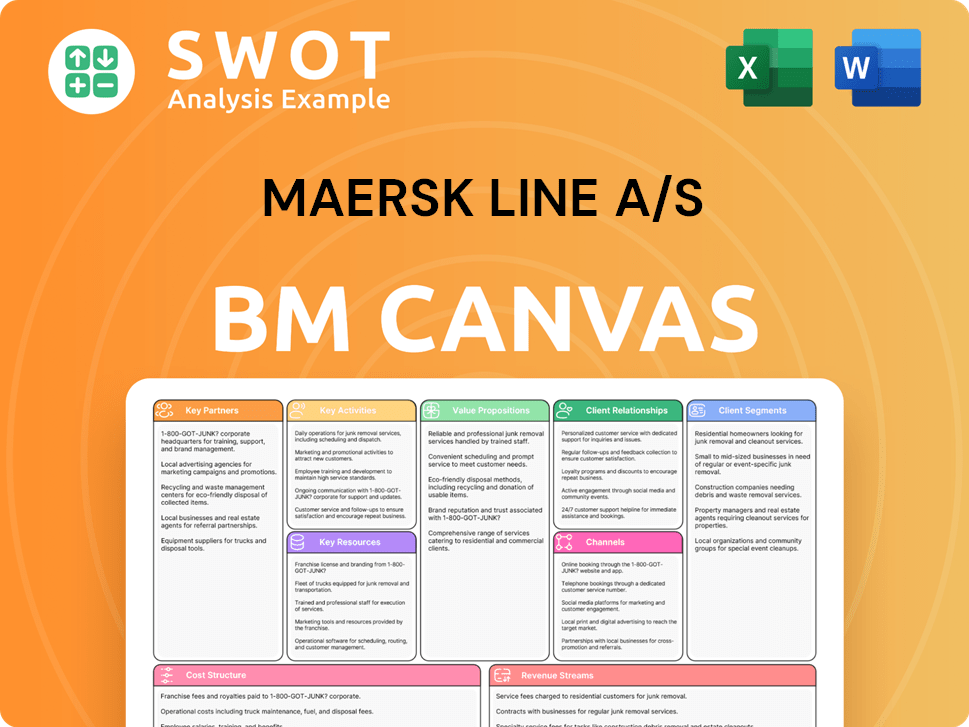
Maersk Line A/S Business Model Canvas
- Complete 9-Block Business Model Canvas
- Effortlessly Communicate Your Business Strategy
- Investor-Ready BMC Format
- 100% Editable and Customizable
- Clear and Structured Layout
What Risks Could Slow Maersk Line A/S’s Growth?
The growth strategy of Maersk Line A/S faces significant challenges in a complex global landscape. Several strategic and operational risks could impact its Maersk Future Prospects. These include geopolitical instability, market volatility, and the effects of climate change.
Geopolitical issues like the Russia-Ukraine war and the Red Sea crisis continue to disrupt supply chains. These disruptions increase costs and reduce capacity, impacting the Shipping Company's operations. The company anticipates the Red Sea disruptions to persist throughout 2025.
Market dynamics, influenced by supply and demand imbalances, also pose challenges. While the global container market volume growth was revised upwards to approximately 6% for 2024, a larger supply-demand imbalance is expected in 2025. This could put pressure on freight rates, as indicated in Maersk Line A/S's guidance for 2025, which acknowledges considerable macroeconomic and geopolitical uncertainties affecting both container volume growth and freight rates.
Geopolitical Instability
Ongoing conflicts and crises, such as the war in Ukraine and the disruptions in the Red Sea, significantly impact global supply chains. These events lead to increased operating costs and capacity losses for the Container Shipping industry.
Market Volatility
Supply-demand imbalances within the container market can lead to fluctuations in freight rates. The expected increase in new ship deliveries in 2025, combined with potential Red Sea reopening, could exacerbate these imbalances.
Climate Change
Rising temperatures and extreme weather events disrupt transportation routes and damage infrastructure. These events also affect the availability of raw materials, necessitating investments in resilient infrastructure and sustainable practices.
Economic Nationalism
The rise of economic nationalism and protectionism poses significant risks to global trade. These trends can lead to trade wars and other measures that disrupt established trade patterns, affecting the Maritime Industry.
Infrastructural Challenges
Shortages of labor, such as truck drivers and port workers, and the increasing risk of cyber-attacks, present ongoing threats to supply chain resilience. These factors can disrupt operations and increase costs.
Risk Management
Maersk Line A/S addresses these risks through strategic foresight and robust risk management frameworks. Continuous efforts in automation and cost management are also employed to build greater resilience in operations.
Impact on Global Trade
The Maersk Line A/S, along with other major players in the Container Shipping industry, is vulnerable to shifts in global trade dynamics. Disruptions from geopolitical events, such as the Russia-Ukraine war and the Red Sea crisis, lead to increased transit times and higher operational expenses. These factors can reduce the profitability of the Shipping Company. For additional insights, see our analysis on the Marketing Strategy of Maersk Line A/S.
Sustainability Challenges
Maersk Line A/S faces growing pressure to reduce its environmental footprint. Climate change and stricter environmental regulations require significant investments in sustainable practices and technologies. These investments include alternative fuels and more efficient vessel designs to meet emission reduction targets and maintain Maersk's Future Prospects.
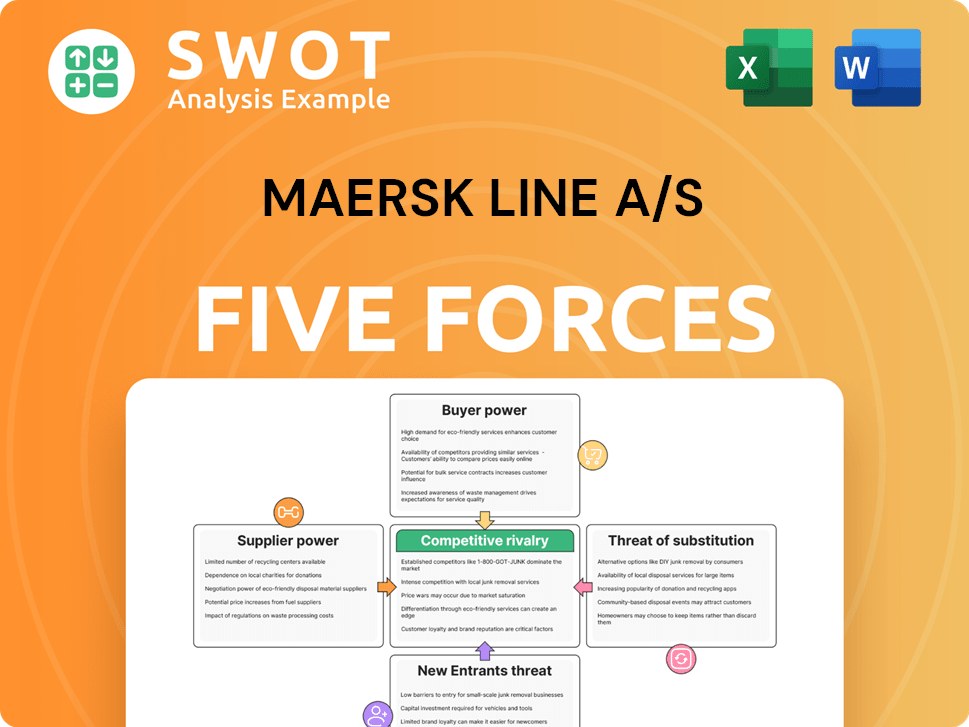
Maersk Line A/S Porter's Five Forces Analysis
- Covers All 5 Competitive Forces in Detail
- Structured for Consultants, Students, and Founders
- 100% Editable in Microsoft Word & Excel
- Instant Digital Download – Use Immediately
- Compatible with Mac & PC – Fully Unlocked
Related Blogs

- What are Mission Vision & Core Values of Maersk Line A/S Company?
- What is Competitive Landscape of Maersk Line A/S Company?
- How Does Maersk Line A/S Company Work?
- What is Sales and Marketing Strategy of Maersk Line A/S Company?
- What is Brief History of Maersk Line A/S Company?
- Who Owns Maersk Line A/S Company?
- What is Customer Demographics and Target Market of Maersk Line A/S Company?
Disclaimer
All information, articles, and product details provided on this website are for general informational and educational purposes only. We do not claim any ownership over, nor do we intend to infringe upon, any trademarks, copyrights, logos, brand names, or other intellectual property mentioned or depicted on this site. Such intellectual property remains the property of its respective owners, and any references here are made solely for identification or informational purposes, without implying any affiliation, endorsement, or partnership.
We make no representations or warranties, express or implied, regarding the accuracy, completeness, or suitability of any content or products presented. Nothing on this website should be construed as legal, tax, investment, financial, medical, or other professional advice. In addition, no part of this site—including articles or product references—constitutes a solicitation, recommendation, endorsement, advertisement, or offer to buy or sell any securities, franchises, or other financial instruments, particularly in jurisdictions where such activity would be unlawful.
All content is of a general nature and may not address the specific circumstances of any individual or entity. It is not a substitute for professional advice or services. Any actions you take based on the information provided here are strictly at your own risk. You accept full responsibility for any decisions or outcomes arising from your use of this website and agree to release us from any liability in connection with your use of, or reliance upon, the content or products found herein.