

Converge Bundle

Who Does Converge ICT Serve?
The Philippines' telecommunications sector is constantly evolving, with fiber internet leading the charge. Understanding the Converge SWOT Analysis reveals how crucial customer demographics and the target market are for companies like Converge ICT Solutions Inc. Their success highlights the power of pinpointing the right audience in a competitive landscape. Converge's strategic moves, especially in underserved areas, are a testament to this.

From its beginnings catering to businesses in Central Luzon, Converge Company has dramatically expanded its reach. This shift showcases the importance of adapting to market demands and understanding evolving customer needs. This deep dive explores the customer demographics and target market of Converge Company, examining who their ideal customer is, their location, and preferences. We will also analyze market segmentation strategies and how Converge ICT continues to refine its approach in the dynamic digital world.
Who Are Converge’s Main Customers?
Understanding the Competitors Landscape of Converge involves a deep dive into its customer demographics and target market. Converge ICT Solutions strategically segments its customer base to maximize its reach and service offerings. This approach allows for tailored services, ensuring customer satisfaction and driving growth.
The company's primary customer segments include residential, enterprise, and wholesale clients. Each segment has unique needs and demands, which influences the services provided. The residential segment is a key focus, with a broad appeal across various demographics. The enterprise and wholesale segments cater to businesses and other service providers, respectively.
The residential segment of the Converge Company is extensive, encompassing households with varying income levels and family structures. These customers seek high-speed fiber internet for diverse needs like work, education, entertainment, and communication. While specific demographic data such as age, gender, and income breakdowns are proprietary, the company's expansion across urban, suburban, and rural areas indicates a wide reach. The average monthly household income in the Philippines was approximately PHP 26,700 in 2023, influencing the need for different service tiers to accommodate various economic capacities.
 Enterprise Segment
The enterprise segment targets small, medium, and large businesses. These businesses require reliable, high-capacity internet solutions. Services include dedicated internet access, data center services, and other ICT solutions. Industries served include BPOs, IT firms, manufacturing, and retail.
Wholesale Segment
The wholesale segment provides fiber optic infrastructure and bandwidth to other telecommunication and internet service providers. It acts as a crucial backbone for connectivity in the Philippines. This B2B2C model diversifies revenue streams and expands market reach.

Revenue and Growth
The residential segment has historically driven the largest share of revenue and the fastest growth. This growth is fueled by the increasing demand for remote work, online learning, and digital entertainment, especially amplified by the pandemic. The company reported a consolidated subscriber base of 1.96 million as of December 31, 2023, with a significant portion attributed to residential subscribers.
- The shift from its original B2B focus was prompted by market research.
- Research indicated a massive underserved residential market hungry for reliable fiber internet.
- The company strategically leveraged its expanding fiber network for broader consumer reach.
- This strategy has allowed Converge ICT to effectively target its customer demographics.
Converge SWOT Analysis
- Complete SWOT Breakdown
- Fully Customizable
- Editable in Excel & Word
- Professional Formatting
- Investor-Ready Format

What Do Converge’s Customers Want?
Understanding the needs and preferences of the Owners & Shareholders of Converge is crucial for effective market positioning. The company's success hinges on its ability to meet the diverse demands of both residential and enterprise customers. This involves a deep dive into what drives their purchasing decisions and how the company can tailor its services to match these expectations.
For residential clients, the primary drivers include high-speed internet for streaming, gaming, and remote work. Reliability and affordability are also key factors, with customers often influenced by competitive pricing and positive reviews. Enterprise clients, on the other hand, seek dedicated bandwidth, network security, and robust service level agreements to ensure business continuity and operational efficiency. Converge addresses these needs through tailored solutions and continuous service enhancements.
The company's approach involves segment-specific marketing, highlighting speed and reliability for residential users and emphasizing business continuity for enterprise clients. This strategy is supported by ongoing efforts to expand its fiber backbone, ensuring that more areas receive reliable internet access. This proactive approach reflects a commitment to addressing unmet needs and adapting to evolving market trends.

Residential Customer Needs
Residential customers of the Converge Company prioritize high-speed internet for streaming, gaming, and remote work. Reliability is critical, as interruptions can significantly impact daily activities. Purchasing decisions are often influenced by competitive pricing and positive word-of-mouth.
Enterprise Customer Needs
Enterprise clients require dedicated bandwidth, network redundancy, and robust service level agreements (SLAs). Their motivations are rooted in operational efficiency, data security, and scalability. Tailored enterprise solutions, including dedicated internet access and managed ICT services, address these needs.
Key Decision-Making Criteria
Decision-making factors often include advertised speed, consistency of service, and perceived value for money. A significant portion of Filipino households prioritize internet speeds of 100 Mbps or higher. The company continuously gathers feedback through various channels to inform product development.
Market Trends Influence
Market trends, such as the increasing adoption of cloud services and digital transformation initiatives, directly influence product development. The company has been actively expanding its fiber backbone to reach more areas. This expansion directly addresses the need for reliable internet in underserved regions.
Marketing Strategies
The company tailors its marketing messages to highlight speed and reliability for residential users. It emphasizes business continuity and dedicated support for enterprise clients. This segment-specific approach ensures that marketing efforts resonate with the target audience.
Customer Feedback
Continuous feedback collection through various channels helps refine service offerings. This approach ensures that services meet the evolving needs of both residential and enterprise customers. This proactive approach helps the company stay competitive.
Customer Acquisition and Retention
Understanding customer demographics and preferences is key to effective customer acquisition and retention strategies. This involves analyzing customer demographics such as age range, income levels, and location data. Analyzing customer profile and user behavior helps in creating targeted marketing campaigns and improving service offerings.
- Targeted marketing campaigns based on market segmentation.
- Focus on customer preferences such as speed, reliability, and affordability.
- Competitive pricing and bundled services to attract and retain customers.
- Continuous improvement of customer service to address customer pain points.
Converge PESTLE Analysis
- Covers All 6 PESTLE Categories
- No Research Needed – Save Hours of Work
- Built by Experts, Trusted by Consultants
- Instant Download, Ready to Use
- 100% Editable, Fully Customizable

Where does Converge operate?
The geographical market presence of Converge ICT Solutions is primarily focused on the Philippines, with its main operations spanning Luzon, Visayas, and Mindanao. The company has a strong foothold in Luzon, especially in Metro Manila and Central Luzon, where the initial network infrastructure was established. This strategic focus on key areas has allowed Converge to build a robust customer base and brand recognition across the country.
As of the end of 2023, Converge's fiber network had passed 16.7 million homes, achieving 78% household coverage nationwide. This extensive reach demonstrates the company's commitment to expanding its fiber optic network across the Philippines. The expansion into Visayas and Mindanao reflects a strategic move to tap into the growing demand in these emerging markets.
Converge's approach to market segmentation and expansion is tailored to regional demographics and preferences. The company adjusts its offerings, pricing models, and marketing strategies to suit the unique needs of each region. This approach allows Converge to effectively target its customer base and drive growth across diverse markets. To learn more about their strategic growth, consider reading about the Growth Strategy of Converge.
Luzon: Core Market
Luzon remains a critical market for Converge, particularly in Metro Manila and Central Luzon. This area benefits from high population density and strong demand for high-speed internet services. The company's initial network rollout was concentrated here, leading to strong market share and brand recognition.
Visayas and Mindanao: Expansion Markets
Converge is actively expanding into the Visayas and Mindanao regions to capitalize on growing demand. These areas present significant growth opportunities, with the company adapting its strategies to meet the unique needs and preferences of customers in these regions. This expansion acknowledges the differences in customer demographics, preferences, and buying power across these regions.
Market Segmentation Strategies
Converge employs market segmentation to tailor its services and marketing efforts. This involves adjusting pricing models, offering region-specific promotions, and leveraging local partnerships. This approach helps the company to effectively reach its target market and maximize customer acquisition.
Network Rollout and Digital Inclusion
The continuous network rollout is a testament to Converge's commitment to expanding its geographic footprint. Recent expansions have focused on connecting more provincial areas, aligning with the government's push for digital inclusion. This strategic geographic distribution of sales and growth highlights Converge's ambition to be a truly nationwide fiber broadband provider.
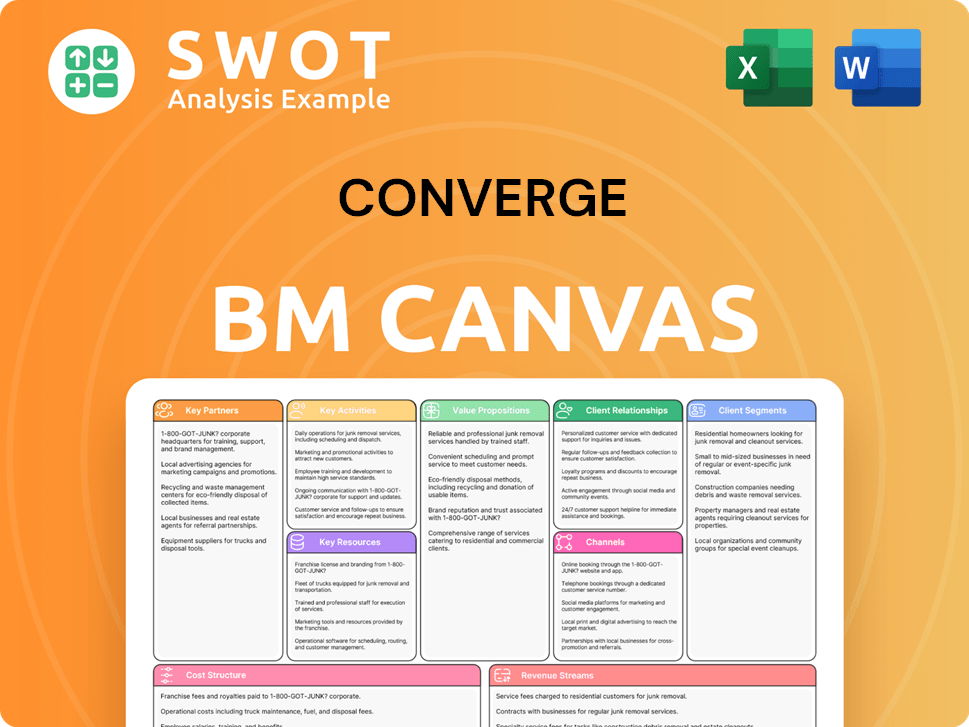
Converge Business Model Canvas
- Complete 9-Block Business Model Canvas
- Effortlessly Communicate Your Business Strategy
- Investor-Ready BMC Format
- 100% Editable and Customizable
- Clear and Structured Layout
How Does Converge Win & Keep Customers?
The company, employs a comprehensive strategy for acquiring and retaining customers, utilizing both digital and traditional marketing channels. This approach allows them to reach a broad audience, including the digitally-savvy residential segment. Their customer acquisition strategies are designed to build brand awareness and attract new subscribers in a competitive market.
Retention efforts are centered on delivering personalized customer experiences. This is achieved through various customer service channels, leveraging customer data to understand usage patterns, and offering loyalty programs. These strategies are crucial for minimizing churn and maximizing customer lifetime value. After-sales service, including technical support and prompt issue resolution, also plays a vital role in retaining customers.
The company's adaptive strategy has evolved over time. Initially focused on direct sales to businesses, the company has expanded its focus to include digital marketing and mass media campaigns to target the residential market. Successful acquisition campaigns often highlight the superior speed and reliability of fiber internet. These strategies are important for customer loyalty and improving key metrics in a competitive market.
Digital Marketing Campaigns
Digital marketing is a cornerstone of the company's customer acquisition strategy. They utilize social media campaigns on platforms like Facebook, Instagram, and YouTube to reach a broad audience. Search engine optimization (SEO) and online advertisements are also key components, targeting the digitally-savvy residential segment. These efforts help to build brand awareness and drive customer acquisition.
Traditional Marketing Efforts
Traditional marketing methods, such as television commercials and print advertisements, are still used to build brand awareness, especially in newly rolled-out areas. Community outreach programs also play a role in expanding their customer base. These traditional methods complement the digital strategies to ensure a wide reach across different demographics.
Referral Programs and Sales Tactics
Referral programs incentivize existing customers to recommend the service to their networks. Sales tactics include direct sales teams, partnerships with real estate developers, and a presence in retail outlets. These strategies help to convert leads into paying customers and expand market reach. These tactics are part of the overall strategy.
Personalized Customer Experiences
To retain customers, the company focuses on providing personalized experiences. This is primarily achieved through customer service channels such as hotlines, online chat, and social media support. The goal is to create positive customer experiences and build loyalty. The company uses customer data to understand usage patterns and preferences.
Customer Service Channels
Customer service is a critical component of the retention strategy. The company utilizes hotlines, online chat, and social media support to address customer issues promptly. These channels help maintain customer satisfaction and minimize churn. Effective customer service is essential for building and maintaining customer loyalty.
Loyalty Programs and Service Bundles
Loyalty programs are often integrated into service bundles or promotional offers to encourage continued subscriptions. These programs reward customer loyalty and incentivize them to remain with the company. These programs help to increase customer lifetime value. Bundling services, such as internet with streaming, is common.
After-Sales Service and Technical Support
After-sales service, including technical support and prompt issue resolution, is vital for customer retention. Addressing customer issues quickly and efficiently minimizes churn. Providing reliable technical support ensures that customers have a positive experience. Prompt issue resolution helps to retain customers.
Adaptive Strategy
The company has adapted its strategies over time, initially focusing on direct sales to businesses. With its expansion into the residential market, digital marketing and mass media campaigns became more prominent. This adaptability allows the company to meet evolving customer needs and market dynamics. This helps the company stay competitive.
Fiber Internet Advantages
Successful acquisition campaigns often highlight the superior speed and reliability of fiber internet compared to traditional broadband technologies. This helps to attract customers looking for a faster and more reliable internet service. Highlighting the benefits of fiber is a key part of the marketing strategy. This helps to differentiate their offering.
Proactive Communication and Value-Added Services
Retention initiatives include proactive communication about service upgrades and value-added services, such as streaming bundles. Addressing customer feedback efficiently is also crucial. These strategies directly impact customer loyalty and lifetime value. These efforts help increase customer satisfaction.
To delve deeper into the strategies and understand how the company successfully targets its market, consider reading the Growth Strategy of Converge. This will provide a more comprehensive understanding of the company's approach.
Converge Porter's Five Forces Analysis
- Covers All 5 Competitive Forces in Detail
- Structured for Consultants, Students, and Founders
- 100% Editable in Microsoft Word & Excel
- Instant Digital Download – Use Immediately
- Compatible with Mac & PC – Fully Unlocked

Related Blogs

- What are Mission Vision & Core Values of Converge Company?
- What is Competitive Landscape of Converge Company?
- What is Growth Strategy and Future Prospects of Converge Company?
- How Does Converge Company Work?
- What is Sales and Marketing Strategy of Converge Company?
- What is Brief History of Converge Company?
- Who Owns Converge Company?
Disclaimer
All information, articles, and product details provided on this website are for general informational and educational purposes only. We do not claim any ownership over, nor do we intend to infringe upon, any trademarks, copyrights, logos, brand names, or other intellectual property mentioned or depicted on this site. Such intellectual property remains the property of its respective owners, and any references here are made solely for identification or informational purposes, without implying any affiliation, endorsement, or partnership.
We make no representations or warranties, express or implied, regarding the accuracy, completeness, or suitability of any content or products presented. Nothing on this website should be construed as legal, tax, investment, financial, medical, or other professional advice. In addition, no part of this site—including articles or product references—constitutes a solicitation, recommendation, endorsement, advertisement, or offer to buy or sell any securities, franchises, or other financial instruments, particularly in jurisdictions where such activity would be unlawful.
All content is of a general nature and may not address the specific circumstances of any individual or entity. It is not a substitute for professional advice or services. Any actions you take based on the information provided here are strictly at your own risk. You accept full responsibility for any decisions or outcomes arising from your use of this website and agree to release us from any liability in connection with your use of, or reliance upon, the content or products found herein.