

Capstone Infrastructure Bundle

Who are Capstone Infrastructure's Key Customers?
Understanding the customer base is crucial for any infrastructure company aiming for long-term success. Capstone Infrastructure Corporation, with its evolving portfolio of renewable and essential energy projects, offers a compelling case study. This analysis delves into the Capstone Infrastructure SWOT Analysis, exploring the company's strategic shifts and the resulting impact on its customer demographics and target market.

From its origins as a power generation investor to its current status as a diversified infrastructure player, Capstone Infrastructure's target market has undergone significant transformation. This evolution necessitates a detailed market analysis to identify its ideal customer and understand the specific needs of its client base. Examining the demographic profile of Capstone Infrastructure clients reveals valuable insights into its customer acquisition strategy and geographic focus, providing a roadmap for future growth.
Who Are Capstone Infrastructure’s Main Customers?
For Capstone Infrastructure, understanding its customer demographics and target market is key to its business strategy. As an infrastructure company, Capstone primarily operates in the Business-to-Business (B2B) sector. This means its focus is on providing essential services to other businesses and organizations, rather than individual consumers. This B2B model shapes the company's approach to market analysis and customer engagement.
The target market for Capstone Infrastructure includes several key segments. These segments are primarily large industrial consumers, municipalities, provincial utilities, and other corporate entities. These customers require reliable and stable energy and utility services, which aligns with Capstone's portfolio of renewable power, utilities, and energy businesses. The company's success hinges on long-term partnerships and agreements with these types of clients.
Capstone's customer base is characterized by its focus on essential services. This focus means that its clients are often large-scale, long-term partners with critical infrastructure needs. The company's portfolio includes a variety of power generation facilities, including wind, solar, hydro, biomass, and natural gas. This diversity allows Capstone to serve a broad range of clients within the industrial and public sectors. The company's strategic shift towards renewable energy sources, particularly wind and solar, reflects the growing demand for low-carbon solutions and government initiatives.
 Key Customer Groups
Capstone Infrastructure's primary customers are large industrial consumers, municipalities, and provincial utilities. These entities need stable energy and utility services. The company secures long-term agreements to provide these services.
Focus on Renewables
A significant portion of Capstone's growth is within the renewable energy sector. The company has several wind and solar projects. In December 2024, Capstone's wind projects were selected by BC Hydro.
Strategic Shift
Capstone has shifted its focus to core infrastructure categories. This strategic move concentrates on areas that offer stable cash flow. The company emphasizes renewable energy projects to ensure long-term growth.
Customer Needs
Capstone's customers require reliable and sustainable energy solutions. The company's diverse portfolio allows it to meet these needs. This includes wind, solar, hydro, biomass, and natural gas power generation.

Detailed Customer Profile
The customer profile for Capstone Infrastructure is defined by the scale of energy consumption, commitment to renewable energy targets, and operational stability. These factors are more relevant than traditional customer demographics like age or income. The company's strategy involves securing long-term agreements with these key clients.
- Large industrial consumers
- Municipalities
- Provincial utilities
- Corporate entities needing stable energy
Capstone Infrastructure SWOT Analysis
- Complete SWOT Breakdown
- Fully Customizable
- Editable in Excel & Word
- Professional Formatting
- Investor-Ready Format

What Do Capstone Infrastructure’s Customers Want?
Understanding the customer needs and preferences is crucial for any infrastructure company. For Capstone Infrastructure, this involves recognizing the specific demands of its business-to-business (B2B) clients. The company's target market primarily consists of entities that require reliable and sustainable essential services, cost-effective solutions, and a commitment to environmental responsibility.
The purchasing behaviors of Capstone's customers are significantly influenced by long-term contracts and regulatory environments. They seek partners who can guarantee consistent operational performance and minimize disruptions. The increasing focus on environmental, social, and governance (ESG) goals also drives their decisions, with many clients prioritizing sustainable and low-carbon energy solutions.
Capstone Infrastructure's customer base is driven by the need for dependable power and utility services. They also increasingly value sustainable solutions, aligning with the company's focus on renewable energy projects. The company's strategic moves, like the planned 3.8-gigawatt-hour battery facility in California, demonstrate an understanding of evolving energy needs and a proactive approach to meeting customer demands.

Reliable Services
Customers prioritize consistent and dependable power and utility services. This reliability is essential for maintaining their operations and serving their own customers.
Cost-Effectiveness
Clients seek cost-effective solutions that provide value. This includes competitive pricing and efficient utility management to minimize operational expenses.
Sustainability
There is a growing demand for sustainable and low-carbon energy solutions. Many corporate clients aim to reduce their carbon footprint and align with ESG goals.
Long-Term Contracts
Purchasing decisions are often influenced by long-term contracts. These agreements provide stability and predictable revenue streams for both the customer and Capstone.
Regulatory Compliance
Customers must adhere to evolving environmental regulations. Capstone helps them meet these requirements through its sustainable energy projects.
Operational Efficiency
Clients value partners who ensure consistent power supply and efficient utility management. This minimizes operational disruptions and ensures smooth operations.
Key Customer Needs
Capstone addresses several key customer needs, including energy security and regulatory compliance. The company's integrated approach streamlines solutions for complex energy challenges.
- Long-Term Energy Security: Customers require a reliable and consistent energy supply to ensure their operations.
- Environmental Regulations: Meeting evolving environmental standards is a significant concern for clients.
- Complexity of Energy Sources: Managing diverse energy sources can be complex, and Capstone offers streamlined solutions.
- ESG Goals: Increasingly, customers are focused on reducing their carbon footprint and aligning with ESG goals.
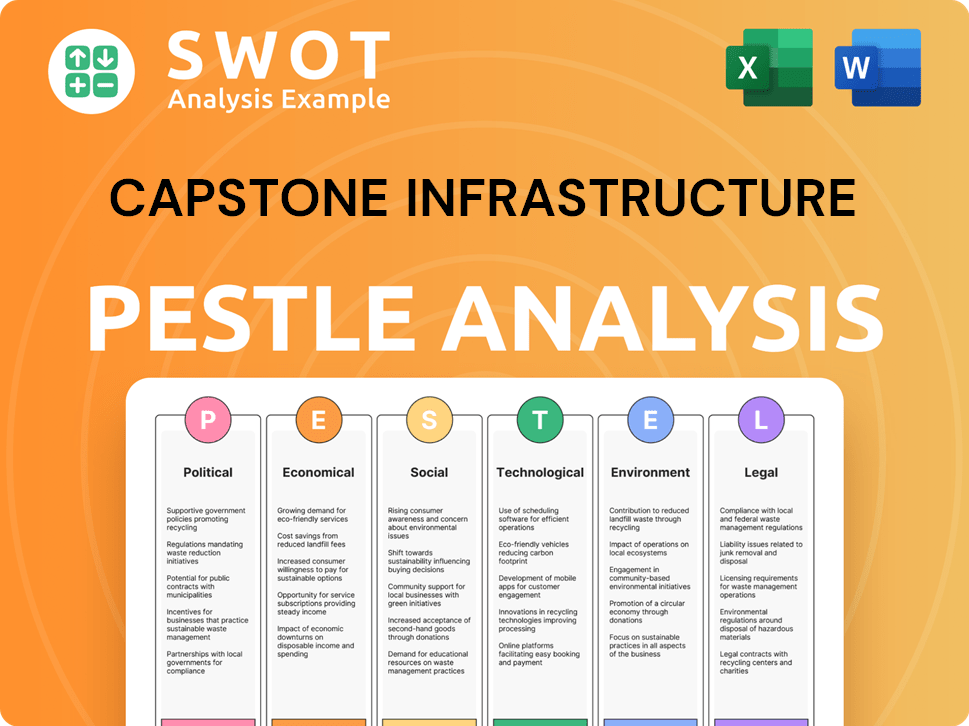
Capstone Infrastructure PESTLE Analysis
- Covers All 6 PESTLE Categories
- No Research Needed – Save Hours of Work
- Built by Experts, Trusted by Consultants
- Instant Download, Ready to Use
- 100% Editable, Fully Customizable
Where does Capstone Infrastructure operate?
The geographical market presence of Capstone Infrastructure is primarily focused on North America, with a strong emphasis on Canada and an expanding presence in the United States. This strategic focus allows the company to leverage specific market opportunities and navigate regional regulatory landscapes effectively. This targeted approach is crucial for understanding the Brief History of Capstone Infrastructure and its current market position.
In Canada, Capstone operates across six provinces, owning and operating 35 power facilities. These facilities generate over 1.7 gigawatt hours of electricity annually, sufficient to power roughly 180,000 households. This established infrastructure and operational expertise contribute to a robust market share and brand recognition within the Canadian market.
The company’s strategic geographical focus is evident in its recent expansions and partnerships. For instance, Capstone secured major wind projects in British Columbia in January 2025, reflecting the province’s demand for renewable energy. Furthermore, Capstone is strategically withdrawing from its earlier broader international focus, including Europe, New Zealand, and Australia, to concentrate on North America.
Canadian Market Presence
Capstone Infrastructure operates in six Canadian provinces: Ontario, Alberta, Nova Scotia, British Columbia, Quebec, and Saskatchewan. Its operational power projects include wind, solar, hydro, biomass, and natural gas power plants. The company has a strong market share and brand recognition in these regions.
U.S. Market Expansion
Capstone is strategically expanding into the U.S. market, with a focus on California. The company is exploring the development of a 3.8-gigawatt-hour battery facility in the state. This expansion reflects a shift in focus towards North America.
Customer Demographics and Market Analysis
Capstone Infrastructure’s customer demographics are primarily businesses and governmental entities involved in energy procurement and infrastructure development. The company’s target market is defined by the demand for renewable energy solutions and long-term power purchase agreements.
Geographic Focus
The primary geographic focus is North America, specifically Canada and the United States. Within Canada, the company operates in multiple provinces, while in the U.S., it is concentrating on states like California.
Customer Profile
Capstone’s ideal customer profile includes utilities, municipalities, and large corporations seeking sustainable and reliable energy sources. These customers often prioritize long-term contracts and environmental sustainability.
Market Segmentation
The company segments its market based on geographic location, energy demand, and regulatory environments. This segmentation allows Capstone to tailor its offerings to meet specific customer needs and preferences.
Customer Acquisition
Capstone’s customer acquisition strategy involves securing long-term power purchase agreements and forming strategic partnerships. The company focuses on building strong relationships with key stakeholders in the energy sector.
Financial Performance
The company's Q3 2024 results indicated a net income of $7.6 million for the first nine months ended September 30, 2024, reflecting its financial health.
Capstone Infrastructure Business Model Canvas
- Complete 9-Block Business Model Canvas
- Effortlessly Communicate Your Business Strategy
- Investor-Ready BMC Format
- 100% Editable and Customizable
- Clear and Structured Layout

How Does Capstone Infrastructure Win & Keep Customers?
The customer acquisition and retention strategies of Capstone Infrastructure are tailored for its business-to-business (B2B) clientele. These strategies focus on building long-term relationships, forming strategic partnerships, and demonstrating consistent performance in essential services. Given the nature of infrastructure projects, traditional marketing approaches are less relevant.
Capstone's acquisition efforts primarily involve direct engagement and tendering processes for large-scale projects. Securing long-term power purchase agreements (PPAs) and other contractual arrangements is key to providing a stable cash flow. For example, in December 2024, the company secured three major wind projects with BC Hydro, totaling 537 MW of capacity, which is a significant driver of new customer acquisition. Strategic partnerships, such as the equity ownership with First Nations for the British Columbia wind projects, also play a crucial role in market entry.
Customer retention for Capstone hinges on operational excellence and adherence to contractual obligations. The company's commitment to providing clean, safe, and reliable renewable energy underlines its focus on meeting fundamental customer needs. Customer data and internal performance metrics are essential for maintaining high service levels and ensuring long-term contract renewals. The company's emphasis on quality and integrity, as highlighted in its November 2024 ESG Report, supports its reputation and retention efforts. For more information on the company's structure, you can read about the Owners & Shareholders of Capstone Infrastructure.
Customer Acquisition Focus
Capstone's approach to acquiring customers centers on securing long-term contracts, particularly Power Purchase Agreements (PPAs). This strategy ensures a stable revenue stream and reliable cash flow.
Strategic Partnerships
Strategic partnerships, such as those with First Nations, are crucial for market entry and expansion. These collaborations enhance project development and community engagement.
Customer Retention Strategies
Customer retention is achieved through operational excellence, adherence to contractual terms, and fostering strong client relationships. High service levels and reliable performance are essential for contract renewals.
Data and Metrics
The company utilizes customer data and internal performance metrics to maintain high service levels. These metrics are crucial for ensuring long-term contract renewals and customer satisfaction.
Key Acquisition Tactics
Capstone Infrastructure's customer acquisition strategy involves several key tactics, primarily focused on securing long-term contracts and partnerships. These tactics ensure a stable revenue stream and support sustainable growth.
- Securing long-term Power Purchase Agreements (PPAs).
- Participating in tenders for large-scale projects.
- Forming strategic partnerships.
- Focusing on renewable energy projects.
Capstone Infrastructure Porter's Five Forces Analysis
- Covers All 5 Competitive Forces in Detail
- Structured for Consultants, Students, and Founders
- 100% Editable in Microsoft Word & Excel
- Instant Digital Download – Use Immediately
- Compatible with Mac & PC – Fully Unlocked

Related Blogs

- What are Mission Vision & Core Values of Capstone Infrastructure Company?
- What is Competitive Landscape of Capstone Infrastructure Company?
- What is Growth Strategy and Future Prospects of Capstone Infrastructure Company?
- How Does Capstone Infrastructure Company Work?
- What is Sales and Marketing Strategy of Capstone Infrastructure Company?
- What is Brief History of Capstone Infrastructure Company?
- Who Owns Capstone Infrastructure Company?
Disclaimer
All information, articles, and product details provided on this website are for general informational and educational purposes only. We do not claim any ownership over, nor do we intend to infringe upon, any trademarks, copyrights, logos, brand names, or other intellectual property mentioned or depicted on this site. Such intellectual property remains the property of its respective owners, and any references here are made solely for identification or informational purposes, without implying any affiliation, endorsement, or partnership.
We make no representations or warranties, express or implied, regarding the accuracy, completeness, or suitability of any content or products presented. Nothing on this website should be construed as legal, tax, investment, financial, medical, or other professional advice. In addition, no part of this site—including articles or product references—constitutes a solicitation, recommendation, endorsement, advertisement, or offer to buy or sell any securities, franchises, or other financial instruments, particularly in jurisdictions where such activity would be unlawful.
All content is of a general nature and may not address the specific circumstances of any individual or entity. It is not a substitute for professional advice or services. Any actions you take based on the information provided here are strictly at your own risk. You accept full responsibility for any decisions or outcomes arising from your use of this website and agree to release us from any liability in connection with your use of, or reliance upon, the content or products found herein.