

Schroders Bundle

Who Really Owns Schroders?
Delving into the Schroders SWOT Analysis reveals much about its strategic positioning, but understanding its very foundation starts with its ownership. Schroders, a titan in global asset management, has a fascinating ownership structure shaped by centuries of history. Unraveling who owns Schroders is key to grasping its strategic direction and long-term influence in the financial markets.

The Schroders ownership structure, including its major shareholders list and the enduring influence of the Schroder family, offers a unique perspective on corporate governance. As a publicly traded company (Schroders PLC), understanding the ownership breakdown is vital for investors and anyone interested in how this global asset manager operates. This exploration of Schroders shareholders will cover the company's history, its institutional investors, and the impact of its dual listing, providing a comprehensive view of who controls Schroders and how its ownership has evolved over time, including details often found in the annual report.
Who Founded Schroders?
The foundation of J. Henry Schröder & Co. in 1804 marked the beginning of its ownership journey. Johann Heinrich Schröder, a German merchant, established the firm in London, setting the stage for a long-standing presence in the financial world. Initially, the ownership was firmly within the Schröder family, a common practice for financial institutions of that era.
Details of the exact equity splits at the company's inception are not readily available due to the historical nature of the firm and the lack of detailed corporate reporting at the time. However, it is understood that the firm operated as a private partnership for many years. Ownership and control were primarily vested in family members who joined the business, ensuring a continuity of their guiding principles.
Over the early decades, the firm expanded its activities from merchant banking to investment management. Early backers or angel investors would have likely been individuals or entities closely connected to the Schröder family or their business network. These early agreements were likely informal partnerships, emphasizing trust and long-term relationships over formal vesting schedules or complex buy-sell clauses. The founding team's vision, focused on international finance and a conservative approach to risk, was directly reflected in the distribution of control among family members.

Early Ownership Dynamics
The early ownership of the firm was primarily concentrated within the Schröder family, reflecting the norms of the time for merchant banks. The firm operated as a private partnership for many years, with control mainly in the hands of family members. There are no widely documented initial ownership disputes or buyouts from this early period, suggesting a relatively stable and family-controlled ownership during its formative years. For more insights into the company's strategic direction, consider exploring the Target Market of Schroders.
- The initial ownership structure was centered around the Schröder family.
- The firm operated as a private partnership, ensuring family control.
- Early agreements were likely informal, based on trust and long-term relationships.
- The focus was on international finance and a conservative approach to risk.
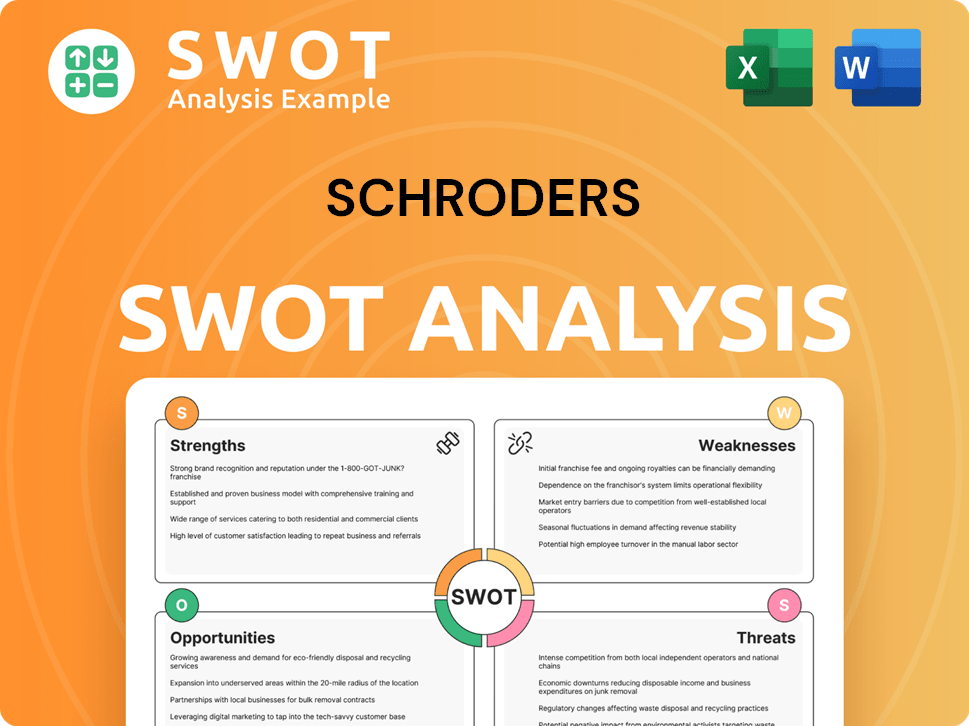
Schroders SWOT Analysis
- Complete SWOT Breakdown
- Fully Customizable
- Editable in Excel & Word
- Professional Formatting
- Investor-Ready Format
How Has Schroders’s Ownership Changed Over Time?
The evolution of ownership at Schroders has been marked by significant shifts. Initially a private partnership for over a century and a half, the company's transformation began with its listing on the London Stock Exchange in 1959. This initial public offering (IPO) marked a pivotal moment, transitioning the firm from a private family business to a publicly traded entity. This move allowed a broader spectrum of investors to participate in the company's growth.
Despite going public, the Schroder family has maintained a substantial stake, significantly influencing the company's strategic direction. This continuity of family ownership has been a defining characteristic of Schroders' ownership structure. The company's history reflects a strategic blend of family influence and public market dynamics, shaping its approach to acquisitions and overall business strategy. The company's commitment to long-term value creation has been a key factor in its success.
| Key Event | Impact on Ownership | Details |
|---|---|---|
| 1959: IPO on London Stock Exchange | Transition to Public Company | Allowed broader investor participation; Schroder family retained significant stake. |
| Strategic Acquisitions | Potential for Share Issuance | Expansion of capabilities and geographic reach; may alter shareholder composition. |
| Ongoing Market Fluctuations | Influence on Shareholder Composition | Market conditions affect the holdings of institutional and individual investors. |
Currently, the Schroder family, primarily through trusts, remains a significant shareholder. As of December 31, 2023, the family held approximately 47.9% of the voting shares in Schroders PLC, providing substantial influence over the company's strategic direction. Other major investors include institutional holders such as BlackRock, holding 5.02% as of April 30, 2025, and The Vanguard Group, with 3.03% of the shares. These institutional investors represent a broad base of indirect ownership through their clients' investments. For more insights, you can explore the Competitors Landscape of Schroders.
Schroders Ownership: Key Takeaways
Schroders' ownership structure is a blend of family influence and public market participation.
- The Schroder family maintains a significant ownership stake.
- Institutional investors like BlackRock and Vanguard hold substantial shares.
- Ownership changes are influenced by market conditions and strategic decisions.
- The company's structure contributes to a long-term perspective.
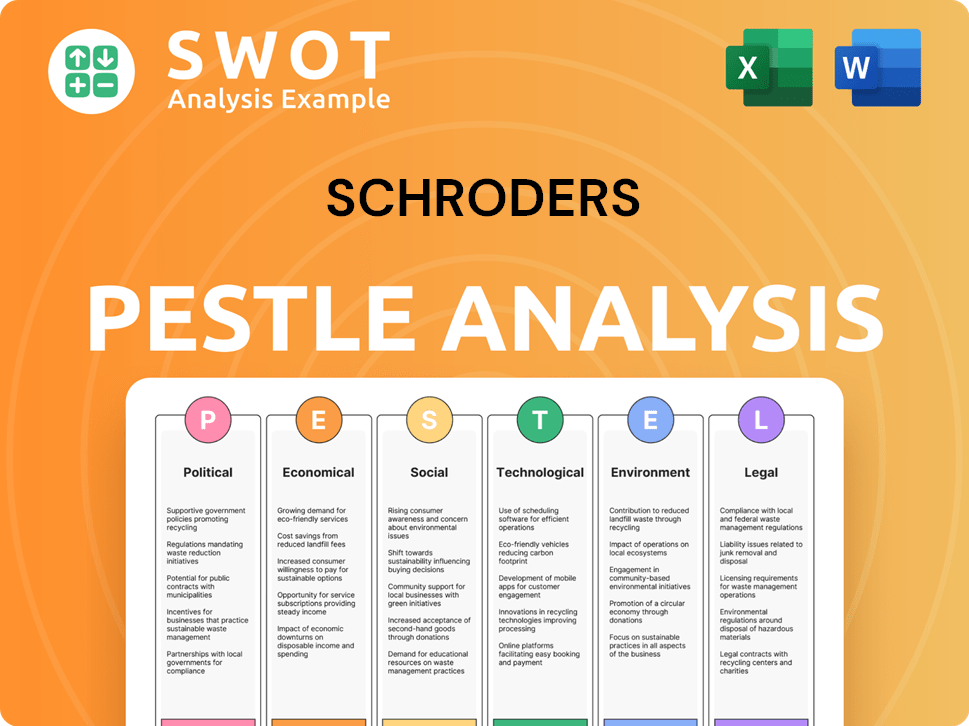
Schroders PESTLE Analysis
- Covers All 6 PESTLE Categories
- No Research Needed – Save Hours of Work
- Built by Experts, Trusted by Consultants
- Instant Download, Ready to Use
- 100% Editable, Fully Customizable
Who Sits on Schroders’s Board?
The Board of Directors at Schroders PLC, as of May 2025, includes a mix of family representatives, major shareholder interests, and independent experts. Michael Dobson serves as Chairman, and Peter Harrison is the Group Chief Executive. The presence of the Schroder family is significant, reflecting their substantial ownership within the company. Independent non-executive directors also contribute external perspectives and oversight, ensuring a balanced governance approach. The company's structure considers the interests of large investors, such as BlackRock and Vanguard, through engagement with management and the board, even without direct board representation.
The composition of the board aims to balance the influence of the founding family with the interests of the broader shareholder base. This is reflected in the company's commitment to transparency and accountability, as detailed in its annual reports and corporate governance statements. This structure helps maintain a long-term strategic focus, providing a degree of insulation from short-term shareholder activism. The Growth Strategy of Schroders is also influenced by the board's decisions.
| Board Member | Position | Notes |
|---|---|---|
| Michael Dobson | Chairman | |
| Peter Harrison | Group Chief Executive | |
| Georg Wunderlin | Chief Financial Officer |
Schroders operates with a one-share-one-vote structure. However, the Schroder family's large stake, approximately 47.9% as of December 31, 2023, gives them significant control over key decisions, including board appointments. This substantial family stake acts as a de facto special voting right. The company's ownership structure, therefore, reflects a balance between the family's influence and the interests of other shareholders, with a focus on long-term strategic goals.
Schroders Ownership Structure
The Schroder family maintains a significant influence over Schroders, holding approximately 47.9% of the voting shares as of December 2023. This ownership structure gives them a substantial say in the company's direction and governance. Institutional investors also hold significant stakes, influencing decisions through engagement.
- The Schroder family's stake is a key factor in determining the company's strategic direction.
- Institutional investors' influence is managed through active engagement with the board and management.
- The company's governance emphasizes transparency and accountability.
- The ownership structure helps to insulate the company from short-term pressures.
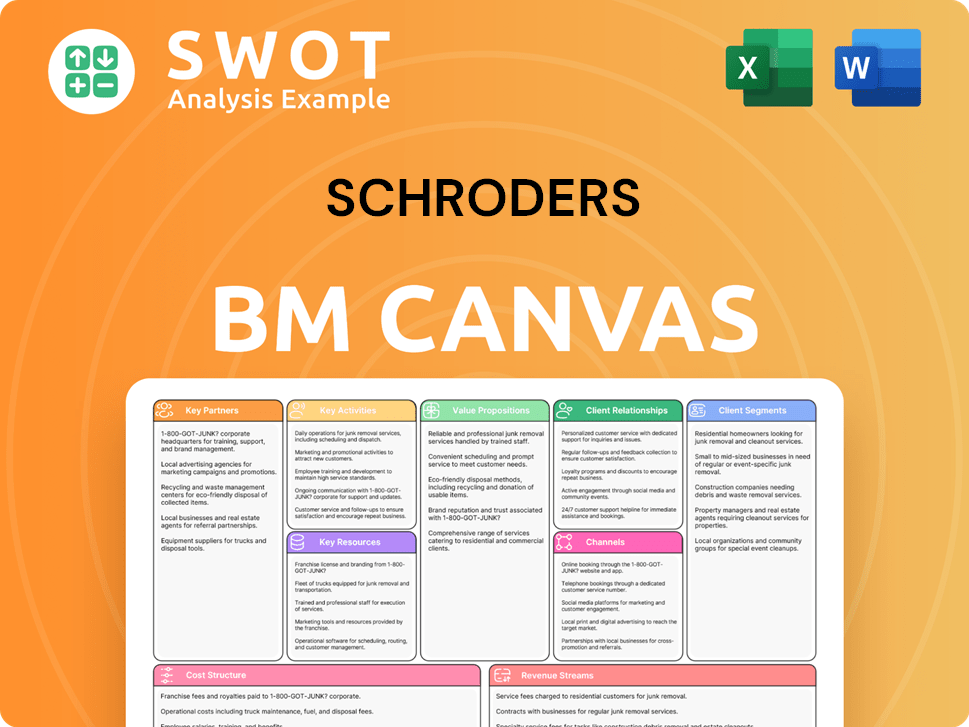
Schroders Business Model Canvas
- Complete 9-Block Business Model Canvas
- Effortlessly Communicate Your Business Strategy
- Investor-Ready BMC Format
- 100% Editable and Customizable
- Clear and Structured Layout
What Recent Changes Have Shaped Schroders’s Ownership Landscape?
Over the past few years, the ownership structure of Schroders PLC has remained relatively stable, with the Schroder family maintaining a significant influence. This stability is a key characteristic of the company's ownership profile. While there haven't been dramatic shifts in the largest ownership stakes, strategic acquisitions like the 2022 majority stake in Greencoat Capital have had indirect impacts. Such moves can affect the overall market capitalization and, potentially, the proportional ownership of existing shareholders, depending on whether new shares are issued or share buybacks occur.
The broader trend of increasing institutional ownership, driven by the growth of passive investment vehicles, continues to be relevant for understanding the Schroders ownership landscape. Institutional investors like BlackRock and Vanguard are substantial shareholders, reflecting this wider trend. However, the Schroder family's enduring commitment to the company remains a defining feature. There is no public indication of a planned privatization or a major shift in ownership structure in the near future. For more insights, you can explore the Marketing Strategy of Schroders.
| Shareholder | Approximate Ownership (as of late 2024) | Notes |
|---|---|---|
| Schroder Family | Significant, but not publicly disclosed percentage | Family's long-term commitment is a key factor. |
| Institutional Investors (BlackRock, Vanguard, etc.) | Varies, but collectively a substantial portion | Reflects the broader trend of institutional ownership. |
| Public Shareholders | Remaining portion | Includes a mix of individual and other institutional investors. |
The company's focus remains on strategic growth initiatives, such as expansion in private assets and sustainable investing, rather than major impending ownership changes. The most recent annual reports and public statements emphasize these strategic priorities. Schroders' financial performance and share price are closely watched, influencing investor sentiment and, by extension, the dynamics of its shareholder base. For instance, in 2024, the company's assets under management (AUM) were reported at approximately £726.2 billion.
 Schroders Ownership Stability
The Schroder family's significant influence has kept the ownership profile stable. Strategic acquisitions have had indirect impacts on shareholders. Institutional investors hold a substantial portion of shares.
Key Institutional Investors
BlackRock and Vanguard are major institutional shareholders. They reflect the broader trend of institutional ownership. Their stakes are subject to change based on market conditions and investment strategies.
Strategic Focus
The company is focused on expanding in private assets and sustainable investing. Public statements and reports highlight these growth areas. These initiatives may influence future ownership dynamics.
Financial Performance
Schroders' AUM was approximately £726.2 billion in 2024. Financial results and share price are closely monitored by investors. The company's performance affects investor sentiment.
Schroders Porter's Five Forces Analysis
- Covers All 5 Competitive Forces in Detail
- Structured for Consultants, Students, and Founders
- 100% Editable in Microsoft Word & Excel
- Instant Digital Download – Use Immediately
- Compatible with Mac & PC – Fully Unlocked

Related Blogs

- What are Mission Vision & Core Values of Schroders Company?
- What is Competitive Landscape of Schroders Company?
- What is Growth Strategy and Future Prospects of Schroders Company?
- How Does Schroders Company Work?
- What is Sales and Marketing Strategy of Schroders Company?
- What is Brief History of Schroders Company?
- What is Customer Demographics and Target Market of Schroders Company?
Disclaimer
All information, articles, and product details provided on this website are for general informational and educational purposes only. We do not claim any ownership over, nor do we intend to infringe upon, any trademarks, copyrights, logos, brand names, or other intellectual property mentioned or depicted on this site. Such intellectual property remains the property of its respective owners, and any references here are made solely for identification or informational purposes, without implying any affiliation, endorsement, or partnership.
We make no representations or warranties, express or implied, regarding the accuracy, completeness, or suitability of any content or products presented. Nothing on this website should be construed as legal, tax, investment, financial, medical, or other professional advice. In addition, no part of this site—including articles or product references—constitutes a solicitation, recommendation, endorsement, advertisement, or offer to buy or sell any securities, franchises, or other financial instruments, particularly in jurisdictions where such activity would be unlawful.
All content is of a general nature and may not address the specific circumstances of any individual or entity. It is not a substitute for professional advice or services. Any actions you take based on the information provided here are strictly at your own risk. You accept full responsibility for any decisions or outcomes arising from your use of this website and agree to release us from any liability in connection with your use of, or reliance upon, the content or products found herein.