

RCS Capital Corp. Bundle

Who Really Owns RCS Capital Corp.?
Understanding the ownership structure of a company is crucial for investors and analysts alike. RCS Capital Corp.'s journey, marked by rapid growth and significant shifts, offers a compelling case study in corporate ownership dynamics. From its inception to its evolution, the question of "Who owns RCS Capital?" is central to understanding its strategic decisions and financial performance.

Founded in 2012, RCS Capital Corp. quickly became a significant player in the financial services industry. Its initial public offering in 2013 was a pivotal moment, setting the stage for expansion and acquisitions. This article explores the RCS Capital Corp. SWOT Analysis and delves into the RCS Capital ownership, including its parent company, key investors, and the impact of shareholders on its trajectory, providing insights into who are the major shareholders in RCS Capital and the company's overall corporate structure.
Who Founded RCS Capital Corp.?
RCS Capital Corporation (RCAP) was established in 2012. The company's inception involved seasoned real estate investors Nicholas S. Schorsch and William M. Kahane, who also co-founded American Realty Capital (ARC).
The early ownership structure of RCS Capital Corp. was heavily concentrated. RCAP Holdings, LLC, controlled by Schorsch and Kahane, held a significant majority of the voting power. This structure gave them considerable influence over the company's direction from the start.
This initial structure highlights the influence of the founders and their control over the company. Understanding the early ownership is crucial for grasping the evolution of RCS Capital Corp. and its subsequent developments.

Founders
Nicholas S. Schorsch and William M. Kahane were the founders of RCS Capital Corp.
Initial Ownership
RCAP Holdings, LLC, controlled by Schorsch and Kahane, held a substantial majority of the voting power.
Voting Power
Initially, RCAP Holdings held 97.5% of the voting power through Class B common stock.
Class A vs. Class B Shares
Class A shares had one vote per share, while Class B shares initially had four votes per share.
Subsidiaries
RCAP Holdings owned 100% interest in initial operating subsidiaries before the IPO.
ARC Network
Schorsch and Kahane leveraged their existing American Realty Capital network, founded in 2007, to establish RCAP.
The founders, Nicholas S. Schorsch and William M. Kahane, through RCAP Holdings, LLC, initially controlled RCS Capital. This control was maintained through a dual-class share structure, where Class B shares held significantly more voting power than Class A shares. Before the IPO, RCAP Holdings controlled the initial operating subsidiaries. The early ownership structure of RCS Capital Corp. highlights the dominance of Schorsch and Kahane, who leveraged their existing American Realty Capital network. For more insights into the company's strategic focus, you can explore the Target Market of RCS Capital Corp.

Key Takeaways
The early ownership structure of RCS Capital Corp. was designed to ensure founder control. This control was maintained through a dual-class share structure, with RCAP Holdings, LLC, holding a significant majority of the voting power.
- Schorsch and Kahane, the founders, controlled the company through RCAP Holdings.
- Class B shares initially held four votes per share, ensuring founder control.
- RCAP Holdings owned the initial operating subsidiaries.
- The structure reflects a concentrated ownership model at the outset.
RCS Capital Corp. SWOT Analysis
- Complete SWOT Breakdown
- Fully Customizable
- Editable in Excel & Word
- Professional Formatting
- Investor-Ready Format

How Has RCS Capital Corp.’s Ownership Changed Over Time?
The ownership of RCS Capital Corp underwent significant transformations, particularly after its initial public offering (IPO) in June 2013 under the NYSE symbol 'RCAP.' Initially, the company, aiming to broaden its independent retail advice platform, pursued an aggressive acquisition strategy. This included the acquisition of Cetera Financial Group for $1.15 billion in April 2014, adding a substantial number of financial advisors to its network. Other acquisitions in 2014 further expanded its reach.
However, the company faced considerable challenges, including accounting errors reported by American Realty Capital Properties Inc. in October 2014, which led to increased scrutiny. By late 2015 and early 2016, RCS Capital was in financial distress, prompting a major restructuring. The company's wholesaling business was sold to Apollo Global Management for $25 million in November 2015. In January 2016, an agreement was reached with key stakeholders for a $150 million new investment and a debt restructuring, leading to a prearranged Chapter 11 bankruptcy filing. This process ultimately restructured the company, with Cetera Financial Group becoming a wholly-owned subsidiary of a restructured, privately-held entity, and the equity primarily owned by former first and second lien lenders. RCS Capital Corporation emerged from bankruptcy in May 2016 under the new name Aretec Group, Inc.
| Event | Date | Impact on Ownership |
|---|---|---|
| IPO | June 2013 | Company became public; initial shareholders. |
| Cetera Acquisition | April 2014 | Expanded the company's network and assets. |
| Accounting Issues | October 2014 | Increased scrutiny and financial instability. |
| Wholesaling Business Sale | November 2015 | Restructuring efforts to focus on core business. |
| Chapter 11 Bankruptcy | January 2016 | Restructuring of debt and equity; wiped out existing common and preferred equity. |
| Emergence from Bankruptcy | May 2016 | Company restructured under new ownership. |
The restructuring in 2016 significantly altered the RCS Capital ownership structure, primarily shifting ownership to the lenders involved in the bankruptcy proceedings. This effectively eliminated the investments of previous common and preferred shareholders. The current ownership of Aretec Group, Inc., the successor to RCS Capital, is now held by the entities that participated in the restructuring.
Key Takeaways on RCS Capital Ownership
The evolution of RCS Capital's ownership reflects a period of rapid expansion followed by financial distress and restructuring. The company's aggressive acquisition strategy, especially the Cetera acquisition, initially boosted its market presence. However, accounting issues and subsequent financial challenges led to a significant restructuring.
- The IPO in 2013 marked the beginning of the company's public phase.
- The Cetera acquisition was a pivotal move to expand its advisory network.
- The 2016 bankruptcy restructuring led to a change in ownership.
- The current owners are primarily the lenders from the bankruptcy proceedings.
RCS Capital Corp. PESTLE Analysis
- Covers All 6 PESTLE Categories
- No Research Needed – Save Hours of Work
- Built by Experts, Trusted by Consultants
- Instant Download, Ready to Use
- 100% Editable, Fully Customizable

Who Sits on RCS Capital Corp.’s Board?
Initially, the structure of RCS Capital Corp. as a 'controlled company' under NYSE rules allowed it to bypass some corporate governance standards. This meant that the company didn't necessarily need a majority of independent directors or independent functions for nominations and compensation. Nicholas S. Schorsch, as executive chairman, and William M. Kahane, as CEO, held considerable control. Through RCAP Holdings, LLC, which they controlled, they held 97.5% of the voting power via Class B common stock. Each Class B share granted four votes, ensuring Class B holders always had the majority of the voting power.
After its bankruptcy and restructuring in 2016, RCS Capital Corp. became Aretec Group, Inc. The restructuring plan eliminated common and preferred equity, and most of the equity in the reorganized company went to the former first and second lien lenders. This shifted control from the original founders and public shareholders to the creditors, who became the new owners. The board's composition likely shifted to represent the interests of these former lenders, moving away from the concentrated control of the founders. For additional insights, you can explore the Marketing Strategy of RCS Capital Corp.
| Board Member | Role | Notes |
|---|---|---|
| Details unavailable post-restructuring | Details unavailable post-restructuring | Details unavailable post-restructuring |
| Details unavailable post-restructuring | Details unavailable post-restructuring | Details unavailable post-restructuring |
| Details unavailable post-restructuring | Details unavailable post-restructuring | Details unavailable post-restructuring |
The shift in RCS Capital ownership, from its initial structure to its post-bankruptcy Aretec Group, Inc. phase, fundamentally changed the dynamics of its board of directors and voting power. This transition highlights the impact of financial restructuring on corporate governance and control. The precise details regarding the current board members and their roles post-restructuring are not as readily available as the pre-bankruptcy information. However, the shift in ownership to former lenders suggests a board composition that reflects their interests, moving away from the founder-dominated control.
Ownership and Control Changes
The initial structure of RCS Capital Corp. saw significant control held by Nicholas S. Schorsch and William M. Kahane.
- The restructuring in 2016 led to a shift in ownership to former lenders.
- This change impacted the composition of the board of directors.
- The voting power dynamics were significantly altered.
- The focus moved from founder control to creditor representation.
RCS Capital Corp. Business Model Canvas
- Complete 9-Block Business Model Canvas
- Effortlessly Communicate Your Business Strategy
- Investor-Ready BMC Format
- 100% Editable and Customizable
- Clear and Structured Layout

What Recent Changes Have Shaped RCS Capital Corp.’s Ownership Landscape?
The original entity, RCS Capital Corporation, underwent significant changes. Following a Chapter 11 bankruptcy filing in January 2016, it emerged as Aretec Group, Inc. in May 2016. This restructuring fundamentally altered the ownership structure of RCS Capital. The common and preferred equity was essentially eliminated, and ownership was transferred to the company's former first and second lien lenders. This transition moved the company from a publicly traded model to a privately held one, with creditors taking the primary ownership stake. Cetera Financial Group, a key asset of RCS Capital, became an independent and well-capitalized private company, no longer associated with the legacy issues of the former entity.
In the financial services industry, trends in ownership include increased institutional ownership and founder dilution. Consolidation through mergers and acquisitions, along with the influence of activist investors, also play a role. The wealth management market is projected to reach $12.8 trillion by 2025, and the global alternative investment market was valued at $13.4 trillion in 2024. These figures highlight the dynamic nature of the sector where Cetera operates, creating opportunities for shifts in ownership. Firms in the 'Question Mark' segment, similar to RCS Capital's historical context, have seen investment increase by an average of 15-20% as of 2024 to improve market position.
It's important to distinguish between the former RCS Capital Corporation and other entities using 'RCS' in their name. For example, Real Capital Solutions (RCS) is focused on acquiring distressed commercial real estate, with a goal of $1 billion in acquisitions by 2025. Riverside Credit Solutions (RCS) was acquired by Ares Management Corporation in September 2024, deploying over $700 million in investments since its inception in 2016. These entities are separate from the former RCS Capital Corporation. For more insights, you can explore the Growth Strategy of RCS Capital Corp.
 RCS Capital Corp Ownership
Following the bankruptcy and restructuring, the ownership of RCS Capital Corp shifted significantly. The primary owners became the former first and second lien lenders.
Cetera Financial Group
Cetera Financial Group, a key asset, emerged as an independent, privately held company. This separation allowed it to operate without the legacy issues of the original RCS Capital.
Industry Trends
The financial services industry sees trends like increased institutional ownership and mergers. The wealth management market is growing, offering opportunities for firms.
Other RCS Entities
It's important to differentiate between the former RCS Capital and other entities using 'RCS.' Real Capital Solutions and Riverside Credit Solutions are distinct.
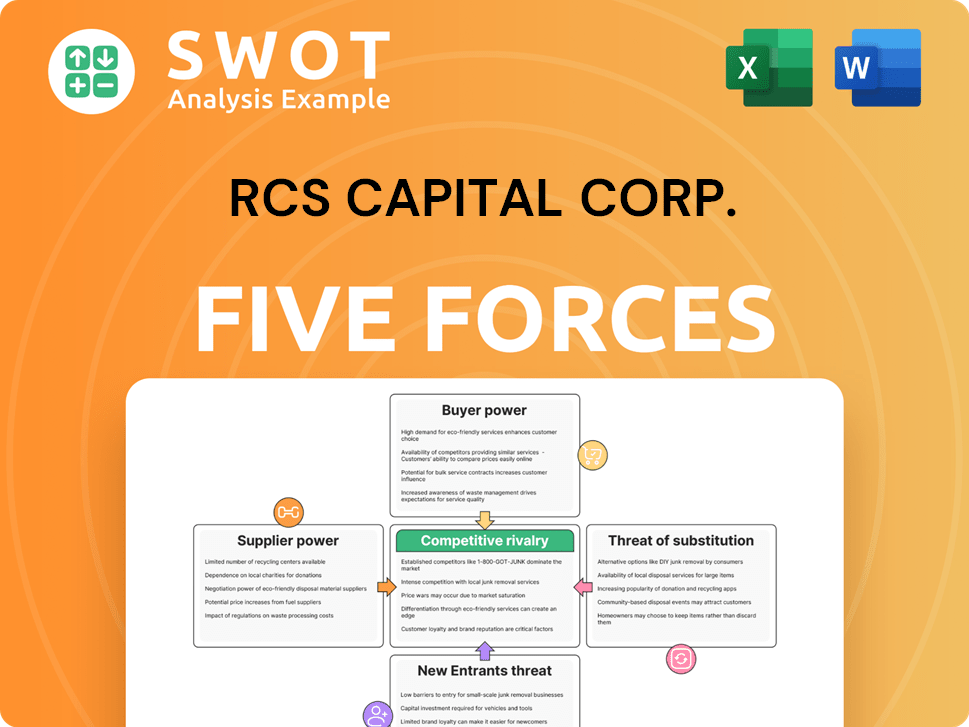
RCS Capital Corp. Porter's Five Forces Analysis
- Covers All 5 Competitive Forces in Detail
- Structured for Consultants, Students, and Founders
- 100% Editable in Microsoft Word & Excel
- Instant Digital Download – Use Immediately
- Compatible with Mac & PC – Fully Unlocked
Related Blogs

- What are Mission Vision & Core Values of RCS Capital Corp. Company?
- What is Competitive Landscape of RCS Capital Corp. Company?
- What is Growth Strategy and Future Prospects of RCS Capital Corp. Company?
- How Does RCS Capital Corp. Company Work?
- What is Sales and Marketing Strategy of RCS Capital Corp. Company?
- What is Brief History of RCS Capital Corp. Company?
- What is Customer Demographics and Target Market of RCS Capital Corp. Company?
Disclaimer
All information, articles, and product details provided on this website are for general informational and educational purposes only. We do not claim any ownership over, nor do we intend to infringe upon, any trademarks, copyrights, logos, brand names, or other intellectual property mentioned or depicted on this site. Such intellectual property remains the property of its respective owners, and any references here are made solely for identification or informational purposes, without implying any affiliation, endorsement, or partnership.
We make no representations or warranties, express or implied, regarding the accuracy, completeness, or suitability of any content or products presented. Nothing on this website should be construed as legal, tax, investment, financial, medical, or other professional advice. In addition, no part of this site—including articles or product references—constitutes a solicitation, recommendation, endorsement, advertisement, or offer to buy or sell any securities, franchises, or other financial instruments, particularly in jurisdictions where such activity would be unlawful.
All content is of a general nature and may not address the specific circumstances of any individual or entity. It is not a substitute for professional advice or services. Any actions you take based on the information provided here are strictly at your own risk. You accept full responsibility for any decisions or outcomes arising from your use of this website and agree to release us from any liability in connection with your use of, or reliance upon, the content or products found herein.