

Kuwait Finance House Bundle

Who Really Controls Kuwait Finance House?
Unraveling the Kuwait Finance House SWOT Analysis is just the beginning. Understanding KFH ownership is critical for investors and strategists alike. This financial powerhouse, a pioneer in Islamic banking, has undergone significant transformations, making its ownership structure a key area of interest. The acquisition of Ahli United Bank (AUB) in 2022 reshaped the landscape, creating Kuwait's largest bank.

This exploration into KFH ownership will provide a comprehensive overview, from its inception in 1977 by Kuwaiti merchants to its current status as a publicly traded entity. We'll examine the KFH shareholders, major stakeholders, and the influence of institutional investors and government entities. This analysis will also cover the KFH company profile, its history, and its financial information, including its impressive market capitalization and asset growth, offering actionable insights for informed decision-making related to this significant Islamic financial institution.
Who Founded Kuwait Finance House?
The establishment of Kuwait Finance House (KFH) in 1977 marked a pivotal moment in Kuwait's financial landscape. Founded as the nation's first Islamic bank, KFH's inception was guided by an Amiri decree, reflecting a strategic vision to introduce Sharia-compliant banking services.
The initial ownership structure of Kuwait Finance House, as stipulated by the decree, involved significant government participation. This government backing was crucial in establishing the bank and ensuring its early stability and growth. The early shareholders played a vital role in shaping the bank's direction and establishing its presence in the financial sector.
The founders and early shareholders of Kuwait Finance House played a crucial role in shaping its direction. The initial capital of KFH was KD 10 million, setting the stage for its operations. The first board of directors, including key figures like Ahmed Al-Yasseen and Mohammed Bu Hendi, set the tone for the bank's early operations.

Government Stake
The Kuwaiti government held a significant stake in KFH from its inception, with the government owning 49% of the shares.
Ministry of Finance
The Ministry of Finance (now the Public Investment Authority) initially held 20% of the shares, reflecting the government's commitment.
Ministry of Justice
The Ministry of Justice also held a 20% stake, demonstrating broad governmental support for the new bank.
Ministry of Awqaf and Islamic Affairs
The Ministry of Awqaf and Islamic Affairs held 9% of the shares, aligning with the bank's Islamic banking principles.
Initial Leadership
The first board of directors included Ahmed Al-Yasseen as Chairman and Managing Director, guiding the bank's early strategy.
First General Manager
Bader Al-Mukhaizeem was appointed as the first General Manager, leading the bank's operational setup.
The founders of Kuwait Finance House, including the initial board members and shareholders, were instrumental in navigating the challenges of establishing an Islamic bank. Their vision and leadership were critical to the early success of KFH, which has since grown to become a significant player in the financial sector. The initial focus was on establishing a pioneering Islamic banking institution. For a deeper understanding of how KFH has evolved its strategies over time, one can explore the Marketing Strategy of Kuwait Finance House.

Key Takeaways
The early ownership of KFH was characterized by substantial government involvement and a focus on Islamic banking principles.
- The government's initial stake was 49%, with the Ministry of Finance, Ministry of Justice, and Ministry of Awqaf and Islamic Affairs holding significant shares.
- The founding board, led by Ahmed Al-Yasseen, set the strategic direction of the bank.
- The initial capital of KD 10 million provided the financial foundation for KFH's operations.
- The early leadership faced the challenge of establishing a novel Islamic banking model.
Kuwait Finance House SWOT Analysis
- Complete SWOT Breakdown
- Fully Customizable
- Editable in Excel & Word
- Professional Formatting
- Investor-Ready Format

How Has Kuwait Finance House’s Ownership Changed Over Time?
The ownership structure of Kuwait Finance House (KFH) has seen significant changes since its listing on the Kuwait Stock Exchange in 1984. The evolution reflects strategic shifts and expansions, notably the acquisition of Ahli United Bank (AUB). This merger, finalized in 2024, reshaped KFH into a banking powerhouse, influencing its shareholder composition and overall market position. Understanding the current KFH ownership is crucial for investors and stakeholders interested in the bank's financial performance and strategic direction.
The merger with AUB, valued at approximately $11.6 billion, was a landmark event for KFH. This strategic move expanded KFH's reach across 11 countries with a network of approximately 615 branches. The transformation of AUB into a fully Sharia-compliant institution by December 2023, followed by the merger with Ahli United Bank Kuwait in February 2024, highlights the complexities involved in this acquisition. This expansion has solidified KFH's position as a major player in the Islamic banking sector.
| Shareholder | Percentage (May 2025) | |
|---|---|---|
| Kuwait Investment Authority | 16.80% | |
| Kuwait Public Institution for Social Security Fund | 9.19% | |
| Kuwait Public Authority of Minor Affairs | 7.32% | |
| Kuwait Awqaf Public Foundation | 5.09% |
As of May 2025, the major shareholders of Kuwait Finance House include several key entities. The Kuwait Investment Authority holds a significant stake, followed by the Kuwait Public Institution for Social Security Fund, the Kuwait Public Authority of Minor Affairs, and the Kuwait Awqaf Public Foundation. Other notable shareholders include the Bahrain Social Insurance Organization, Tamdeen Investment Co., and Sheikh Salem Sabah Al Naser AlSabah. The Kuwaiti government's direct and indirect ownership of KFH is approximately 36.324%. For more details, you can explore the Revenue Streams & Business Model of Kuwait Finance House.
Key Takeaways on KFH Ownership
The ownership of Kuwait Finance House is primarily influenced by government and quasi-government entities.
- The Kuwait Investment Authority is the largest single shareholder.
- The merger with Ahli United Bank significantly impacted KFH's size and market reach.
- The Kuwaiti government has a substantial ownership stake in KFH.
- Understanding the KFH ownership structure is crucial for assessing its strategic direction.
Kuwait Finance House PESTLE Analysis
- Covers All 6 PESTLE Categories
- No Research Needed – Save Hours of Work
- Built by Experts, Trusted by Consultants
- Instant Download, Ready to Use
- 100% Editable, Fully Customizable

Who Sits on Kuwait Finance House’s Board?
The Board of Directors of Kuwait Finance House (KFH) is central to the company's governance and strategic direction. Hamad Abdulmohsen Al-Marzook currently serves as the Chairman. The board approved the financial results for the year ending December 31, 2024, on January 9, 2025, demonstrating its role in overseeing financial performance. KFH's board is responsible for representing the interests of a diverse shareholder base, which includes significant government and quasi-government entities.
The board's decisions directly impact shareholder value, as seen in the approval of a 22% cash dividend (including a 10% interim dividend distributed in H1 2024) and an 8% bonus share distribution for the year ended 2024, which were later approved by the General Assembly in March 2025. The board's leadership was also critical in the successful merger with Ahli United Bank in 2024, showcasing its strategic capabilities. Understanding the KFH ownership structure and the influence of its major shareholders is key to assessing the company's trajectory.
| Board Member | Position | Notes |
|---|---|---|
| Hamad Abdulmohsen Al-Marzook | Chairman | Oversees the board's activities and strategic direction. |
| N/A | Board Member | Details on other board members are not available in the provided search results. |
| N/A | Board Member | Further information on additional board members is not available. |
As a publicly traded company, KFH generally operates under a one-share-one-vote principle. The substantial stakes held by entities like the Kuwait Investment Authority and the Public Institution for Social Security give them considerable voting power. This structure influences major decisions and underscores the importance of understanding the KFH shareholders and their impact on the company. For more insights, explore the Growth Strategy of Kuwait Finance House.
Key Takeaways on KFH Ownership and Governance
The Board of Directors at Kuwait Finance House plays a critical role in the company's strategic direction and financial performance.
- Hamad Abdulmohsen Al-Marzook is the current Chairman.
- The board approved a 22% cash dividend and an 8% bonus share distribution for 2024.
- Major shareholders, including government entities, have significant voting power.
- The board's decisions reflect its influence on shareholder returns and capital allocation.
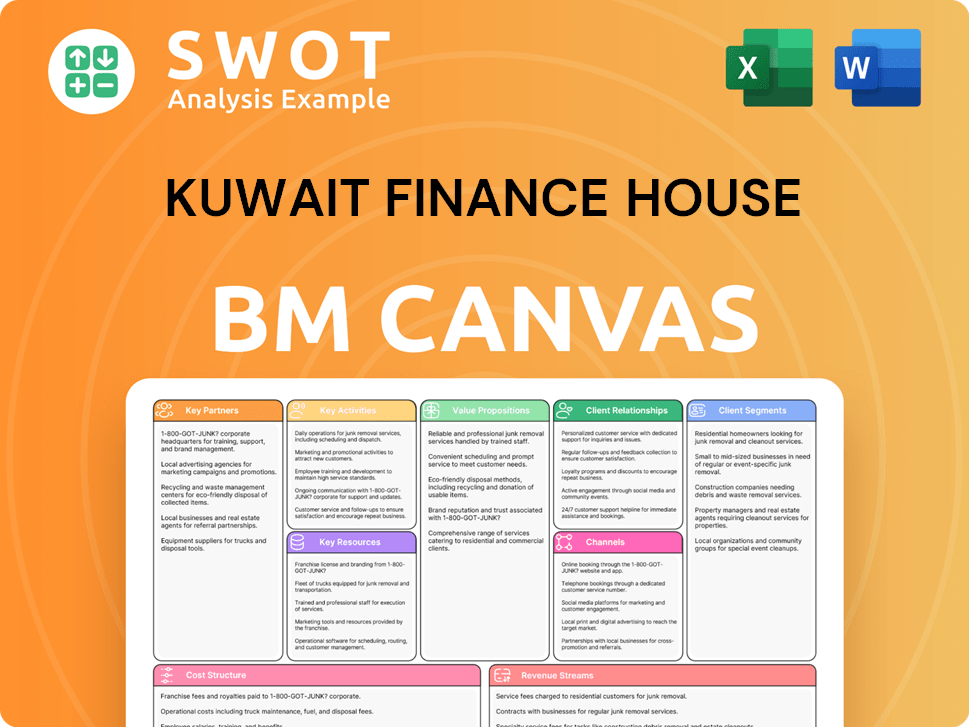
Kuwait Finance House Business Model Canvas
- Complete 9-Block Business Model Canvas
- Effortlessly Communicate Your Business Strategy
- Investor-Ready BMC Format
- 100% Editable and Customizable
- Clear and Structured Layout
What Recent Changes Have Shaped Kuwait Finance House’s Ownership Landscape?
In the last few years, Kuwait Finance House (KFH) has significantly reshaped its structure through strategic acquisitions and divestitures. A pivotal event was the acquisition of Ahli United Bank (AUB) in 2022, a move valued at approximately $11.6 billion, which solidified KFH's position as the largest bank in Kuwait by assets and the second-largest Islamic bank globally. This strategic expansion has been a key driver in shaping the current KFH ownership profile.
Alongside its growth, KFH has also engaged in some divestitures. In May 2024, Al Salam Bank acquired Kuwait Finance House Bahrain (KFH Bahrain) from the KFH Group, resulting in a gain of KWD 70.1 million for KFH. Further illustrating its dynamic approach, Fitch Ratings noted in August 2024 that KFH exited the Malaysian market, indicating a strategic shift in its global footprint. These developments highlight the evolving KFH ownership and strategic direction.
| Key Development | Date | Details |
|---|---|---|
| Acquisition of AUB | July 2022 | KFH acquired Ahli United Bank for approximately $11.6 billion, becoming Kuwait's largest bank. |
| KFH Bahrain Divestiture | May 2024 | Al Salam Bank acquired KFH Bahrain, resulting in a gain of KWD 70.1 million for KFH. |
| Exit from Malaysian Market | August 2024 | KFH exited the Malaysian market, according to Fitch Ratings. |
Financially, KFH reported a historic net profit of KD 601.8 million attributable to shareholders for the year ended 2024, a 3.0% increase compared to 2023. Total assets reached KD 36.7 billion in 2024, and total shareholders' equity reached KD 5.5 billion, an increase of 3.8% compared to the previous year. The capital adequacy ratio stood at 19.89% for 2024, exceeding minimum requirements. For more insights into the bank's background, you can explore the Brief History of Kuwait Finance House.
 KFH Ownership Structure
The ownership structure of KFH is primarily influenced by its shareholders and is a key aspect of the KFH company profile. The bank is publicly traded, with significant institutional and individual shareholders. Understanding the shareholder composition is vital for assessing the bank's strategic direction and financial performance.
KFH Financial Performance
KFH's financial information indicates robust performance, with a net profit of KD 601.8 million in 2024. The bank's total assets and shareholders' equity also show steady growth, reflecting its strong market position. These figures are crucial for investors and stakeholders evaluating KFH's investment potential.
Kuwait Finance House Porter's Five Forces Analysis
- Covers All 5 Competitive Forces in Detail
- Structured for Consultants, Students, and Founders
- 100% Editable in Microsoft Word & Excel
- Instant Digital Download – Use Immediately
- Compatible with Mac & PC – Fully Unlocked

Related Blogs

- What are Mission Vision & Core Values of Kuwait Finance House Company?
- What is Competitive Landscape of Kuwait Finance House Company?
- What is Growth Strategy and Future Prospects of Kuwait Finance House Company?
- How Does Kuwait Finance House Company Work?
- What is Sales and Marketing Strategy of Kuwait Finance House Company?
- What is Brief History of Kuwait Finance House Company?
- What is Customer Demographics and Target Market of Kuwait Finance House Company?
Disclaimer
All information, articles, and product details provided on this website are for general informational and educational purposes only. We do not claim any ownership over, nor do we intend to infringe upon, any trademarks, copyrights, logos, brand names, or other intellectual property mentioned or depicted on this site. Such intellectual property remains the property of its respective owners, and any references here are made solely for identification or informational purposes, without implying any affiliation, endorsement, or partnership.
We make no representations or warranties, express or implied, regarding the accuracy, completeness, or suitability of any content or products presented. Nothing on this website should be construed as legal, tax, investment, financial, medical, or other professional advice. In addition, no part of this site—including articles or product references—constitutes a solicitation, recommendation, endorsement, advertisement, or offer to buy or sell any securities, franchises, or other financial instruments, particularly in jurisdictions where such activity would be unlawful.
All content is of a general nature and may not address the specific circumstances of any individual or entity. It is not a substitute for professional advice or services. Any actions you take based on the information provided here are strictly at your own risk. You accept full responsibility for any decisions or outcomes arising from your use of this website and agree to release us from any liability in connection with your use of, or reliance upon, the content or products found herein.