

EFG International Bundle

Who Really Owns EFG International?
Ever wondered who truly calls the shots at EFG International, a powerhouse in global private banking? The ownership structure of a company is a crucial element, dictating its strategic direction and overall performance. Understanding the key players and their influence is vital for anyone looking to navigate the complex world of finance.

EFG International, with its impressive CHF 165.5 billion in assets under management as of late 2024, presents a compelling case study in corporate ownership. This article will dissect the EFG International SWOT Analysis, unraveling the intricacies of its ownership, including its major shareholders and the evolution of its EFG International company profile. We will also explore the composition of its board of directors, providing a comprehensive view of who ultimately shapes the future of this prominent Swiss private bank. Gaining insights into the EFG International ownership details is key to understanding its trajectory.
Who Founded EFG International?
The establishment of EFG International in 1995 involved a collective effort, with key individuals like Jean Pierre Cuoni, Lawrence D. Howell, and Baron Corso von Habsburg at the forefront. The company's origins can be traced back to the acquisition of operational rights from the Zurich office of Banque de Dépôts and the Swiss operations of the Royal Bank of Scotland. This marked a significant step in the formation of what would become a notable player in the financial sector.
The groundwork for EFG International was laid earlier, in 1980, when John Latsis, a Greek oil and shipping magnate, acquired Geneva-based Banque de Dépôts from the Onassis family. Latsis then renamed it EFG and relocated its base to Zurich. This strategic move set the stage for the bank's future development and expansion within the financial industry.
At the time of its flotation on the Swiss Exchange in October 2005, the ownership structure of EFG International showed Jean Pierre Cuoni holding 5% of the bank, Lawrence D. Howell with 6%, and the Latsis family interests controlling a significant 48%. The substantial initial stake held by the Latsis family highlights their crucial role as the primary financial backers during the company's early stages.

Ownership Structure
The early ownership structure of EFG International reveals the pivotal roles of its founders and the significant backing from the Latsis family. The initial public offering (IPO) in 2005 provided a snapshot of the ownership distribution. Understanding the dynamics of Target Market of EFG International, and the key players is essential for anyone interested in the company's history and strategic development.
- Jean Pierre Cuoni held 5% of the bank at the IPO.
- Lawrence D. Howell held 6% at the IPO.
- The Latsis family controlled 48% at the IPO, indicating their significant influence.
- No detailed information is publicly available regarding early agreements or disputes.
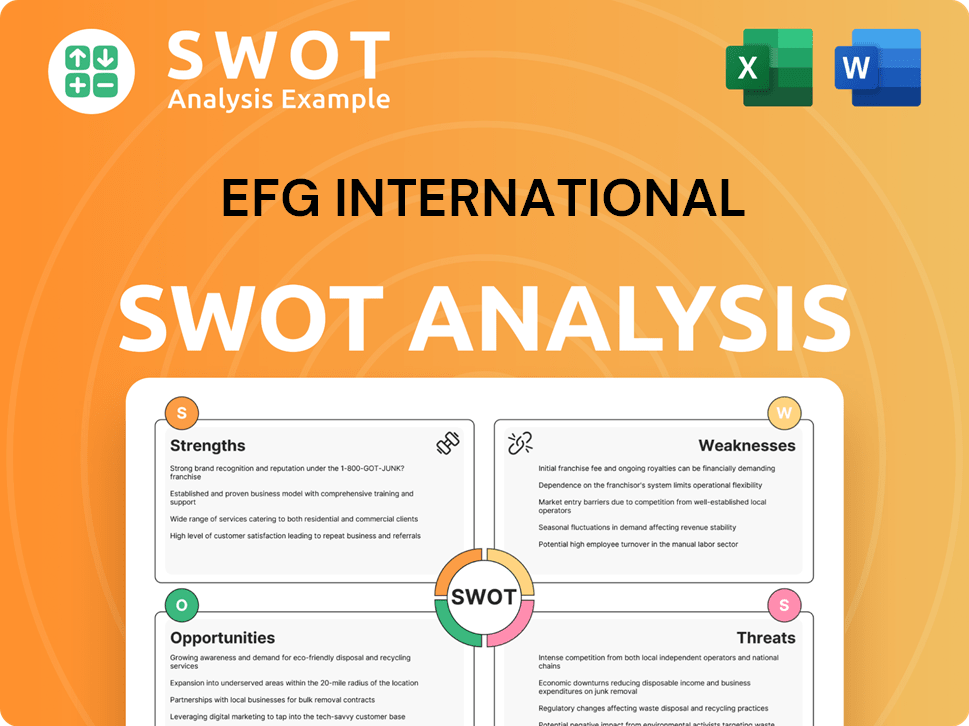
EFG International SWOT Analysis
- Complete SWOT Breakdown
- Fully Customizable
- Editable in Excel & Word
- Professional Formatting
- Investor-Ready Format
How Has EFG International’s Ownership Changed Over Time?
The ownership structure of EFG International has evolved significantly since its inception. A pivotal moment was its listing on the SIX Swiss Exchange in Zurich in 2005. This initial public offering (IPO) allowed for broader investor participation and set the stage for future strategic moves. The company's journey reflects a blend of family influence and institutional investment, shaping its strategic direction and market presence.
The acquisition of BSI in 2016 was a transformative event for EFG International, substantially altering its shareholder base. This move not only doubled its assets under management but also introduced new significant stakeholders. Analyzing the EFG International ownership structure provides insights into its strategic direction and market influence.
| Event | Date | Impact on Ownership |
|---|---|---|
| Initial Public Offering (IPO) | 2005 | Allowed broader investor participation. |
| Acquisition of BSI | 2016 | Doubled assets under management and changed shareholder base. |
| Current Ownership Structure | December 31, 2024 | EFG Bank European Financial Group SA holds 44.9% of voting rights. |
As of December 31, 2024, the largest shareholder of EFG International is EFG Bank European Financial Group SA, holding 44.9% of the voting rights. This entity is part of European Financial Group EFG (Luxembourg), with the Latsis family interests as ultimate beneficiaries. BTGP-BSI Limited (wholly owned by Banco BTG Pactual S.A.) holds 17.3% of the voting rights. The Capital Group Companies, Inc. held 10,224,204 shares as of December 31, 2024. For more details, you can explore the Brief History of EFG International.
Key Takeaways on EFG International Ownership
EFG International's ownership structure is a mix of family control and institutional investment.
- The Latsis family maintains a significant influence.
- BTG Pactual and other institutional investors hold substantial stakes.
- The acquisition of BSI in 2016 was a major turning point.
- Understanding the shareholders is crucial for assessing the company's strategy.
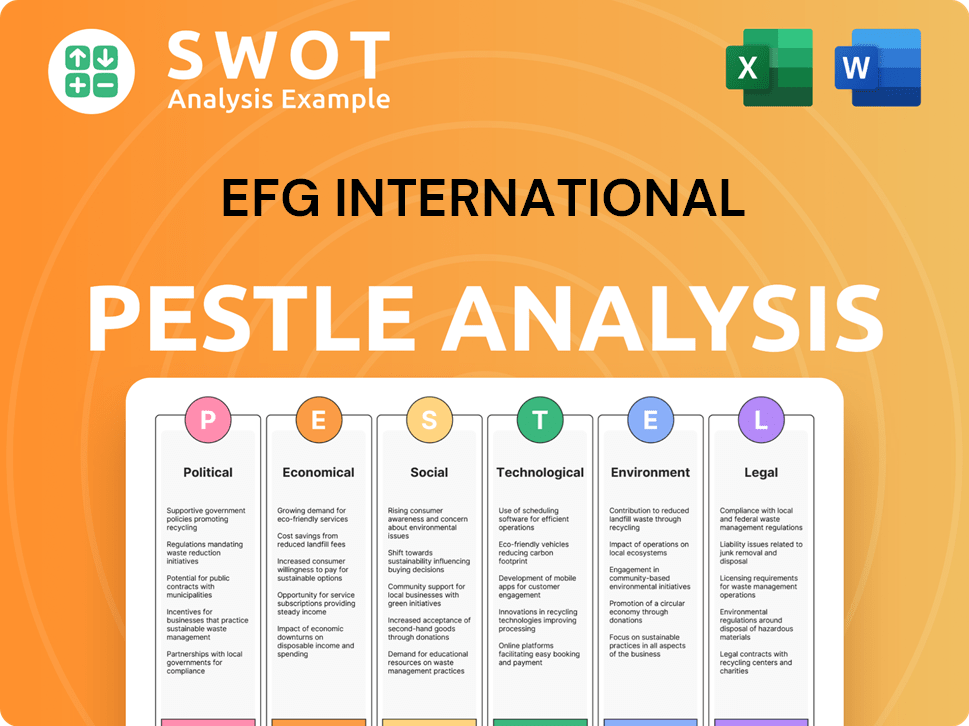
EFG International PESTLE Analysis
- Covers All 6 PESTLE Categories
- No Research Needed – Save Hours of Work
- Built by Experts, Trusted by Consultants
- Instant Download, Ready to Use
- 100% Editable, Fully Customizable
Who Sits on EFG International’s Board?
The Board of Directors of EFG International plays a critical role in the company's governance. At the Annual General Meeting (AGM) held on March 21, 2025, Alexander Classen was re-elected as Chairman for a one-year term. The board's composition reflects the interests of its major shareholders and includes independent members. This structure ensures a balance of perspectives in guiding the company's strategic direction and overseeing its operations.
As of the AGM on March 21, 2025, several board members were re-elected for another year, including Emmanuel L Bussetil, Boris F J Collardi, and others. John S. Latsis's continued presence on the board represents the significant interests of the Latsis family, the largest shareholder. New members, such as Yvonne Bettkober and Wanda Eriksen, were also elected, bringing expertise in areas like digital transformation. These appointments aim to enhance the board's capabilities and support the company's strategic goals. For more information about the business, you can read the Revenue Streams & Business Model of EFG International.
| Board Member | Role | Term |
|---|---|---|
| Alexander Classen | Chairman | One Year |
| Emmanuel L Bussetil | Board Member | One Year |
| Boris F J Collardi | Board Member | One Year |
| Yvonne Bettkober | Board Member | One Year |
| Wanda Eriksen | Board Member | One Year |
| Luisa Delgado | Board Member | Commencing September 1, 2025 |
| Konstantinos (Kostas) Tsiveriotis | Board Member | Until the conclusion of the 2026 AGM (subject to regulatory approval) |
EFG International's voting structure is primarily based on one-share-one-vote for its registered shares listed on the SIX Swiss Exchange. The Latsis family, through EFG Bank European Financial Group SA, holds a substantial 44.9% of the voting rights, giving them significant influence. The company has not faced significant proxy battles recently, and the AGM on March 21, 2025, approved all proposed motions, including the dividend payment. This stability reflects a well-managed governance structure, with the major shareholders, including the Latsis family, playing a key role in the company's direction. This information is crucial for understanding EFG International ownership and the influence of its major shareholders.
Key Takeaways on EFG International Ownership
The Board of Directors includes members representing major shareholders, ensuring alignment with shareholder interests.
- The Latsis family holds a significant 44.9% voting right.
- Recent AGM saw the re-election of key board members and the addition of new members.
- The voting structure is primarily one-share-one-vote, with no special voting rights.
- The company's governance appears stable, with all motions approved at the latest AGM.
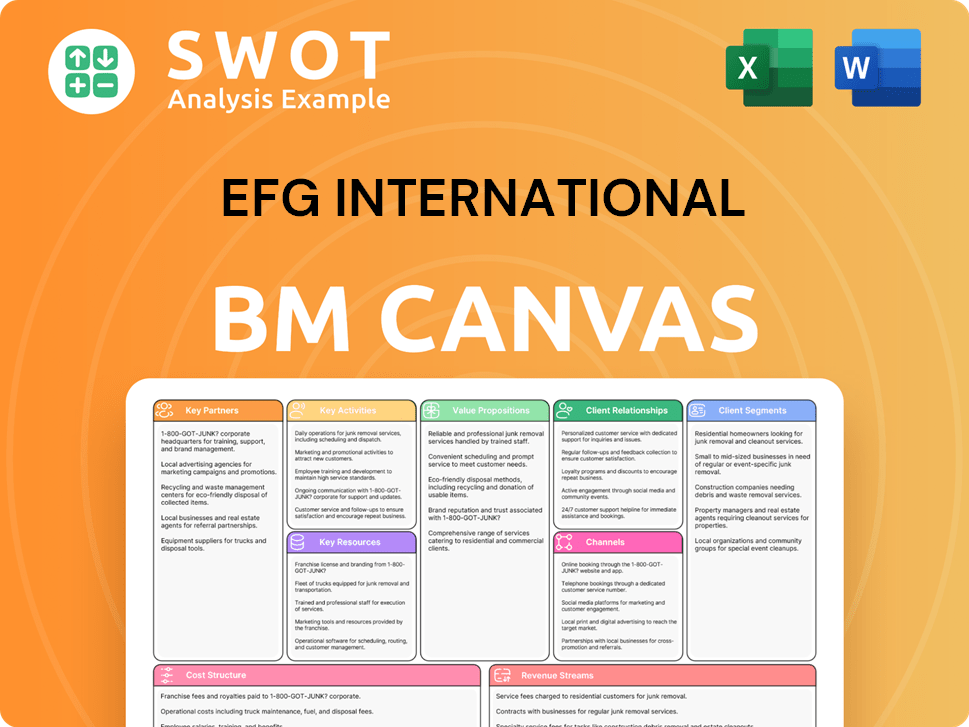
EFG International Business Model Canvas
- Complete 9-Block Business Model Canvas
- Effortlessly Communicate Your Business Strategy
- Investor-Ready BMC Format
- 100% Editable and Customizable
- Clear and Structured Layout
What Recent Changes Have Shaped EFG International’s Ownership Landscape?
Over the past few years, EFG International has focused on strategic growth, which has influenced its ownership profile. In 2024, EFG International achieved a record IFRS net profit of CHF 321.6 million, a 6% increase from 2023, and net asset inflows of CHF 10.1 billion, representing a growth rate of 7.1%. Assets under management reached CHF 165.5 billion at the end of 2024, up 16% from CHF 142.2 billion in 2023. These financial results reflect the company's strong performance and strategic direction, which are key factors in understanding who owns EFG International and how its ownership structure is evolving. The proposed acquisition of Cité Gestion, announced in February 2025, is a significant move that will likely affect the EFG International ownership structure.
A notable development in EFG International ownership is the proposed acquisition of Swiss private bank Cité Gestion, announced in February 2025. EFG International will acquire 100% of Cité Gestion, which manages approximately CHF 7.5 billion in assets under management as of end-2024. This transaction is expected to be finalized in the second half of 2025, pending regulatory approvals, and is anticipated to strengthen EFG's presence in its home market and be accretive to earnings per share by 2026. Furthermore, the company's share buyback programs, like the one initiated in September 2023 and the more recent one to fund employee compensation, have also influenced ownership by reducing the number of outstanding shares, potentially increasing the ownership percentage of existing shareholders. Understanding these changes is crucial for anyone interested in the EFG International stock and its future.
| Key Development | Details | Impact on Ownership |
|---|---|---|
| Acquisition of Cité Gestion | Acquisition of 100% of Cité Gestion, managing approximately CHF 7.5 billion in assets. | Strengthens market presence, potentially altering shareholder composition. |
| Share Buyback Programs | Repurchase of up to 6 million shares by July 31, 2025, to fund employee compensation. | Reduces outstanding shares, potentially increasing the ownership percentage of existing shareholders. |
| Leadership Changes | Appointments of new executives in key markets. | Reflects ongoing efforts to strengthen leadership and expand in key markets, which could influence investor confidence and ownership dynamics. |
Leadership changes and strategic initiatives are also shaping the EFG International company profile. In March 2025, Carlo Maturi was appointed as the new Chair of the Board of Directors of EFG Monaco, and Hervé Ordioni became the new CEO. Additionally, Soha Nashaat was appointed as the new Executive Chair for EFG (Middle East) Limited in Dubai, effective May 1, 2025. These appointments, along with the company's strategic acquisitions, such as the proposed acquisition of Cité Gestion, indicate an active approach to growth and market positioning. For more insights into the company's strategic direction, consider reading about the Growth Strategy of EFG International.
 Acquisition of Cité Gestion
EFG International's planned acquisition of Cité Gestion is a strategic move to bolster its presence in the Swiss market. This acquisition is expected to be finalized in the second half of 2025, subject to regulatory approvals.
Share Buyback Programs
The company is actively repurchasing its shares to fund employee compensation and reduce the number of outstanding shares. This action may increase the ownership percentage of the remaining shareholders.
Leadership Changes
Recent appointments, such as Carlo Maturi as Chair of the Board of Directors in Monaco and Soha Nashaat as Executive Chair in Dubai, reflect EFG’s commitment to strengthening its leadership and expanding its global reach.
Financial Performance
EFG International reported record IFRS net profit of CHF 321.6 million in 2024, a 6% increase compared to 2023, and net asset inflows of CHF 10.1 billion, representing a growth rate of 7.1%.
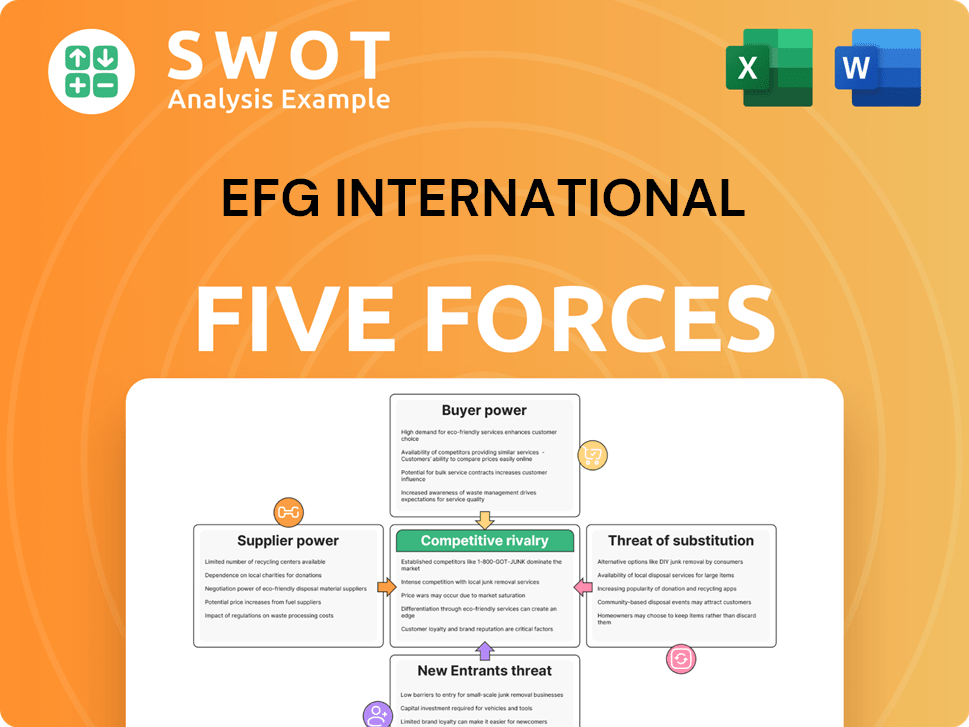
EFG International Porter's Five Forces Analysis
- Covers All 5 Competitive Forces in Detail
- Structured for Consultants, Students, and Founders
- 100% Editable in Microsoft Word & Excel
- Instant Digital Download – Use Immediately
- Compatible with Mac & PC – Fully Unlocked
Related Blogs

- What are Mission Vision & Core Values of EFG International Company?
- What is Competitive Landscape of EFG International Company?
- What is Growth Strategy and Future Prospects of EFG International Company?
- How Does EFG International Company Work?
- What is Sales and Marketing Strategy of EFG International Company?
- What is Brief History of EFG International Company?
- What is Customer Demographics and Target Market of EFG International Company?
Disclaimer
All information, articles, and product details provided on this website are for general informational and educational purposes only. We do not claim any ownership over, nor do we intend to infringe upon, any trademarks, copyrights, logos, brand names, or other intellectual property mentioned or depicted on this site. Such intellectual property remains the property of its respective owners, and any references here are made solely for identification or informational purposes, without implying any affiliation, endorsement, or partnership.
We make no representations or warranties, express or implied, regarding the accuracy, completeness, or suitability of any content or products presented. Nothing on this website should be construed as legal, tax, investment, financial, medical, or other professional advice. In addition, no part of this site—including articles or product references—constitutes a solicitation, recommendation, endorsement, advertisement, or offer to buy or sell any securities, franchises, or other financial instruments, particularly in jurisdictions where such activity would be unlawful.
All content is of a general nature and may not address the specific circumstances of any individual or entity. It is not a substitute for professional advice or services. Any actions you take based on the information provided here are strictly at your own risk. You accept full responsibility for any decisions or outcomes arising from your use of this website and agree to release us from any liability in connection with your use of, or reliance upon, the content or products found herein.