

Dis-Chem Bundle

Who Really Owns Dis-Chem Pharmacies?
Understanding a company's ownership is key to grasping its future. A significant share sale by a Dis-Chem founder has sparked curiosity: 'Who owns Dis-Chem?' This question is more than academic; it speaks to the heart of Dis-Chem's strategic direction and accountability. Founded in 1978, Dis-Chem has become a leading pharmacy group in South Africa.

Dis-Chem's journey, from its roots with founders Ivan and Lynette Saltzman to its current status, is a compelling story of growth. With a vast footprint of 333 retail stores by February 2025 and a reported R39.2 billion revenue, understanding the Dis-Chem SWOT Analysis is crucial. This article explores the Dis-Chem ownership structure, revealing the influence of major shareholders and the impact on the company's governance, providing insights into the Dis-Chem owner and the company's strategic evolution.
Who Founded Dis-Chem?
The roots of Dis-Chem Pharmacies trace back to 1978, when pharmacists Ivan and Lynette Saltzman established the company. Their initial venture, a retail pharmacy in Mondeor, Johannesburg, began with a modest investment, setting the stage for what would become a major player in the South African pharmaceutical market. This early start marked the beginning of a business that would later transform the retail pharmacy landscape in South Africa.
The Saltzmans' vision was to introduce a discount pharmacy model, offering a broader range of products than typically found in South African pharmacies at the time. This innovative approach, coupled with a focus on customer service, quickly gained traction. The company's early success laid the foundation for its subsequent expansion and its eventual prominence within the industry. You can read more about this in the Brief History of Dis-Chem.
From its inception, Dis-Chem was largely a family-run business. Before its 2016 listing, the Saltzman family, through Ivlyn Proprietary Limited, held a significant controlling stake. This ownership structure highlights the family's deep involvement in the company's early years and its pivotal role in shaping the business. The initial strategy of offering low prices and good service proved successful, helping the company achieve profitability in its first year.

Early Ownership Details
Before the initial public offering (IPO) in 2016, the ownership structure of Dis-Chem was primarily concentrated. The Saltzman family, through Ivlyn Proprietary Limited, held a substantial 66.9% of the shares. Key management members owned an additional 23.4%, while a financial investor held the remaining 9.7%.
- The first store opened in Mondeor, Johannesburg, in 1978.
- The initial capital investment was R10,000.
- The company broke even in its first year, generating R84,000 in revenue.
- The second store opened in Randridge Mall in 1982, further solidifying the discount formula.
Dis-Chem SWOT Analysis
- Complete SWOT Breakdown
- Fully Customizable
- Editable in Excel & Word
- Professional Formatting
- Investor-Ready Format

How Has Dis-Chem’s Ownership Changed Over Time?
The journey of Dis-Chem's ownership structure began with its IPO on the Johannesburg Stock Exchange (JSE) in November 2016. At the time, the Saltzman family, through Ivlyn Local Investment Holdings, held a significant 66.9% stake. This initial public offering marked a pivotal moment, transforming the company from a privately held entity to a publicly traded one, and setting the stage for subsequent ownership changes.
Since its IPO, the ownership landscape of Dis-Chem Pharmacies has evolved considerably. Institutional investors now hold the majority of shares. As of April 3, 2025, institutional investors collectively control 51% of the company. This shift reflects the natural dilution that occurs with public listings and strategic decisions by the founding family. The top two shareholders account for 54% of the business.
| Stakeholder | Approximate Ownership (April 3, 2025) | Key Events |
|---|---|---|
| Institutional Investors | 51% | Collective majority ownership. |
| Coronation Asset Management (Pty) Ltd | 29.83% (as of February 2, 2024) | Acquired a 5.8% stake from Ivlyn Local Investment Holdings. |
| Public Investment Corporation (SOC) Ltd | 25% (as of April 3, 2025) | Significant institutional investor; held approximately 10% in January 2022. |
These changes in the Dis-Chem ownership structure indicate a move towards broader institutional ownership. Ivan Saltzman's sale of R1.43 billion worth of shares in February 2024 further illustrates this trend, reducing Ivlyn's stake. The strategic focus areas of Dis-Chem, such as expanding its retail footprint and investing in an integrated health ecosystem, are likely influenced by the long-term growth objectives of its major institutional investors, shaping the company's future direction.
Dis-Chem Ownership Evolution
The ownership of Dis-Chem has changed significantly since its IPO in 2016. Institutional investors now hold the majority of shares, reflecting a shift away from the founding family's initial control.
- The Saltzman family initially held a significant stake.
- Institutional investors now dominate the shareholder base.
- Strategic divestments by the founders have contributed to the changes.
- Major shareholders include Coronation Asset Management and the Public Investment Corporation.
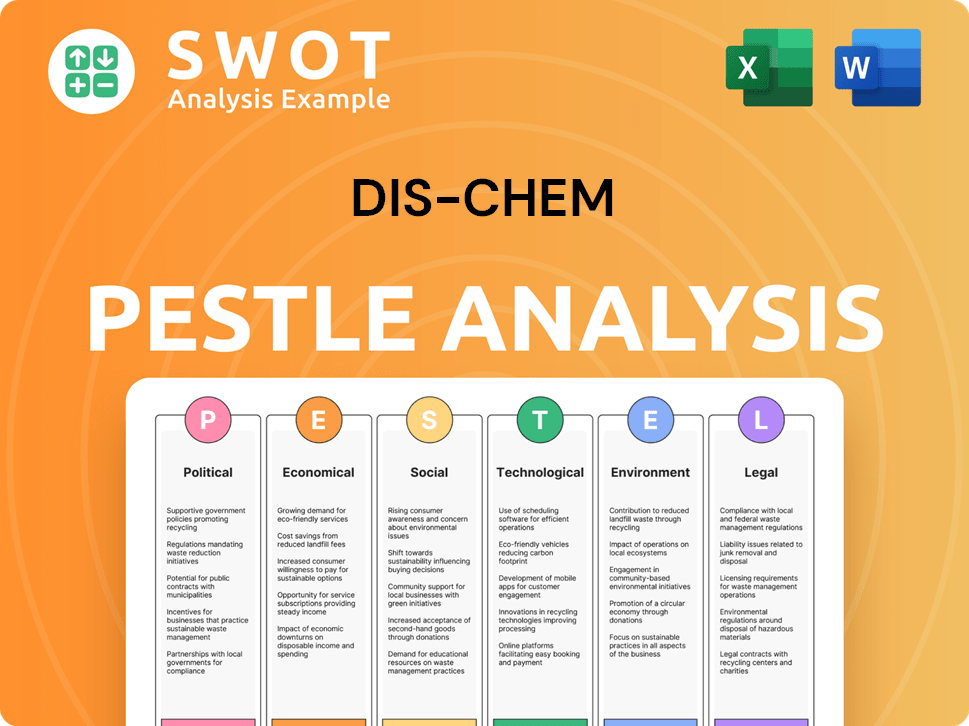
Dis-Chem PESTLE Analysis
- Covers All 6 PESTLE Categories
- No Research Needed – Save Hours of Work
- Built by Experts, Trusted by Consultants
- Instant Download, Ready to Use
- 100% Editable, Fully Customizable
Who Sits on Dis-Chem’s Board?
The current board of directors of Dis-Chem Pharmacies plays a critical role in the company's governance. Key figures include co-founders Ivan and Lynette Saltzman. Ivan Saltzman, a founder and former CEO, remains a significant figure. Rui Morais is the current CEO as of June 2023. Julia Pope serves as the Director of Finance/CFO, Nikki Lumley is the Corporate Secretary, and Saul Saltzman, Ivan's son, is also a director. This composition reflects a blend of founder influence and professional management, shaping the strategic direction of the company.
The board's composition and the influence of key shareholders are essential to understanding Dis-Chem's operational dynamics. The board balances the interests of various shareholder groups, including major shareholders, founders, and independent members. The presence of family members like Ivan and Saul Saltzman, alongside professional executives, influences decision-making and strategic direction, impacting the company's performance and governance practices. Understanding the board's composition is crucial for assessing Dis-Chem's overall corporate governance.
| Board Member | Title | Notes |
|---|---|---|
| Ivan Saltzman | Founder, Former CEO | Significant influence |
| Rui Morais | CEO (as of June 2023) | Current Chief Executive |
| Julia Pope | Director of Finance/CFO | Oversees financial operations |
| Nikki Lumley | Corporate Secretary | Responsible for corporate governance |
| Saul Saltzman | Director | Son of Ivan Saltzman |
The voting structure of Dis-Chem, a public company, is based on ordinary shares listed on the JSE. The Saltzman family, through Ivlyn (Pty) Ltd, held 78% of The Directors Adventures Trust, which owned properties leased by Dis-Chem, indicating a significant, albeit indirect, influence on certain operational aspects. Institutional investors like Coronation Asset Management (approximately 29.83% in February 2024) and Public Investment Corporation (around 25% in April 2025) also hold substantial stakes, influencing board decisions. This ownership structure is a key aspect of understanding Dis-Chem ownership and its governance.
Voting Power and Shareholding
The Saltzman family's influence and institutional investor holdings significantly impact board decisions and company strategy. The one-share-one-vote principle applies, but large shareholdings give substantial control.
- Saltzman family's influence through shareholdings.
- Institutional investors like Coronation and PIC hold significant stakes.
- One-share-one-vote principle governs voting rights.
- Transparency in related-party transactions is crucial.
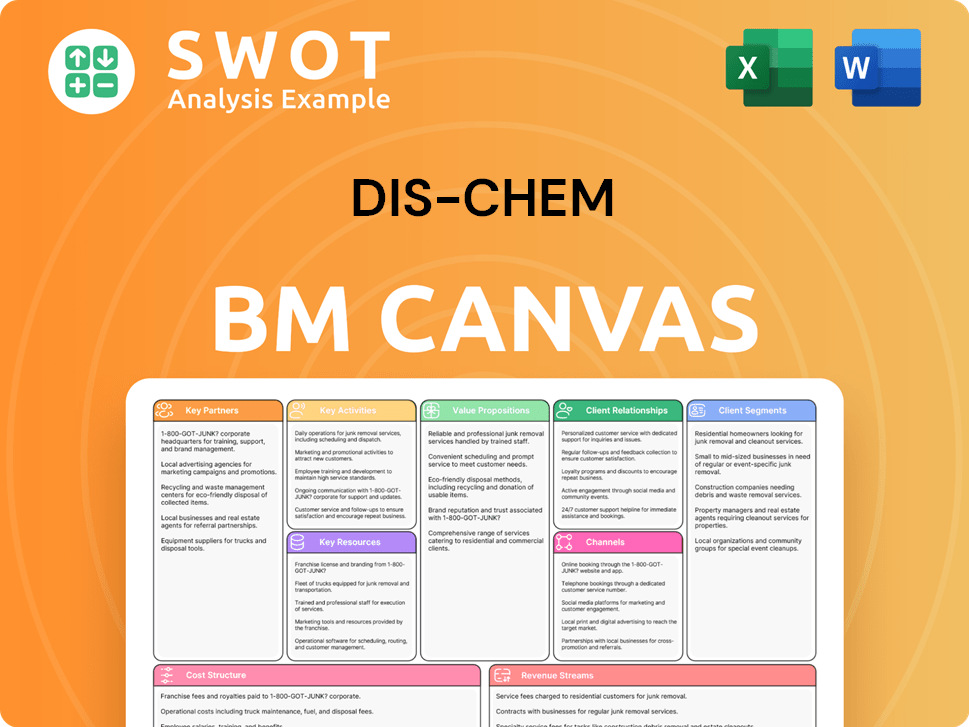
Dis-Chem Business Model Canvas
- Complete 9-Block Business Model Canvas
- Effortlessly Communicate Your Business Strategy
- Investor-Ready BMC Format
- 100% Editable and Customizable
- Clear and Structured Layout
What Recent Changes Have Shaped Dis-Chem’s Ownership Landscape?
Over the past few years, the ownership of Dis-Chem Pharmacies has seen significant shifts. In February 2024, founder Ivan Saltzman, through Ivlyn Local Investment Holdings, sold shares worth R1.43 billion, decreasing Ivlyn's stake. This transaction, alongside other share sales by family members, indicates a gradual decrease in the founding family's direct ownership. Simultaneously, institutional investors, particularly Coronation Asset Management, have increased their holdings, signaling a shift towards greater institutional influence.
Recent acquisitions and strategic moves have also reshaped the ownership landscape. In June 2024, Dis-Chem acquired a 50% stake in OneSpark for R155,940,228, expanding its health-centric financial services. Furthermore, in September 2024, a subsidiary received approval to acquire Columbia Falls Properties 7 (Pty) Ltd for R500 million, consolidating ownership of the Midrand warehouse and head office. These actions reflect a strategic focus on expanding service offerings and consolidating key assets, influencing the overall Dis-Chem ownership structure.
| Key Development | Date | Details |
|---|---|---|
| Share Sale by Founder | February 2024 | Ivan Saltzman, through Ivlyn Local Investment Holdings, sold shares worth R1.43 billion. |
| Acquisition of OneSpark Stake | June 2024 | Dis-Chem acquired a 50% stake in OneSpark for R155,940,228. |
| Warehouse Acquisition Approval | September 2024 | Dis-Chem Distribution (Pty) Ltd approved to acquire Columbia Falls Properties 7 (Pty) Ltd for R500 million. |
| Institutional Ownership | April 2025 | Institutions hold a 51% stake in Dis-Chem. |
| Financial Results | May 30, 2025 | Group revenue increased by 8.0% to R39.2 billion, with earnings per share and headline earnings per share increasing by 20.0%. |
The trend towards increased institutional ownership, with institutions holding a 51% stake as of April 2025, is notable. This often leads to greater emphasis on corporate governance and long-term value creation. Dis-Chem's commitment to expanding its retail footprint, with plans to increase trading space by approximately 40% and accelerate new store openings into FY26, aligns with this focus. These developments, alongside the company's strong financial performance, as evidenced by the May 30, 2025, results showing an 8.0% increase in group revenue to R39.2 billion, suggest a continued focus on growth and operational efficiency, likely supported by its evolving ownership structure. To understand the company's strategic direction, consider exploring the Growth Strategy of Dis-Chem.
 Dis-Chem Ownership Trends
Recent shifts include share sales by founders and increased institutional ownership.
Key Acquisitions
Acquisition of OneSpark and the Midrand warehouse reflects strategic expansion.
Institutional Influence
Increased institutional ownership is driving focus on governance and long-term value.
Financial Performance
Strong revenue growth and earnings demonstrate operational efficiency.
Dis-Chem Porter's Five Forces Analysis
- Covers All 5 Competitive Forces in Detail
- Structured for Consultants, Students, and Founders
- 100% Editable in Microsoft Word & Excel
- Instant Digital Download – Use Immediately
- Compatible with Mac & PC – Fully Unlocked

Related Blogs

- What are Mission Vision & Core Values of Dis-Chem Company?
- What is Competitive Landscape of Dis-Chem Company?
- What is Growth Strategy and Future Prospects of Dis-Chem Company?
- How Does Dis-Chem Company Work?
- What is Sales and Marketing Strategy of Dis-Chem Company?
- What is Brief History of Dis-Chem Company?
- What is Customer Demographics and Target Market of Dis-Chem Company?
Disclaimer
All information, articles, and product details provided on this website are for general informational and educational purposes only. We do not claim any ownership over, nor do we intend to infringe upon, any trademarks, copyrights, logos, brand names, or other intellectual property mentioned or depicted on this site. Such intellectual property remains the property of its respective owners, and any references here are made solely for identification or informational purposes, without implying any affiliation, endorsement, or partnership.
We make no representations or warranties, express or implied, regarding the accuracy, completeness, or suitability of any content or products presented. Nothing on this website should be construed as legal, tax, investment, financial, medical, or other professional advice. In addition, no part of this site—including articles or product references—constitutes a solicitation, recommendation, endorsement, advertisement, or offer to buy or sell any securities, franchises, or other financial instruments, particularly in jurisdictions where such activity would be unlawful.
All content is of a general nature and may not address the specific circumstances of any individual or entity. It is not a substitute for professional advice or services. Any actions you take based on the information provided here are strictly at your own risk. You accept full responsibility for any decisions or outcomes arising from your use of this website and agree to release us from any liability in connection with your use of, or reliance upon, the content or products found herein.