

Colony Bank Bundle

Who Really Controls Colony Bank?
Uncover the ownership secrets of Colony Bankcorp, Inc., a financial institution that has evolved significantly since its founding in 1975. Understanding who owns a company is paramount to grasping its strategic direction and future prospects, especially after pivotal events like acquisitions. This analysis will dissect the evolution of Colony Bank's ownership, offering critical insights into its governance and commitment to its founding mission.

From its roots as a community-focused bank, Colony Bank has grown into a publicly traded entity, making its ownership structure a complex but crucial area of study. This examination of Colony Bank SWOT Analysis will explore the influence of key investors, the role of public shareholders, and the dynamics that have shaped the company. Discover the answers to questions like "Who owns Colony Bank?" and how its ownership structure impacts its strategic decisions, including potential mergers and acquisitions.
Who Founded Colony Bank?
The genesis of the company dates back to 1975 in Fitzgerald, Georgia. It emerged from a need identified by a local farmer who faced challenges securing business funding. This led to the formation of the company by a group of local business owners and community leaders who shared a vision for a financial institution dedicated to supporting local businesses and fostering community growth.
While specific details about the founders' names and initial equity distributions are not readily available, the company was built by 'forward-thinking entrepreneurs'. Their core mission was to 'enable progress for individuals, families, and businesses alike'. This foundational principle has guided the company's operations and expansion over the years.
The company was officially organized as a bank-holding company in 1982 under federal and Georgia bank holding company laws. This restructuring set the stage for future growth and strategic initiatives. The company's commitment to community banking has been a constant throughout its history, influencing its decisions and shaping its identity.

Early Ownership Structure
Initially, the company operated as a privately-held entity, backed by the local community. The structure allowed for a focus on local needs and direct engagement with the community it served.
Transition to Public Trading
In 1998, the company took a significant step by listing its stock on NASDAQ under the symbol 'CBAN'. This transition marked a shift in the company's ownership structure, opening it up to a broader base of investors.
Vision of the Founders
The founders' vision was centered on establishing a bank deeply rooted in the community. This commitment has been a cornerstone of the company's growth strategy and has influenced its acquisitions and operations.
Impact on Acquisitions
The company's history of acquisitions reflects its dedication to community banking. These acquisitions have helped expand its footprint while maintaining a focus on local engagement.
Financial Performance
The company's financial reports and annual reports provide insights into its performance. Investors and stakeholders can access these reports to understand the company's financial health and strategic direction.
Key Personnel
Information about the company's leadership team, including executives and the board of directors, is available to provide insights into the company's governance and strategic decisions.
Understanding the company's ownership structure is key to assessing its strategic direction and financial performance. Information about the company's stock, including its price history and major shareholders, is available through financial reports and investor relations materials. For further insights into the company's strategic growth, consider reading Growth Strategy of Colony Bank. The company's commitment to community banking, as established by its founders, continues to influence its operations and expansion strategies, as reflected in its financial performance and strategic decisions. Analyzing the company's annual reports and investor relations materials offers a comprehensive view of its financial health and strategic direction. In 2024, the company's total assets were approximately in the billions of dollars, reflecting its growth and market presence. The company's stock performance and insider holdings are also crucial aspects of understanding the company's ownership and financial health.
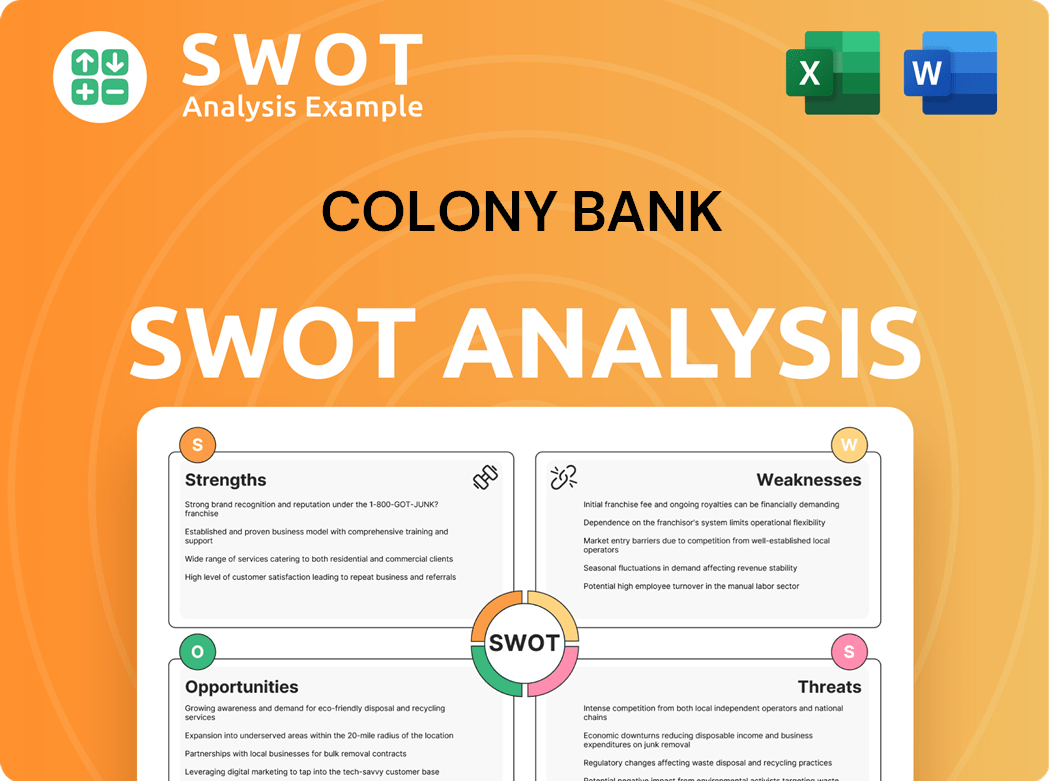
Colony Bank SWOT Analysis
- Complete SWOT Breakdown
- Fully Customizable
- Editable in Excel & Word
- Professional Formatting
- Investor-Ready Format
How Has Colony Bank’s Ownership Changed Over Time?
The evolution of Colony Bank's marketing strategy, and its ownership structure, has been marked by significant milestones. Initially rooted in community banking, the company transitioned to the public market, listing its common stock on NASDAQ in 1998. This move signaled a shift towards broader investor participation and increased visibility. The subsequent move to the NYSE in 2024 further solidified its position in the financial landscape, attracting a diverse range of investors and influencing the company's ownership dynamics.
As of May 2025, the ownership structure of Colony Bankcorp, Inc. reflects a mix of institutional, insider, and retail investors. This blend indicates a balance between large-scale investment firms, individuals with direct involvement in the company, and individual investors. The company's strategic acquisitions, such as the purchase of SouthCrest Financial Group in 2021, and the Ellerbee Agency in 2025 for $3.5 million, showcase its growth strategy and its impact on its financial standing and ownership dynamics.
| Ownership Category | Percentage (May 2025) | Shares Held (May 2025) |
|---|---|---|
| Institutional Investors | 55.48% | Not Available |
| Insiders | 7.32% | Not Available |
| Retail Investors | 23.78% | Not Available |
Key institutional investors include BlackRock Inc., holding 10.81% of the shares, which is equivalent to 1,885,842 shares, and Vanguard Group Inc., with 5.16% ownership, representing 899,861 shares. Banc Funds Co LLC held 4.02% of the shares, which is equivalent to 700,359 shares, Fourthstone LLC held 3.91% of the shares, which is equivalent to 682,658 shares, and Dimensional Fund Advisors LP held 3.62% of the shares, which is equivalent to 631,656 shares as of December 31, 2024. Among individual insiders, B. Gene Waldron is a significant shareholder, owning 633,884 shares, which represents 3.63% of the company. Other key insiders include Jonathan W. R. Ross (2.95%, 513,805 shares) and Robert Sidney Ross (2.56%, 446,154 shares). Colony Bankcorp's total assets were $3.11 billion at December 31, 2024, with total deposits at $2.57 billion, and total loans at $1.88 billion.

Ownership Overview
Understanding Colony Bank ownership is essential for investors and stakeholders. The company's ownership structure is a blend of institutional and insider holdings.
- Institutional investors hold a significant portion of the stock.
- Insiders, including key executives, also have substantial holdings.
- Retail investors make up a portion of the ownership.
- The company's strategic acquisitions have influenced its financial position.
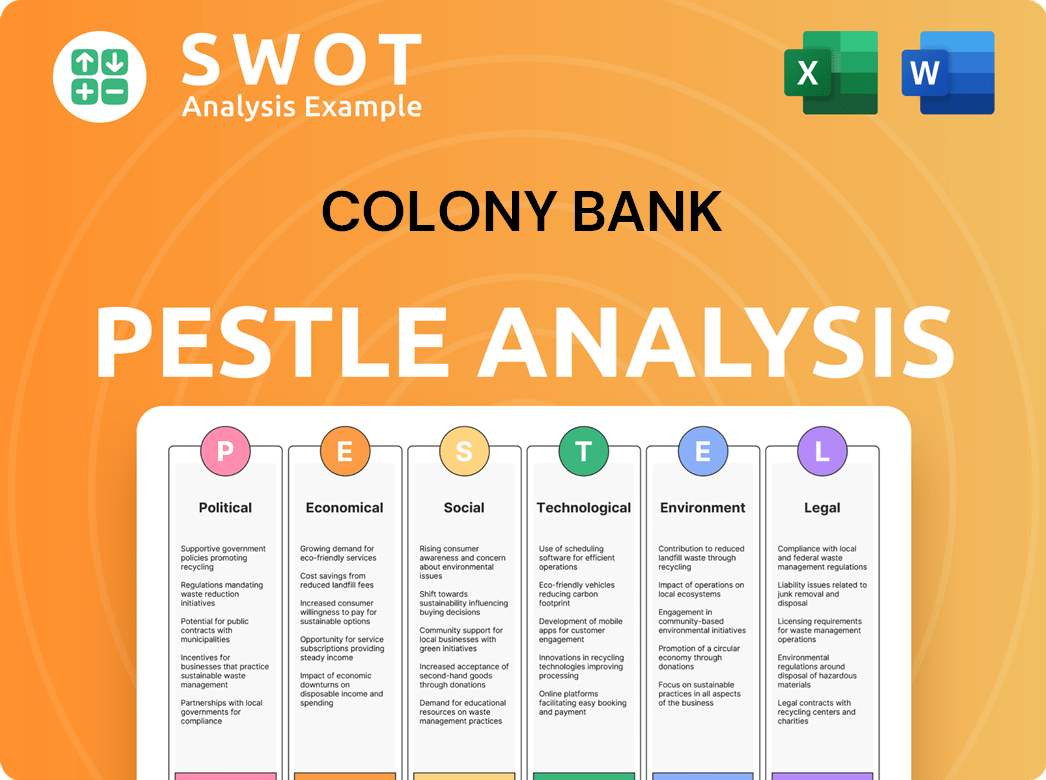
Colony Bank PESTLE Analysis
- Covers All 6 PESTLE Categories
- No Research Needed – Save Hours of Work
- Built by Experts, Trusted by Consultants
- Instant Download, Ready to Use
- 100% Editable, Fully Customizable
Who Sits on Colony Bank’s Board?
The Board of Directors of Colony Bankcorp, Inc. oversees the company's strategic direction and governance. As of April 17, 2025, the shareholders will vote on the election of eight directors to serve until the 2026 Annual Meeting of Shareholders. The board includes individuals representing various interests within the company, ensuring diverse perspectives in decision-making.
The current board members include Mark H. Massee, Chairman of the Board; Scott Downing; T. Heath Fountain (CEO); Ed Loomis; Meagan Mowry; Matt Reed; Audrey Hollingsworth; and Brian Schmitt. Paul Joiner, III was appointed to the Board of Directors for both Colony Bankcorp, Inc. and Colony Bank, effective March 1, 2025, increasing the board size from eight to nine directors. Mr. Joiner has been determined to be 'independent' by NYSE listing rules.
| Board Member | Title | Additional Information |
|---|---|---|
| Mark H. Massee | Chairman of the Board | |
| Scott Downing | Director | |
| T. Heath Fountain | CEO & Director | |
| Ed Loomis | Director | |
| Meagan Mowry | Director | |
| Matt Reed | Director | |
| Audrey Hollingsworth | Director | |
| Brian Schmitt | Director | |
| Paul Joiner, III | Director | Appointed March 1, 2025 |
The voting structure for Colony Bankcorp, Inc. is based on a one-share-one-vote principle. Each share of common stock entitles its owner to one vote on matters submitted to shareholders. The record date for determining shareholders entitled to vote at the 2025 Annual Meeting was March 28, 2025. This approach ensures that all shareholders have a proportionate voice in the company's decisions, emphasizing accountability and transparency. For more information on the company's background, you can read the Brief History of Colony Bank.
Understanding Colony Bank Ownership
The board of directors plays a critical role in the oversight of Colony Bank. The voting structure is straightforward, with each share carrying one vote, ensuring shareholder equity. This structure is designed to promote transparency and accountability within the company.
- Shareholders vote on director elections.
- Shareholders vote on executive compensation.
- Shareholders ratify the independent registered public accounting firm.
- The board ensures compliance with NYSE listing rules.
Colony Bank Business Model Canvas
- Complete 9-Block Business Model Canvas
- Effortlessly Communicate Your Business Strategy
- Investor-Ready BMC Format
- 100% Editable and Customizable
- Clear and Structured Layout

What Recent Changes Have Shaped Colony Bank’s Ownership Landscape?
In the past few years, the ownership structure of Colony Bankcorp, Inc. has shown interesting trends. Institutional investors remain a significant part of the ownership, holding 55.48% of the shares as of May 2025. Insider holdings have stayed consistent at 7.32%. Mutual funds have slightly decreased their stake, moving from 38.78% to 38.22% during the same period. This provides insight into the stability and confidence in the company's direction, as seen by the institutional support.
A notable acquisition in 2025 was the purchase of the Ellerbee Agency for $3.5 million, which is expected to boost earnings per share by two cents in 2026. The company's financial performance in the first quarter of 2025 was robust, with a net income of $6.6 million, or $0.38 per diluted share. Total loans increased to $1.92 billion, and total deposits reached $2.62 billion by March 31, 2025. These figures highlight the growth and expansion of the bank, as well as its financial health. For more details, you can check out the Growth Strategy of Colony Bank.
| Ownership Category | May 2025 | Previous |
|---|---|---|
| Institutional Investors | 55.48% | Data Not Available |
| Insider Holdings | 7.32% | Data Not Available |
| Mutual Funds | 38.22% | 38.78% |
Colony Bankcorp has maintained a shareholder-focused dividend policy. The quarterly dividend increased from $0.1125 per share in 2024 to $0.1150 in 2025, which represents an annual yield of 3.1% based on the April 19, 2025, stock price. The company's capital position is strong, with a Tier 1 capital ratio of 14.26% and a total risk-based capital ratio of 17.10% at the end of 2024. These factors contribute to the overall financial stability and attractiveness of Colony Bank as an investment.
 Colony Bank ownership
Institutional investors hold a majority stake, showing confidence in the bank's future. Insider holdings remain steady, indicating alignment between management and shareholders. Mutual fund ownership has slightly decreased, but the overall ownership structure remains robust.
Colony Bank stock
The stock has shown a consistent dividend policy, with increasing quarterly dividends. The company's strong capital position, with high Tier 1 and total risk-based capital ratios, supports investor confidence. The bank's financial performance is solid, with growth in loans and deposits.
Who owns Colony Bank
The primary owners are institutional investors, who hold a significant percentage of the shares. Insiders also have a notable stake, demonstrating their commitment to the company. Mutual funds also play a role in the ownership structure.
Colony Bank executives
The executive team is focused on organic expansion and strategic acquisitions. The company aims for an 8-12% organic growth rate by the end of 2025. They prioritize customer service and quick decision-making to maintain a competitive edge.
Colony Bank Porter's Five Forces Analysis
- Covers All 5 Competitive Forces in Detail
- Structured for Consultants, Students, and Founders
- 100% Editable in Microsoft Word & Excel
- Instant Digital Download – Use Immediately
- Compatible with Mac & PC – Fully Unlocked

Related Blogs

- What are Mission Vision & Core Values of Colony Bank Company?
- What is Competitive Landscape of Colony Bank Company?
- What is Growth Strategy and Future Prospects of Colony Bank Company?
- How Does Colony Bank Company Work?
- What is Sales and Marketing Strategy of Colony Bank Company?
- What is Brief History of Colony Bank Company?
- What is Customer Demographics and Target Market of Colony Bank Company?
Disclaimer
All information, articles, and product details provided on this website are for general informational and educational purposes only. We do not claim any ownership over, nor do we intend to infringe upon, any trademarks, copyrights, logos, brand names, or other intellectual property mentioned or depicted on this site. Such intellectual property remains the property of its respective owners, and any references here are made solely for identification or informational purposes, without implying any affiliation, endorsement, or partnership.
We make no representations or warranties, express or implied, regarding the accuracy, completeness, or suitability of any content or products presented. Nothing on this website should be construed as legal, tax, investment, financial, medical, or other professional advice. In addition, no part of this site—including articles or product references—constitutes a solicitation, recommendation, endorsement, advertisement, or offer to buy or sell any securities, franchises, or other financial instruments, particularly in jurisdictions where such activity would be unlawful.
All content is of a general nature and may not address the specific circumstances of any individual or entity. It is not a substitute for professional advice or services. Any actions you take based on the information provided here are strictly at your own risk. You accept full responsibility for any decisions or outcomes arising from your use of this website and agree to release us from any liability in connection with your use of, or reliance upon, the content or products found herein.