

Sainsbury Bundle

Decoding Sainsbury's: What Drives This Retail Giant?
Embark on a journey to understand the core principles that shape Sainsbury's, a titan in the UK retail landscape. Discover how Sainsbury's mission, vision, and core values influence its strategic direction and impact its stakeholders.

Understanding the Sainsbury SWOT Analysis is crucial, but delving into Sainsbury's mission, vision, and core values offers deeper insights into the company's identity and aspirations. These fundamental elements are not just corporate jargon; they are the guiding principles that shape Sainsbury's goals, influence its actions, and define its commitment to customers, employees, and the community. Explore how Sainsbury's mission statement explained, vision statement analysis, and core values examples contribute to its sustained success in a competitive market.
Key Takeaways
- Sainsbury's mission and 'Next Level Sainsbury's' strategy drive operations and growth.
- Focus on value, sustainability, and ethical practices are key strengths.
- Value-driven initiatives like Aldi Price Match boost market share and financials.
- Alignment with guiding principles is crucial for future success.
- Emphasis on value, quality, and sustainability differentiates Sainsbury's.
Mission: What is Sainsbury Mission Statement?
Sainsbury's mission is 'to make good food joyful, accessible and affordable for everyone, every day.'
Let's delve into the heart of Sainsbury's, exploring its mission statement and how it shapes the company's actions and strategies. Understanding the Sainsbury's mission is crucial for investors, analysts, and anyone interested in the company's direction and values.

Customer-Centric Focus
The core of the Sainsbury's mission is deeply customer-centric. It emphasizes providing for 'everyone,' highlighting a commitment to inclusivity and catering to a broad demographic. This focus is a key element in understanding Sainsbury's company strategy.
Product and Value Proposition
The mission centers on 'good food,' indicating a dedication to quality. Simultaneously, 'accessible and affordable' underscores a value proposition that balances quality with competitive pricing. This dual focus is a defining characteristic of Sainsbury's mission statement explained.
Daily Relevance
The phrase 'every day' emphasizes the company's commitment to meeting the daily needs of its customers. This daily relevance is crucial for building customer loyalty and driving consistent sales. This is a key aspect of Sainsbury's goals.
Operational Manifestations
Sainsbury's has invested heavily in price reductions. Over the past four years, £1 billion has been invested in lowering prices. The Aldi Price Match program further exemplifies this commitment. These actions directly support the ‘affordable’ aspect of the mission.
Premium Offering and Innovation
The success of the 'Taste the Difference' brand, with an 18% sales increase in the six months leading up to September 2024, showcases Sainsbury's dedication to 'good food.' The introduction of over 540 new products in the first half of 2024 also demonstrates innovation. This is a part of Sainsbury's values.
Competitive Landscape and Strategy
Sainsbury's mission is executed within a competitive market. For a better understanding of the competitive environment, consider analyzing the Competitive Analysis of Sainsbury. This mission is a cornerstone of Sainsbury's strategic approach.
In essence, the Sainsbury's mission is a comprehensive statement that guides the company's operations, emphasizing customer satisfaction, quality, value, and daily relevance. It's a clear articulation of what Sainsbury's company aims to achieve in the market.
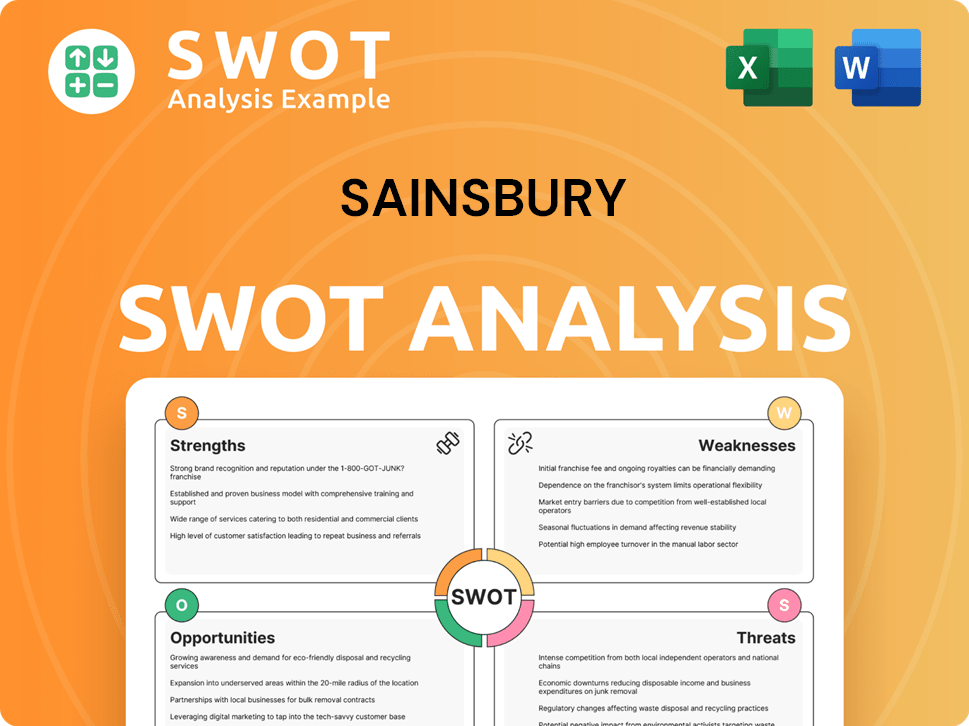
Sainsbury SWOT Analysis
- Complete SWOT Breakdown
- Fully Customizable
- Editable in Excel & Word
- Professional Formatting
- Investor-Ready Format
Vision: What is Sainsbury Vision Statement?
Sainsbury's de facto vision, encapsulated in its 'Next Level Sainsbury's' strategy, is to be the leading UK retailer, excelling in food, loyalty, and efficiency, while enhancing the Argos brand.
Let's delve into the vision of Sainsbury's, a crucial aspect of understanding the company's direction, especially considering the absence of a single, formal vision statement. The 'Next Level Sainsbury's' strategy, launched in February 2024, serves as their operational vision, guiding their future endeavors. This strategy, driven by their purpose (mission), outlines their aspirations and strategic goals. Understanding this vision is key to grasping Sainsbury's future trajectory.
Focus on Key Outcomes
The strategy focuses on four key outcomes: 'First choice for food,' 'Loyalty everyone loves,' 'More Argos, more often,' and 'Save and invest to win.' These outcomes highlight Sainsbury's commitment to strengthening its core food business, enhancing customer loyalty, improving Argos' performance, and driving efficiency and profitability. These are the cornerstones of their vision.
Market Position and Ambition
Sainsbury's vision is primarily focused on solidifying and enhancing its position within the UK retail market, particularly as a leader in food. Their goal is to gain market share and become the 'first choice for food.' The ambition extends to becoming a 'world-leading loyalty platform,' showcasing their forward-thinking approach.
Realistic Yet Ambitious
Based on recent performance, including market share gains and an increase in underlying operating profit, the vision appears realistic yet ambitious. Sainsbury's is demonstrating its ability to execute on its strategic goals. The focus on core strengths and strategic investments suggests a practical approach to achieving these aspirations.
Strategic Investments
Sainsbury's is investing heavily in technology and its loyalty program, Nectar, to achieve its vision. These investments are crucial for enhancing customer experience and driving efficiency. These strategic moves are vital for achieving their long-term vision.
Financial Performance as a Measure
Financial performance serves as a critical indicator of progress towards Sainsbury's vision. The company's ability to increase underlying operating profit and gain market share demonstrates the initial success of its strategic initiatives. This data is crucial for evaluating the effectiveness of their vision.
Sustainability and Future Plans
While not explicitly stated in the 'Next Level Sainsbury's' strategy, sustainability is likely an integral part of their long-term vision, aligning with broader industry trends and consumer expectations. Further details on Sainsbury's vision for sustainability can be found in their corporate social responsibility reports.
In essence, the Marketing Strategy of Sainsbury reflects a clear vision for the future, centered on strengthening its core business, enhancing customer loyalty, and driving efficiency. This vision is ambitious yet grounded in practical strategies, making it a key element in understanding Sainsbury's mission, vision, and values. The focus on key outcomes, strategic investments, and financial performance provides a roadmap for achieving their goals and solidifying their position in the competitive UK retail market. Understanding these components is essential for anyone seeking to analyze Sainsbury's company and its future prospects. The company's commitment to customer satisfaction and ethical values further supports its vision.
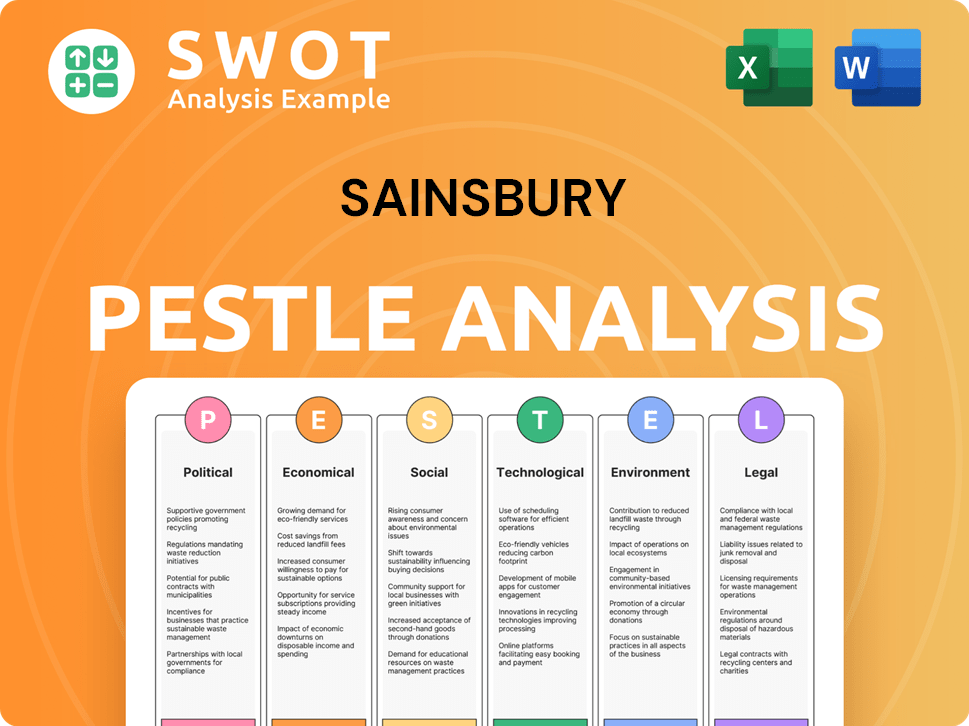
Sainsbury PESTLE Analysis
- Covers All 6 PESTLE Categories
- No Research Needed – Save Hours of Work
- Built by Experts, Trusted by Consultants
- Instant Download, Ready to Use
- 100% Editable, Fully Customizable
Values: What is Sainsbury Core Values Statement?
Understanding the Sainsbury's mission, Sainsbury's vision, and Sainsbury's core values is crucial for grasping the company's identity and strategic direction. These values shape its operations, guide its decisions, and define its relationship with customers, employees, and the environment.
 Customer Focus
Customer satisfaction is a cornerstone of Sainsbury's values. This commitment is demonstrated through initiatives like the Aldi Price Match, Nectar Prices, and improvements in online shopping, all aimed at making Sainsbury's the "first choice for food." In fiscal year 2023, Sainsbury's achieved a Net Promoter Score (NPS) of 62, a testament to their strong customer advocacy and their Sainsbury's commitment to customer satisfaction.
Sustainability and Responsibility
Sustainability is a core Sainsbury's value, reflected in ambitious environmental targets. Sainsbury's aims to be carbon neutral in its own operations by 2035 and across its value chain by 2050, with initiatives like reducing plastic packaging (50% reduction by 2025) and tackling food waste (12% reduction through the 'Waste Less, Save More' program). Their commitment to sustainable sourcing, including aiming for 100% sustainable cocoa by 2025, also showcases their Sainsbury's corporate social responsibility.
Colleague Engagement and Well-being
Sainsbury's values its employees, as demonstrated by a low voluntary employee turnover rate of 5% in 2024, significantly below the retail industry average. Investment in programs like the 'Sainsbury's Academy' highlights their commitment to employee development and well-being, indicating the Impact of Sainsbury's mission on employees.
Integrity and Ethical Practices
Integrity is a key Sainsbury's value, guiding interactions with stakeholders and emphasizing ethical practices and transparency. This is supported by their commitment to sustainable and responsible sourcing, ensuring they know the origins of ingredients and addressing environmental and human rights impacts in their supply chains, reflecting their Sainsbury's ethical values and practices.
These Sainsbury's core values collectively define the Sainsbury's company by emphasizing customer-centricity, social and environmental responsibility, and employee well-being. These values are central to the company's identity, influencing its strategic decisions and shaping its future. To gain a deeper understanding of how these values translate into action, consider reading about the Brief History of Sainsbury. Next, we'll explore how the Sainsbury's mission and Sainsbury's vision influence the company's strategic decisions.
How Mission & Vision Influence Sainsbury Business?
The mission, vision, and core values of Sainsbury's profoundly shape its strategic direction and operational decisions. These guiding principles are not merely aspirational statements; they are the foundation upon which the company builds its business strategies, ensuring alignment across all facets of its operations.

Mission-Driven Strategy
Sainsbury's mission, "to make good food joyful, accessible, and affordable," is the cornerstone of its 'Next Level Sainsbury's' plan, launched in February 2024. This mission directly influences key strategic choices, ensuring that all actions contribute to its core purpose.
- Refocusing on the grocery business, allocating more space to food offerings.
- Investing heavily in lowering prices and expanding the Aldi Price Match program.
- Committing to sustainability through net-zero targets and green initiatives.
- Implementing a 'Save and invest to win' strategy, targeting £1 billion in cost savings.
Grocery Focus and Market Share
The strategic decision to prioritize the grocery business is a direct result of Sainsbury's mission to provide "good food." This shift has yielded tangible results, with food sales increasing by 5% in the first half of the fiscal year. Grocery sales for the 52 weeks to March 2025 were up 4.5%, demonstrating the effectiveness of this mission-aligned strategy.
Affordability and Price Investments
To fulfill the "accessible and affordable" part of its mission, Sainsbury's has made significant investments in lowering prices. This includes the expansion of the Aldi Price Match program, which has contributed to the company achieving its highest market share gains in over a decade. CEO Simon Roberts emphasized the impact, stating that Sainsbury's has invested £1 billion in lowering prices.
Sustainability Initiatives
Sainsbury's core values, including a commitment to sustainability, influence strategic decisions related to sourcing, operations, and infrastructure. The company has set ambitious net-zero targets and is investing in initiatives like its Smart Charge EV charging network, which has powered millions of miles without fossil fuels. The company plans to invest £800 million to £850 million per year over the next three years, with a portion supporting these growth plans and sustainability initiatives.
'Save and Invest to Win' Strategy
The 'Save and invest to win' pillar of Sainsbury's strategy is designed to balance affordability with investment in customer experience and mission support. This includes a target of £1 billion in structural cost savings over three years. Simon Roberts highlighted the importance of efficiency and productivity, especially in the face of rising costs.
Financial Performance and Mission Alignment
These strategic decisions, guided by Sainsbury's mission and values, are aimed at driving both financial performance and achieving its purpose. The company's focus on efficiency and productivity has led to an increase in underlying operating profit of 7.2% for the year ending March 2025. This demonstrates how Sainsbury's mission, vision, and values are interconnected, driving both business success and societal impact.
Long-Term Vision and Investment
Sainsbury's is committed to long-term planning, with significant investments in areas that support its mission and values. The company's strategic investments, including those in sustainability and customer experience, are designed to create sustainable value and ensure its continued success. For more insights into Sainsbury's growth strategy, you can read about it in Growth Strategy of Sainsbury.
In essence, the influence of Sainsbury's mission, vision, and core values is pervasive, shaping its strategic objectives and driving its operational decisions. The company's focus on "good food, joyful, accessible, and affordable" guides its investments, market strategies, and commitment to sustainability, ultimately fostering both financial success and positive societal impact. Next, we will delve into the core improvements to the company's mission and vision.
Sainsbury Business Model Canvas
- Complete 9-Block Business Model Canvas
- Effortlessly Communicate Your Business Strategy
- Investor-Ready BMC Format
- 100% Editable and Customizable
- Clear and Structured Layout

What Are Mission & Vision Improvements?
While Sainsbury's demonstrates a strong commitment to its mission, vision, and core values, there are opportunities to enhance these guiding principles for greater impact and relevance in the evolving retail landscape. These improvements aim to strengthen the company's strategic direction and ensure long-term success, aligning with the expectations of stakeholders and the demands of the market.
Refining the Vision Statement for Clarity and Conciseness
Sainsbury's 'Next Level' strategy is comprehensive, but a more succinct and easily understood vision statement could improve clarity. A concise vision statement would articulate the company's ultimate desired future state, making it easier for all stakeholders to grasp and remember the core purpose of the Sainsbury's company. This could involve a statement that emphasizes the company's aspiration to be a leader in sustainable and customer-centric retail.
Explicitly Integrating Sustainability into the Core Mission and Vision
While Sainsbury's 'Plan for Better' incorporates sustainability, elevating it within the core mission or vision could reinforce its importance. This would align with the increasing consumer demand for sustainable practices and could be reflected in the company's mission statement. For example, the mission statement could be updated to explicitly mention a commitment to a sustainable food system, reflecting the company's environmental goals.
Enhancing the Integration of Diverse Business Units
To enhance the sense of a unified vision, Sainsbury's could more clearly articulate how its diverse businesses (supermarkets, convenience stores, Argos) collectively contribute to its overall purpose. The integration of these units, such as the 'More Argos, more often' initiative, could be further emphasized within the vision statement. This could involve a statement that highlights the synergy between different business units to provide a comprehensive retail experience.
Emphasizing Innovation in Digital Retail and Customer Experience
To address emerging technologies and changing consumer behaviors, the mission and vision could be adapted to emphasize innovation in digital retail and personalized customer experiences. Building on the success of initiatives like Nectar Prices, a more explicit mention in the core statements could signal a stronger future focus. This could include a statement that emphasizes the company's commitment to using technology to enhance the customer experience and drive sales, as seen in the growth of online grocery orders, which increased by 1.9% in the last quarter of 2024.
How Does Sainsbury Implement Corporate Strategy?
Implementing a company's mission, vision, and core values is crucial for translating aspirations into tangible actions and achieving strategic objectives. This chapter explores how Sainsbury's, a prominent player in the UK's retail sector, puts its guiding principles into practice.
'Next Level Sainsbury's' Strategy: The Blueprint for Action
The 'Next Level Sainsbury's' strategy, launched in February 2024, serves as the primary framework for Sainsbury's to execute its mission and achieve its vision. This strategy outlines key initiatives and priorities designed to deliver on the company's core values. It focuses on strengthening Sainsbury's position as a leading food retailer and driving sustainable growth.
- This strategy provides a clear roadmap for the company's future, encompassing various aspects of its operations, from product offerings to sustainability efforts.
- It emphasizes key areas such as value, quality, and service, aligning with the company's commitment to customer satisfaction.
- The 'Next Level Sainsbury's' strategy is regularly communicated to stakeholders through investor presentations, annual reports, and corporate announcements.
'First Choice for Food' in Action: Grocery Initiatives
A key aspect of implementing the 'First choice for food' outcome is the ongoing investment in Sainsbury's grocery offering. This includes launching new products and expanding premium ranges to cater to diverse customer preferences. The focus on consistent value is implemented through initiatives like the Aldi Price Match and Nectar Prices.
These initiatives provide personalized offers to over 16 million digital subscribers weekly, demonstrating Sainsbury's commitment to customer satisfaction and value. These programs aim to make Sainsbury's a preferred destination for grocery shopping, enhancing customer loyalty and driving sales. The company's focus on quality and value is a cornerstone of its strategy.
Leadership's Role: Reinforcing the Message
Leadership plays a vital role in reinforcing Sainsbury's mission, vision, and core values. CEO Simon Roberts has consistently communicated the importance of the 'Food First' and now 'Next Level Sainsbury's' strategies. He emphasizes value, quality, and service in his statements.
His communication highlights the company's commitment to these principles and their impact on performance. This consistent messaging from the top helps to align employees and stakeholders with the company's goals. This helps the company to achieve its Revenue Streams & Business Model of Sainsbury.
Communication Channels: Disseminating the Strategy
Sainsbury's effectively communicates its mission and strategy through various channels. These include investor presentations, annual reports, and corporate announcements. The 'Plan for Better,' which outlines their sustainability commitments, is also communicated to stakeholders.
This details their progress on environmental and social goals. This comprehensive communication strategy ensures that all stakeholders are informed about the company's direction and progress. This transparency builds trust and strengthens relationships with investors, customers, and employees.
Sustainability in Action: Concrete Examples
Concrete examples of alignment between stated values and business practices are evident in Sainsbury's sustainability efforts. The investment in the Smart Charge EV charging network powered by renewable energy aligns with their commitment to a better planet. Their efforts to reduce plastic packaging and food waste demonstrate a tangible commitment to environmental responsibility.
These initiatives demonstrate a commitment to environmental responsibility and contribute to a more sustainable future. Sainsbury's has set ambitious targets for reducing its environmental impact, including reducing carbon emissions and minimizing waste. These efforts are crucial for building a sustainable business model.
Formal Programs and Systems: Ensuring Alignment
Sainsbury's utilizes formal programs and systems to ensure alignment between its values and actions. Their sustainability strategy includes specific targets and reporting mechanisms, validated by external initiatives like the Science Based Targets initiative. Their focus on colleague engagement and training programs like the Sainsbury's Academy also reflects an effort to embed their values within the corporate culture.
The integration of their 'Plan for Better' into their operational framework signifies a systemic approach to embedding sustainability within their business. These programs ensure that the company's values are consistently applied across all aspects of its operations. These initiatives demonstrate Sainsbury's commitment to long-term sustainability and ethical business practices.
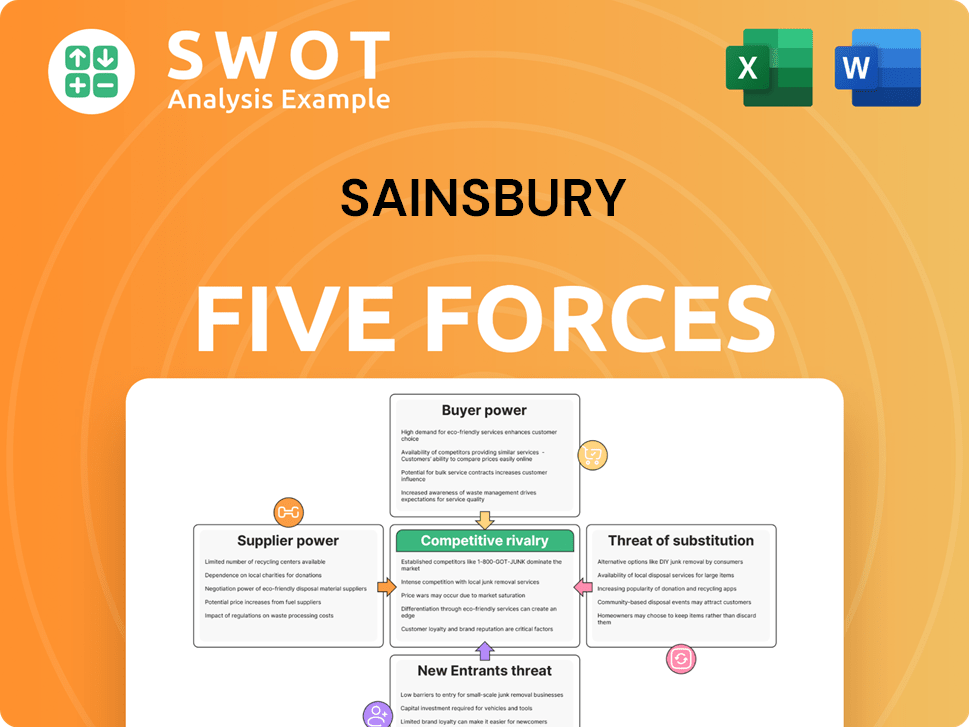
Sainsbury Porter's Five Forces Analysis
- Covers All 5 Competitive Forces in Detail
- Structured for Consultants, Students, and Founders
- 100% Editable in Microsoft Word & Excel
- Instant Digital Download – Use Immediately
- Compatible with Mac & PC – Fully Unlocked
Related Blogs

- What are Mission Vision & Core Values of Sainsbury Company?
- What is Competitive Landscape of Sainsbury Company?
- What is Growth Strategy and Future Prospects of Sainsbury Company?
- How Does Sainsbury Company Work?
- What is Sales and Marketing Strategy of Sainsbury Company?
- Who Owns Sainsbury Company?
- What is Customer Demographics and Target Market of Sainsbury Company?
Disclaimer
All information, articles, and product details provided on this website are for general informational and educational purposes only. We do not claim any ownership over, nor do we intend to infringe upon, any trademarks, copyrights, logos, brand names, or other intellectual property mentioned or depicted on this site. Such intellectual property remains the property of its respective owners, and any references here are made solely for identification or informational purposes, without implying any affiliation, endorsement, or partnership.
We make no representations or warranties, express or implied, regarding the accuracy, completeness, or suitability of any content or products presented. Nothing on this website should be construed as legal, tax, investment, financial, medical, or other professional advice. In addition, no part of this site—including articles or product references—constitutes a solicitation, recommendation, endorsement, advertisement, or offer to buy or sell any securities, franchises, or other financial instruments, particularly in jurisdictions where such activity would be unlawful.
All content is of a general nature and may not address the specific circumstances of any individual or entity. It is not a substitute for professional advice or services. Any actions you take based on the information provided here are strictly at your own risk. You accept full responsibility for any decisions or outcomes arising from your use of this website and agree to release us from any liability in connection with your use of, or reliance upon, the content or products found herein.