

Yes Bank Bundle

Can Yes Bank Thrive in India's Competitive Banking Landscape?
Yes Bank, a key player in the Indian banking sector, has undergone a significant transformation since its restructuring in 2020. This private sector bank offers a wide array of banking services, evolving to meet the demands of a dynamic market. Understanding Yes Bank operations and its business model is crucial for anyone looking to navigate the complexities of the Indian financial system.

Following its recovery, Yes Bank has shown a commitment to sustainable growth, making it a compelling subject for analysis. This exploration will uncover the intricacies of Yes Bank SWOT Analysis, examining its financial performance, products and services, and its position within the Indian banking sector. Investors, customers, and industry observers alike can benefit from a deeper understanding of how Yes Bank makes money and its future prospects.
What Are the Key Operations Driving Yes Bank’s Success?
The core operations of Yes Bank are centered around providing a wide array of financial products and services. This approach allows the bank to cater to a diverse customer base, including large corporations, small and medium enterprises (SMEs), and individual retail clients. The bank's business model is designed to create and deliver value across these segments.
Yes Bank offers a comprehensive suite of services. These include corporate banking, retail banking, investment banking, and wealth management solutions. The bank's offerings are designed to meet the varied financial needs of its customers, from basic savings accounts to complex investment strategies.
The bank's operational processes are increasingly driven by technology. A robust digital banking platform supports seamless transactions and account management. This focus on technology enhances customer experience and operational efficiency, which is a key part of Yes Bank operations.
 Corporate Banking Services
Yes Bank provides working capital finance, term loans, trade finance, and treasury products for corporations. These services support the financial needs of large businesses, helping them manage their operations and investments effectively. The bank focuses on building strong relationships with its corporate clients.
Retail Banking Services
Retail banking services include savings accounts, current accounts, fixed deposits, personal loans, home loans, and credit cards. These services cater to the personal financial needs of individual customers. The bank offers a range of products to meet the diverse needs of its retail customers.
Investment Banking Services
Yes Bank offers investment banking services such as mergers and acquisitions advisory, private equity placements, and capital market services. These services are designed to assist businesses with strategic financial transactions and capital raising. The bank's investment banking arm supports corporate growth and expansion.
Wealth Management Solutions
Wealth management solutions include portfolio management, financial planning, and investment advisory services. These services help clients manage their wealth and achieve their financial goals. The bank provides personalized financial advice and investment strategies.

Technology and Customer Focus
Yes Bank's operations are distinguished by a strong emphasis on technology-driven solutions and customer-centricity. The bank has invested in upgrading its digital infrastructure to improve customer experience and operational efficiency. This focus translates into convenience, faster service delivery, and tailored financial solutions.
- Digital Banking Platform: Enables seamless transactions and account management.
- Analytics: Used for credit assessment, risk management, and personalized product offerings.
- Digital Payments: Continued push towards digital payments and online account opening.
- Branch Network and Digital Channels: A growing number of physical branches, ATMs, mobile banking, and internet banking.
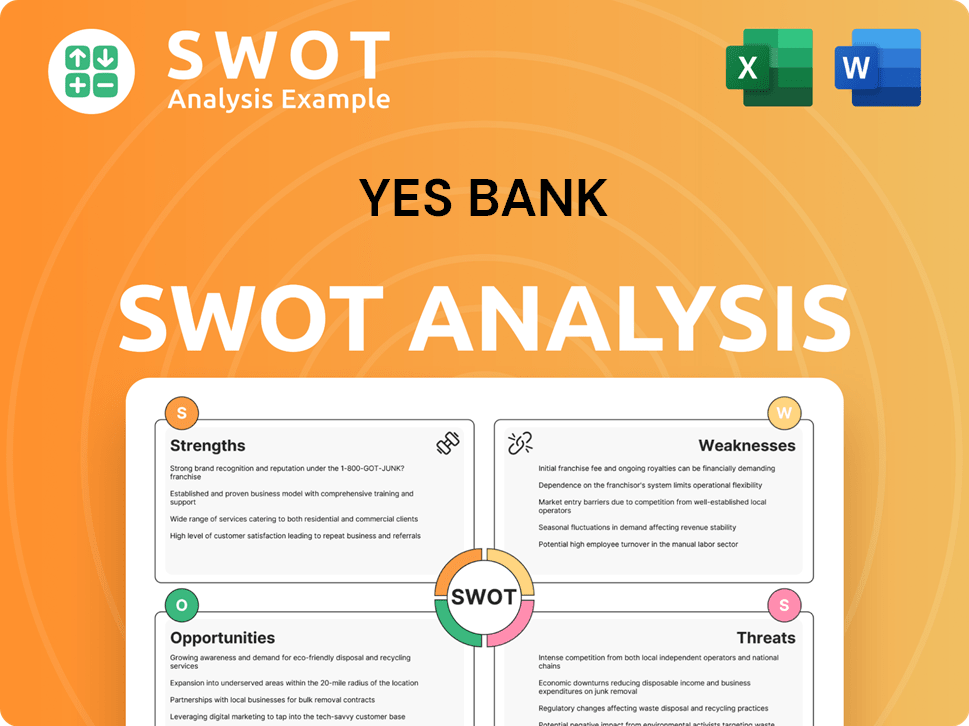
Yes Bank SWOT Analysis
- Complete SWOT Breakdown
- Fully Customizable
- Editable in Excel & Word
- Professional Formatting
- Investor-Ready Format
How Does Yes Bank Make Money?
Understanding the revenue streams and monetization strategies of Yes Bank is crucial for assessing its financial health and business model. The bank's ability to generate income from diverse sources highlights its adaptability in the competitive Indian banking sector. This diversification is key to sustaining profitability and growth.
Yes Bank, as a private sector bank, employs a multifaceted approach to generate revenue. This includes a mix of interest-based income from loans and investments, along with fee-based income from various banking services. The strategic focus on both traditional and non-traditional revenue streams is a defining characteristic of its business model.
The primary revenue streams for Yes Bank are net interest income (NII) and non-interest income. NII is the difference between the interest earned on loans and investments and the interest paid on deposits and borrowings. Non-interest income comprises fees and commissions from various services, such as transaction banking, foreign exchange, and wealth management. These streams are vital to understanding Yes Bank operations.

Net Interest Income (NII)
NII is a primary revenue source, representing the interest earned on loans and investments minus interest paid on deposits and borrowings. For Q3 FY2024, Yes Bank reported an NII of ₹2,153 crore.
Non-Interest Income
This includes fees and commissions from services like transaction banking, foreign exchange, and wealth management. In Q3 FY2024, non-interest income was ₹1,178 crore, showing a significant growth.
Transaction Banking Fees
Fees charged for processing transactions, which contribute to the overall non-interest income. These fees are essential for the bank's revenue.
Foreign Exchange Income
Income generated from foreign exchange transactions, a key component of non-interest income. It reflects the bank's global reach.
Credit Card Fees
Fees associated with credit card services, contributing to the bank's non-interest income. This is a significant part of the retail banking segment.
Wealth Management Fees
Fees earned from wealth management services, reflecting the bank's focus on high-net-worth individuals. These fees are a growing source of revenue.
Monetization Strategies
Yes Bank employs several strategies to monetize its services and enhance revenue generation. These include cross-selling, tiered pricing, and a focus on high-yield loan segments. These strategies are crucial for the bank's financial performance.
- Cross-selling and Bundling: Offering multiple services to existing customers to increase revenue per customer.
- Tiered Pricing: Providing preferential rates or benefits to premium customers or those with higher transaction volumes.
- Focus on Retail and SME Loans: Targeting these segments for higher yields, improving net interest margin.
- Digital Banking: Leveraging digital platforms to reduce operational costs and enhance customer experience.
Yes Bank PESTLE Analysis
- Covers All 6 PESTLE Categories
- No Research Needed – Save Hours of Work
- Built by Experts, Trusted by Consultants
- Instant Download, Ready to Use
- 100% Editable, Fully Customizable

Which Strategic Decisions Have Shaped Yes Bank’s Business Model?
The journey of Yes Bank has been marked by significant milestones and strategic shifts, particularly since its reconstruction in March 2020. This pivotal event, supported by the Reserve Bank of India (RBI) and a consortium of Indian banks, was crucial for addressing asset quality issues and stabilizing operations. Post-reconstruction, the bank has focused on strengthening its balance sheet, improving asset quality, and enhancing corporate governance. These efforts have been instrumental in reshaping the bank's trajectory within the Indian banking sector.
A key strategic move has been the emphasis on recovering stressed assets and reducing non-performing asset (NPA) ratios. Yes Bank has actively worked to regain customer trust and rebuild its loan book responsibly. This involved implementing stricter underwriting standards and enhancing risk management frameworks. The bank's commitment to digital transformation has also been a significant strategic move, aiming to become a 'Digital Bank' and cater to evolving customer needs. This includes launching new digital products and services, such as partnerships to enhance digital payment offerings.
Yes Bank's competitive advantages stem from its technology-driven solutions, a diversified product portfolio, and a growing retail presence. The bank's ability to adapt to new trends, such as the increasing adoption of digital payments and financial technology, is crucial for its sustained growth. Its strategic partnerships and efforts to expand its retail and SME loan book also contribute to its competitive positioning. You can learn more about the Target Market of Yes Bank to understand its customer focus.
Key Milestones
Reconstruction in March 2020, supported by RBI and other banks, was a critical turning point for Yes Bank operations. The bank focused on addressing asset quality issues and stabilizing its operations. Post-reconstruction, the bank prioritized strengthening its balance sheet and improving corporate governance.
Strategic Moves
A major strategic move was the focus on recovering stressed assets and reducing NPA ratios. Yes Bank implemented stricter underwriting standards and enhanced risk management. Continuous investment in technology and digital platforms to become a 'Digital Bank' is ongoing.
Competitive Edge
Yes Bank's competitive edge comes from its technology-driven solutions and a diversified product portfolio. It has a growing retail presence, which is crucial in the Indian banking sector. Adaptability to digital trends and strategic partnerships enhance its competitive positioning.
Financial Performance
As of December 2023, Yes Bank's Gross Non-Performing Assets (GNPA) stood at 2.0%. Net Non-Performing Assets (NNPA) were 0.9%. The bank has shown progress in improving its financial health post-reconstruction.
Key Strategies and Focus Areas
Yes Bank's strategies include strengthening its balance sheet, improving asset quality, and enhancing corporate governance. The bank is focused on digital transformation, aiming to become a 'Digital Bank' to enhance customer experience. Strategic partnerships and expansion of retail and SME loan books are also key areas of focus.
- Focus on recovering stressed assets and reducing NPA ratios.
- Implementing stricter underwriting standards and enhancing risk management.
- Continuous investment in technology and digital platforms.
- Strategic partnerships to enhance digital payment offerings.
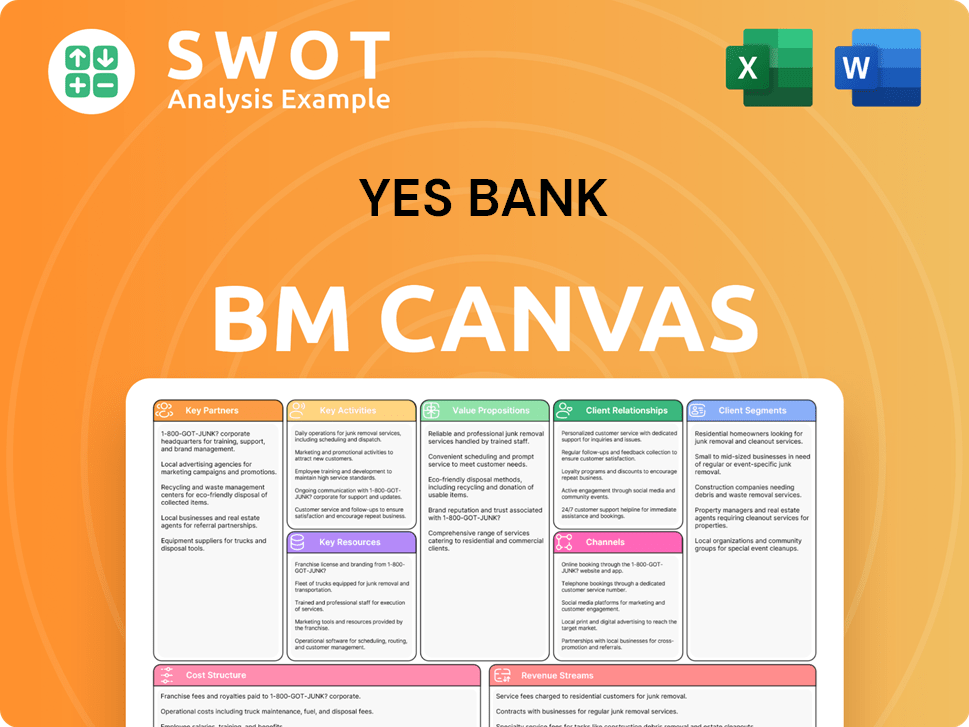
Yes Bank Business Model Canvas
- Complete 9-Block Business Model Canvas
- Effortlessly Communicate Your Business Strategy
- Investor-Ready BMC Format
- 100% Editable and Customizable
- Clear and Structured Layout
How Is Yes Bank Positioning Itself for Continued Success?
Yes Bank holds a significant position within the Indian banking sector, specifically among private sector banks. While it may not be the largest in terms of market share, the bank has been working to regain its standing after its reconstruction. Its focus on technology and customer-centricity has helped attract and keep customers, especially in urban and semi-urban areas. The bank is seeing an upward trend in market share in areas like digital payments and some retail lending products.
Several risks and challenges could affect Yes Bank operations and revenue. These include potential economic slowdowns that can impact credit demand and asset quality, intense competition from other banks and fintech companies, and changes in regulations. The bank also faces the ongoing task of managing its legacy stressed assets, although progress has been made. Technological disruptions, such as new payment systems or challenger banks, also pose a risk if the bank doesn't continue to innovate.
Industry Position
Yes Bank is a notable private sector bank in India, focusing on technology and customer service. It has been rebuilding its market position post-reconstruction. It competes with both established banks and new fintech companies in the Indian banking sector.
Key Risks
Economic slowdowns and intense competition from other banks and fintech companies pose risks. Managing legacy stressed assets and adapting to technological changes are ongoing challenges. Regulatory changes also present potential hurdles for Yes Bank operations.
Future Outlook
Yes Bank aims to strengthen its digital capabilities and expand its lending portfolios. The bank focuses on data analytics for personalized services and improved risk management. The Yes Bank business model focuses on sustainable growth and shareholder value.
Strategic Initiatives
The bank plans to diversify its revenue streams and expand through digital channels. It aims to improve asset quality and capitalize on India's economic growth. These initiatives are crucial for the bank's future prospects.
Financial Performance and Future Prospects
Yes Bank's financial performance is crucial for its future. The bank's strategic initiatives include strengthening digital capabilities, expanding its retail and SME lending portfolios, and improving operational efficiencies. The bank's ability to manage credit risks and capitalize on India's economic growth will be key.
- The bank is focusing on sustainable growth and delivering value to shareholders.
- It plans to diversify revenue streams, focusing on fee-based income and digital channels.
- Yes Bank aims to leverage data analytics for personalized customer offerings and enhanced risk management.
- The future outlook depends on continued digital transformation and effective credit risk management.
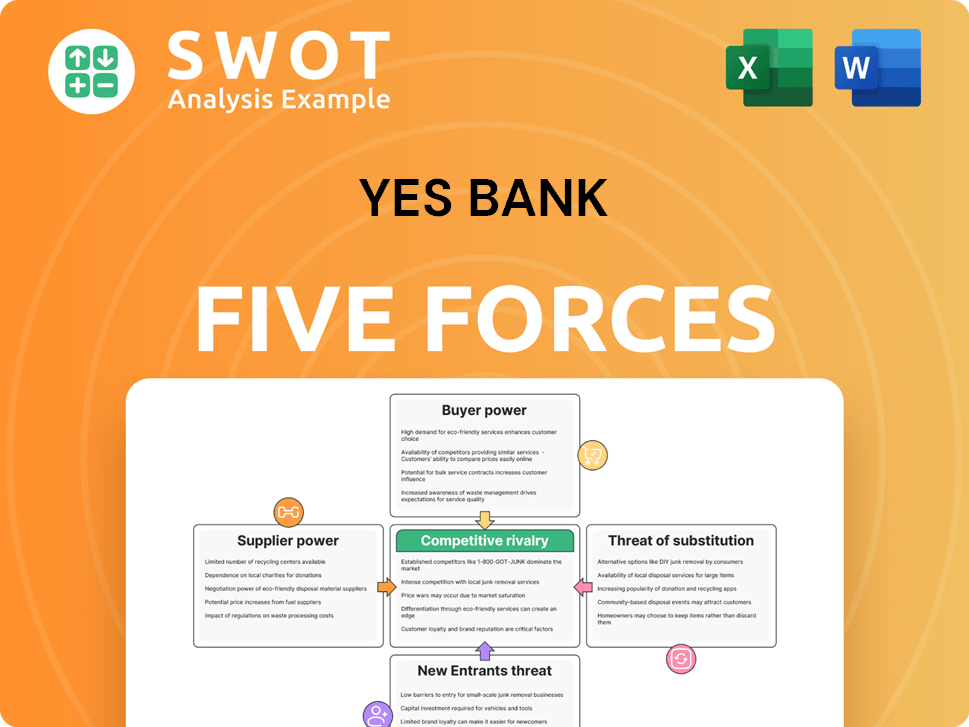
Yes Bank Porter's Five Forces Analysis
- Covers All 5 Competitive Forces in Detail
- Structured for Consultants, Students, and Founders
- 100% Editable in Microsoft Word & Excel
- Instant Digital Download – Use Immediately
- Compatible with Mac & PC – Fully Unlocked
Related Blogs

- What are Mission Vision & Core Values of Yes Bank Company?
- What is Competitive Landscape of Yes Bank Company?
- What is Growth Strategy and Future Prospects of Yes Bank Company?
- What is Sales and Marketing Strategy of Yes Bank Company?
- What is Brief History of Yes Bank Company?
- Who Owns Yes Bank Company?
- What is Customer Demographics and Target Market of Yes Bank Company?
Disclaimer
All information, articles, and product details provided on this website are for general informational and educational purposes only. We do not claim any ownership over, nor do we intend to infringe upon, any trademarks, copyrights, logos, brand names, or other intellectual property mentioned or depicted on this site. Such intellectual property remains the property of its respective owners, and any references here are made solely for identification or informational purposes, without implying any affiliation, endorsement, or partnership.
We make no representations or warranties, express or implied, regarding the accuracy, completeness, or suitability of any content or products presented. Nothing on this website should be construed as legal, tax, investment, financial, medical, or other professional advice. In addition, no part of this site—including articles or product references—constitutes a solicitation, recommendation, endorsement, advertisement, or offer to buy or sell any securities, franchises, or other financial instruments, particularly in jurisdictions where such activity would be unlawful.
All content is of a general nature and may not address the specific circumstances of any individual or entity. It is not a substitute for professional advice or services. Any actions you take based on the information provided here are strictly at your own risk. You accept full responsibility for any decisions or outcomes arising from your use of this website and agree to release us from any liability in connection with your use of, or reliance upon, the content or products found herein.