

Manulife Bundle

How Does Manulife Thrive in the Financial World?
Manulife, a global financial powerhouse, achieved a remarkable "banner year" in 2024, showcasing its strength with record core earnings and significant growth across key business areas. Managing a staggering $1.6 trillion in assets as of December 31, 2024, and serving over 36 million customers, Manulife's influence is undeniable. This article dives deep into the core operations of this leading Manulife SWOT Analysis to understand its strategies.

Manulife's success hinges on its diverse range of Manulife products and Manulife services, including Manulife insurance policies, wealth management, and asset management solutions. Its strategic focus on Asia and Global Wealth & Asset Management, along with a robust digital transformation, has driven its recent financial performance. Whether you're researching Manulife financial options or seeking insights into the industry, understanding Manulife's operations is key.
What Are the Key Operations Driving Manulife’s Success?
Manulife creates value through its core offerings, primarily across Asia, Canada, and the United States, alongside its Global Wealth and Asset Management (WAM) division. The company provides a diverse range of Manulife products and Manulife services, including life insurance, wealth accumulation solutions, banking, and investment advice. These offerings cater to various customer segments, from individuals to institutions, ensuring financial security and growth.
Operational processes are crucial to Manulife's value delivery. In the insurance sector, this involves product development, underwriting, claims processing, and customer service, supported by extensive distribution networks. For wealth and asset management, Manulife Investment Management provides investment advice and solutions. The company's focus on digital initiatives, with 27 in production as of early 2025, strengthens operational efficiency and customer experience.
Manulife differentiates itself through its diversified geographic footprint, allowing it to adapt its offerings to regional needs, combined with its robust financial strength and strong brand reputation. This approach translates into tailored financial solutions, reliable protection, and a wide array of investment opportunities for its customers. To understand how Manulife approaches its marketing, you can read about the Marketing Strategy of Manulife.
 Core Offerings
Manulife offers a wide array of Manulife insurance policies, including term, whole, and universal life insurance. They also provide wealth accumulation and decumulation products, banking solutions, and investment advice. These offerings cater to both individual and institutional clients.
Operational Processes
Key operational processes include product development, underwriting, claims processing, and customer service. Manulife utilizes a vast distribution network with over 109,000 contracted agents. Digital initiatives and AI applications enhance efficiency and customer experience.
Value Proposition
Manulife provides tailored financial solutions, reliable protection, and access to a broad range of investment opportunities. The company's diversified geographic footprint and strong financial standing enable it to meet diverse customer needs effectively. This results in customer benefits through tailored financial solutions, reliable protection, and access to a broad range of investment opportunities.
Key Segments
Manulife operates across three primary segments: Asia, Canada, and the United States. The Global Wealth and Asset Management (WAM) division is also a key area. This diversified approach enables Manulife to tap into multiple markets and adapt its offerings to regional needs.

Key Differentiators
Manulife's success is built on its diversified geographic footprint, robust financial strength, and strong brand reputation. The company focuses on innovation, such as behavioral insurance offerings and enhancements to programs like Manulife Vitality.
- Extensive distribution networks with over 109,000 agents.
- Strong presence in Asia through bank partnerships.
- Focus on digital initiatives and AI applications.
- Commitment to promoting healthier living through incentives.
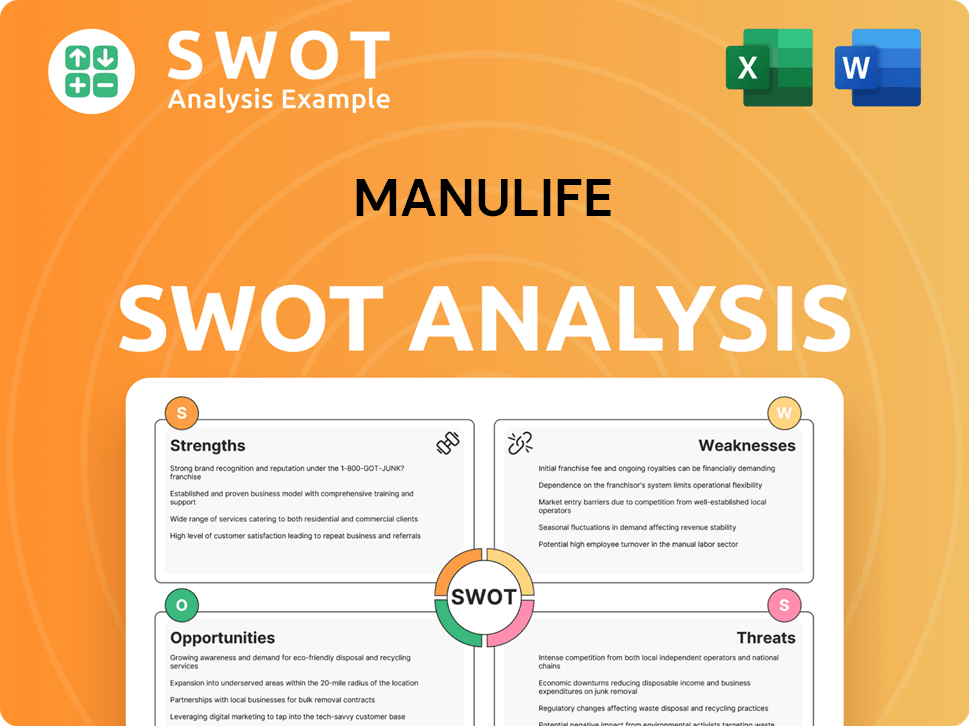
Manulife SWOT Analysis
- Complete SWOT Breakdown
- Fully Customizable
- Editable in Excel & Word
- Professional Formatting
- Investor-Ready Format
How Does Manulife Make Money?
The primary revenue streams for Manulife, a leading provider of Manulife insurance and financial services, are derived from insurance premiums, investment income, and fees associated with asset management. In 2024, the company demonstrated robust financial performance, reporting core earnings of $7.2 billion, reflecting an 8% increase compared to 2023 on a constant exchange rate basis. The net income attributed to shareholders reached $5.4 billion, marking a $0.3 billion increase from the previous year.
For the first quarter of 2025 (1Q25), Manulife maintained its strong financial trajectory, with core earnings totaling $1.8 billion. This performance highlights the company's ability to generate consistent revenue across its diverse business segments. The company’s strategic focus on diversified revenue streams and effective monetization strategies has been key to its financial success.
Manulife financial success is driven by a diversified revenue mix across its key segments. This diversification helps to mitigate risks and capitalize on growth opportunities in various markets. The company's ability to adapt to changing market conditions and customer needs is a key factor in its sustained profitability.
Segment-Specific Revenue Performance
Manulife's revenue streams are segmented to reflect its global operations and diversified product offerings. Each segment contributes differently to the overall financial performance, with varying growth rates and profitability. The following provides a detailed breakdown of each segment's performance:
- Asia: The Asia segment continues to be a significant growth driver for Manulife. In 4Q24, core earnings in Asia increased by 16%, and for the full year 2024, they rose by 27%. In 1Q25, core earnings in Asia increased by 7% to $492 million, driven by higher business volumes and favorable claims experience. Annualized premium equivalent (APE) sales for the Asia segment reached $1.41 billion in 1Q25, a 50% increase from 1Q24.
- Global Wealth and Asset Management (WAM): The Global WAM segment experienced a 34% increase in core earnings in 4Q24, primarily due to higher net fee income from favorable market impacts and positive net flows. Global WAM achieved over $13 billion of net inflows in 2024. In 1Q25, Global WAM delivered 24% core earnings growth, although net inflows were $0.5 billion, down from $6.7 billion in 1Q24.
- Canada: Canada's core earnings increased 11% in 4Q24 due to favorable insurance experience and business growth in Group Insurance. In 1Q25, Canada core earnings increased 3%, driven by favorable net insurance experience and growth in Group Insurance.
- U.S.: The U.S. segment saw a 16% decrease in core earnings in 4Q24, attributed to lower investments and impacts from a finalized reinsurance deal. In 1Q25, U.S. core earnings decreased 25%, reflecting lower investment spreads and strengthened provisions.
Manulife employs several monetization strategies to maximize revenue and profitability. These strategies include tiered pricing for its Manulife products, cross-selling insurance with wealth management solutions, and leveraging digital platforms to enhance customer engagement. The company has also engaged in significant reinsurance transactions to optimize its risk profile and capital utilization. Learn more about the company's structure and ownership by reading Owners & Shareholders of Manulife.
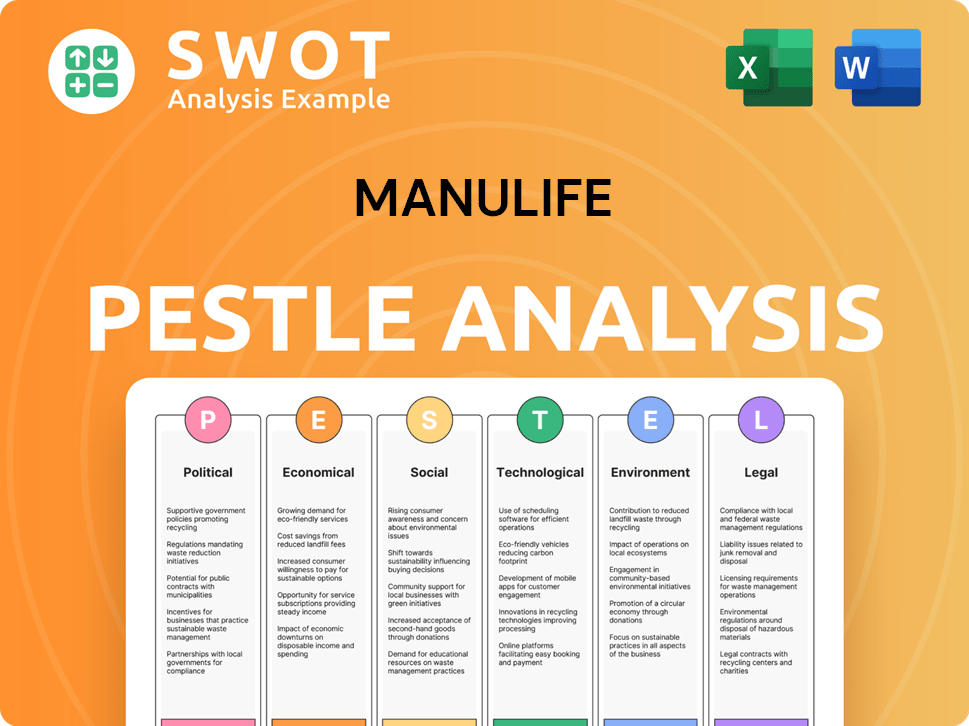
Manulife PESTLE Analysis
- Covers All 6 PESTLE Categories
- No Research Needed – Save Hours of Work
- Built by Experts, Trusted by Consultants
- Instant Download, Ready to Use
- 100% Editable, Fully Customizable
Which Strategic Decisions Have Shaped Manulife’s Business Model?
In 2024 and early 2025, Manulife demonstrated significant strides in its operations and financial performance. The company experienced a 'banner year' in 2024, achieving record core earnings and substantial growth in new business, particularly in insurance. Strategic moves, such as major reinsurance transactions, have further solidified its financial position and outlook.
Despite facing challenges like increased provisions in Q1 2025, Manulife has shown resilience, especially in its Asian markets. The company's digital transformation strategy has yielded substantial benefits, enhancing customer experience and operational efficiency. These initiatives, combined with a strong financial foundation, position Manulife to navigate market dynamics and capitalize on growth opportunities.
Manulife's competitive edge is underpinned by its global presence, brand reputation, and financial strength. Its diverse product portfolio and commitment to technological innovation further support its business model. The company continues to adapt to evolving market trends, ensuring long-term sustainability and value creation for its stakeholders. To learn more about the company's target audience, you can read the article Target Market of Manulife.
Key Milestones
In 2024, Manulife achieved record core earnings of $7.2 billion, an 8% increase from 2023. Record insurance new business results were also achieved, with over 30% increases in APE sales, new business CSM, and new business value. The company completed the largest long-term care (LTC) reinsurance transaction in the industry.
Strategic Moves
Manulife completed two significant LTC reinsurance deals within a year, validating its reserve prudence. In Canada, it entered into the largest universal life reinsurance agreement. The company is also focusing on digital transformation, generating over $600 million in benefits globally in 2024.
Competitive Edge
Manulife benefits from its extensive global presence, particularly in Asia, Canada, and the United States. Its strong brand reputation fosters customer trust. The company's LICAT ratio was 137% in Q1 2025, exceeding the 100% supervisory target. The company also offers a diverse product portfolio.
Financial Highlights
Despite operational challenges, Asia saw a 43% increase in new business value in 1Q25. Manulife has 27 GenAI use cases in production. The company's commitment to innovation includes the launch of new ETF series in 2024 and the integration of AI-backed planning tools.
Key Financial Data and Strategic Initiatives
Manulife's financial strength is demonstrated by its robust capital reserves and a strong LICAT ratio. The company's digital transformation efforts have significantly boosted operational efficiency and customer satisfaction. The strategic focus on Asia, Canada, and the United States continues to drive business growth.
- $7.2 billion in record core earnings in 2024.
- Over 30% increases in APE sales, new business CSM, and new business value.
- LICAT ratio of 137% in Q1 2025.
- 27 GenAI use cases in production.
Manulife Business Model Canvas
- Complete 9-Block Business Model Canvas
- Effortlessly Communicate Your Business Strategy
- Investor-Ready BMC Format
- 100% Editable and Customizable
- Clear and Structured Layout

How Is Manulife Positioning Itself for Continued Success?
As a leading international financial services provider, Manulife holds a strong market position, ranking among the top 10 largest life insurance companies globally. Its extensive global presence and strong brand reputation contribute to customer loyalty. In Canada, Manulife is the largest insurance company by revenue, offering a wide array of insurance and wealth management products.
Despite its strong position, Manulife faces risks like market volatility and slower global economic growth, which can impact investment returns. Regulatory changes and emerging competitors also pose challenges. Continuous investment in digital solutions is crucial to meet evolving customer needs and remain competitive. The company is exposed to various financial risks, including credit, market, and operational risks.
Industry Position
Manulife is a top global financial services provider. It holds a significant market share in Asia, Canada, and the U.S. The company is the largest insurance provider in Canada by revenue, demonstrating its strong market presence.
Risks and Headwinds
Manulife faces market volatility and economic slowdowns, impacting investment returns. Regulatory changes and new competitors present challenges. The need for continuous investment in digital solutions is crucial for adapting to evolving customer needs. The company is exposed to financial risks.
Future Outlook
Manulife aims to accelerate growth in Asia and Global Wealth & Asset Management. It is focused on the longevity economy through partnerships. The company plans to leverage its AI and GenAI capabilities for efficiency and enhanced customer outcomes. The company has set ambitious financial targets.
Strategic Initiatives
Manulife's strategy includes increasing its core return on equity (ROE) to over 18% by 2027 and improving expense efficiency. Disciplined capital management, including dividend increases and share repurchases, is a priority, as highlighted in the Growth Strategy of Manulife article.
Key Financial Targets and Strategies
Manulife has set ambitious financial targets for the coming years, aiming to enhance shareholder value. These targets and strategies are designed to ensure sustainable growth and profitability.
- Increase Core ROE to over 18% by 2027.
- Improve expense efficiency to under 45% in the medium term.
- Continue disciplined capital management, including dividend increases. A 10% increase in common share dividends was announced in February 2025.
- Focus on accelerating growth in Asia and Global Wealth & Asset Management.
- Leverage AI and GenAI capabilities for efficiency and customer enhancement.
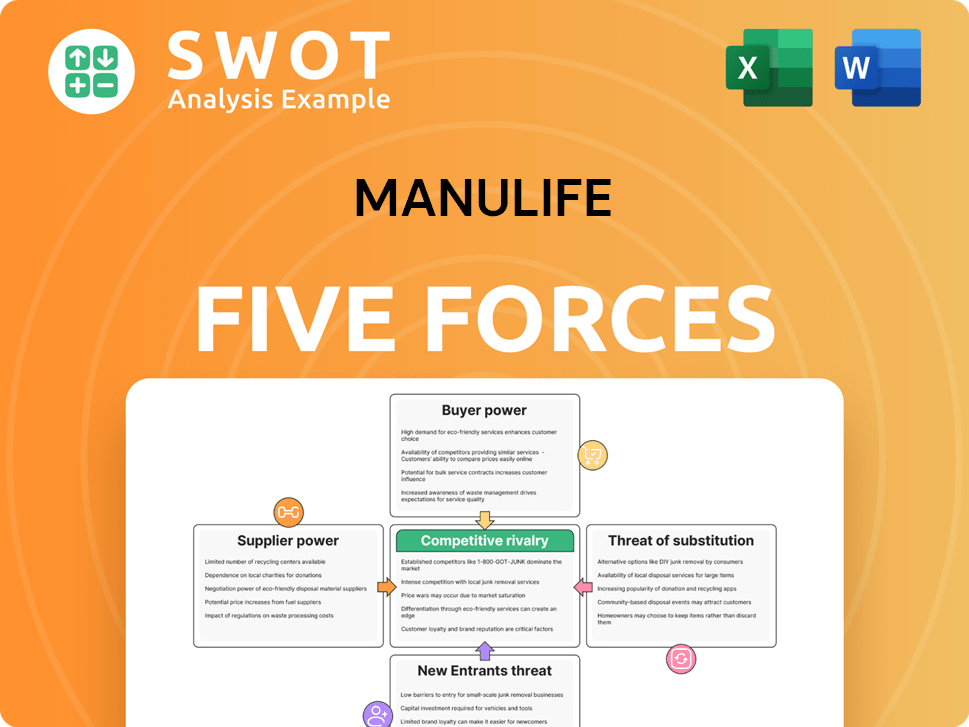
Manulife Porter's Five Forces Analysis
- Covers All 5 Competitive Forces in Detail
- Structured for Consultants, Students, and Founders
- 100% Editable in Microsoft Word & Excel
- Instant Digital Download – Use Immediately
- Compatible with Mac & PC – Fully Unlocked
Related Blogs

- What are Mission Vision & Core Values of Manulife Company?
- What is Competitive Landscape of Manulife Company?
- What is Growth Strategy and Future Prospects of Manulife Company?
- What is Sales and Marketing Strategy of Manulife Company?
- What is Brief History of Manulife Company?
- Who Owns Manulife Company?
- What is Customer Demographics and Target Market of Manulife Company?
Disclaimer
All information, articles, and product details provided on this website are for general informational and educational purposes only. We do not claim any ownership over, nor do we intend to infringe upon, any trademarks, copyrights, logos, brand names, or other intellectual property mentioned or depicted on this site. Such intellectual property remains the property of its respective owners, and any references here are made solely for identification or informational purposes, without implying any affiliation, endorsement, or partnership.
We make no representations or warranties, express or implied, regarding the accuracy, completeness, or suitability of any content or products presented. Nothing on this website should be construed as legal, tax, investment, financial, medical, or other professional advice. In addition, no part of this site—including articles or product references—constitutes a solicitation, recommendation, endorsement, advertisement, or offer to buy or sell any securities, franchises, or other financial instruments, particularly in jurisdictions where such activity would be unlawful.
All content is of a general nature and may not address the specific circumstances of any individual or entity. It is not a substitute for professional advice or services. Any actions you take based on the information provided here are strictly at your own risk. You accept full responsibility for any decisions or outcomes arising from your use of this website and agree to release us from any liability in connection with your use of, or reliance upon, the content or products found herein.