

Koppers Bundle

Unveiling Koppers Company: How Does It Thrive?
Koppers Holdings Inc. (NYSE: KOP) is a global powerhouse, but what exactly does this integrated provider do? Operating across critical sectors, Koppers transforms raw materials into essential products, impacting everything from railways to residential construction. With a focus on Koppers SWOT Analysis, and a diverse portfolio, understanding Koppers' operations is key to grasping its strategic importance.

This exploration into the
What Are the Key Operations Driving Koppers’s Success?
The core operations of Koppers Company revolve around creating and delivering value through three main segments. These are: Railroad and Utility Products and Services (RUPS), Performance Chemicals (PC), and Carbon Materials and Chemicals (CMC). Each segment contributes to a diverse portfolio, serving industries like railroads, utilities, construction, and manufacturing. The company's focus on sustainable practices and strategic partnerships further enhances its operational efficiency and market position.
Koppers business model involves the transformation of raw materials into essential products. For instance, the RUPS segment sources hardwood lumber for crossties, which are then treated with creosote from the CMC segment and often with borate from the PC segment. This integrated approach, along with a commitment to innovation, allows Koppers to offer a wide range of products and services. The company's commitment to environmental sustainability is evident in its use of recycled, reused, or renewable materials, which account for at least 75% of its revenue.
The value proposition of Koppers lies in its ability to provide essential products and services to key industries. By focusing on sustainability, innovation, and strategic partnerships, Koppers ensures supply security and logistics benefits for its customers. This approach has enabled the company to maintain a strong market presence and adapt to changing industry needs. For more details on their marketing approach, check out the Marketing Strategy of Koppers.
 RUPS Segment Overview
The RUPS segment provides treated and untreated wood products, rail joint bars, and services primarily to the railroad markets in the United States and Canada. It also serves the utility markets with treated wood products and services. This segment is crucial for infrastructure maintenance and development.
PC Segment Overview
The PC segment develops, manufactures, and markets wood preservation chemicals and wood treatment technologies. These are used in various end markets, including infrastructure, residential and commercial construction, and agriculture. This segment helps extend the lifespan of wood products.
CMC Segment Overview
The CMC segment is a key manufacturer of creosote, carbon pitch, naphthalene, phthalic anhydride, and carbon black feedstock. It serves industries such as aluminum and steel. This segment provides essential materials for various industrial processes.
Sustainability in Operations
Koppers emphasizes sustainability, with a focus on using recycled, reused, or renewable materials. An example is their facility in Hubbell, Michigan, which converts scrap copper into copper carbonate for wood preservation chemicals. This commitment helps reduce environmental impact.

Key Operational Aspects
The company's supply chain involves approximately 300-400 direct suppliers and a global manufacturing and distribution network. Strategic partnerships are essential for sourcing and distribution. Koppers' vertically integrated business model, including internal sourcing of creosote and borate, provides a competitive advantage.
- Procurement of hardwood lumber from small sawmills for the RUPS segment.
- Treatment of wood with creosote and borate to enhance durability.
- Collaboration with chemical suppliers like Lonza Group AG, BASF SE, and Dow Chemical Company.
- Partnerships with infrastructure companies such as Norfolk Southern Corporation and BNSF Railway.
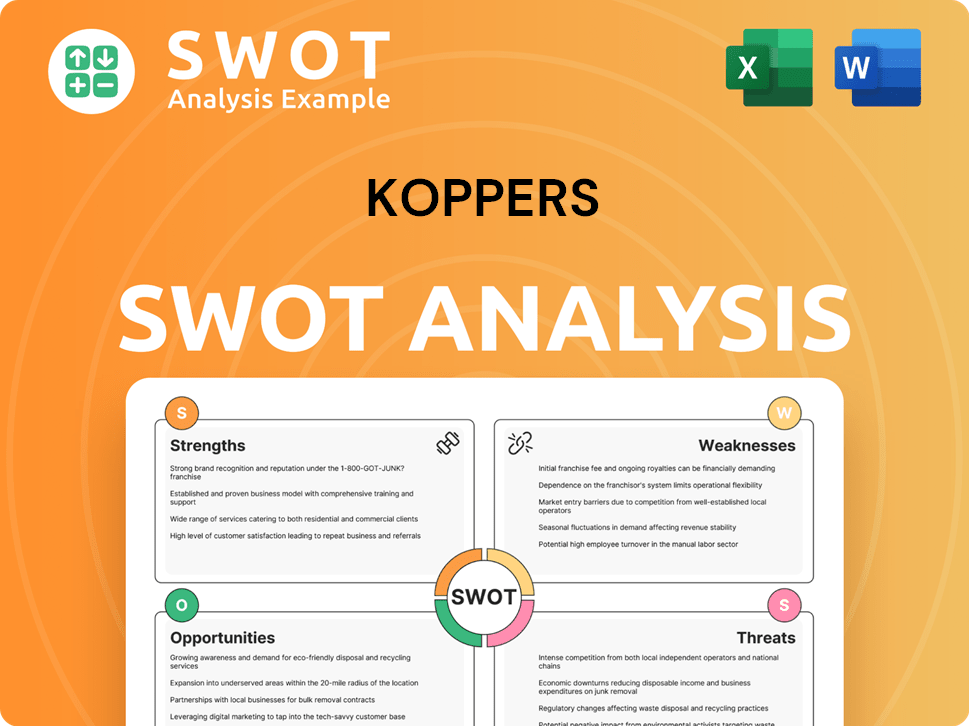
Koppers SWOT Analysis
- Complete SWOT Breakdown
- Fully Customizable
- Editable in Excel & Word
- Professional Formatting
- Investor-Ready Format
How Does Koppers Make Money?
The revenue streams and monetization strategies of the Koppers Company are primarily centered around the sale of its diverse product portfolio across three key segments: Railroad and Utility Products and Services (RUPS), Performance Chemicals (PC), and Carbon Materials and Chemicals (CMC). The company's approach involves delivering products and services essential for global infrastructure, with a focus on long-term contracts and a vertically integrated business model.
In 2024, Koppers reported consolidated sales of $2.09 billion. The RUPS segment led with a record $942.7 million in sales, marking a 5.0% increase. The PC segment saw $651.6 million in sales, a 3.0% decrease, while the CMC segment faced a decline due to price decreases across most products. The company anticipates total sales of approximately $2.17 billion in 2025, reflecting a projected 4% increase, driven by stronger volumes and pricing improvements in the RUPS segment.
Koppers' monetization strategy also includes long-term industrial contract partnerships. As of 2024, the company had 87 active contracts, with an average duration of 5.3 years and annual values ranging from $2.4 million to $18.6 million. This approach, combined with the ability to pass on cost increases to customers, contributes to the company's profitability and revenue stability. To learn more about the company's background, you can read the Brief History of Koppers.
Key Revenue and Monetization Strategies
Koppers utilizes several strategies to generate revenue and maintain profitability. These strategies are crucial for understanding the Koppers business model and its financial performance.
- Product Sales: Revenue is generated through the sale of a wide range of Koppers products across its three main segments: RUPS, PC, and CMC.
- Service Provision: The company provides essential Koppers services, particularly in the railroad and utility sectors, which contribute significantly to its revenue streams.
- Long-Term Contracts: Koppers engages in long-term industrial contracts, ensuring a stable revenue base and fostering strong relationships with key customers.
- Cost Pass-Through: The ability to pass on cost increases to customers helps maintain profit margins, especially important in managing fluctuations in raw material prices.
- Vertical Integration: The vertically integrated business model enhances control over the supply chain, contributing to cost efficiency and revenue stability.
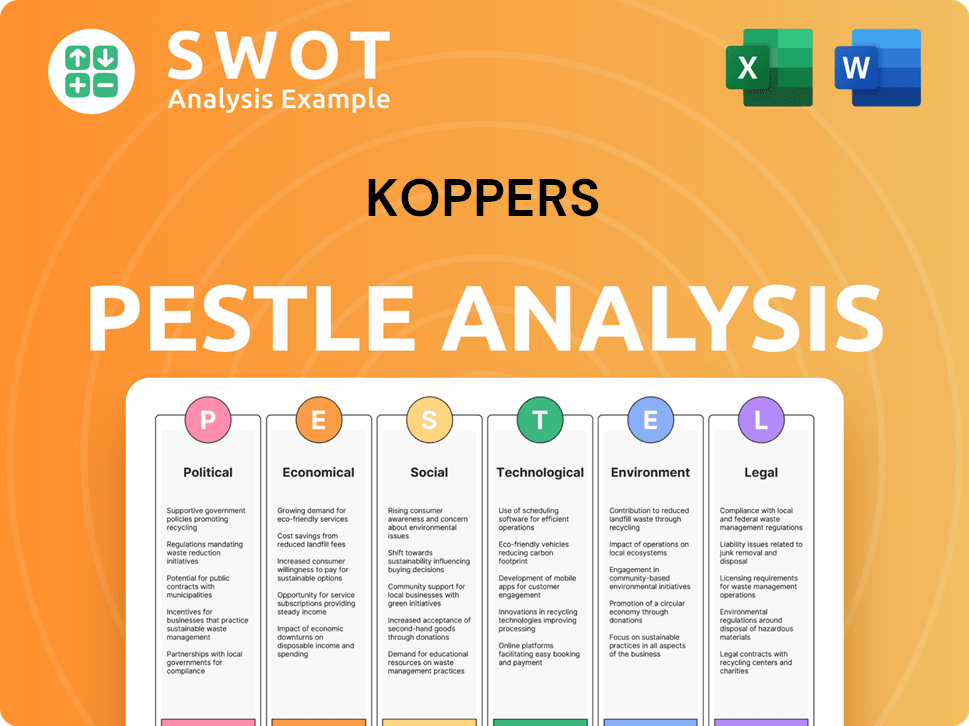
Koppers PESTLE Analysis
- Covers All 6 PESTLE Categories
- No Research Needed – Save Hours of Work
- Built by Experts, Trusted by Consultants
- Instant Download, Ready to Use
- 100% Editable, Fully Customizable
Which Strategic Decisions Have Shaped Koppers’s Business Model?
The strategic landscape of the Koppers Company has been marked by significant shifts and adaptations. These changes reflect the company's efforts to optimize operations, respond to market dynamics, and maintain a competitive edge. Key decisions and challenges have shaped its trajectory, influencing its financial performance and market position.
A critical move for Koppers was the planned discontinuation of phthalic anhydride production at its Stickney, Illinois facility in 2025. This strategic decision was driven by the substantial capital investment required, which could not be economically justified. This closure is expected to result in pre-tax charges of $51-55 million through 2026, but will save the company $40 million to $60 million in capital investment over the next 5 to 10 years. Additionally, the termination of its largest U.S. qualified pension plan in February 2025 required additional funding, impacting operating cash flow.
Operational challenges in 2024 included volume slowdowns and market share losses in its Performance Chemicals business, along with the effects of hurricanes and delays in rail shipments. Despite these setbacks, the company has shown resilience, achieving record operating profit in its domestic utility pole business and improving margins in Performance Chemicals through cost-saving initiatives. These moves are part of a broader strategy to enhance efficiency and adaptability within the Koppers business.
Key Milestones
The planned closure of the phthalic anhydride production facility in 2025 is a significant milestone, aiming at cost savings and strategic realignment. The termination of the largest U.S. qualified pension plan was completed in February 2025.
Strategic Moves
Investments in technology solutions and organizational realignment are geared towards expanding sales reach, particularly in underserved geographic areas within the utility market. The company is focused on cost efficiency, debt reduction, and pursuing organic growth and M&A opportunities.
Competitive Edge
A diversified and integrated business model serves niche markets with specialized chemicals and treated wood products. Internal sourcing of creosote and borate, combined with a national network of treating plants, provides supply security and logistics advantages.
Sustainability Initiatives
Recognized for sustainability efforts, Koppers was named to America's Most Responsible Companies list for the fifth consecutive year in 2025. The company achieved a 50% reduction in Scope 1 and Scope 2 greenhouse gas emissions against a 2007 baseline, seven years ahead of schedule.
Competitive Advantages and Strategic Focus
The Koppers Company's competitive advantages are rooted in its diversified and integrated business model, which serves niche markets with specialized chemicals and treated wood products. The company's ability to internally source creosote and borate, combined with its national network of treating plants, provides supply security and logistics advantages, which is crucial for its Koppers products.
- Commitment to innovation with dedicated teams of chemists and wood-science professionals.
- Focus on cost efficiency and debt reduction.
- Pursuing organic growth and M&A opportunities, especially with increased infrastructure spending.
- Adaptation to market dynamics by focusing on cost efficiency and debt reduction.
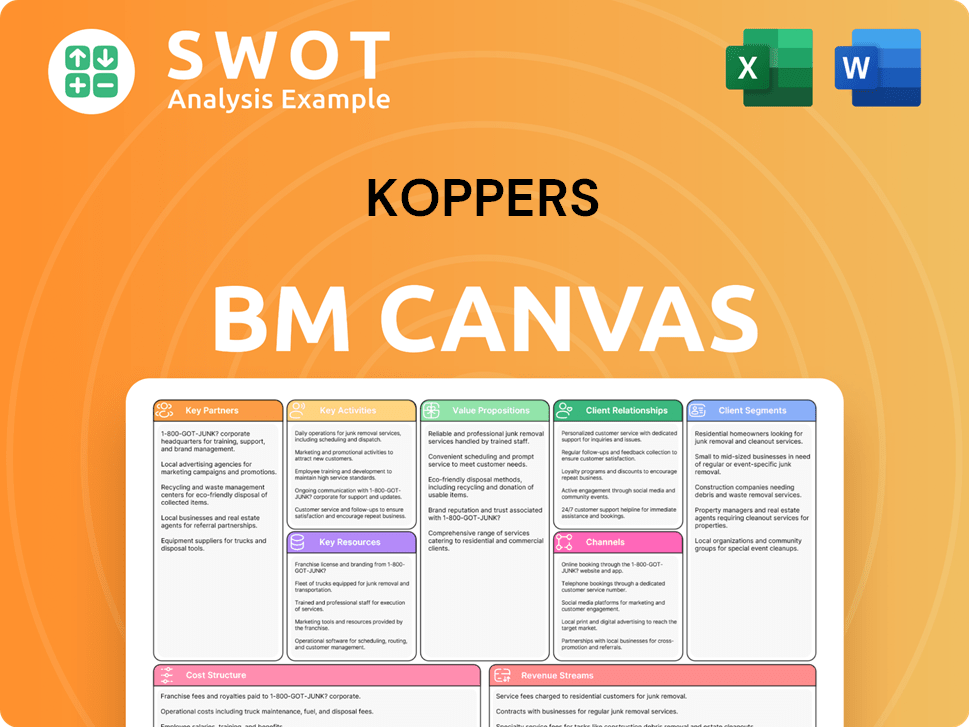
Koppers Business Model Canvas
- Complete 9-Block Business Model Canvas
- Effortlessly Communicate Your Business Strategy
- Investor-Ready BMC Format
- 100% Editable and Customizable
- Clear and Structured Layout
How Is Koppers Positioning Itself for Continued Success?
Koppers Holdings Inc. holds a strong industry position. The company is a diversified industrial entity with leading market positions in treated wood products, wood preservation chemicals, and carbon compounds. It serves key infrastructure sectors, including railroads and utilities. The company operates globally, with manufacturing and distribution networks in North America, South America, Australasia, and Europe.
The company faces risks such as potential market share loss and commodity price fluctuations. It also deals with supply chain volatility and geopolitical risks, including trade policies. Regulatory changes and the need for significant capital investments pose further challenges. Despite these risks, the company is focused on sustained profitability and strategic growth initiatives.
Industry Position
The company is a major supplier in the North American railroad crosstie market. Its profitability metrics are above the industry average, indicating a competitive advantage. The company's global presence and diverse product offerings support its strong market position.
Risks and Headwinds
Key risks include market share loss in the Performance Chemicals segment and fluctuations in commodity prices like coal tar. Supply chain volatility and geopolitical risks, such as trade policies, also pose challenges. Capital investments and regulatory changes, as seen with the phthalic anhydride plant closure, add further complexities.
Future Outlook
The company anticipates approximately $2.17 billion in sales for 2025. Adjusted EBITDA is projected at $280 million, with adjusted EPS of $4.75 per share. Koppers plans to improve earnings per share by over 10% annually through 2030.
Strategic Initiatives
Koppers focuses on cost reduction and technology investments to penetrate the utility market. Sustainability is a key focus, with a significant portion of products from recycled or renewable materials. The company will host a Virtual Investor Day in September 2025 to unveil its 2030 strategic plan.
Financial Projections and Strategic Goals
The company aims to capitalize on global infrastructure spending, projected to reach $94 trillion by 2040, and the increasing demand for carbon compounds. Koppers is committed to sustainable practices and innovation. For more detailed information about the company's ownership and financial structure, you can read the article about Owners & Shareholders of Koppers.
- Focus on cost reduction measures.
- Investments in technology solutions.
- Emphasis on sustainability and recycled materials.
- Capitalizing on global infrastructure spending.
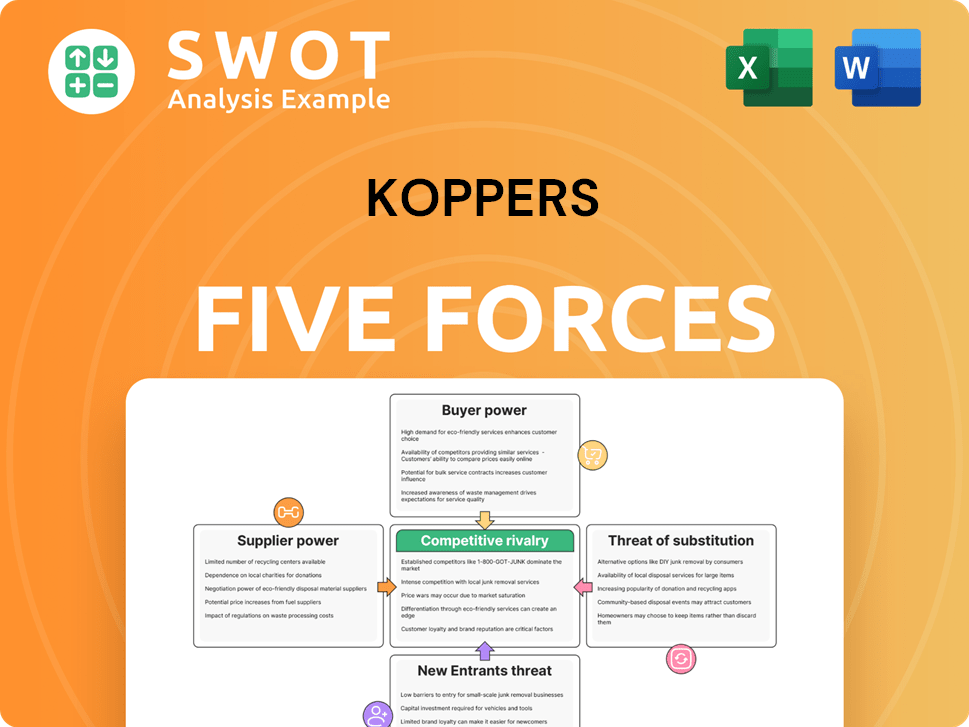
Koppers Porter's Five Forces Analysis
- Covers All 5 Competitive Forces in Detail
- Structured for Consultants, Students, and Founders
- 100% Editable in Microsoft Word & Excel
- Instant Digital Download – Use Immediately
- Compatible with Mac & PC – Fully Unlocked
Related Blogs

- What are Mission Vision & Core Values of Koppers Company?
- What is Competitive Landscape of Koppers Company?
- What is Growth Strategy and Future Prospects of Koppers Company?
- What is Sales and Marketing Strategy of Koppers Company?
- What is Brief History of Koppers Company?
- Who Owns Koppers Company?
- What is Customer Demographics and Target Market of Koppers Company?
Disclaimer
All information, articles, and product details provided on this website are for general informational and educational purposes only. We do not claim any ownership over, nor do we intend to infringe upon, any trademarks, copyrights, logos, brand names, or other intellectual property mentioned or depicted on this site. Such intellectual property remains the property of its respective owners, and any references here are made solely for identification or informational purposes, without implying any affiliation, endorsement, or partnership.
We make no representations or warranties, express or implied, regarding the accuracy, completeness, or suitability of any content or products presented. Nothing on this website should be construed as legal, tax, investment, financial, medical, or other professional advice. In addition, no part of this site—including articles or product references—constitutes a solicitation, recommendation, endorsement, advertisement, or offer to buy or sell any securities, franchises, or other financial instruments, particularly in jurisdictions where such activity would be unlawful.
All content is of a general nature and may not address the specific circumstances of any individual or entity. It is not a substitute for professional advice or services. Any actions you take based on the information provided here are strictly at your own risk. You accept full responsibility for any decisions or outcomes arising from your use of this website and agree to release us from any liability in connection with your use of, or reliance upon, the content or products found herein.