

Foxlink Bundle

How Does Foxlink Thrive in the Tech World?
Cheng Uei Precision Industry Co., Ltd., or Foxlink, is a powerhouse in the electronics manufacturing sector, but how does this global leader really work? Established in 1986, Foxlink has become a crucial player, designing and producing essential components for top tech brands. With a diverse portfolio and strategic partnerships, understanding Foxlink's operations is key to grasping its impact on the global supply chain.

Foxlink, a key player in Foxlink SWOT Analysis, has a significant role in the electronics manufacturing industry. The company's success is evident in its partnerships and financial performance, with a focus on innovation. Its ability to adapt and expand, particularly into areas like AI and green energy, highlights its forward-thinking strategy. Understanding the Foxlink operations and its place in the supply chain is crucial for anyone interested in the future of technology.
What Are the Key Operations Driving Foxlink’s Success?
The Foxlink company creates and delivers value through its comprehensive capabilities in designing, developing, and manufacturing electronic components and integrated solutions. Its core offerings include a wide range of connectors, cable assemblies, power management devices, and battery packs. Furthermore, Foxlink positions itself as a joint design manufacturer (JDM), supporting customers from new product design to optimization and introduction.
The company serves diverse customer segments across consumer electronics, communications, automotive, and industrial applications. Foxlink's operational processes are robust and globally distributed, with over 15 design, manufacturing, and sales sites worldwide. This global footprint, combined with efficient supply chain management, allows for optimized logistics and inventory control.
What makes Foxlink's operations unique and effective is its commitment to providing 'total solutions' from components to turnkey products, coupled with a strong emphasis on time-to-market and time-to-volume. The company's strategy involves building long-term partnerships with leading international companies and creating alliances for key technologies. The company's integrated approach translates into customer benefits such as faster product development cycles, reduced costs, and differentiated market offerings. For a deeper dive into the target market, see Foxlink's Target Market.
 Core Products and Services
Key products include connectors, cable assemblies (USB, Thunderbolt, HDMI), power management devices, and battery packs. The company offers vertically integrated solutions, including tooling, molding, and assembly services. Foxlink operates as a JDM, supporting customers from design to introduction.
Global Manufacturing Footprint
The company has over 15 design, manufacturing, and sales sites worldwide, including facilities in the US, India, and Taiwan. This global presence enables efficient supply chain management. Foxlink is investing in high-tech electronics factories, such as the one in Da Nang, Vietnam.
Operational Excellence
The company focuses on 'total solutions' and emphasizes time-to-market and time-to-volume. It builds long-term partnerships and alliances for key technologies. The integrated approach delivers faster product development and reduced costs.
Technology and Innovation
Investments in advanced technologies, such as AI and green energy, are a priority. The Ubilink supercomputing center highlights the company's commitment to sustainable solutions. Foxlink is continually innovating to meet market demands.

Key Operational Highlights
In 2024, Foxlink successfully shipped its first batch from its new high-tech electronics factory in Da Nang, Vietnam. The company's focus on AI and green energy, exemplified by the Ubilink supercomputing center, demonstrates its commitment to innovation and sustainability. Foxlink continues to expand its global footprint and technological capabilities.
- Global presence with over 15 sites worldwide.
- Focus on 'total solutions' from components to turnkey products.
- Investments in advanced technologies, including AI and green energy.
- Strong emphasis on time-to-market and time-to-volume.
Foxlink SWOT Analysis
- Complete SWOT Breakdown
- Fully Customizable
- Editable in Excel & Word
- Professional Formatting
- Investor-Ready Format

How Does Foxlink Make Money?
The Foxlink company generates revenue through several major streams, primarily centered around its core manufacturing and design services. These services focus on electronic components and integrated solutions. The company's main revenue sources include product sales of connectors, cable assemblies, power management devices, and battery packs.
Foxlink's products are sold on an OEM/ODM (Original Equipment Manufacturer/Original Design Manufacturer) basis to a wide array of global brands in consumer electronics, communications, and automotive industries. This approach allows Foxlink to cater to diverse client needs while maintaining control over its manufacturing processes.
Foxlink reported revenue of NT$90.9 billion (approximately US$2.91 billion) in 2023. The company anticipates a significant increase, with projected revenue topping NT$100 billion (US$3.1 billion) in 2024. A notable driver of this growth is its expanding energy business, which is increasingly contributing to the overall revenue.
Diversification and Innovation
Foxlink's monetization strategies extend beyond traditional product sales, with the company actively diversifying into new areas. This strategy leverages its manufacturing and technological expertise to explore new revenue streams. An example of this is its venture into AI computing power rentals through its Ubilink supercomputing center.
- The Ubilink supercomputing center, launched in November 2024, aims to serve small and medium-sized enterprises (SMEs) that cannot afford dedicated computing facilities, offering high-performance computing services.
- This shift towards a service-oriented revenue model potentially generates recurring income from cloud-based AI services.
- Foxlink is expanding its green energy solutions, including energy storage systems (ESS), energy management systems (EMS), and energy blockchain technology (EBT), often through strategic partnerships.
- These collaborations aim to develop and pilot renewable energy projects and promote carbon credit services and International Renewable Energy Certificates (IRECs), creating new revenue streams in the sustainability sector.
- The company's investments in optical systems and wireless telecommunications also represent efforts to expand product lines and explore new revenue avenues. For more insights, you can read about the Growth Strategy of Foxlink.
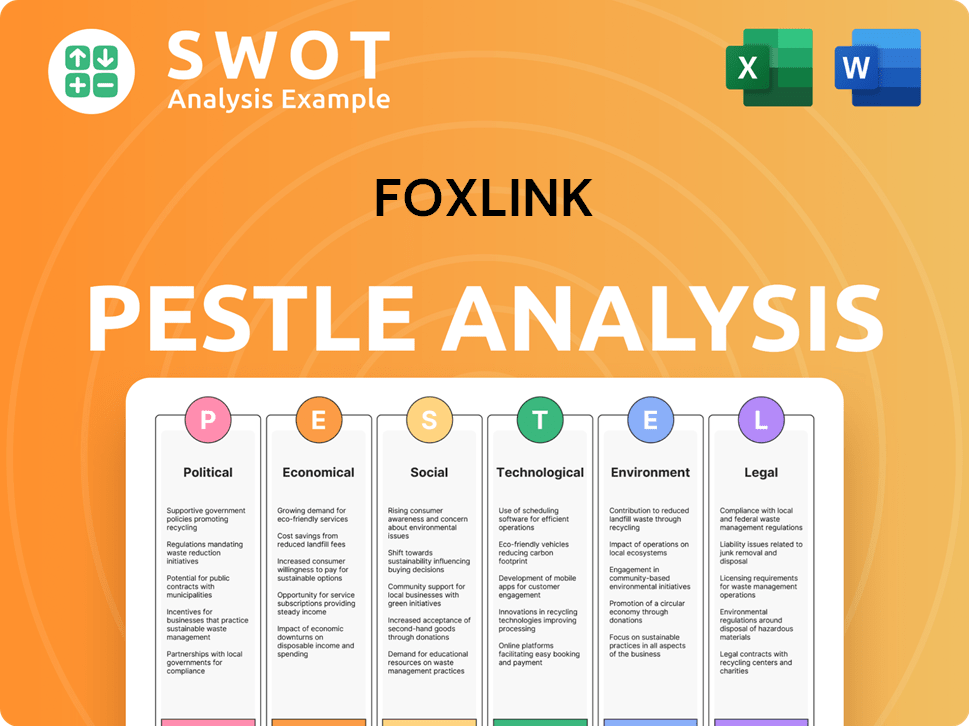
Foxlink PESTLE Analysis
- Covers All 6 PESTLE Categories
- No Research Needed – Save Hours of Work
- Built by Experts, Trusted by Consultants
- Instant Download, Ready to Use
- 100% Editable, Fully Customizable
Which Strategic Decisions Have Shaped Foxlink’s Business Model?
The Foxlink company has achieved significant milestones and strategic moves that have shaped its operations and financial performance, particularly in recent years. A notable development is its aggressive expansion into the green energy and AI sectors. This strategic shift, along with continued global manufacturing expansion, underscores its adaptability and forward-thinking approach in a rapidly evolving market.
Key to Foxlink's success are its strategic investments in cutting-edge technologies and global manufacturing capabilities. These moves are designed to enhance its competitive edge and capitalize on emerging opportunities. The company's ability to integrate diverse technologies and maintain long-term partnerships with leading global brands further solidifies its position in the electronics manufacturing industry.
The company's focus on vertical integration, diverse product offerings, and a global manufacturing footprint are central to its competitive advantages. Foxlink's commitment to innovation and adaptability is evident in its strategic responses to market challenges, such as diversifying into green energy and AI, and expanding its global presence.
Key Milestones
In August 2024, Foxlink, through its subsidiary Shinfox Energy, partnered with Ubitus K.K. to establish Ubilink.AI, aiming to become Asia's largest green AI center. The inauguration of Taiwan's largest AI supercomputing center, Ubilink, in November 2024, marked a significant achievement. The center is equipped with over 100 H100 servers and more than 1,000 NVIDIA Hopper GPUs.
Strategic Moves
Despite a fire incident in its India factory in 2023, Foxlink is back on track with a new plant in Tamil Nadu, India. The company is also investing $135 million in a high-tech electronics factory in Da Nang, Vietnam, which shipped its first batch in 2024 and is expected to generate 2,000 jobs. Furthermore, Foxlink expanded its green energy manufacturing footprint in the United States with a $20 million investment in Foxlink Arizona.
Competitive Edge
Foxlink's competitive advantages stem from its vertical integration, diverse product offerings, and global manufacturing footprint. Its 'total solution' approach, from components to turnkey products, coupled with a focus on design, manufacturing, and quality, differentiates it from competitors. Continuous investment in research and development, including AI technology, is crucial for maintaining a competitive edge.
Future Plans
Plans are underway to expand the Ubilink center's compute capacity to a total of 10,240 GPUs by 2025. The company also intends to establish a Ubilink center in the U.S. by the end of 2025. These expansions highlight Foxlink's commitment to growth and innovation in the AI and green energy sectors.
Key Financial and Operational Data
The Ubilink AI supercomputing center delivers 45.82 petaflops of computing power and is expected to account for 55% of Taiwan's total AI computing power. The investment in the Da Nang, Vietnam factory is $135 million. The Foxlink Arizona investment is $20 million and is expected to create over 100 new jobs. These figures demonstrate the scale of Foxlink's investments and its impact on the electronics manufacturing landscape.
- Ubilink AI supercomputing center has over 1,000 NVIDIA Hopper GPUs.
- The new factory in Da Nang, Vietnam, is expected to generate 2,000 jobs.
- Foxlink Arizona investment increases capacity for car electrical chargers, battery cell storage devices, and sheet metal products.
- The Ubilink center is planned to expand to 10,240 GPUs by 2025.
Foxlink Business Model Canvas
- Complete 9-Block Business Model Canvas
- Effortlessly Communicate Your Business Strategy
- Investor-Ready BMC Format
- 100% Editable and Customizable
- Clear and Structured Layout

How Is Foxlink Positioning Itself for Continued Success?
The Foxlink company holds a significant position in the global electronics manufacturing industry, particularly in connectors, cable assemblies, and power management solutions. Its relationships with major brands like Apple, Microsoft, and Google highlight its crucial role in their supply chains. With over 29,000 employees and over 15 facilities worldwide, Foxlink operations are extensive.
Despite its strong market position, Foxlink faces risks such as intense competition, supply chain disruptions, and evolving consumer preferences. The rapidly changing technological landscape, especially in AI and green energy, necessitates continuous investment and adaptation. For example, the need for Apple to find Indian suppliers for camera modules highlights the complexities of global supply chains.
Industry Position
Foxlink is a major player in electronics manufacturing, specializing in connectors and cable assemblies. Its partnerships with tech giants like Apple solidify its supply chain importance. Its projected revenue for 2024 is over NT$100 billion (US$3.1 billion), indicating a substantial presence in the market.
Risks and Challenges
Key risks include intense competition and supply chain disruptions. Technological advancements, especially in AI and green energy, require continuous investment. The need for companies to adapt to new sourcing locations adds to the complexity.
Future Outlook
Foxlink is focusing on AI, green energy, and product diversification to drive growth. The company aims to expand its manufacturing footprint in regions like India and Vietnam. Strategic initiatives are designed to sustain competitive advantages and generate revenue in both traditional and emerging sectors.
Strategic Initiatives
Foxlink is investing in AI, with plans to expand its AI supercomputing center, Ubilink, globally. It is also developing renewable energy solutions through its subsidiary Shinfox Energy. These initiatives are part of a broader strategy to ensure the company's continued success.
Future Growth Strategies
The company's plans include expanding AI capabilities and developing green energy solutions. Product diversification and global manufacturing footprint optimization are also key. These strategies aim to enhance revenue generation and maintain a competitive edge in the market. To learn more about the company's financial structure, see Owners & Shareholders of Foxlink.
- Expansion of AI supercomputing centers, with a U.S. facility expected by the end of 2025.
- Development of renewable and clean energy solutions through Shinfox Energy.
- Mass production of 800G and MT lines for optical communication and data center products in the first half of 2025.
- Strategic expansion and optimization of manufacturing facilities in regions like India and Vietnam.
Foxlink Porter's Five Forces Analysis
- Covers All 5 Competitive Forces in Detail
- Structured for Consultants, Students, and Founders
- 100% Editable in Microsoft Word & Excel
- Instant Digital Download – Use Immediately
- Compatible with Mac & PC – Fully Unlocked

Related Blogs

- What are Mission Vision & Core Values of Foxlink Company?
- What is Competitive Landscape of Foxlink Company?
- What is Growth Strategy and Future Prospects of Foxlink Company?
- What is Sales and Marketing Strategy of Foxlink Company?
- What is Brief History of Foxlink Company?
- Who Owns Foxlink Company?
- What is Customer Demographics and Target Market of Foxlink Company?
Disclaimer
All information, articles, and product details provided on this website are for general informational and educational purposes only. We do not claim any ownership over, nor do we intend to infringe upon, any trademarks, copyrights, logos, brand names, or other intellectual property mentioned or depicted on this site. Such intellectual property remains the property of its respective owners, and any references here are made solely for identification or informational purposes, without implying any affiliation, endorsement, or partnership.
We make no representations or warranties, express or implied, regarding the accuracy, completeness, or suitability of any content or products presented. Nothing on this website should be construed as legal, tax, investment, financial, medical, or other professional advice. In addition, no part of this site—including articles or product references—constitutes a solicitation, recommendation, endorsement, advertisement, or offer to buy or sell any securities, franchises, or other financial instruments, particularly in jurisdictions where such activity would be unlawful.
All content is of a general nature and may not address the specific circumstances of any individual or entity. It is not a substitute for professional advice or services. Any actions you take based on the information provided here are strictly at your own risk. You accept full responsibility for any decisions or outcomes arising from your use of this website and agree to release us from any liability in connection with your use of, or reliance upon, the content or products found herein.