

Toast Bundle

Can Toast Company Continue to Sizzle?
Toast, a leader in restaurant technology, has rapidly transformed the industry with its all-in-one platform. From its inception in 2011, Toast has empowered restaurants with innovative solutions, currently serving approximately 140,000 locations. The company's recent financial success, including its first GAAP net income, highlights its impressive trajectory.

This analysis will dissect Toast's Toast SWOT Analysis, exploring its growth strategy and future prospects within the competitive restaurant technology landscape. We'll examine its business model, conduct a thorough market analysis, and evaluate the competitive landscape to understand how Toast plans to maintain its momentum. Understanding the Toast company's strategic vision is crucial for investors and industry professionals alike, seeking to capitalize on the evolving food service sector and the future of the toast industry.
How Is Toast Expanding Its Reach?
The company is actively pursuing a multi-pronged expansion strategy to broaden its market reach and diversify its revenue streams. A key focus is the expansion into new customer segments beyond its core SMB and mid-market restaurant base, including enterprise chains and food and beverage retail. This strategic move aims to capture a larger share of the expanding food service technology market.
In 2024, the company made significant strides in the enterprise segment, securing partnerships with major brands. These partnerships include Hilton Hotels (500+ locations), Mendocino Farms, and Ascent Hospitality Management, which includes 500 Perkins and Huddle House locations. Further solidifying its position, the company recently signed its largest deal with Applebee's and expanded its enterprise solutions with Topgolf.
The company anticipates surpassing 10,000 customer locations across these new segments in 2025. This growth is a testament to the effectiveness of its expansion initiatives and the increasing demand for its services within the enterprise sector.
 Enterprise Segment Expansion
The company is focusing on expanding its services to larger restaurant chains and enterprise clients. This includes partnerships with major brands like Hilton Hotels, Mendocino Farms, and Applebee's. This expansion strategy aims to increase its overall market share and revenue streams.
International Growth
International expansion is another critical component of the company's growth strategy. The company is focusing on the U.K., Ireland, and Canada, where sales representatives are outperforming U.S. productivity. The company is also exploring new business models for international expansion, such as e-commerce and resellers.
Go-to-Market and Customer Success Initiatives
The company is investing in its field-based go-to-market engine and customer success initiatives. This includes tailored onboarding services and customer support to drive further location growth. The company's goal is to increase its U.S. restaurant market share from 15% to 20%.
Financial Performance
In 2024, SaaS ARPU grew 50% year-over-year for new locations in Europe and Asia-Pacific. This strong performance highlights the effectiveness of the company's international expansion efforts. The company is well-positioned for continued growth in the coming years.

Key Expansion Strategies
The company's growth strategy focuses on expanding into new customer segments, international markets, and enhancing customer success initiatives. These initiatives are designed to increase market share and revenue.
- Enterprise segment partnerships, including Hilton Hotels and Applebee's.
- International expansion, with a focus on the U.K., Ireland, and Canada.
- Investment in go-to-market strategies and customer success programs.
- Targeting a U.S. restaurant market share increase from 15% to 20%.
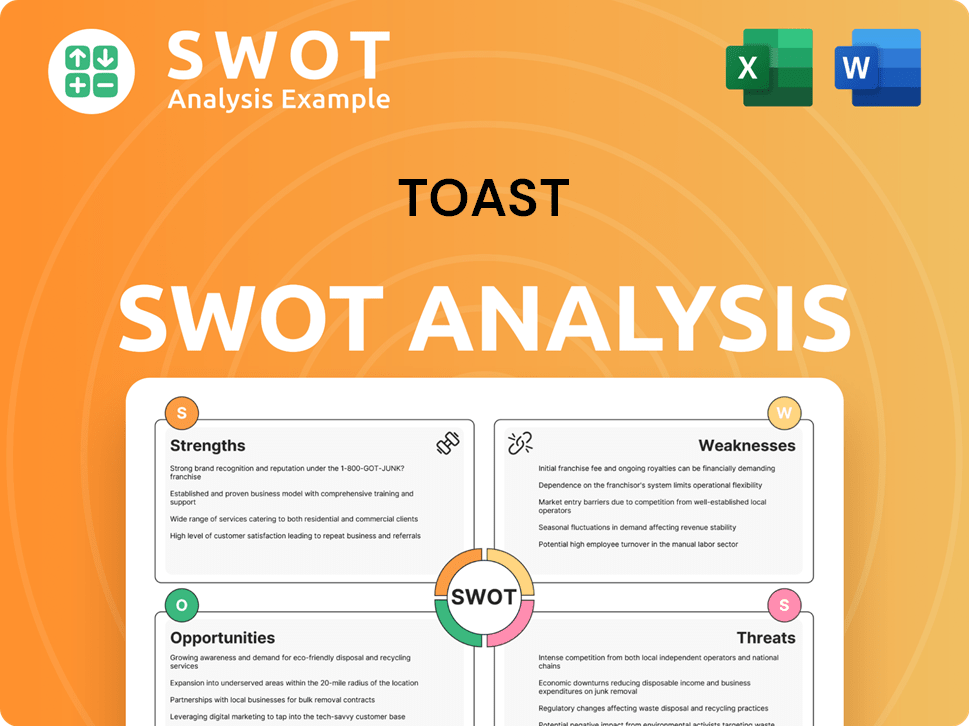
Toast SWOT Analysis
- Complete SWOT Breakdown
- Fully Customizable
- Editable in Excel & Word
- Professional Formatting
- Investor-Ready Format
How Does Toast Invest in Innovation?
The Growth strategy of the [Company Name] heavily relies on technological innovation to meet the evolving needs of its customers. By focusing on research and development (R&D) and integrating advanced technologies like AI, the company aims to provide comprehensive solutions for the restaurant industry. This approach allows the company to not only enhance its current offerings but also to anticipate and adapt to future market trends, ensuring sustained growth and a competitive edge.
The company's commitment to innovation is evident in its substantial investment in R&D, which totaled $351 million in 2024. This investment underscores the company's dedication to staying at the forefront of technological advancements and providing cutting-edge solutions. This dedication is pivotal to its future prospects and its ability to maintain a strong position in the market.
The company's strategic initiatives, particularly the launch of ToastIQ, demonstrate its proactive approach to leveraging technology. This intelligence engine, powered by AI, data, and insights, is designed to provide restaurants with actionable recommendations and automated workflows. This focus on data-driven solutions enhances operational efficiency, improves customer experiences, and drives revenue growth for its clients.

ToastIQ: AI-Powered Intelligence
ToastIQ, launched on May 1, 2025, is a key innovation. It uses AI and data from over 130,000 locations to offer insights and recommendations.
Key Features of ToastIQ
Features include Menu Upsells, Shift at a Glance, and Digital Chits. These features are designed to improve service and operational efficiency.
AI-Marketing Assistant
The AI-Marketing Assistant creates tailored marketing plans. It analyzes restaurant data to develop effective email, SMS, and social media strategies.
Sous Chef and Future AI
The company is also developing Sous Chef, an intelligent back-of-house assistant. They are exploring voice AI and video solutions.
All-in-One Platform
The company aims to offer an all-in-one platform. It connects front-of-house and back-of-house operations across various service models.
Strategic Partnerships
Partnerships, like the one with Uber Technologies, streamline delivery. This ecosystem approach supports innovation and efficiency.
Key Technological Advancements
The company's digital transformation strategy focuses on an all-in-one platform. This platform supports various service models, including dine-in, takeout, and delivery. The integration of AI and data analytics is central to enhancing operational efficiency and customer experience. The company's strategic partnerships are essential for streamlining operations and expanding its market reach. For further insights into the company's financial strategies, consider reading about Owners & Shareholders of Toast.
- AI-Driven Solutions: Implementing AI for menu recommendations and marketing automation.
- Data Analytics: Utilizing data from over 130,000 locations to provide actionable insights.
- Platform Integration: Connecting front-of-house and back-of-house operations.
- Strategic Partnerships: Collaborating with companies like Uber Technologies to improve delivery services.
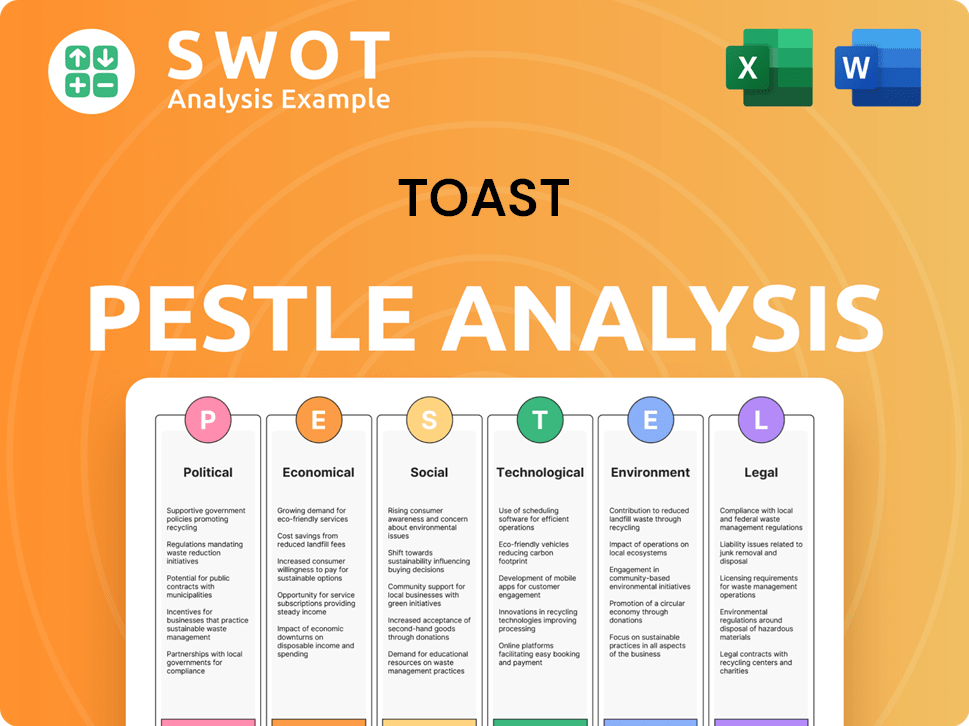
Toast PESTLE Analysis
- Covers All 6 PESTLE Categories
- No Research Needed – Save Hours of Work
- Built by Experts, Trusted by Consultants
- Instant Download, Ready to Use
- 100% Editable, Fully Customizable
What Is Toast’s Growth Forecast?
The financial landscape for the company shows a strong trajectory of growth. The company demonstrated a significant financial turnaround in 2024, achieving its first GAAP net income of $19 million, a stark contrast to the $246 million net loss in 2023. This shift underscores the effectiveness of the company's growth strategy and operational improvements.
The company's Annualized Recurring Run-Rate (ARR) shows a healthy expansion. As of December 31, 2024, ARR surpassed $1.6 billion, and by March 31, 2025, it reached $1.7 billion, marking a 31% year-over-year increase. This growth in ARR indicates an increasing customer base and higher revenue generation from existing clients. The Gross Payment Volume (GPV) also saw substantial growth, increasing by 26% year-over-year to $159.1 billion in 2024, and continuing with a 22% year-over-year increase to $42.2 billion in the first quarter of 2025.
The company's positive financial performance is further highlighted by its Q1 2025 results. The company reported a GAAP net income of $56 million in Q1 2025, a substantial improvement from a GAAP net loss of $(83) million in Q1 2024. Additionally, the adjusted EBITDA for Q1 2025 was $133 million, reflecting strong operational efficiency. These figures suggest that the company is not only growing but also becoming more profitable.
Financial Performance in 2024
In 2024, the company achieved its first GAAP net income of $19 million, a significant turnaround from the $246 million net loss in 2023. The company's financial strategy has led to improved profitability and operational efficiency. This turnaround is a key indicator of the company's successful growth strategy.
Annualized Recurring Run-Rate (ARR) Growth
The company's ARR grew impressively. As of December 31, 2024, ARR exceeded $1.6 billion, and by March 31, 2025, it reached $1.7 billion. This represents a 31% year-over-year increase, showing strong customer adoption and revenue expansion. The company is well-positioned for continued growth.
Gross Payment Volume (GPV) Surge
GPV experienced substantial growth in 2024, increasing by 26% year-over-year to $159.1 billion. This upward trend continued into Q1 2025, with a 22% year-over-year increase to $42.2 billion. The increasing GPV highlights the company's expanding market presence.
Q1 2025 Financial Highlights
In Q1 2025, the company reported a GAAP net income of $56 million, a significant improvement from the $83 million loss in Q1 2024. The adjusted EBITDA for Q1 2025 was $133 million. These results demonstrate strong financial health and successful execution of the company's business model.
Future Outlook and Projections
For the full year ending December 31, 2025, the company anticipates continued financial success. The company projects non-GAAP subscription services and financial technology solutions gross profit to be in the range of $1,775 million to $1,795 million, reflecting a 25-27% growth compared to 2024. The company expects Adjusted EBITDA to be between $540 million and $560 million for the full year 2025, with margins expanding to 30% by year-end. These projections indicate a positive outlook for the future, supported by strategic expansions and financial performance.
- The company's revenue projections are optimistic, indicating strong growth potential.
- The expansion of Adjusted EBITDA margins to 30% by the end of 2025 reflects improved operational efficiency.
- These forecasts are supported by a solid business model and effective market strategies.
- The company's focus on financial technology solutions is driving revenue growth.
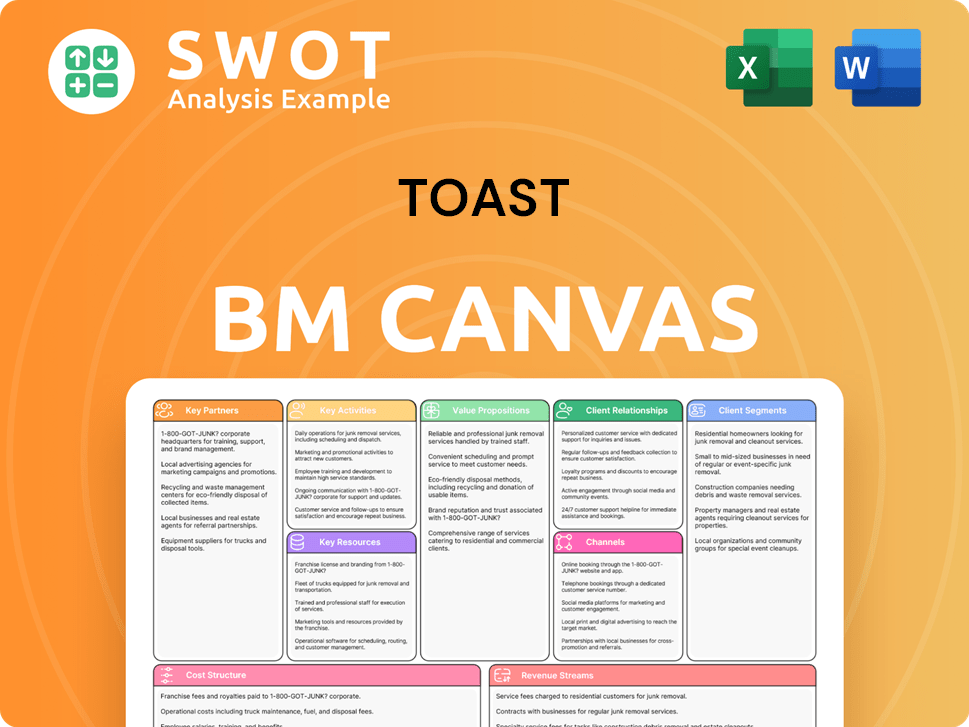
Toast Business Model Canvas
- Complete 9-Block Business Model Canvas
- Effortlessly Communicate Your Business Strategy
- Investor-Ready BMC Format
- 100% Editable and Customizable
- Clear and Structured Layout
What Risks Could Slow Toast’s Growth?
The growth strategy of the Toast company faces several potential risks and obstacles that could impact its future prospects. These challenges span the competitive landscape, macroeconomic conditions, regulatory hurdles, and operational execution. Understanding these risks is crucial for assessing the company's long-term viability and investment potential.
The restaurant technology market is highly competitive, which poses a significant risk to the Toast company. This intense competition means that innovative features can be quickly replicated by rivals, potentially eroding Toast's market share. Furthermore, macroeconomic factors and regulatory changes add complexity to the business environment.
Investing in a company like Toast requires a thorough understanding of these potential pitfalls. The following sections detail the key risks and obstacles the company faces, providing a comprehensive market analysis.
Competitive Landscape
The restaurant technology market is crowded, with numerous competitors vying for market share. New features are easily copied, and established players offer similar services. A detailed Competitors Landscape of Toast is crucial for understanding the competitive dynamics.
Macroeconomic Uncertainties
Economic downturns and shifts in consumer spending habits can negatively impact restaurant spending. Inflation and changing consumer preferences can squeeze margins. These factors can affect demand for Toast's services.
Labor and Supply Chain Challenges
Although labor concerns are diminishing, adapting to changing workforce expectations remains a challenge. Supply chain issues and menu strategy continue to be pain points for operators due to inflation. These issues can affect restaurant operations and, consequently, Toast's business model.
Regulatory Risks
Regulatory changes, particularly at the local level, pose a significant challenge. Compliance with payment processing requirements and data privacy regulations like CCPA and GDPR adds to operational costs. Labor law considerations, including minimum wage and independent contractor rules, could increase expenses.
Financial and Execution Risks
Aggressive investments in sales, marketing, and R&D may strain short-term profitability. International expansion and entering new markets demand significant investment and can divert resources. Reliance on financial technology solutions also creates vulnerability to market fluctuations.
Market Expectations
The potential for disappointing quarterly results, especially given high expectations, remains a risk for investors. Meeting market expectations is crucial for maintaining investor confidence and supporting the company's growth strategy.
Market Share Analysis
The restaurant technology market is highly competitive, with numerous players vying for market share. According to recent reports, the point-of-sale (POS) market is expected to reach \$29.4 billion by 2027. The competitive landscape includes established players and new entrants, putting pressure on Toast's market share. A detailed market analysis reveals the dynamics of this competitive environment.
Financial Performance
Toast's financial performance is closely tied to the restaurant industry's health. Economic downturns can reduce restaurant spending, impacting demand for Toast's services. The company's revenue projections and profitability depend on navigating these macroeconomic challenges. In 2024, the restaurant industry faced challenges related to inflation and labor costs.
Regulatory Environment
Regulatory changes pose a significant challenge, particularly at the local level. Compliance with state-specific payment processing requirements and evolving data privacy regulations, such as CCPA and GDPR, adds to operational costs. Labor law considerations, including minimum wage impacts and independent contractor classification rules, could increase operational expenses. These factors require ongoing monitoring and adaptation.
Growth Strategy Execution
Toast's growth strategy includes investments in sales, marketing, and R&D, which may strain short-term profitability. International expansion and entering new market segments demand significant investment and can divert resources from core segments. Successful execution is crucial for achieving long-term growth. The company's ability to adapt to these challenges will determine its future prospects.
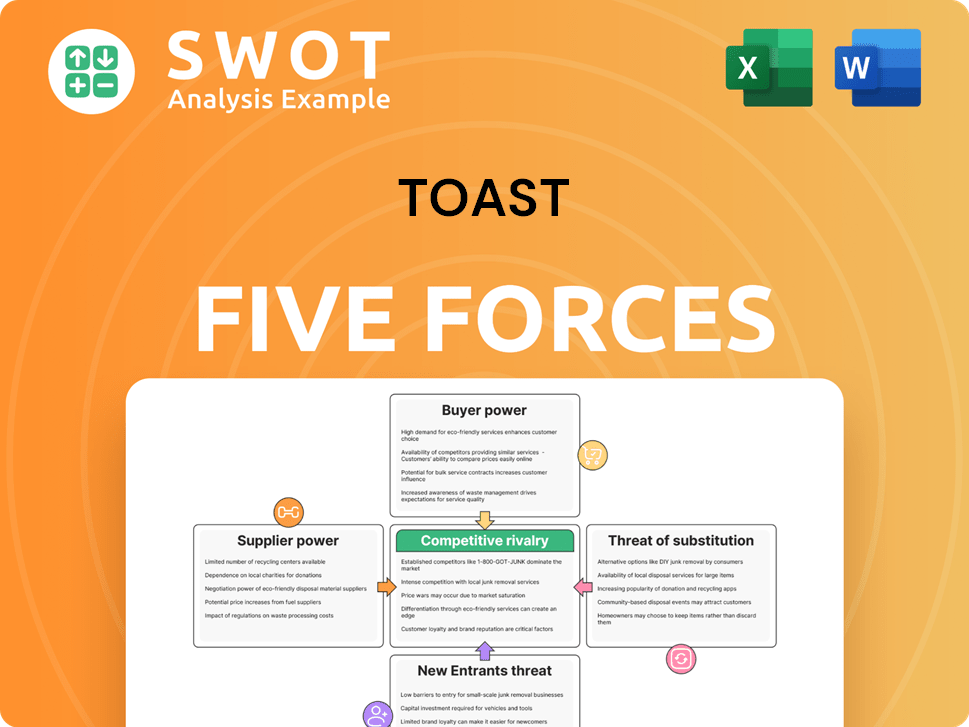
Toast Porter's Five Forces Analysis
- Covers All 5 Competitive Forces in Detail
- Structured for Consultants, Students, and Founders
- 100% Editable in Microsoft Word & Excel
- Instant Digital Download – Use Immediately
- Compatible with Mac & PC – Fully Unlocked
Related Blogs

- What are Mission Vision & Core Values of Toast Company?
- What is Competitive Landscape of Toast Company?
- How Does Toast Company Work?
- What is Sales and Marketing Strategy of Toast Company?
- What is Brief History of Toast Company?
- Who Owns Toast Company?
- What is Customer Demographics and Target Market of Toast Company?
Disclaimer
All information, articles, and product details provided on this website are for general informational and educational purposes only. We do not claim any ownership over, nor do we intend to infringe upon, any trademarks, copyrights, logos, brand names, or other intellectual property mentioned or depicted on this site. Such intellectual property remains the property of its respective owners, and any references here are made solely for identification or informational purposes, without implying any affiliation, endorsement, or partnership.
We make no representations or warranties, express or implied, regarding the accuracy, completeness, or suitability of any content or products presented. Nothing on this website should be construed as legal, tax, investment, financial, medical, or other professional advice. In addition, no part of this site—including articles or product references—constitutes a solicitation, recommendation, endorsement, advertisement, or offer to buy or sell any securities, franchises, or other financial instruments, particularly in jurisdictions where such activity would be unlawful.
All content is of a general nature and may not address the specific circumstances of any individual or entity. It is not a substitute for professional advice or services. Any actions you take based on the information provided here are strictly at your own risk. You accept full responsibility for any decisions or outcomes arising from your use of this website and agree to release us from any liability in connection with your use of, or reliance upon, the content or products found herein.