

Hamilton Insurance Bundle

Can Hamilton Insurance Company Sustain Its Impressive Growth?
Hamilton Insurance Group has quickly become a prominent player in the global specialty insurance and reinsurance market, highlighted by its successful IPO and significant financial performance. From its inception, Hamilton has focused on leveraging data science and technology, setting the stage for its impressive trajectory. This analysis dives into the core of Hamilton's Hamilton Insurance SWOT Analysis and its future prospects.

This deep dive will explore Hamilton Insurance Company's ambitious growth strategy, examining how it intends to maintain its momentum within the competitive insurance industry. We will analyze its strategic planning, focusing on key drivers such as market expansion, technological innovation, and financial performance. Understanding the future prospects of Hamilton Insurance Company requires a close look at its competitive advantages and long-term vision within the evolving landscape of the insurance market.
How Is Hamilton Insurance Expanding Its Reach?
The Growth Strategy of Hamilton Insurance Company involves several key expansion initiatives designed to enhance its financial performance and market position. These initiatives are focused on geographical diversification, product innovation, and strategic partnerships within the Insurance Industry. The company is actively working to broaden its reach and offerings to capitalize on emerging opportunities and maintain a competitive edge.
A significant aspect of Hamilton Insurance Group’s strategy includes expanding its presence in key markets, particularly within the U.S. Excess & Surplus (E&S) casualty market. This targeted approach allows the company to access new customer bases and diversify its revenue streams. The company's strategic goals are centered on achieving sustainable growth and enhancing shareholder value through disciplined execution and strategic investments.
The company's expansion strategy includes a strong focus on the U.S. E&S casualty market, a segment where Hamilton Select, launched in 2022, now accounts for 7% of the gross written premiums within the International segment. This strategic move highlights the company's commitment to capitalizing on opportunities within the U.S. insurance landscape and driving growth through targeted market segments. For more information about the company's revenue streams and business model, see Revenue Streams & Business Model of Hamilton Insurance.
 Geographical Expansion
Hamilton Insurance Group is expanding its geographical footprint, especially in the International and Bermuda segments. This expansion is a key component of its strategic planning, aiming to increase its market share and diversify its revenue streams. The company's focus on strategic planning is evident in its targeted approach to market expansion.
Product Innovation
The company is also innovating its product offerings to meet evolving market demands. This includes entering new categories such as credit, bond, and political risk reinsurance. Strategic hires are being made to lead these new ventures, ensuring that the company has the expertise needed to succeed in these new areas.
Strategic Partnerships
Hamilton Insurance Company is actively seeking strategic partnerships to enhance its market position. These collaborations are designed to leverage the strengths of other companies and create new opportunities for growth. The company's focus on partnerships is a key element of its overall growth strategy.
Market Diversification
A core element of Hamilton's strategy is market diversification, spreading its risk and revenue across different segments. This includes expanding into the U.S. E&S market and new product categories. This diversification helps the company to mitigate risks and improve financial performance.

Key Growth Drivers
The company's growth is driven by several key factors, including geographical expansion and product innovation. These initiatives are supported by strategic partnerships and a focus on market diversification, ensuring sustainable growth and a strong competitive position. These are the key growth drivers for Hamilton Insurance Company.
- Expanding in the International and Bermuda segments.
- Entering new product categories like credit and bond reinsurance.
- Leveraging expertise in property and specialty classes.
- Capitalizing on favorable market conditions.
Hamilton Insurance SWOT Analysis
- Complete SWOT Breakdown
- Fully Customizable
- Editable in Excel & Word
- Professional Formatting
- Investor-Ready Format

How Does Hamilton Insurance Invest in Innovation?
The core of the Hamilton Insurance Company's growth strategy centers on leveraging technology and innovation. This approach aims to enhance underwriting and claims management, which drives both sustained growth and operational efficiency within the insurance industry. The company's strategic planning heavily involves the use of data science and technology to refine its processes, ensuring a competitive edge in the market.
Investment in technology is a key factor contributing to operational efficiency, which has, in turn, led to increasing gross margins over the past five years. This focus on technological advancement is pivotal for the company's financial performance and future prospects. The strategic goals of Hamilton Insurance Company include continuous improvement in its technological capabilities to support its underwriting and claims handling processes.
Hamilton Insurance Company's strategic vision is to integrate advanced analytical capabilities into its operations. This is evident through its partnership with the Two Sigma Hamilton Fund (TSHF), which generated a 16.3% return in 2024. This fund, as of March 31, 2025, represented approximately 40% of Hamilton's total investments, including cash investments. This allocation highlights the company's commitment to systematic strategies and its impact on the company's growth strategy.

Data-Driven Underwriting
Hamilton Insurance Company uses data analytics to improve underwriting accuracy. This approach helps in risk assessment and pricing strategies. The focus is on refining processes to achieve better financial performance.
Technological Integration
The company integrates technology to streamline claims management. This includes automation and digital tools. The goal is to improve efficiency and customer satisfaction.
Investment Strategy
Hamilton Insurance Company strategically invests in funds like TSHF. This demonstrates a sophisticated approach to investment management. The strategy complements its underwriting activities.
Operational Efficiency
The company's investment in technology leads to operational efficiency. This has resulted in increasing gross margins. This is a key driver for the company's growth.
Partnerships and Acquisitions
Hamilton Insurance Company's partnerships and acquisitions are part of its strategic planning. These moves help to expand into new markets. This contributes to the company's overall growth.
Risk Management
Risk management is a core component of Hamilton's strategy. The company uses technology to assess and mitigate risks. This ensures financial stability and sustained growth.
Key Growth Drivers
The key growth drivers for Hamilton Insurance Company are its technological capabilities and strategic insights. These elements contribute to improved underwriting profitability and overall financial performance. The company's diversified underwriting portfolio and focus on profitable lines of business are also crucial.
- Data analytics to improve underwriting accuracy and risk assessment.
- Technological integration for streamlined claims management and operational efficiency.
- Strategic investments, such as the Two Sigma Hamilton Fund, to enhance investment returns.
- Focus on profitable lines of business and a diversified underwriting portfolio.
- Continuous efforts to streamline processes and enhance underwriting and claims handling.
Hamilton Insurance PESTLE Analysis
- Covers All 6 PESTLE Categories
- No Research Needed – Save Hours of Work
- Built by Experts, Trusted by Consultants
- Instant Download, Ready to Use
- 100% Editable, Fully Customizable

What Is Hamilton Insurance’s Growth Forecast?
The financial outlook for Hamilton Insurance Group is notably strong, reflecting robust performance in 2024 and promising growth into 2025. This positive trajectory is supported by significant increases in key financial metrics, indicating effective strategic planning and operational excellence. The company's ability to navigate industry challenges while maintaining profitability positions it favorably within the insurance industry.
In 2024, Hamilton reported a net income of $400 million, a substantial increase of 55% compared to the previous year. This impressive financial performance led to an 18.3% return on average equity and a 23.5% growth in book value per common share. These figures highlight the company's efficiency in generating profits and enhancing shareholder value. The company's growth strategy is clearly paying off.
Gross premiums written for the full year 2024 rose by 24% to $2.4 billion, with net premiums earned increasing by 31.6% to $1.7 billion. The company's combined ratio of 91.3% in 2024 demonstrates strong underwriting discipline, which is crucial for long-term profitability. This strong financial performance underscores the company's commitment to sustainable growth and operational excellence.
Q1 2025 Performance
Despite industry-wide insured catastrophe losses, Hamilton Insurance Company started 2025 strongly, with a net income of $81 million in the first quarter. Gross premiums written in Q1 2025 increased by 16.8% year-over-year to $843.3 million, and net premiums earned climbed 29.5% to $498.9 million. The annualized return on average equity for Q1 2025 was 13.7%, showcasing continued profitability.
Asset and Equity Growth
Total assets reached $8.3 billion at March 31, 2025, a 7% increase from the end of 2024, with shareholders' equity reaching $2.4 billion. The growth in assets and equity reflects the company's financial strength and its ability to support future expansion. This growth is a key indicator of the company's stability and its capacity to seize market opportunities.
Future Growth Projections
Analysts project Hamilton's revenue to grow by an average of 8.7% per annum over the next three years, outpacing the U.S. insurance industry's projected 5.2% growth. This indicates a strong potential for sustained expansion and market share gains. The company's diversified business model, encompassing casualty, specialty, and property lines, contributes to stable underwriting profitability.
- Share Repurchases: Hamilton's management actively engages in share repurchases, with $10.3 million repurchased in Q1 2025, reflecting confidence in its long-term prospects.
- Strategic Goals: The company's strategic goals are supported by a diversified business model and a focus on stable underwriting profitability.
- Market Expansion: Hamilton Insurance Company is well-positioned for expansion, as highlighted in the Target Market of Hamilton Insurance article.
- Competitive Advantages: The company's strong financial performance and strategic initiatives provide it with significant competitive advantages.
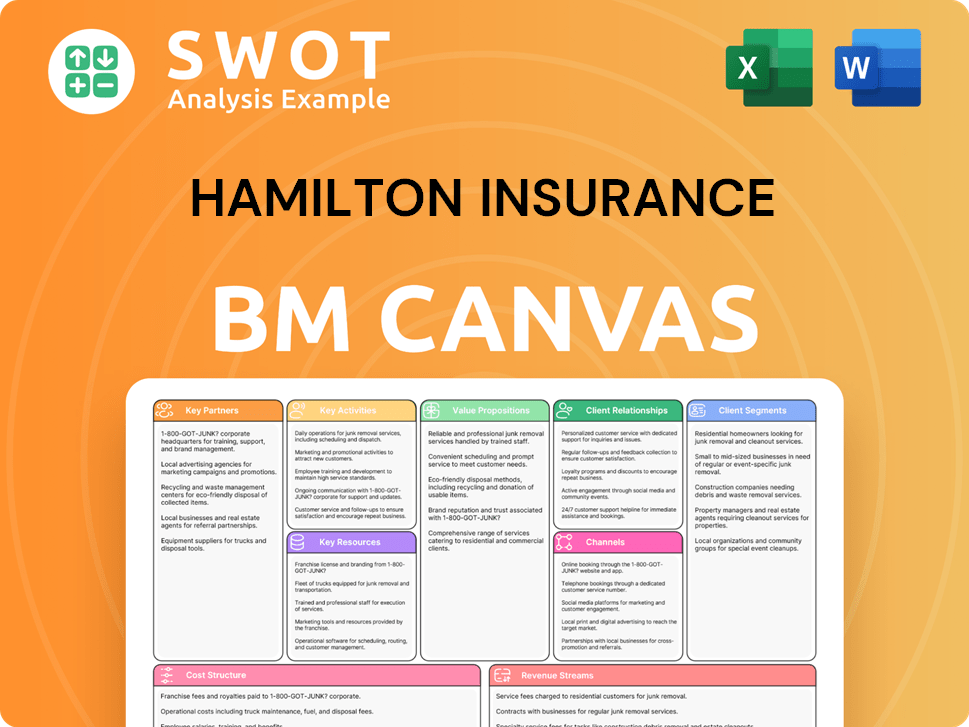
Hamilton Insurance Business Model Canvas
- Complete 9-Block Business Model Canvas
- Effortlessly Communicate Your Business Strategy
- Investor-Ready BMC Format
- 100% Editable and Customizable
- Clear and Structured Layout
What Risks Could Slow Hamilton Insurance’s Growth?
The Hamilton Insurance Company faces several risks that could affect its growth, even with strong financial results and strategic initiatives. The insurance industry is competitive and cyclical, which can cause pricing and terms to decline. Additionally, regulatory changes and unpredictable events, such as natural disasters, pose significant challenges to the company's operations and financial performance.
Unforeseen catastrophic events, including natural disasters and other major loss incidents, can lead to significant underwriting losses. For example, the California wildfires significantly impacted Q1 2025 results, resulting in $159.7 million in losses. The company's investment strategy, particularly with assets managed by Two Sigma Investments, also presents a degree of risk. Moreover, factors such as social and economic inflation, and political and economic volatility, can impact the company's financial stability.
The company acknowledges the risk of inadequate assessment of underwriting risk, which could arise from incorrect estimations of past or future inflationary trends and claims practices. To address these risks, Hamilton Insurance Company focuses on business diversification, maintaining a robust balance sheet, and adhering to underwriting discipline. Its diversified business model, with a split across casualty (45%), specialty (30%), and property (25%) in 2024, helps mitigate the impact of large loss activity.
Market Competition
The insurance industry is highly competitive. This can lead to pricing pressures and reduced profitability. The cyclical nature of insurance and reinsurance means market conditions can shift, affecting financial performance.
Regulatory Changes
Operating in various jurisdictions means the company must comply with evolving regulations. These include cybersecurity, privacy, and data protection laws. Changes in these areas can increase compliance costs and operational complexities.
Catastrophic Events
Natural disasters and other large loss events can cause significant underwriting losses. The California wildfires in Q1 2025 resulted in $159.7 million in losses. Events like the collapse of the Francis Scott Key Bridge can also impact financial results.
Investment Strategy
The company's investment strategy, especially with assets managed by Two Sigma Investments, carries inherent risks. While the strategy has historically yielded strong returns, it is subject to market fluctuations. This is a key aspect of their Competitors Landscape of Hamilton Insurance.
Economic Factors
Social and economic inflation, political and economic volatility, and potential loss cost inflation are significant concerns. Announced tariffs and recession risks can also impact financial performance. These factors can increase claims costs and affect profitability.
Underwriting Risk Assessment
Inadequate assessment of underwriting risk can lead to inaccurate estimations of future trends. Incorrect estimations of past or future inflationary trends and claims practices can cause financial losses. This requires continuous monitoring and adjustment.
Diversification
A diversified business model helps mitigate the impact of large loss activity. In 2024, the company's business was split across casualty (45%), specialty (30%), and property (25%). This diversification helps spread risk across different areas.
Strong Balance Sheet
Maintaining a strong balance sheet is crucial for financial stability. This allows the company to withstand economic shocks and unexpected losses. Comfortable reserve levels are essential to meet potential obligations.
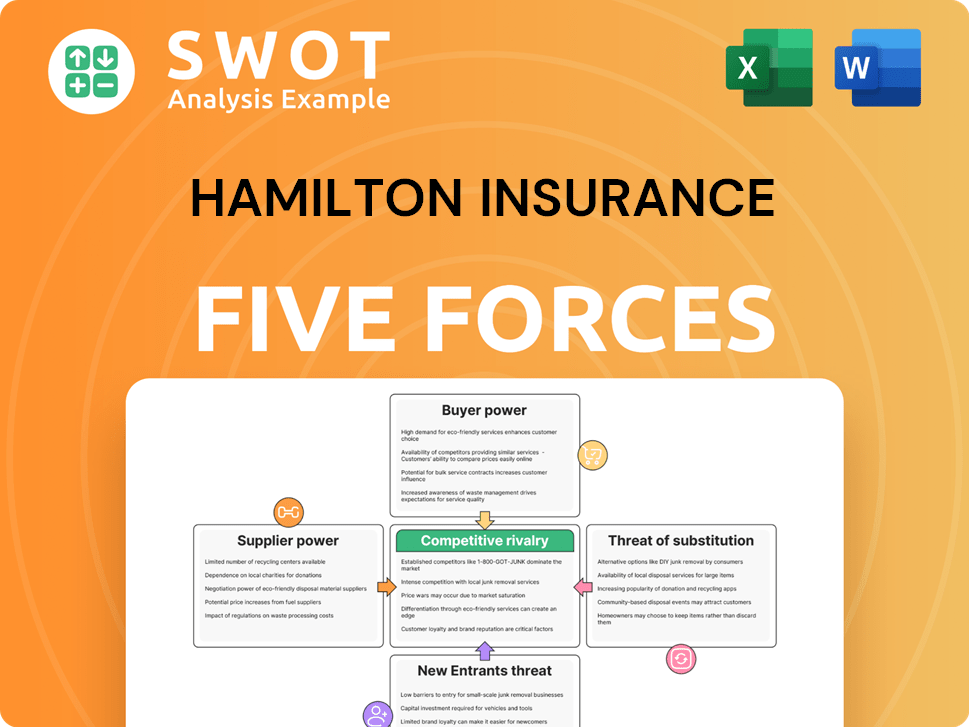
Hamilton Insurance Porter's Five Forces Analysis
- Covers All 5 Competitive Forces in Detail
- Structured for Consultants, Students, and Founders
- 100% Editable in Microsoft Word & Excel
- Instant Digital Download – Use Immediately
- Compatible with Mac & PC – Fully Unlocked
Related Blogs

- What are Mission Vision & Core Values of Hamilton Insurance Company?
- What is Competitive Landscape of Hamilton Insurance Company?
- How Does Hamilton Insurance Company Work?
- What is Sales and Marketing Strategy of Hamilton Insurance Company?
- What is Brief History of Hamilton Insurance Company?
- Who Owns Hamilton Insurance Company?
- What is Customer Demographics and Target Market of Hamilton Insurance Company?
Disclaimer
All information, articles, and product details provided on this website are for general informational and educational purposes only. We do not claim any ownership over, nor do we intend to infringe upon, any trademarks, copyrights, logos, brand names, or other intellectual property mentioned or depicted on this site. Such intellectual property remains the property of its respective owners, and any references here are made solely for identification or informational purposes, without implying any affiliation, endorsement, or partnership.
We make no representations or warranties, express or implied, regarding the accuracy, completeness, or suitability of any content or products presented. Nothing on this website should be construed as legal, tax, investment, financial, medical, or other professional advice. In addition, no part of this site—including articles or product references—constitutes a solicitation, recommendation, endorsement, advertisement, or offer to buy or sell any securities, franchises, or other financial instruments, particularly in jurisdictions where such activity would be unlawful.
All content is of a general nature and may not address the specific circumstances of any individual or entity. It is not a substitute for professional advice or services. Any actions you take based on the information provided here are strictly at your own risk. You accept full responsibility for any decisions or outcomes arising from your use of this website and agree to release us from any liability in connection with your use of, or reliance upon, the content or products found herein.