

Purple Bundle

How Does Purple Company Stack Up in the Sleep Industry?
The sleep products market is fiercely competitive, and Purple SWOT Analysis is at the forefront of innovation. Understanding the competitive landscape is crucial for investors, analysts, and anyone interested in the future of sleep technology. This analysis dives deep into Purple Company's position, examining its strengths, weaknesses, opportunities, and threats within the industry.

This detailed market analysis explores Purple Company's competitive advantages and business strategy, offering insights into its market share and revenue streams. We'll dissect Purple Company's key strengths and weaknesses, evaluating its competitive positioning against industry rivals. Furthermore, we'll explore Purple Company's recent performance and future prospects, providing a comprehensive view of its growth strategy and value proposition within the dynamic sleep industry.
Where Does Purple’ Stand in the Current Market?
The core operations of the Purple Company center around the design, manufacturing, and distribution of comfort technology and sleep products, with a primary focus on mattresses. Their value proposition is built upon the innovative GelFlex Grid technology, which is intended to provide unique comfort and support. This technology differentiates them in the competitive landscape of the sleep products market.
As of December 31, 2024, the company operated 58 showrooms across the United States, indicating a strategic emphasis on physical retail presence. The company leverages a multi-channel distribution strategy, combining direct-to-consumer (DTC) online sales, wholesale partnerships with retailers like Mattress Firm and Ashley Furniture, and its own showrooms. This approach aims to maximize market reach and cater to diverse consumer preferences.
In 2024, DTC sales accounted for 58.1% of Purple's net revenues, while wholesale sales made up the remaining 41.9%. The company's recent performance shows a slight decrease in net revenue for the full year 2024, but improved profitability metrics, including a rise in GAAP gross margin. A detailed Marketing Strategy of Purple can help to analyze the company's competitive positioning.
 Market Share and Positioning
Purple Innovation holds a position in the premium segment of the mattress market, primarily due to its distinctive GelFlex Grid technology. As of Q4 2023, the company's estimated market share in the direct-to-consumer mattress segment was approximately 3.5%. This indicates a competitive environment with established and emerging players.
Financial Performance in 2024
For the full year 2024, Purple reported net revenue of $487.9 million, a decrease of 4.4% compared to $510.5 million in 2023. The GAAP gross margin for 2024 was 37.1%, an increase of 350 basis points year-over-year. The company returned to positive Adjusted EBITDA in Q4 2024, reporting $2.9 million.
Q1 2025 Performance
In Q1 2025, Purple's net revenue declined by 13.2% to $104.2 million from $120.0 million in Q1 2024. The GAAP gross margin improved to 39.4%, up 460 basis points year-over-year, with the adjusted gross margin reaching 40.3%. The company's financial health, as of March 31, 2025, showed cash and cash equivalents of $21.6 million.
Strategic Focus
The company's strategic focus includes expanding its physical retail presence through showrooms and leveraging its DTC and wholesale channels. The company aims to improve profitability while navigating macroeconomic challenges. This multi-channel approach is designed to increase brand visibility and accessibility.

Key Takeaways from Market Analysis
The market analysis reveals that Purple operates in a competitive environment with a focus on premium products. The company is working to improve profitability and expand its market presence. The business strategy involves a balance between DTC sales, wholesale partnerships, and physical retail locations.
- The company's unique GelFlex Grid technology provides a competitive advantage.
- The DTC channel is a significant revenue source, with wholesale contributing a substantial portion.
- Improved gross margins indicate better cost management and pricing strategies.
- The company faces challenges from macroeconomic conditions and increased competition.
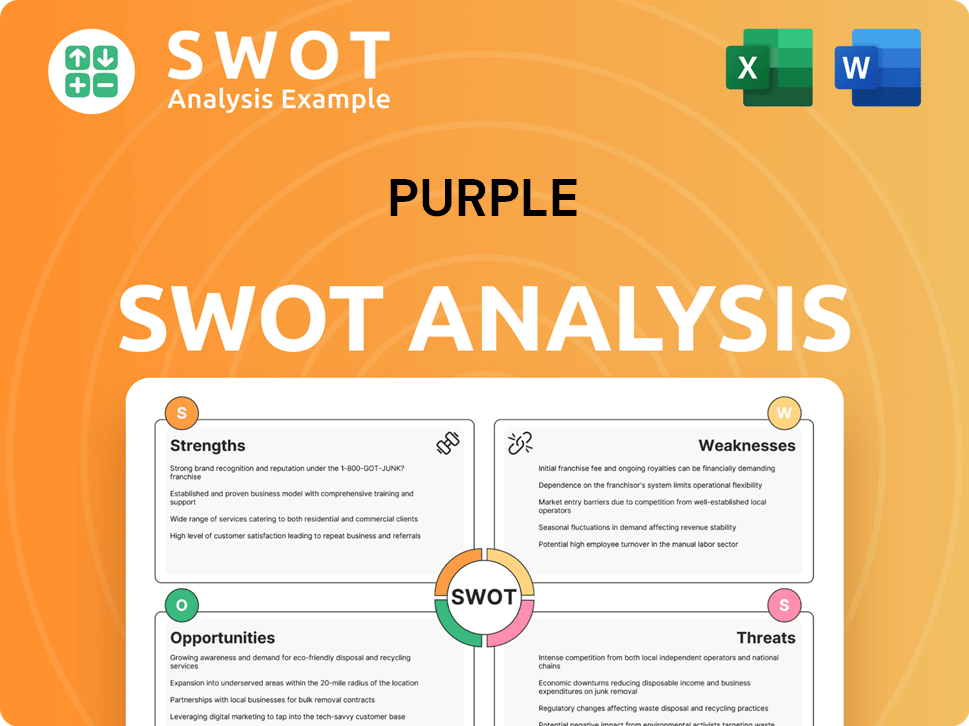
Purple SWOT Analysis
- Complete SWOT Breakdown
- Fully Customizable
- Editable in Excel & Word
- Professional Formatting
- Investor-Ready Format
Who Are the Main Competitors Challenging Purple?
The competitive landscape for Purple Innovation is dynamic, with various players vying for market share in the sleep technology sector. The company faces competition from both established mattress manufacturers and emerging direct-to-consumer brands. Understanding the competitive positioning of these entities is crucial for a comprehensive market analysis.
The Purple Company operates in a market characterized by intense rivalry. The company's business strategy must account for the diverse strategies employed by its competitors, including pricing, product innovation, brand recognition, and distribution channels. This analysis is essential for evaluating Purple Company's competitive advantages and potential growth strategy.
Key competitors include traditional mattress manufacturers and other innovative sleep technology companies. Some of the significant direct competitors include Tempur Sealy International and Serta Simmons Bedding. Tempur Sealy International holds a substantial market share of approximately 25% and boasts an extensive product line and established distribution network. Serta Simmons Bedding also holds a significant share, around 20%, offering a wide range of products.

Traditional Mattress Manufacturers
These companies have a long-standing presence in the market, often with established brand recognition and extensive retail networks. Their competitive strategies typically involve a broad product portfolio and aggressive marketing campaigns. Understanding their market share and distribution strategies is critical for Purple Company's competitive positioning.
Direct-to-Consumer (DTC) Brands
DTC brands like Casper, Leesa, and others focus on online sales and often differentiate themselves through innovative product designs, unique materials, and customer-centric approaches. They typically offer competitive pricing and convenient purchasing experiences. These brands challenge Purple Company with their digital-first strategies.
Sleep Technology Companies
These companies emphasize technological advancements in sleep products, such as smart beds, adjustable firmness, and temperature regulation. They often target tech-savvy consumers and focus on product innovation to gain a competitive edge. These companies are a key part of the industry analysis.
Pricing Strategies
Competitors use a variety of pricing strategies, including value pricing, premium pricing, and promotional discounts. Purple Company must analyze these strategies to maintain a competitive price point while highlighting its unique value proposition. This is a crucial aspect of Purple Company's revenue streams.
Product Innovation
Product innovation is a key differentiator. Competitors continuously introduce new materials, designs, and features to attract customers. Purple Company must invest in R&D to stay ahead of the curve and offer unique sleep solutions. This is a critical element of Purple Company's growth strategy.
Distribution Channels
Competitors utilize various distribution channels, including retail stores, online platforms, and partnerships. Purple Company must optimize its distribution strategy to reach its target market effectively. The expansion of the commercial relationship with Mattress Firm is a prime example of this.
Key Competitor Analysis
Other notable competitors in the broader sleep products market include La-Z-Boy, Sleep Number, HNI, Sealy, and Springwel Mattresses. In the direct-to-consumer and mattress-in-a-box segments, Purple Company competes with brands such as Casper, Leesa, GhostBed, Nectar, Saatva, WinkBeds, and Helix. These competitors challenge Purple Company through various strategies, including pricing, product innovation, brand recognition, and distribution channels. For instance, Casper offers a range of mattresses with a medium to slightly firm feel and soft top foams for contouring and pressure relief. Helix differentiates itself with personalized sleep solutions and customizable firmness options. The market is also seeing new and emerging players disrupting the traditional landscape, and mergers or alliances can significantly impact competitive dynamics. For example, Purple Company recently announced a significant expansion of its commercial relationship with Mattress Firm, which will more than double its retail footprint in Mattress Firm stores nationwide, increasing Purple Company mattress slots from 5,000 to 12,000, expected to drive over $70 million in incremental net revenue starting next year.
- Tempur Sealy International: A major player with a substantial market share and extensive product lines.
- Serta Simmons Bedding: Another significant competitor with a broad range of products.
- Casper: A DTC brand known for its innovative designs and customer-focused approach.
- Helix: Offers personalized sleep solutions and customizable firmness options.
- Mattress Firm: Purple Company's strategic partner, significantly expanding its retail presence.
For a deeper understanding of Purple Company's growth strategy, explore the Growth Strategy of Purple.
Purple PESTLE Analysis
- Covers All 6 PESTLE Categories
- No Research Needed – Save Hours of Work
- Built by Experts, Trusted by Consultants
- Instant Download, Ready to Use
- 100% Editable, Fully Customizable

What Gives Purple a Competitive Edge Over Its Rivals?
The Purple Company, known for its innovative sleep products, carves out its niche in the competitive landscape through a blend of proprietary technology, a strong brand, and strategic market positioning. A comprehensive market analysis reveals that its competitive advantages stem from its unique GelFlex Grid technology, which provides significant differentiation in a crowded market. This technology, developed over three decades, offers superior pressure relief and support, setting it apart from traditional mattress designs.
Purple Company's business strategy focuses on a direct-to-consumer (DTC) model, which enhances profit margins and fosters direct customer relationships. This approach, combined with effective marketing campaigns, has built strong brand recognition. The company's expansion into retail, including 58 showrooms across the United States as of December 31, 2024, further strengthens its market presence and customer engagement. The company's recent performance indicates a focus on innovation and strategic partnerships to maintain its competitive edge.
Purple Company's success is also driven by a commitment to customer satisfaction, reflected in its high-quality products and generous return policies. The company's ability to adapt and innovate is crucial in the evolving competitive landscape. For a deeper dive into the company's origins and evolution, consider reading Brief History of Purple.
GelFlex Grid Technology
The core of Purple's competitive advantage is its proprietary GelFlex Grid. This technology, developed over 30 years, provides exceptional pressure relief and support. The GelFlex Grid's unique design allows it to adapt instantly to movement, enhancing comfort. This innovation is a key differentiator in the mattress market.
Direct-to-Consumer (DTC) Model
Purple Company leverages a direct-to-consumer (DTC) model to enhance profitability and customer relationships. This approach allows for better control over the customer experience and direct feedback. The DTC model also supports effective marketing and brand building, contributing to strong brand recognition.
Retail Expansion
Purple strategically expands its retail presence to enhance customer engagement and brand visibility. As of December 31, 2024, the company operates 58 showrooms across the United States. This expansion, including strategic partnerships, aims to increase market share and improve customer accessibility.
Customer Satisfaction
Purple prioritizes customer satisfaction through high-quality products and generous return policies. This focus on customer experience builds brand loyalty and positive word-of-mouth. By ensuring customer satisfaction, Purple aims to maintain its competitive edge in the market.
Key Competitive Advantages
Purple's competitive advantages are multifaceted, including its proprietary technology, DTC model, and retail expansion. These elements work together to create a strong market position. The company's ability to innovate and adapt to market changes is crucial for sustained success in the competitive landscape.
- Proprietary GelFlex Grid technology for superior comfort and support.
- Direct-to-consumer model for enhanced customer relationships and profitability.
- Strategic retail expansion to increase brand visibility and customer engagement.
- Commitment to customer satisfaction through quality products and return policies.
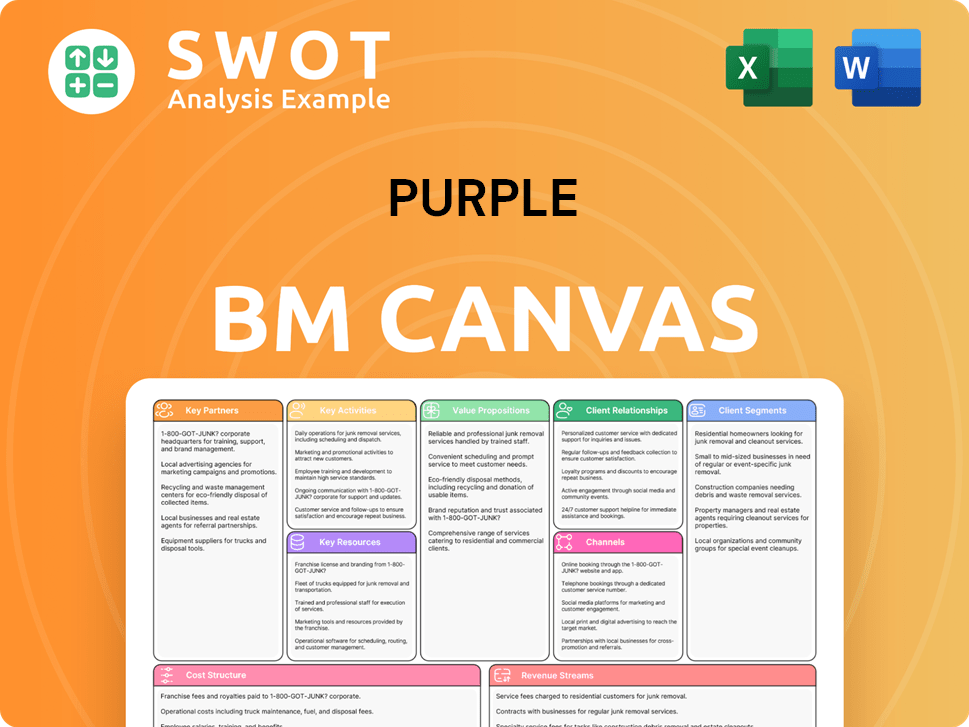
Purple Business Model Canvas
- Complete 9-Block Business Model Canvas
- Effortlessly Communicate Your Business Strategy
- Investor-Ready BMC Format
- 100% Editable and Customizable
- Clear and Structured Layout
What Industry Trends Are Reshaping Purple’s Competitive Landscape?
The competitive landscape for sleep products is shaped by trends like technological advancements, evolving consumer preferences, and economic shifts. The market is experiencing rapid technological changes and a growing shift towards e-commerce and direct-to-consumer models. The market analysis reveals that consumer spending and potential tariff impacts pose challenges, particularly affecting premium mattress sales. Despite these hurdles, the company is actively pursuing strategies to remain resilient and capitalize on opportunities.
The future outlook for the company involves focusing on its 'Path to Premium' strategy and innovation, including the full rollout of its Rejuvenate 2.0 collection. Wholesale distribution expansion, with a significant partnership, is expected to boost revenue. Operational efficiencies and cost savings are also key focuses. The company's ability to leverage its unique material technology for healthcare applications and the growing demand for premium sleep products present significant opportunities. For 2025, the company forecasts revenue between $465 million and $485 million and adjusted EBITDA ranging from flat to a positive $10 million.
Industry Trends
The sleep products industry is influenced by technological advancements and evolving consumer preferences. E-commerce and direct-to-consumer models are gaining traction. Consumer spending and potential tariffs are impacting the market. For more on the company's target audience, see Target Market of Purple.
Future Challenges
Consumer discretionary spending and potential tariff impacts remain challenges. Wholesale and e-commerce channels have experienced reduced demand. The company's ability to navigate these challenges will be critical. Ensuring profitability through premium product sales is a key focus.
Opportunities
Expanding into international markets and developing additional comfort technology product lines are significant opportunities. The global sleep products market is projected to grow at a CAGR of 6.7%, with the premium segment at 9.3%. The company's unique material technology offers promising healthcare applications.
Business Strategy
The company is focused on its 'Path to Premium' strategy and innovation. Wholesale distribution expansion is planned, expected to drive over $70 million in incremental net revenue. Operational efficiencies and cost savings, with an expected $25-30 million in annual EBITDA savings, are also key.
Key Takeaways
The company faces challenges related to consumer spending and tariffs but is actively pursuing growth through innovation and strategic partnerships. The company's focus on premium products and operational efficiencies is designed to improve profitability. The company has a positive outlook for 2025 with revenue projections between $465 million and $485 million.
- Market analysis reveals the importance of adapting to technological and consumer trends.
- The company's business strategy includes expanding wholesale distribution and focusing on premium products.
- The company is targeting operational efficiencies to improve financial performance.
- The global sleep products market's growth offers significant opportunities.
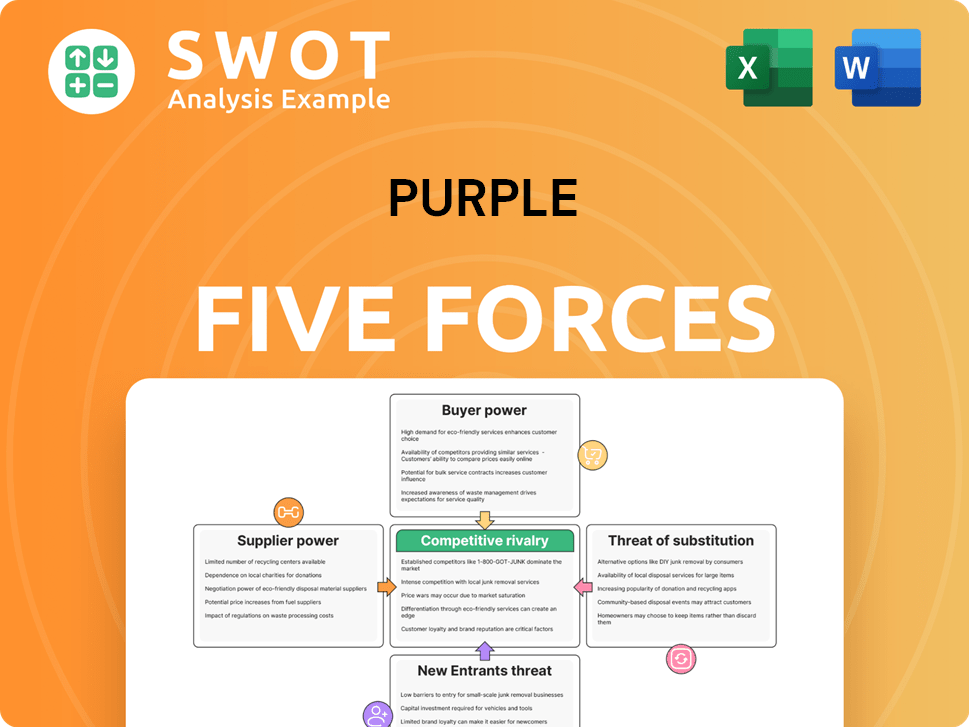
Purple Porter's Five Forces Analysis
- Covers All 5 Competitive Forces in Detail
- Structured for Consultants, Students, and Founders
- 100% Editable in Microsoft Word & Excel
- Instant Digital Download – Use Immediately
- Compatible with Mac & PC – Fully Unlocked
Related Blogs

- What are Mission Vision & Core Values of Purple Company?
- What is Growth Strategy and Future Prospects of Purple Company?
- How Does Purple Company Work?
- What is Sales and Marketing Strategy of Purple Company?
- What is Brief History of Purple Company?
- Who Owns Purple Company?
- What is Customer Demographics and Target Market of Purple Company?
Disclaimer
All information, articles, and product details provided on this website are for general informational and educational purposes only. We do not claim any ownership over, nor do we intend to infringe upon, any trademarks, copyrights, logos, brand names, or other intellectual property mentioned or depicted on this site. Such intellectual property remains the property of its respective owners, and any references here are made solely for identification or informational purposes, without implying any affiliation, endorsement, or partnership.
We make no representations or warranties, express or implied, regarding the accuracy, completeness, or suitability of any content or products presented. Nothing on this website should be construed as legal, tax, investment, financial, medical, or other professional advice. In addition, no part of this site—including articles or product references—constitutes a solicitation, recommendation, endorsement, advertisement, or offer to buy or sell any securities, franchises, or other financial instruments, particularly in jurisdictions where such activity would be unlawful.
All content is of a general nature and may not address the specific circumstances of any individual or entity. It is not a substitute for professional advice or services. Any actions you take based on the information provided here are strictly at your own risk. You accept full responsibility for any decisions or outcomes arising from your use of this website and agree to release us from any liability in connection with your use of, or reliance upon, the content or products found herein.