

Hyundai Steel Bundle

Can Hyundai Steel Conquer the Shifting Steel Market?
Hyundai Steel is making waves with a massive $21 billion investment in the U.S., including a new Electric Arc Furnace steel mill. This strategic move, announced in March 2025, signals a significant shift in the company's approach to the Hyundai Steel SWOT Analysis. But how does Hyundai Steel stack up against its rivals in this dynamic environment? This analysis delves into the competitive landscape, examining its position and future outlook.

This exploration of the Hyundai Steel competitive landscape will provide a detailed steel industry analysis, examining key players and their strategies. We'll dissect the company's market share, financial performance, and product portfolio, comparing it to competitors like POSCO. Understanding Hyundai Steel's key strengths and weaknesses, along with its sustainability initiatives, is crucial for any investment analysis or strategic decision-making in the Korean steel market and beyond.
Where Does Hyundai Steel’ Stand in the Current Market?
Within the global steel industry, Hyundai Steel holds a significant market position. The company serves key sectors such as automotive, construction, and shipbuilding. It offers a comprehensive range of steel products to meet diverse industry needs. As of March 31, 2025, Hyundai Steel reported trailing 12-month revenue of $16.4 billion.
Hyundai Steel's primary geographic focus is the Korean domestic market, where it generates most of its revenue. However, it also exports its products globally, expanding its reach. The company is strategically investing in the U.S. market, aiming to enhance its supply chain agility. This expansion supports Hyundai Steel's long-term goals.
Despite facing recent financial challenges, Hyundai Steel is actively pursuing sustainable practices and technological advancements. The company's commitment to sustainability is recognized through its '2025 Sustainability Champion' status. This recognition highlights its dedication to environmental, safety, and social responsibility criteria.
 Financial Performance and Market Share
In 2024, Hyundai Steel faced a challenging year, with net profit decreasing to KRW 123 billion ($85.58 million) from KRW 443 billion in 2023. Sales revenues also declined by 10.3% year-on-year to KRW 23.22 trillion ($16.16 billion). The downturn was primarily due to a slowdown in the construction market and an increase in low-priced steel imports. The company's total sales volume in 2024 was 17.07 million metric tons, a 7.9% decrease year-on-year.
Strategic Investments and Expansion
Hyundai Motor Group, including Hyundai Steel, plans to invest $21 billion in the U.S. from 2025 to 2028. This includes the construction of an Electric Arc Furnace (EAF) steel mill in Louisiana. The $5.8 billion plant will have an annual capacity of 2.7 million tons of steel. This strategic move aims to produce low-carbon steel sheets and enhance supply chain flexibility.
Sustainability Initiatives
Hyundai Steel is committed to sustainable practices, earning recognition as a '2025 Sustainability Champion'. The company's commitment includes a mid-to-long-term sustainability management strategy. This strategy focuses on eco-friendly management, win-win management, and right management. These initiatives are crucial for the company's future outlook.
Product Portfolio and Market Position
Hyundai Steel's product portfolio includes a wide range of steel products used in various sectors. The company's market position is strong, particularly in the Korean steel market. However, the company faces challenges such as the slowdown in the construction market. For more insights, explore the Brief History of Hyundai Steel.

Key Strengths and Weaknesses
Hyundai Steel's key strengths include its diverse product portfolio and strong presence in the Korean market. Its strategic investments in the U.S. and commitment to sustainability are also notable. Weaknesses include the impact of market downturns and increased competition from low-priced imports.
- Market Analysis: The company's performance is closely tied to the construction sector.
- Competitive Advantages: Hyundai Steel's competitive advantages include its strategic alliances and global presence.
- Industry Challenges: The steel industry faces challenges such as fluctuating raw material costs and environmental regulations.
- Future Outlook: Hyundai Steel's future outlook depends on its ability to adapt to market changes and technological advancements.
Hyundai Steel SWOT Analysis
- Complete SWOT Breakdown
- Fully Customizable
- Editable in Excel & Word
- Professional Formatting
- Investor-Ready Format

Who Are the Main Competitors Challenging Hyundai Steel?
The Hyundai Steel competitive landscape is shaped by a global steel market that is both dynamic and fiercely contested. The company faces a complex web of rivals, both domestically and internationally, all vying for market share and profitability. Understanding these competitors is crucial for evaluating Hyundai Steel's position and future prospects.
Steel industry analysis reveals a market characterized by high capital intensity, cyclical demand, and the increasing importance of sustainability. Hyundai Steel market analysis must consider not only traditional competitors but also emerging trends like 'green steel' and the impact of geopolitical factors on raw material costs and trade policies. The company's success depends on its ability to adapt to these evolving challenges.
Hyundai Steel competitors span a wide range of companies, each with its own strengths and strategies. A comprehensive understanding of these rivals is essential for informed decision-making. For more in-depth information, you can explore the Owners & Shareholders of Hyundai Steel.

Key Domestic Competitor: POSCO
POSCO is Hyundai Steel's most significant direct competitor in South Korea. POSCO has been recognized as the world's most competitive steelmaker for 15 consecutive years as of 2024, according to World Steel Dynamics.
POSCO scored 8.62 out of 10 in 2024, highlighting its excellence in technological innovation, processing costs, and upstream and non-steel industries. POSCO's strategic focus on core steel and advanced battery materials indicates its commitment to maintaining its competitive edge.
Global Steel Giants
Hyundai Steel competes with major international steelmakers. These include Nippon Steel Corporation, ArcelorMittal, and Baowu Steel.
These companies were among the top five most competitive steelmakers in 2024. They challenge Hyundai Steel through pricing strategies, innovation, and market share dominance.
Other Notable Competitors
Other significant competitors include Nucor Corporation, Steel Dynamics, Inc., Tata Steel, JSW, CSC, and Ternium.
These companies compete with Hyundai Steel in various markets, employing diverse strategies to gain an advantage.
Market Dynamics and Trends
The global steel market was valued at $1.47 trillion in 2024. It is projected to reach $2.11 trillion by 2032.
This growth indicates intense competition for market share. The trend towards 'green steel' and decarbonization is driving significant investments in cleaner technologies.
Emerging Players and Strategic Moves
New and emerging players, along with mergers and alliances, are reshaping the competitive landscape. Investments in cleaner technologies like hydrogen-based direct reduced iron (H-DRI) and electric arc furnaces (EAFs) are creating new competitive advantages.
Hyundai Steel's investment in an EAF steel mill in Louisiana, U.S., with a capacity of 2.7 million tons per year, aims to produce low-carbon steel sheets. This move could intensify competition in the U.S. market.
Sustainability and Reputational Challenges
Hyundai's steel supply chain, including suppliers like Vale and Ternium, has been linked to environmental and human rights concerns. These issues could pose a reputational challenge in the competitive market.
Addressing these concerns is crucial for maintaining a strong competitive position. Sustainability initiatives are becoming increasingly important in the steel industry.
Key Competitive Factors
Several factors influence the competitive dynamics within the steel industry. These include production costs, technological innovation, product quality, and market access. Hyundai Steel and its competitors must excel in these areas to succeed.
- Price: Competitors often engage in price wars to capture market share.
- Innovation: Technological advancements, such as the adoption of EAFs and 'green steel' production methods, are crucial.
- Market Share: Companies strive to increase their market share through strategic investments and acquisitions.
- Sustainability: Environmental and social responsibility are becoming increasingly important.
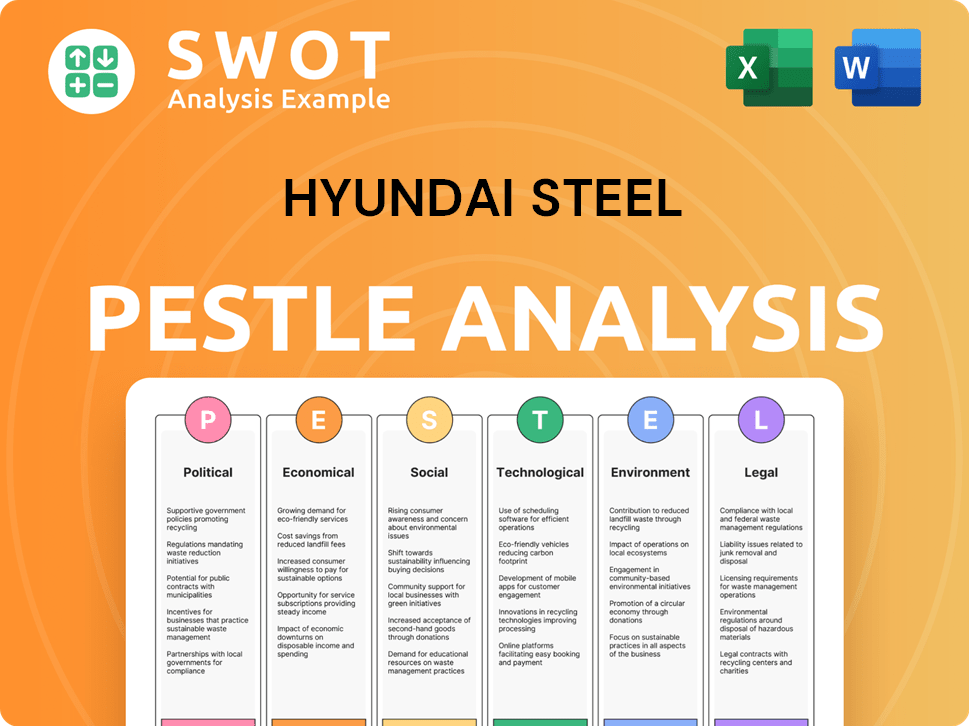
Hyundai Steel PESTLE Analysis
- Covers All 6 PESTLE Categories
- No Research Needed – Save Hours of Work
- Built by Experts, Trusted by Consultants
- Instant Download, Ready to Use
- 100% Editable, Fully Customizable
What Gives Hyundai Steel a Competitive Edge Over Its Rivals?
Understanding the Growth Strategy of Hyundai Steel involves a deep dive into its competitive advantages within the dynamic steel industry. Hyundai Steel's success is significantly shaped by its strategic positioning, technological advancements, and commitment to sustainability. Analyzing these factors provides a comprehensive view of its strengths and how it navigates the competitive landscape.
Hyundai Steel's competitive edge is multifaceted, stemming from its unique integration within the Hyundai Motor Group. This vertical integration allows for a stable supply chain and innovation in automotive steel. Furthermore, the company's focus on technological innovation, including AI-driven manufacturing and sustainable practices, positions it well for future growth. These elements are crucial in a market where efficiency, quality, and environmental responsibility are increasingly valued.
The company's strategic moves and market positioning are critical in the overall steel industry analysis. Hyundai Steel's ability to adapt to market demands, invest in advanced technologies, and embrace sustainable practices are key factors in its continued success. The following sections will explore these aspects in detail, providing a clear picture of Hyundai Steel's competitive advantages and its position relative to its competitors.
Vertical Integration within the Hyundai Motor Group
Hyundai Steel's vertical integration provides a significant advantage in the Hyundai Steel competitive landscape. As the steelmaking subsidiary for the Hyundai Motor Group, it ensures a stable supply of high-quality steel for vehicles. This structure also allows for design flexibility and cost management, crucial in the competitive automotive sector. This strategic alignment enhances innovation and efficiency, setting it apart from other steel manufacturing companies.
Technological Innovation and Advanced Manufacturing
Hyundai Steel is at the forefront of technological innovation, investing heavily in advanced manufacturing processes. By 2025, the company plans to fully operate its 'Smart Enterprise system' using AI and big data to enhance every stage of the steel-making process. This includes AI-based production systems and the development of virtual sensor technology, improving fuel efficiency and monitoring errors. These advancements are key to improving product quality and operational efficiency.
Sustainability Initiatives and Carbon Neutrality Roadmap
Hyundai Steel is committed to sustainable practices, aiming for carbon neutrality by 2050. The company has a detailed roadmap to transition to a low-carbon production system, increasing its reliance on electric furnaces and carbon capture technologies. This includes an investment of approximately KRW 680 billion (around $500 million) from 2021 to 2025 for environmental improvements and greenhouse gas reduction. Focusing on eco-friendly management and green steel production is vital in the current market.
Competitive Advantages and Market Positioning
Hyundai Steel's competitive advantages are multifaceted, including vertical integration, technological innovation, and a strong focus on sustainability. These elements differentiate it from competitors in the Korean steel market and globally. The company's strategic moves and investments in advanced technologies and sustainable practices are key to its long-term success. These factors contribute to its ability to maintain a strong position in the market.
Key Strengths and Weaknesses
Hyundai Steel's key strengths include its vertical integration, technological advancements, and sustainability initiatives. However, weaknesses include its reliance on fossil fuels and the potential for imitation of its sustainability efforts. Understanding these aspects is crucial for a comprehensive Hyundai Steel market analysis.
- Strengths: Vertical integration, technological innovation, and sustainability initiatives.
- Weaknesses: Reliance on fossil fuels and potential for imitation.
- Opportunities: Expanding green steel production and increasing market share.
- Threats: Industry shifts and the need for consistent sustainability efforts.
Hyundai Steel Business Model Canvas
- Complete 9-Block Business Model Canvas
- Effortlessly Communicate Your Business Strategy
- Investor-Ready BMC Format
- 100% Editable and Customizable
- Clear and Structured Layout

What Industry Trends Are Reshaping Hyundai Steel’s Competitive Landscape?
The global steel industry is experiencing significant shifts, creating both challenges and opportunities for companies like Hyundai Steel. Key trends include the increasing demand for 'green steel' driven by environmental regulations and investor pressure, necessitating a move towards cleaner technologies. Simultaneously, economic factors such as urbanization and industrialization, particularly in emerging markets, are influencing market growth. Understanding the Hyundai Steel competitive landscape requires a deep dive into these dynamics.
Hyundai Steel faces the need to navigate these industry shifts while addressing its own sustainability challenges. The company's strategic investments, such as the new EAF steel mill in the U.S., and its commitment to carbon neutrality by 2050 are crucial. However, its reliance on fossil fuels and the impact of economic downturns in key sectors present immediate hurdles. A comprehensive Hyundai Steel market analysis is essential to assess its position.
Industry Trends
The steel industry is increasingly focused on decarbonization and 'green steel' production. This shift is driven by stricter environmental regulations, investor pressures, and carbon pricing mechanisms. The global steel market is projected to grow from $1.47 trillion in 2024 to $2.11 trillion by 2032, indicating growth potential despite current challenges.
Future Challenges
Hyundai Steel faces challenges related to its sustainability efforts, including its reliance on fossil fuels. The company's 2024 financial results reflected a slowdown due to the sluggish construction market and increased low-priced steel imports. U.S. tariffs on imported steel also pose a challenge.
Opportunities
Hyundai Steel's investment in a U.S. steel plant will localize components and strengthen supply chains. The company is exploring new revenue streams in the offshore wind energy sector. Collaborations to develop LFP battery cathode material technology present further opportunities.
Strategic Response
Hyundai Steel is investing in low-carbon production and advanced technologies, particularly in the U.S. market. The company is also working on its 2050 carbon neutrality roadmap. Full operation of its 'Smart Enterprise system' by 2025 aims to improve operational efficiency.
Key Considerations for Hyundai Steel
Hyundai Steel's competitive position will evolve through strategic investments in low-carbon production and advanced technologies, especially in the U.S. market. Addressing its current fossil fuel reliance and strengthening its renewable energy strategy is crucial to maintain its sustainability champion status.
- The company's renewable energy usage rate was 0% in 2022 and 2023.
- Hyundai Steel plans to invest KRW 680 billion from 2021 to 2025 for environmental improvements.
- The global steel market is projected to reach $2.11 trillion by 2032.
- The imposition of U.S. tariffs on imported steel in March 2025 impacted South Korean steelmakers.
Hyundai Steel Porter's Five Forces Analysis
- Covers All 5 Competitive Forces in Detail
- Structured for Consultants, Students, and Founders
- 100% Editable in Microsoft Word & Excel
- Instant Digital Download – Use Immediately
- Compatible with Mac & PC – Fully Unlocked

Related Blogs

- What are Mission Vision & Core Values of Hyundai Steel Company?
- What is Growth Strategy and Future Prospects of Hyundai Steel Company?
- How Does Hyundai Steel Company Work?
- What is Sales and Marketing Strategy of Hyundai Steel Company?
- What is Brief History of Hyundai Steel Company?
- Who Owns Hyundai Steel Company?
- What is Customer Demographics and Target Market of Hyundai Steel Company?
Disclaimer
All information, articles, and product details provided on this website are for general informational and educational purposes only. We do not claim any ownership over, nor do we intend to infringe upon, any trademarks, copyrights, logos, brand names, or other intellectual property mentioned or depicted on this site. Such intellectual property remains the property of its respective owners, and any references here are made solely for identification or informational purposes, without implying any affiliation, endorsement, or partnership.
We make no representations or warranties, express or implied, regarding the accuracy, completeness, or suitability of any content or products presented. Nothing on this website should be construed as legal, tax, investment, financial, medical, or other professional advice. In addition, no part of this site—including articles or product references—constitutes a solicitation, recommendation, endorsement, advertisement, or offer to buy or sell any securities, franchises, or other financial instruments, particularly in jurisdictions where such activity would be unlawful.
All content is of a general nature and may not address the specific circumstances of any individual or entity. It is not a substitute for professional advice or services. Any actions you take based on the information provided here are strictly at your own risk. You accept full responsibility for any decisions or outcomes arising from your use of this website and agree to release us from any liability in connection with your use of, or reliance upon, the content or products found herein.