

Fusion Microfinance Bundle

How Does Fusion Microfinance Thrive in India's Microfinance Arena?
The Indian microfinance sector is a dynamic ecosystem, and Fusion Microfinance SWOT Analysis reveals its position within it. This company has grown rapidly, focusing on financial inclusion and empowering women in rural and semi-urban areas. Understanding the competitive landscape is crucial for investors, analysts, and anyone interested in the lending industry.

This analysis provides a comprehensive market analysis of Fusion Microfinance, examining its competitors and strategic positioning. We'll explore the Fusion Microfinance business model, its financial performance, and its impact on rural communities. By understanding the competitive analysis of Fusion Microfinance, you can gain valuable insights into the company's growth strategy and its ability to navigate the ever-changing microfinance industry.
Where Does Fusion Microfinance’ Stand in the Current Market?
Fusion Micro Finance Limited holds a significant position within the Indian microfinance industry, particularly among non-banking financial company-microfinance institutions (NBFC-MFIs). The company's core operations focus on providing microloans to women in rural and semi-urban areas, supporting their income-generating activities. As of December 31, 2023, Fusion Micro Finance reported an Assets Under Management (AUM) of ₹10,317 crore, demonstrating substantial growth and scale.
The company's value proposition centers on offering accessible financial services to underserved populations, especially women, through Joint Liability Group (JLG) loans. Fusion Micro Finance has built a widespread geographic presence with 1,180 branches across 25 states and 89 districts as of December 2023, enabling it to reach a vast number of clients. Over time, the company has diversified its offerings to include additional financial products, while micro-credit remains its primary focus.
 Market Share and Position
Fusion Micro Finance is a significant player in the Indian microfinance sector. Its AUM of ₹10,317 crore as of December 31, 2023, places it among the top NBFC-MFIs in India. This substantial AUM reflects its robust outreach and client base, solidifying its market position.
Geographic Presence and Reach
The company's extensive branch network, with 1,180 branches across 25 states and 89 districts as of December 2023, allows it to serve a wide range of clients. This widespread presence is crucial for reaching underserved populations in rural and semi-urban areas. The Target Market of Fusion Microfinance is primarily women in these regions.
Financial Performance
Fusion Micro Finance has demonstrated strong financial performance. Its Gross Loan Portfolio (GLP) grew by 33.7% year-on-year to ₹10,317 crore as of December 31, 2023. The profit after tax (PAT) for Q3 FY24 was ₹121 crore, and its capital adequacy ratio was 22.8% as of December 2023.
Product and Service Diversification
While micro-credit remains the core, Fusion Micro Finance has diversified its offerings. It now includes individual loans and insurance products. This diversification enhances its ability to cater to a broader range of financial needs within its target demographic, improving its competitive edge.

Key Strengths and Market Dynamics
Fusion Micro Finance's strong market position is supported by its extensive geographic reach, robust financial performance, and focus on serving underserved populations. The company's ability to adapt to industry trends, such as digital transformation, further strengthens its competitive advantage.
- Extensive Branch Network: 1,180 branches across 25 states.
- Strong Financials: GLP growth of 33.7% year-on-year.
- Focus on JLG Loans: Core product for its target segment.
- Digital Transformation: Leveraging technology for efficiency and customer service.
Fusion Microfinance SWOT Analysis
- Complete SWOT Breakdown
- Fully Customizable
- Editable in Excel & Word
- Professional Formatting
- Investor-Ready Format

Who Are the Main Competitors Challenging Fusion Microfinance?
The Fusion Microfinance operates within a highly competitive Indian microfinance landscape. This environment is characterized by numerous players vying for market share in the financial services sector, particularly in the lending industry.
The Competitive Landscape of Fusion Microfinance is shaped by a mix of direct and indirect competitors, each employing different strategies to attract and retain customers. Understanding these dynamics is crucial for assessing Fusion Microfinance's market position and potential for growth. The microfinance company faces challenges from both established NBFC-MFIs and other financial institutions.
Fusion Microfinance competes with several key players in the Indian microfinance market. These competitors include both NBFC-MFIs and other financial institutions that offer similar financial services. A thorough market analysis reveals the strategies and strengths of these competitors.

Direct Competitors
Direct competitors include large and well-capitalized NBFC-MFIs that offer similar microloan products. These companies often target similar customer segments and geographic areas.
CreditAccess Grameen
A dominant player with a vast network and substantial assets under management (AUM). It challenges Fusion Microfinance through its extensive reach and strong market penetration.
Spandana Sphoorty Financial
Competes directly in the microloan segment, often targeting similar customer segments in rural and semi-urban areas. They compete on interest rates and product offerings.
Bandhan Bank
Originating as an MFI, Bandhan Bank poses a significant challenge due to its extensive reach and diversified financial products. Its large customer base provides a competitive advantage.
Indirect Competitors
Indirect competition comes from Small Finance Banks (SFBs) and other financial institutions. These competitors may offer a broader range of financial products.
AU Small Finance Bank and Equitas Small Finance Bank
These SFBs have expanded their microfinance portfolios, potentially drawing away more financially stable clients. They offer a wider array of financial services.
Competitive Dynamics
Competition in the microfinance sector is driven by pricing, loan disbursement speed, client relationship management, and tailored financial solutions. Market share shifts are influenced by outreach, operational efficiency, and client retention strategies. The entry of fintech players and mergers also reshape the market.
- Pricing: Competitive interest rates and fees are crucial for attracting customers.
- Speed of Loan Disbursement: Quick processing times can be a significant advantage.
- Client Relationship Management: Strong customer service and personalized attention are vital.
- Tailored Financial Solutions: Offering products that meet specific client needs.
Fusion Microfinance PESTLE Analysis
- Covers All 6 PESTLE Categories
- No Research Needed – Save Hours of Work
- Built by Experts, Trusted by Consultants
- Instant Download, Ready to Use
- 100% Editable, Fully Customizable

What Gives Fusion Microfinance a Competitive Edge Over Its Rivals?
The competitive advantages of Fusion Micro Finance Limited are deeply rooted in its strategic focus on the underserved rural and semi-urban markets in India. The company's approach, centered on understanding and serving its target clientele, especially women entrepreneurs, sets it apart in the Growth Strategy of Fusion Microfinance. This client-centric model, combined with a robust distribution network and a specialized lending methodology, forms the core of its competitive edge within the microfinance sector.
A key differentiator for Fusion Micro Finance is its extensive distribution network. As of December 2023, the company operated through a network of 1,180 branches across 25 states. This widespread presence allows it to reach areas where traditional banking services are limited, directly engaging with its target demographic. This extensive reach, combined with a focus on doorstep service and regular client interactions, fosters strong relationships and builds trust, critical in the microfinance landscape.
Fusion Micro Finance's competitive strategy is significantly enhanced by its focus on Joint Liability Group (JLG) lending. This model, where groups of women guarantee each other's loans, reduces credit risk and promotes a sense of community among borrowers. The company has refined its JLG methodology over time, leading to efficient loan disbursement and collection processes. Furthermore, its ability to maintain a healthy asset quality, with Gross Non-Performing Assets (GNPA) at 3.5% and Net Non-Performing Assets (NNPA) at 1.1% as of December 31, 2023, reflects effective risk management practices.
Extensive Distribution Network
Fusion Micro Finance's broad network of 1,180 branches across 25 states is a significant advantage in the competitive landscape. This extensive reach allows the company to serve a large customer base, especially in areas where traditional banking services are limited. The physical presence and direct engagement with clients build trust and foster strong relationships, which are essential for success in microfinance.
Specialized JLG Lending Model
The Joint Liability Group (JLG) lending model is a core competitive advantage. This approach, where groups of women guarantee each other's loans, minimizes credit risk and promotes a sense of community. The company's refined JLG methodology results in efficient loan disbursement and collection, contributing to its strong financial performance.
Strong Asset Quality
Fusion Micro Finance's ability to maintain healthy asset quality is a key indicator of its effective risk management. With a Gross Non-Performing Assets (GNPA) of 3.5% and Net Non-Performing Assets (NNPA) of 1.1% as of December 31, 2023, the company demonstrates strong financial health. This strong asset quality enhances its reputation and attracts investors.
Client-Centric Approach
Fusion Micro Finance's commitment to financial inclusion and women's empowerment resonates with its target demographic. This approach builds a strong brand reputation and distinguishes it from competitors. The company's focus on understanding and serving its clients' needs fosters loyalty and long-term relationships.
Key Competitive Advantages
Fusion Micro Finance's competitive advantages are multifaceted, including its extensive distribution network, specialized JLG lending model, and strong asset quality. These factors, combined with a client-centric approach, position the company favorably in the microfinance sector. Its focus on financial inclusion and women's empowerment further enhances its brand reputation and market position.
- Extensive branch network across underserved areas.
- Refined Joint Liability Group (JLG) lending methodology.
- Strong asset quality with low NPAs.
- Commitment to financial inclusion and women's empowerment.
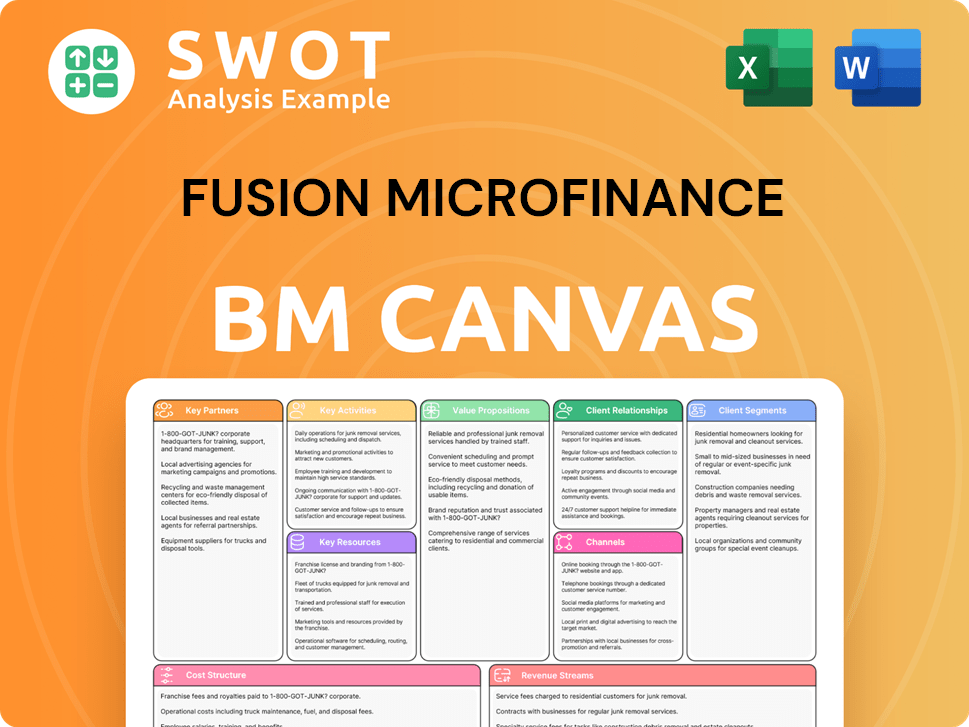
Fusion Microfinance Business Model Canvas
- Complete 9-Block Business Model Canvas
- Effortlessly Communicate Your Business Strategy
- Investor-Ready BMC Format
- 100% Editable and Customizable
- Clear and Structured Layout
What Industry Trends Are Reshaping Fusion Microfinance’s Competitive Landscape?
The competitive landscape for Fusion Microfinance, a prominent microfinance company in India, is shaped by dynamic industry trends, future challenges, and significant opportunities. Understanding these elements is crucial for assessing the company's position and potential for growth. The market analysis reveals that the microfinance sector is undergoing rapid changes, influenced by technological advancements, evolving consumer preferences, and regulatory shifts. This environment necessitates strategic adaptation to maintain a competitive edge and capitalize on emerging prospects within the financial services industry.
The lending industry, particularly within the microfinance segment, faces inherent risks, including credit risk, interest rate risk, and operational risk. The future outlook for Fusion Microfinance depends on its ability to effectively manage these risks while leveraging opportunities for expansion and innovation. The company's ability to adapt to digital transformation, diversify its product offerings, and navigate regulatory changes will be critical to its long-term success. For a detailed look into their strategic roadmap, consider exploring the Growth Strategy of Fusion Microfinance.
Industry Trends
Technological advancements are driving digital lending and cashless transactions, offering opportunities to enhance digital platforms. Regulatory changes from the Reserve Bank of India (RBI) continuously influence the operating environment. Consumer preferences are evolving, with a growing demand for diversified financial products beyond traditional microloans.
Future Challenges
Digital literacy among the client base and the need for significant investment in IT infrastructure and cybersecurity pose challenges. Adapting to regulatory changes while maintaining profitability is a persistent challenge. Global economic shifts, such as inflationary pressures or interest rate fluctuations, can impact the cost of funds and borrower repayment capacity.
Opportunities
Enhancing digital platforms, streamlining loan applications, and improving collection efficiencies can reduce operational costs. Broadening the product portfolio and cross-selling services enhances client stickiness and revenue streams. Expanding into new underserved geographies and forming strategic partnerships offer growth potential.
Competitive Dynamics
Intensified competition from larger NBFC-MFIs and Small Finance Banks may offer more competitive rates. The entry of fintech companies with innovative lending models could challenge traditional MFI models. Strategic focus on core JLG model while embracing digital transformation and product diversification is vital.
Key Considerations for Fusion Microfinance
The company should focus on digital transformation to improve efficiency and reach. Diversifying product offerings to meet evolving customer needs is crucial. Strategic partnerships and expansion into underserved markets can drive growth.
- Digital Transformation: Investing in digital platforms to streamline loan applications and improve collection efficiencies.
- Product Diversification: Expanding beyond traditional microloans to include insurance, savings, and micro-pensions.
- Strategic Partnerships: Collaborating with technology providers and financial institutions to leverage resources and expertise.
- Geographical Expansion: Targeting underserved areas to increase market penetration.
Fusion Microfinance Porter's Five Forces Analysis
- Covers All 5 Competitive Forces in Detail
- Structured for Consultants, Students, and Founders
- 100% Editable in Microsoft Word & Excel
- Instant Digital Download – Use Immediately
- Compatible with Mac & PC – Fully Unlocked

Related Blogs

- What are Mission Vision & Core Values of Fusion Microfinance Company?
- What is Growth Strategy and Future Prospects of Fusion Microfinance Company?
- How Does Fusion Microfinance Company Work?
- What is Sales and Marketing Strategy of Fusion Microfinance Company?
- What is Brief History of Fusion Microfinance Company?
- Who Owns Fusion Microfinance Company?
- What is Customer Demographics and Target Market of Fusion Microfinance Company?
Disclaimer
All information, articles, and product details provided on this website are for general informational and educational purposes only. We do not claim any ownership over, nor do we intend to infringe upon, any trademarks, copyrights, logos, brand names, or other intellectual property mentioned or depicted on this site. Such intellectual property remains the property of its respective owners, and any references here are made solely for identification or informational purposes, without implying any affiliation, endorsement, or partnership.
We make no representations or warranties, express or implied, regarding the accuracy, completeness, or suitability of any content or products presented. Nothing on this website should be construed as legal, tax, investment, financial, medical, or other professional advice. In addition, no part of this site—including articles or product references—constitutes a solicitation, recommendation, endorsement, advertisement, or offer to buy or sell any securities, franchises, or other financial instruments, particularly in jurisdictions where such activity would be unlawful.
All content is of a general nature and may not address the specific circumstances of any individual or entity. It is not a substitute for professional advice or services. Any actions you take based on the information provided here are strictly at your own risk. You accept full responsibility for any decisions or outcomes arising from your use of this website and agree to release us from any liability in connection with your use of, or reliance upon, the content or products found herein.