

CP Axtra Bundle

How Does CP Axtra Navigate the Global Agro-Industrial Arena?
The agro-industrial sector is a dynamic global market, constantly adapting to meet rising demands for food. Charoen Pokphand Foods PCL (CPF), known as CP Axtra, is a major international player. Understanding the CP Axtra SWOT Analysis is crucial to understanding its position.

This analysis delves into the CP Axtra competitive landscape, examining its business strategy and performance within the CP Axtra industry. We'll explore CP Axtra's key competitors, market share, and growth, offering a comprehensive CP Axtra market analysis. This report provides insights into CP Axtra's strategic moves and how it compares to its rivals, essential for anyone tracking the company's progress.
Where Does CP Axtra’ Stand in the Current Market?
Charoen Pokphand Foods PCL (CPF) holds a significant market position as a leading agro-industrial and food conglomerate, particularly in the Asia Pacific region. The company's core operations encompass a vertically integrated business model. This includes animal feed production, animal breeding and farming, meat processing, and the manufacturing of semi-cooked and fully cooked meat and food products. Additionally, CPF is involved in meat and food retailing and operates restaurants.
This integrated approach allows CPF to control quality and efficiency across its extensive value chain, giving it a competitive edge in the CP Axtra industry. CPF's diverse operations, from livestock (swine, broilers, layers, ducks, and aquaculture) to food processing, contribute to its strong market presence. The company's ability to manage all stages of production, from feed to the final product, is a key aspect of its CP Axtra business strategy.
CPF's comprehensive approach, spanning feed production, farming, processing, and retail, creates a robust and adaptable business model. The company's strategic focus on vertical integration allows it to optimize costs, maintain product quality, and respond effectively to market changes. This strategy is crucial for maintaining and enhancing its CP Axtra market analysis.
 Geographic Presence and Market Reach
CPF has a substantial international presence, with investments in 17 countries and exports to over 40 countries globally. In 2024, 63% of CPF's total sales came from overseas operations across 13 countries, highlighting its global reach. Vietnam contributed THB 122 billion ($3.62 billion) to CPF's revenue in 2024, becoming its second-largest market.
Financial Performance and Revenue Breakdown (2024)
CPF's total sales revenue for 2024 was THB 580,747 million, with a net profit of THB 19,558 million, indicating a strong financial recovery. Revenue contributions by business segment were: 23% from animal feed, 55% from farming operations, and 22% from food products. This financial performance provides a clear view of the company's strengths.
Strategic Focus and Future Outlook
CPF's strategic focus for 2025 includes continued growth driven by a rise in swine prices in key markets due to African Swine Flu (ASF) resurgence, cost efficiency improvements, and a downtrend in certain raw material prices. The company's ability to adapt to market dynamics is crucial. This strategic direction is essential for understanding the CP Axtra competitive landscape.
Market Share and Competitive Advantages
CPF's vertically integrated model provides a significant competitive advantage, enabling it to control quality and efficiency across its value chain. The company's extensive international presence and diversified revenue streams further strengthen its market position. Understanding the company's structure is key to assessing its CP Axtra competitors.

Key Takeaways for CP Axtra
CPF's success is rooted in its vertically integrated business model, global presence, and strategic focus on cost efficiency and market expansion. The company's financial performance in 2024 and its strategic plans for 2025 demonstrate its resilience and growth potential. For more detailed information, check out the Owners & Shareholders of CP Axtra article.
- Vertical integration provides control over the entire value chain.
- Global presence diversifies revenue streams and reduces risk.
- Strategic focus on cost efficiency and market expansion drives growth.
- Strong financial performance in 2024 indicates recovery and resilience.
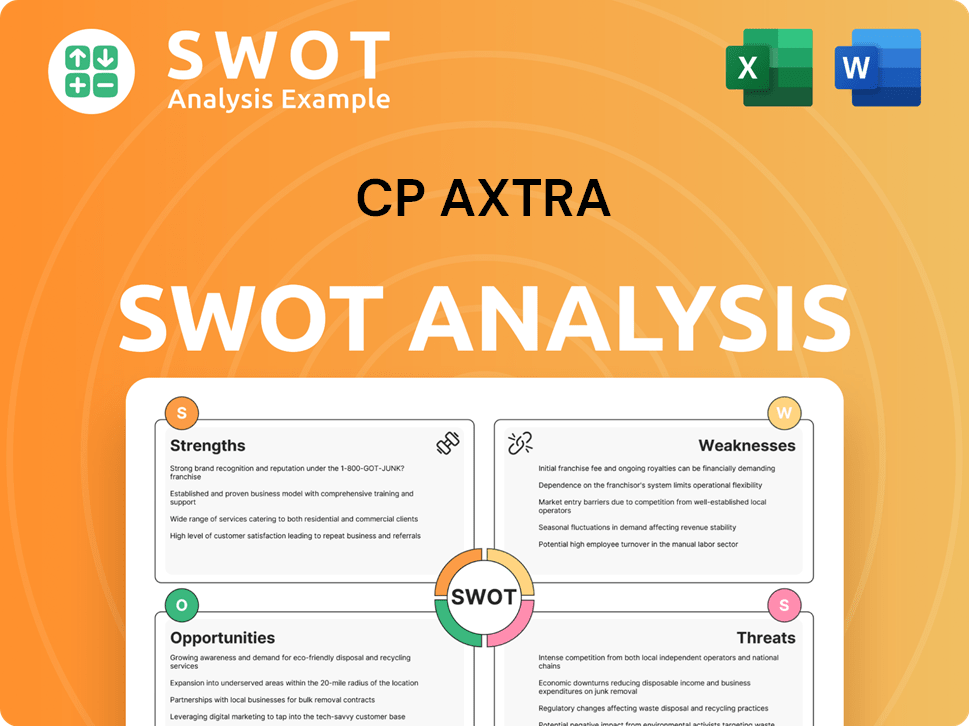
CP Axtra SWOT Analysis
- Complete SWOT Breakdown
- Fully Customizable
- Editable in Excel & Word
- Professional Formatting
- Investor-Ready Format
Who Are the Main Competitors Challenging CP Axtra?
In the agro-industrial and food sector, understanding the CP Axtra competitive landscape is crucial for strategic decision-making. This involves a thorough CP Axtra market analysis to identify key players and their strategies. The competitive environment is dynamic, with companies constantly adapting to market changes and consumer demands.
This analysis focuses on the major competitors of Charoen Pokphand Foods PCL (CPF), providing insights into their financial performance, strategic moves, and market positioning. The goal is to offer a comprehensive view of the CP Axtra industry and the challenges and opportunities it presents.
The competitive dynamics are influenced by factors such as price competitiveness, product innovation, and distribution networks. Ongoing outbreaks of African Swine Flu (ASF) in certain Asian regions continue to impact supply and demand dynamics, influencing meat prices and creating both challenges and opportunities for all players in the livestock sector. For more information on the company's growth strategy, see Growth Strategy of CP Axtra.

Betagro Public Company Limited (BTG)
Betagro is a key competitor in the Thai market. Their integrated operations and market expansion are significant strengths.
In 2024, BTG reported total revenue of THB 114,942.6 million, a 5.3% increase. They plan to invest THB 4.8 billion in 2025.
Thai Foods Group Public Company Limited (TFG)
TFG operates in poultry, swine, and feed mill businesses. Their strong performance in retail is a competitive advantage.
TFG's trailing 12-month revenue as of March 31, 2025, was $1.96 billion. In Q1 2025, net profit surged 1,072% year-on-year.
GFPT Public Company Limited
GFPT focuses on the integrated poultry business. Their performance is influenced by feed costs and export revenue.
GFPT reported a net profit of THB 1.973 billion in 2024. Total revenue from sales in 2024 was THB 19.314 billion.
Competitive Challenges
These competitors challenge CPF through price competitiveness, product innovation, and distribution networks.
The ASF outbreaks continue to impact supply and demand dynamics, influencing meat prices across the sector.
Market Dynamics
Understanding the CP Axtra business strategy requires analyzing the impact of global events.
The livestock sector faces constant shifts due to disease outbreaks and changing consumer preferences.
Strategic Considerations
Companies must adapt their strategies to remain competitive. This includes focusing on efficiency and innovation.
Analyzing CP Axtra's competitors is essential for making informed investment decisions.
Key Takeaways for CP Axtra Market Analysis
The CP Axtra company overview and analysis reveals a competitive landscape shaped by several key players. Understanding their strengths and weaknesses is crucial.
- Betagro's integrated operations and expansion plans.
- TFG's strong performance in retail and profit growth.
- GFPT's focus on integrated poultry and export revenue.
- The impact of ASF on supply and demand dynamics.
- The importance of adapting to market changes and consumer preferences.
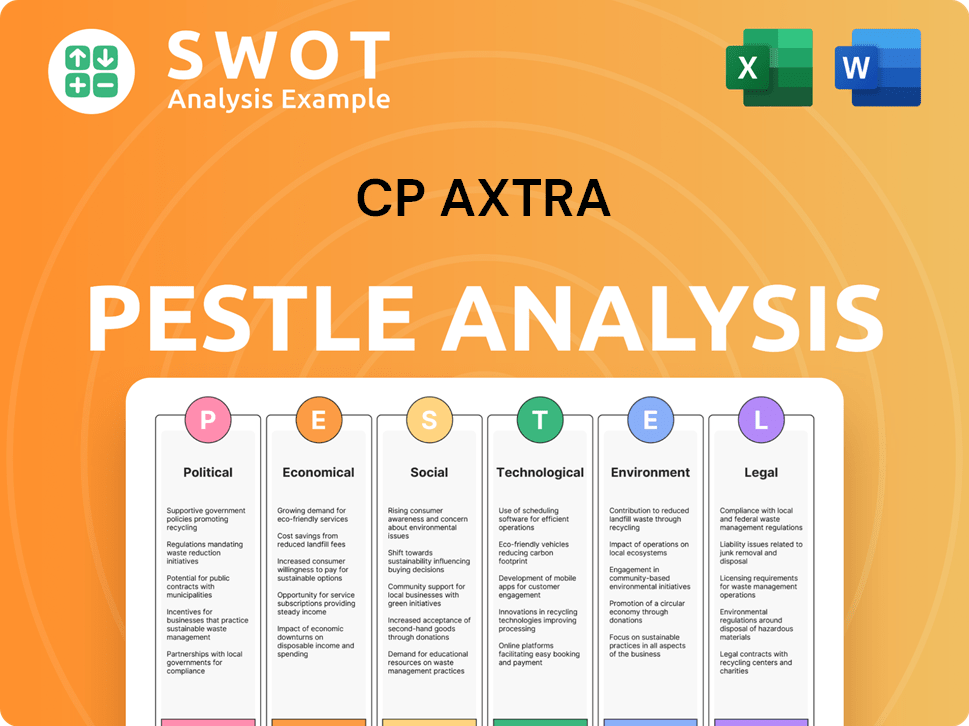
CP Axtra PESTLE Analysis
- Covers All 6 PESTLE Categories
- No Research Needed – Save Hours of Work
- Built by Experts, Trusted by Consultants
- Instant Download, Ready to Use
- 100% Editable, Fully Customizable
What Gives CP Axtra a Competitive Edge Over Its Rivals?
Analyzing the CP Axtra competitive landscape reveals several key strengths. The company, through its parent entity, Charoen Pokphand Foods PCL (CPF), has cultivated a robust business model. This model is underscored by extensive vertical integration and a wide global presence, which are crucial for understanding the CP Axtra market analysis.
CPF's operational scope extends across animal feed production, farming, meat processing, and food production. This comprehensive approach allows for greater control over the supply chain. It also enhances efficiency and cost management, as demonstrated by the company's financial performance in 2024. This strategic setup is essential when assessing the CP Axtra industry and its competitive dynamics.
The company's international footprint is another major advantage. With investments in 17 countries and exports to over 40, CPF diversifies its market reach. This diversification helps mitigate risks associated with single-market dependencies. It also enables the company to capitalize on regional demand shifts. This is a critical factor when evaluating CP Axtra's business strategy and its overall performance.
Vertical Integration
CPF's vertical integration, encompassing feed production to food processing, provides significant control over its supply chain. This control enhances quality, efficiency, and cost management. The integrated model was a key driver in CPF's earnings turnaround in 2024.
Global Presence
CPF's international presence, with investments in 17 countries and exports to over 40, is a substantial advantage. This global reach allows CPF to mitigate risks and capitalize on regional demand. In 2024, 63% of CPF's sales originated from overseas operations.
Technology and Data Analytics
CPF leverages technology and data analytics to gain customer insights and streamline processes. This approach improves operational efficiency and reduces costs. These advancements are crucial in maintaining a competitive edge.
Sustainability
CPF's commitment to sustainability is a growing competitive differentiator. It was ranked in the top 1% of the S&P Global Corporate Sustainability Assessment (CSA) score (DJSI) in 2024. This focus aligns with evolving consumer preferences and regulatory demands.
Key Competitive Advantages
CPF's competitive advantages include vertical integration, global presence, and technological advancements. These strengths are vital for understanding CP Axtra's key industry players and how they compete. These factors contribute to the company's ability to achieve strong CP Axtra market share and growth.
- Vertical Integration: Enables control over the entire supply chain, from feed production to food processing.
- Global Footprint: Diversifies market reach and reduces reliance on single markets.
- Technological Advancement: Improves operational efficiency and customer insights.
- Sustainability Focus: Enhances brand reputation and meets evolving consumer demands.
- Strategic Investments: Through its investment in CP Axtra, CPF enhances its ready-to-cook and ready-to-eat offerings.
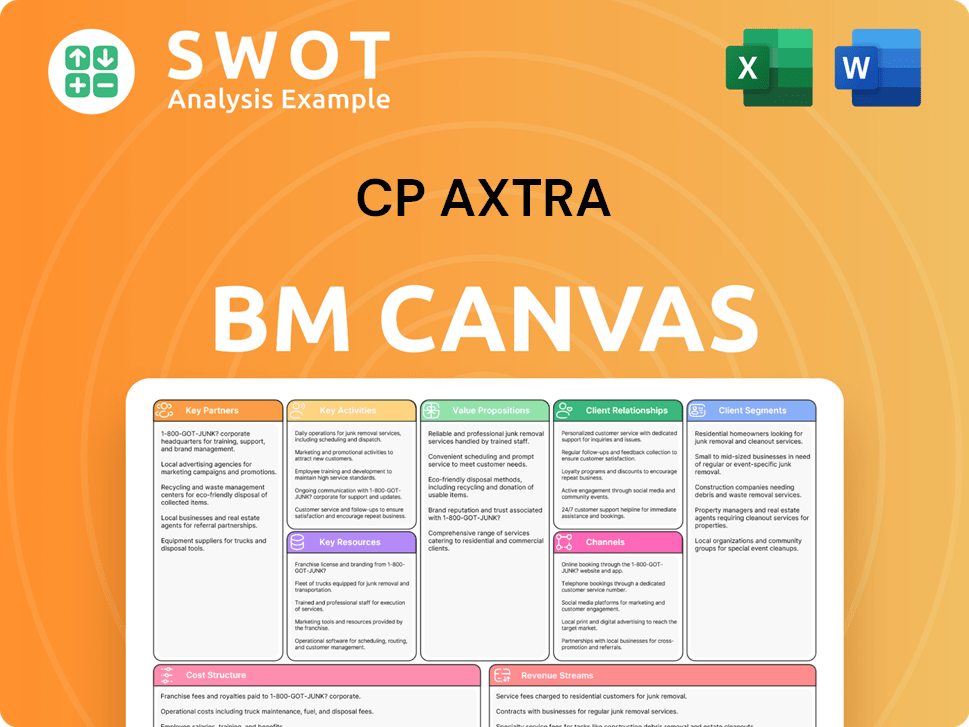
CP Axtra Business Model Canvas
- Complete 9-Block Business Model Canvas
- Effortlessly Communicate Your Business Strategy
- Investor-Ready BMC Format
- 100% Editable and Customizable
- Clear and Structured Layout
What Industry Trends Are Reshaping CP Axtra’s Competitive Landscape?
The agro-industrial and food sector is experiencing significant shifts, driven by technological advancements, evolving consumer preferences, and a growing emphasis on sustainability. These trends shape the CP Axtra competitive landscape, presenting both challenges and opportunities. Understanding these dynamics is crucial for assessing the company's future performance and strategic positioning.
Key risks include fluctuating raw material prices and potential disease outbreaks, such as African Swine Flu (ASF), which can significantly impact meat prices and supply chains. Regulatory changes related to environmental standards and food safety also pose ongoing challenges, requiring continuous adaptation and investment. The industry's future outlook hinges on how well companies navigate these complexities while capitalizing on emerging trends.
Industry Trends
Technological integration, like AI-driven data analytics, is becoming essential for optimizing operations and gaining customer insights. Consumer preferences are shifting towards health, convenience, and ethically produced food, driving demand for ready-to-eat/cook products. Sustainability is a core focus, with companies aiming for Net-Zero emissions.
Future Challenges
Maintaining profitability amidst fluctuating raw material prices and potential disease outbreaks poses a significant challenge. Regulatory changes related to environmental standards and food safety require continuous adaptation and investment. Intense competition from established players and potential new entrants disrupts traditional business models.
Opportunities
The growing demand for convenient and healthy food allows for expansion into ready-to-cook and ready-to-eat offerings. Expansion into emerging markets, particularly in Asia, continues to be a growth opportunity. Strategic partnerships and investment in sustainable practices enhance brand reputation and appeal to environmentally conscious consumers.
Strategic Initiatives
Continued focus on omni-channel sales strategies and expanding store footprints are key. Leveraging AI for operational efficiency and customer engagement can improve performance. Prioritizing sustainability and adapting to market dynamics will be crucial for maintaining leadership.
Key Factors for Success
For the company, adapting to changing market dynamics and investing in technology are crucial. Prioritizing sustainability and expanding into emerging markets will be key for future growth. Strategic partnerships and innovative product development will enhance its CP Axtra market analysis and competitive position.
- Expanding ready-to-eat/cook offerings to meet consumer demand.
- Investing in AI and data analytics for operational efficiency.
- Focusing on sustainable practices to attract environmentally conscious consumers.
- Exploring strategic partnerships for market expansion.
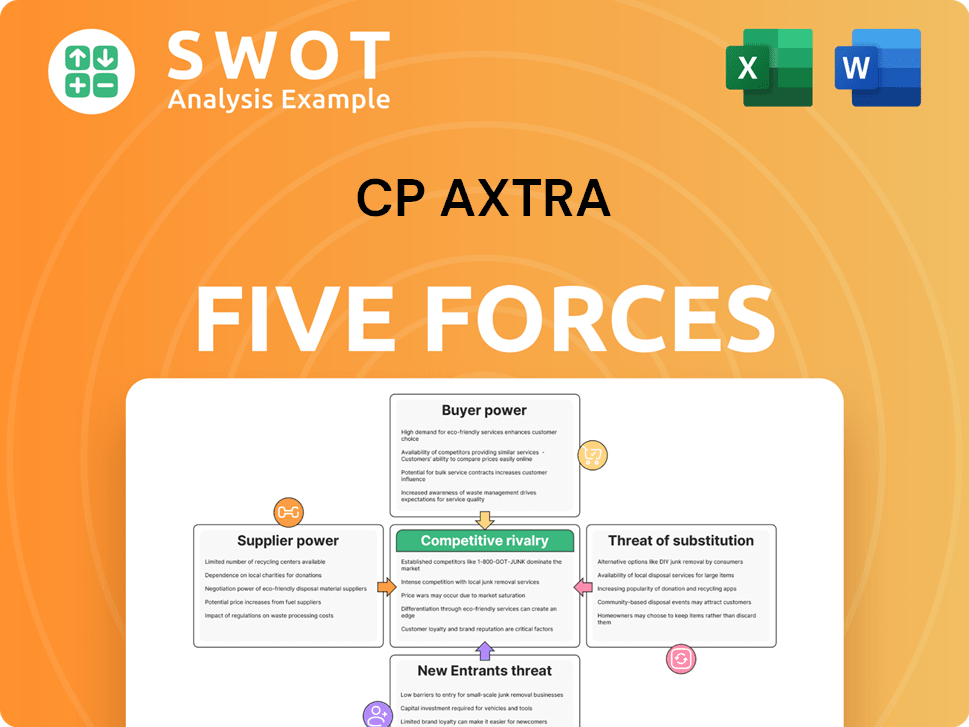
CP Axtra Porter's Five Forces Analysis
- Covers All 5 Competitive Forces in Detail
- Structured for Consultants, Students, and Founders
- 100% Editable in Microsoft Word & Excel
- Instant Digital Download – Use Immediately
- Compatible with Mac & PC – Fully Unlocked
Related Blogs

- What are Mission Vision & Core Values of CP Axtra Company?
- What is Growth Strategy and Future Prospects of CP Axtra Company?
- How Does CP Axtra Company Work?
- What is Sales and Marketing Strategy of CP Axtra Company?
- What is Brief History of CP Axtra Company?
- Who Owns CP Axtra Company?
- What is Customer Demographics and Target Market of CP Axtra Company?
Disclaimer
All information, articles, and product details provided on this website are for general informational and educational purposes only. We do not claim any ownership over, nor do we intend to infringe upon, any trademarks, copyrights, logos, brand names, or other intellectual property mentioned or depicted on this site. Such intellectual property remains the property of its respective owners, and any references here are made solely for identification or informational purposes, without implying any affiliation, endorsement, or partnership.
We make no representations or warranties, express or implied, regarding the accuracy, completeness, or suitability of any content or products presented. Nothing on this website should be construed as legal, tax, investment, financial, medical, or other professional advice. In addition, no part of this site—including articles or product references—constitutes a solicitation, recommendation, endorsement, advertisement, or offer to buy or sell any securities, franchises, or other financial instruments, particularly in jurisdictions where such activity would be unlawful.
All content is of a general nature and may not address the specific circumstances of any individual or entity. It is not a substitute for professional advice or services. Any actions you take based on the information provided here are strictly at your own risk. You accept full responsibility for any decisions or outcomes arising from your use of this website and agree to release us from any liability in connection with your use of, or reliance upon, the content or products found herein.