

Blink Charging Bundle

Can Blink Charging Conquer the EV Charging Arena?
The electric vehicle (EV) revolution is charging ahead, and with it, the demand for accessible and reliable charging infrastructure. Blink Charging Co. stands at the forefront of this transformation, offering a comprehensive suite of EV charging solutions. But in an increasingly crowded market, how does Blink Charging stack up against its rivals?

This article provides an in-depth Blink Charging SWOT Analysis, exploring the company's position within the dynamic EV charging market. We'll dissect the competitive landscape, analyzing key players and their strategies to understand Blink Charging's strengths, weaknesses, opportunities, and threats. Furthermore, we'll examine crucial aspects of the EV charging industry, including market trends, potential challenges, and the company's future outlook, providing valuable insights for investors and industry watchers alike.
Where Does Blink Charging’ Stand in the Current Market?
Blink Charging is a key player in the EV charging market, functioning as an owner, operator, and provider of EV charging equipment and services. The company offers a range of AC (Level 2) and DC fast charging (DCFC) stations designed for various settings, including residential, commercial, and public locations. Their cloud-based services enhance the charging experience for EV drivers and offer flexible business models for property owners, which is a critical aspect of their value proposition.
The company's core operations focus on deploying and managing EV charging infrastructure. They provide solutions for multi-unit dwellings, workplaces, public parking, retail, and hospitality sectors. This includes the installation, maintenance, and ongoing operation of charging stations, alongside network services that support user access and payment processing. The acquisition of SemaConnect in 2022 expanded its market reach, especially in commercial and fleet segments, solidifying its position as a comprehensive solutions provider in the Marketing Strategy of Blink Charging.
Blink Charging's value proposition centers on providing convenient and accessible charging solutions for EV drivers while offering flexible business models for property owners. This includes various ownership options and revenue-sharing agreements, making it attractive for businesses and property owners to invest in EV charging infrastructure. The company's focus on integrated solutions and network services differentiates it from competitors, emphasizing a seamless charging experience and efficient management of charging stations.
 Market Presence and Growth
Blink Charging has a strong presence in the United States and is expanding internationally, particularly in Europe and the Middle East. The company has shown consistent revenue growth in recent years, indicating an expanding operational scale. This growth is supported by strategic partnerships and acquisitions, such as the SemaConnect acquisition, which enhanced its market reach.
Customer Segments
Blink Charging primarily serves two key customer segments: EV drivers and property owners. EV drivers benefit from convenient charging access, while property owners can deploy and manage EV charging infrastructure. The company's flexible business models attract property owners by offering various ownership and revenue-sharing options.
Competitive Positioning
Blink Charging competes in the EV charging industry with a focus on public charging networks and integrated solutions. The company's strategy involves expanding its network and offering diverse charging options to meet the growing demand for EV charging stations. They are strategically positioning themselves as a comprehensive provider, differentiating themselves through network services and flexible ownership models.
Recent Developments
Recent developments include the acquisition of SemaConnect, which expanded their reach in the commercial and fleet segments. The company continues to focus on deploying charging solutions in multi-unit dwellings and public access locations. Financial performance for 2024-2025 will be detailed in upcoming earnings reports, which will provide insights into their growth trajectory.

Key Market Insights
The EV charging market is experiencing rapid expansion, driven by increasing EV adoption and government initiatives. Blink Charging's competitive landscape includes other major players in the EV charging industry. The company's ability to secure strategic partnerships and expand its network is crucial for maintaining its market position and driving future growth.
- Blink Charging is among the top providers in North America, particularly in the public charging network segment.
- The company's focus is on providing AC (Level 2) and DC fast charging (DCFC) stations.
- Blink has a strong presence in the U.S. with a growing international footprint.
- Blink Charging's market position is evolving from a hardware provider to an integrated solutions provider.
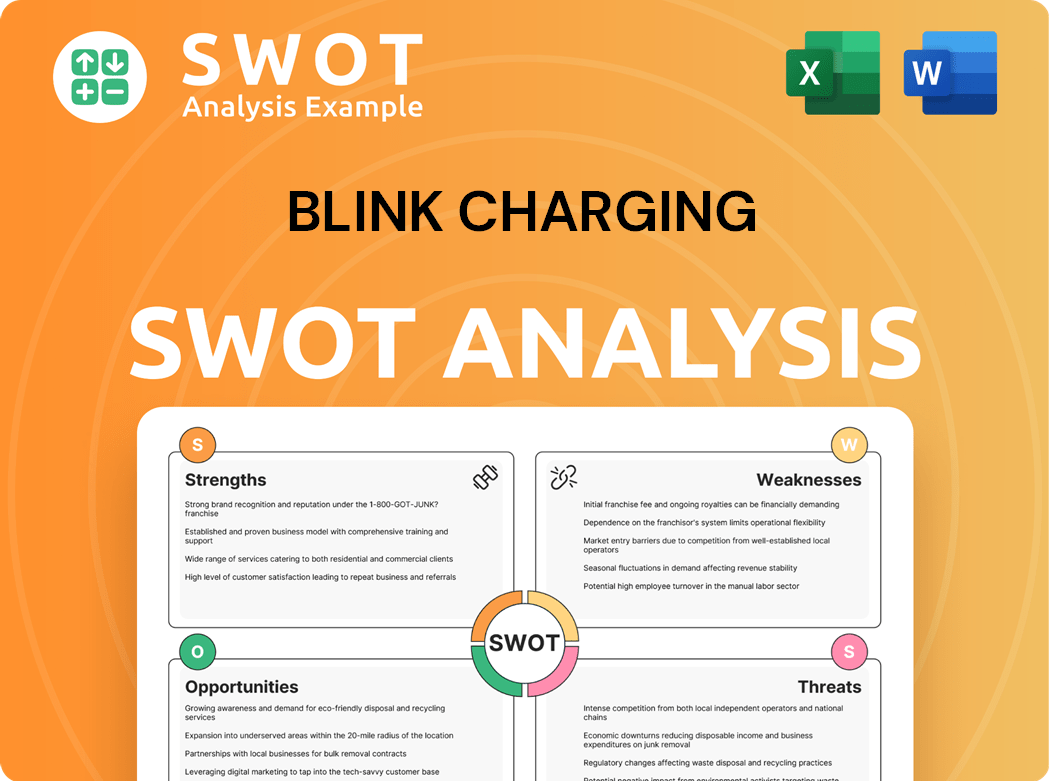
Blink Charging SWOT Analysis
- Complete SWOT Breakdown
- Fully Customizable
- Editable in Excel & Word
- Professional Formatting
- Investor-Ready Format
Who Are the Main Competitors Challenging Blink Charging?
The Growth Strategy of Blink Charging is significantly influenced by the dynamics of the EV charging market. The company operates within a competitive landscape, facing challenges from various players. Understanding the competitive environment is crucial for evaluating its market position and future prospects.
The EV charging industry is experiencing rapid growth, attracting both direct and indirect competitors. This competitive pressure necessitates strategic adaptation and innovation to maintain a strong market presence. The analysis of key competitors is essential for assessing the company's strengths and weaknesses.
The competitive landscape for Blink Charging includes a mix of established companies and emerging players. Direct competitors focus on similar services, while indirect competitors offer alternative charging solutions or leverage existing infrastructure. The evolving nature of the EV charging market requires continuous monitoring and strategic adjustments.

Direct Competitors
Direct competitors offer similar EV charging services, directly challenging Blink Charging's market share. These companies have established networks and are actively expanding their infrastructure. Competition in this segment is primarily based on network size, pricing, and technological advancements.
ChargePoint
ChargePoint is a leading competitor, boasting one of the largest EV charging networks globally. They offer a comprehensive suite of charging solutions for various settings. ChargePoint's strength lies in its extensive network and established relationships with businesses and fleet operators.
EVgo
EVgo primarily focuses on DC fast charging, strategically placing stations in high-traffic areas. They often partner with major retailers and gas stations, emphasizing speed and convenience. EVgo's focus on fast charging presents a direct challenge to Blink Charging.
Electrify America
Electrify America, backed by Volkswagen, has rapidly expanded its high-power DC fast charging network. They aim to provide a seamless long-distance travel experience for EV drivers. Electrify America's expansion poses a significant competitive threat.
Indirect Competitors
Indirect competitors offer alternative charging solutions or leverage existing infrastructure. These players may not directly compete in the same segment but still impact the overall market dynamics. Their presence adds complexity to the competitive landscape.
Traditional Energy Companies
Companies like BP Pulse and Shell Recharge are leveraging their existing infrastructure and customer bases to deploy charging networks. They pose a significant long-term threat due to their resources and established market presence. Their expansion could significantly impact the EV charging market.
Competitive Dynamics and Market Trends
The EV charging market is dynamic, with continuous changes in technology, partnerships, and market share. Several factors influence the competitive landscape, including network expansion, technological innovation, and strategic alliances. Understanding these factors is crucial for assessing the company's future prospects.
- Network Expansion: Competitors are aggressively expanding their charging networks, increasing the availability of charging stations.
- Technological Advancements: Innovations in charging speed, efficiency, and user experience are key differentiators.
- Strategic Partnerships: Collaborations with automakers, retailers, and other entities can provide a competitive advantage.
- Government Regulations: Policies and incentives related to EV adoption and infrastructure development influence market dynamics.
- Market Consolidation: Mergers and acquisitions are reshaping the competitive landscape, impacting market share and capabilities.
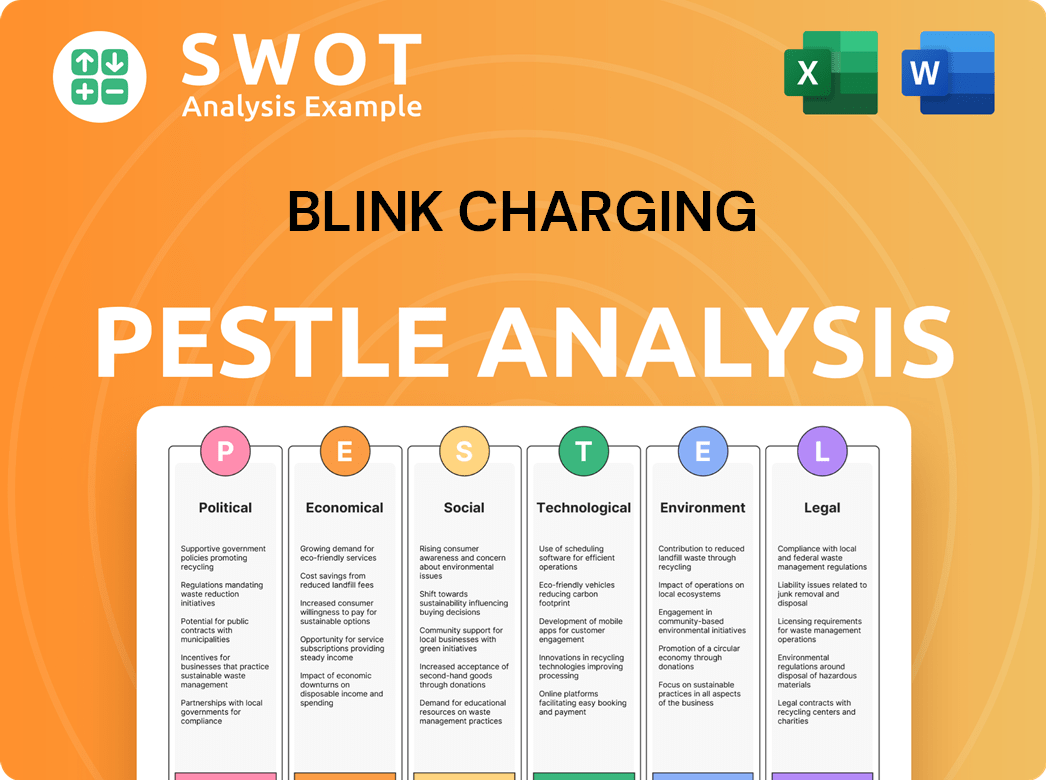
Blink Charging PESTLE Analysis
- Covers All 6 PESTLE Categories
- No Research Needed – Save Hours of Work
- Built by Experts, Trusted by Consultants
- Instant Download, Ready to Use
- 100% Editable, Fully Customizable
What Gives Blink Charging a Competitive Edge Over Its Rivals?
The competitive landscape for EV charging is dynamic, and understanding the strengths of key players like Blink Charging is crucial. The company has strategically positioned itself within the electric vehicle charging stations market, focusing on both hardware and software solutions. An EV charging market analysis reveals that Blink Charging's approach includes a mix of owned and partner-operated charging stations, influencing its market share and growth potential.
Blink Charging's business strategy emphasizes flexible models, offering various ownership and operational structures. This flexibility allows the company to cater to a wide range of clients, from small businesses to large corporations. Recent acquisitions and partnerships have further bolstered its position, enabling expansion and technological advancements. The EV charging industry is competitive, but Blink Charging aims to differentiate itself through its comprehensive approach.
Blink Charging faces competition from various players, including ChargePoint, and the Tesla Supercharger network. A comparison of Blink Charging vs ChargePoint reveals different strategies and market focuses. While the Tesla Supercharger network has a significant advantage due to its integration with Tesla vehicles, Blink Charging focuses on providing charging solutions for a broader range of EVs. Understanding these dynamics is key to assessing Blink Charging's competitive advantages and future outlook.
Flexible Business Models
Blink Charging offers diverse business models, including host-owned, Blink-owned, and revenue-sharing options. This flexibility reduces upfront costs for hosts and broadens its appeal. This strategy supports its expansion plans and allows it to adapt to different market needs. These models are designed to encourage adoption and deployment of EV charging stations across various locations.
Proprietary Cloud-Based Network
Blink's cloud-based network software provides real-time monitoring, payment processing, and station management. This technology ensures reliability and ease of use for both station owners and EV drivers. The platform's scalability supports a growing network and enhances customer satisfaction. This technological advantage is crucial in the competitive EV charging market.
Strategic Acquisitions
Acquisitions, such as SemaConnect, have expanded Blink's product portfolio and customer base. These moves integrate new technologies and intellectual property. The acquisitions have strengthened its overall offering and market reach. This strategy supports its expansion plans and allows it to adapt to different market needs.
Brand Equity and Customer Trust
Blink has built brand equity over more than a decade in the EV charging space, fostering trust among EV drivers and property owners. This recognition provides a competitive edge in attracting new customers and partners. Positive customer reviews and brand recognition are crucial for sustained growth. This long-standing presence supports its market position.
Key Competitive Advantages
Blink Charging's competitive advantages include flexible business models, a proprietary cloud-based network, strategic acquisitions, and a strong brand reputation. These elements help the company differentiate itself in the EV charging market. These advantages are crucial for sustained growth and market share.
- Flexible business models to attract diverse customers.
- Proprietary software for efficient network management.
- Strategic acquisitions to expand market reach.
- Strong brand equity and customer trust.
Blink Charging Business Model Canvas
- Complete 9-Block Business Model Canvas
- Effortlessly Communicate Your Business Strategy
- Investor-Ready BMC Format
- 100% Editable and Customizable
- Clear and Structured Layout

What Industry Trends Are Reshaping Blink Charging’s Competitive Landscape?
The EV charging industry is experiencing rapid changes, significantly impacting companies like Blink Charging. Technological advancements, regulatory shifts, and evolving consumer preferences are reshaping the market. Understanding these trends is crucial for assessing the Blink Charging competitive landscape and its future prospects. This analysis considers the EV charging market analysis, including its challenges and opportunities.
Blink Charging faces both risks and opportunities in the dynamic EV charging market. The company must navigate technological advancements, intensifying competition, and evolving business models. Simultaneously, it can capitalize on expanding markets, strategic partnerships, and product innovations. This competitive analysis helps to understand the Blink Charging competitors and the overall EV charging industry.
Industry Trends
Technological advancements are driving the evolution of electric vehicle charging stations, with DC fast charging and smart charging solutions becoming increasingly important. Regulatory changes, such as government incentives and building codes, influence market growth. Consumer demand for faster, more reliable charging experiences is also growing.
Future Challenges
Potential disruptions include the rise of vehicle-to-grid (V2G) technology and increased competition from new market entrants. Economic shifts, including supply chain issues and inflation, can impact costs. Increased regulation on pricing and interoperability poses another challenge.
Opportunities
Significant growth opportunities exist in emerging markets and through fleet and commercial charging solutions. Strategic partnerships with auto manufacturers, utilities, and real estate developers also present avenues for expansion. Product innovations, such as ultra-fast charging, offer further growth potential.
Blink Charging Strategy
Blink Charging is focusing on expanding its network through strategic acquisitions and partnerships. It is enhancing its software platform and diversifying its product offerings. This strategy aims to capitalize on the accelerating EV adoption trend. For more details, see Revenue Streams & Business Model of Blink Charging.
Key Market Dynamics
The EV charging market is experiencing substantial growth, with projections indicating continued expansion. Factors such as government support and increasing EV adoption rates drive this growth. However, challenges like supply chain disruptions and competition also affect the market.
- Market Growth: The global EV charging market is expected to reach a value of approximately $100 billion by 2028.
- Competition: Key players include ChargePoint, Tesla, and others, intensifying the competition.
- Technological Advancements: DC fast charging and smart charging technologies are becoming increasingly prevalent.
- Regulatory Impact: Government incentives and building codes significantly influence the deployment of charging infrastructure.
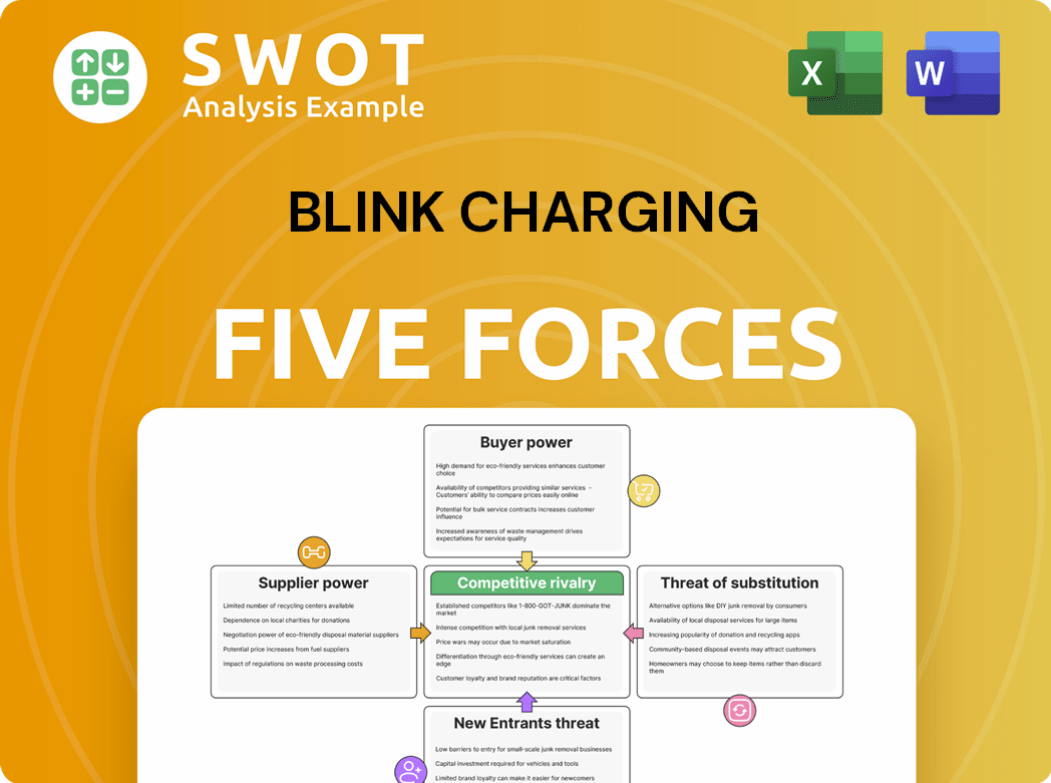
Blink Charging Porter's Five Forces Analysis
- Covers All 5 Competitive Forces in Detail
- Structured for Consultants, Students, and Founders
- 100% Editable in Microsoft Word & Excel
- Instant Digital Download – Use Immediately
- Compatible with Mac & PC – Fully Unlocked
Related Blogs

- What are Mission Vision & Core Values of Blink Charging Company?
- What is Growth Strategy and Future Prospects of Blink Charging Company?
- How Does Blink Charging Company Work?
- What is Sales and Marketing Strategy of Blink Charging Company?
- What is Brief History of Blink Charging Company?
- Who Owns Blink Charging Company?
- What is Customer Demographics and Target Market of Blink Charging Company?
Disclaimer
All information, articles, and product details provided on this website are for general informational and educational purposes only. We do not claim any ownership over, nor do we intend to infringe upon, any trademarks, copyrights, logos, brand names, or other intellectual property mentioned or depicted on this site. Such intellectual property remains the property of its respective owners, and any references here are made solely for identification or informational purposes, without implying any affiliation, endorsement, or partnership.
We make no representations or warranties, express or implied, regarding the accuracy, completeness, or suitability of any content or products presented. Nothing on this website should be construed as legal, tax, investment, financial, medical, or other professional advice. In addition, no part of this site—including articles or product references—constitutes a solicitation, recommendation, endorsement, advertisement, or offer to buy or sell any securities, franchises, or other financial instruments, particularly in jurisdictions where such activity would be unlawful.
All content is of a general nature and may not address the specific circumstances of any individual or entity. It is not a substitute for professional advice or services. Any actions you take based on the information provided here are strictly at your own risk. You accept full responsibility for any decisions or outcomes arising from your use of this website and agree to release us from any liability in connection with your use of, or reliance upon, the content or products found herein.