

Vitec Bundle

How Did Vitec Company Rise to Software Dominance?
Ever wondered how a company transforms from a university spin-off into a Nordic software giant? The story of Vitec Group is a compelling journey of innovation and strategic growth. From its roots in Sweden to its current status on Nasdaq Stockholm, Vitec's evolution offers valuable insights into the software industry. Discover the Vitec SWOT Analysis and its strategic decisions that shaped its destiny.

This brief history of Vitec Group unveils its pivotal moments, from its founding in 1985 by Lars Stenlund and Olov Sandberg to its significant acquisitions. Understanding the Vitec history is crucial for anyone interested in the Vitec company background and its impact on the industry. Explore the Vitec timeline, key milestones, and financial performance to grasp the company's enduring success and future prospects.
What is the Vitec Founding Story?
The founding of the Vitec Company in May 1985 marks the beginning of a significant journey in the technology sector. This Vitec history began with a vision to address the pressing energy concerns of the time, setting the stage for its initial product offerings and future growth. The company's origins are deeply rooted in the academic environment of Umeå University in Sweden.
The idea for Vitec Group originated from a discussion between Lars Stenlund and Olov Sandberg in the fall of 1984. Sandberg's proposal to assist property owners in monitoring their energy use was a direct response to the energy crisis following the 1970s oil crisis. Their initial goal was to develop a system to meet this need, using Turbo Pascal.
The first Vitec products were developed as a hobby project, but they quickly attracted market interest. The need to formalize their operations to sell this program led to the establishment of Vitec. Lars Stenlund, who later served as CEO from 1990 to 2021 and became Chairman of the Board in 2021, brought a background in applied physics, providing a strong technical foundation for the venture. For a deeper understanding of how the company evolved, you can read more about its Revenue Streams & Business Model of Vitec.

Key Founding Aspects of Vitec
Vitec's founding was driven by the need to address energy efficiency challenges.
- Founded in May 1985 by Lars Stenlund and Olov Sandberg.
- Emerging from Umeå University in Sweden.
- Initial product: energy consumption monitoring system.
- CEO Lars Stenlund, with a background in applied physics, played a crucial role.
Vitec SWOT Analysis
- Complete SWOT Breakdown
- Fully Customizable
- Editable in Excel & Word
- Professional Formatting
- Investor-Ready Format

What Drove the Early Growth of Vitec?
The early growth and expansion of the Vitec Company, a software group, were marked by strategic acquisitions and a shift to a subscription-based model. Established in 1985, Vitec went public in 1998. A significant move was adopting a subscription model for its software in 1995, which was an early step towards recurring revenue. This approach laid the groundwork for its future growth.
 Acquisition-Driven Growth
The formalization of an acquisition-driven growth strategy in 2003 was a turning point for the Vitec Group, allowing expansion beyond organic growth. This strategy has been successful, with 60 M&A deals completed since its founding. As of Q1 2025, the company operates across 46 business units. The first acquisition outside Sweden was in 2011, and the first outside the Nordic region was in 2021.
Financial Performance and Recurring Revenue
From 2011 to 2024, recurring revenues for Vitec grew from approximately SEK 211 million to around SEK 2.9 billion, with a Compound Annual Growth Rate (CAGR) of about 22%. Free cash flow to equity (FCFE) also saw substantial growth, with a CAGR of approximately 26% during the same period. This growth is attributed to both acquisitions (median acquired net sales growth of approximately 17% per year in 2020-2024) and solid organic growth (median approximately 7% per year in 2020-2024). For a deeper dive into the target market, consider reading Target Market of Vitec.
2024 Financial Highlights
In 2024, Vitec's net sales reached SEK 3,334 million, reflecting a 20% increase, with 9% organic growth and 11% acquired growth. The company's EBITA surpassed SEK 1 billion for the first time in 2024, reaching SEK 1,002 million with a 30% margin. Cash flow from operating activities also strengthened, reaching SEK 1,041 million in 2024, a 45% improvement from the previous year.
Recent Developments (Q1 2025)
In Q1 2025, Vitec reported net sales of SEK 880 million, a 23% increase from Q1 2024, with recurring revenues growing by 28% to SEK 786 million. The company acquired the Dutch software company Intergrip in February 2025, further strengthening its position in vertical market software. These efforts highlight Vitec's continuous expansion into new markets and product categories, demonstrating a consistent growth trajectory shaped by strategic acquisitions and a robust recurring revenue model.
Vitec PESTLE Analysis
- Covers All 6 PESTLE Categories
- No Research Needed – Save Hours of Work
- Built by Experts, Trusted by Consultants
- Instant Download, Ready to Use
- 100% Editable, Fully Customizable

What are the key Milestones in Vitec history?
The Vitec Company's brief history reveals a journey marked by strategic acquisitions and a focus on vertical market software solutions. From its early adoption of a subscription-based model to its significant expansion through acquisitions, Vitec Group has consistently adapted to the evolving software landscape. The Vitec history is a testament to its strategic vision and its ability to capitalize on market opportunities.
| Year | Milestone |
|---|---|
| 1995 | Early adoption of a subscription-based software model, a key innovation in the software industry. |
| 1998 | Vitec Company went public, marking a significant step in its growth trajectory. |
| 2011-2024 | Recurring revenues increased from 59% to 86% of net sales, demonstrating strong customer retention and the success of the subscription model. |
| 2024 | Completed a record-breaking seven acquisitions, including Trinergy and Olyslager Group B.V., expanding its portfolio and market reach. |
| 2025 | Acquired Intergrip, a Dutch software company, further solidifying its position in educational systems. |
Vitec Company's innovations include the early adoption of subscription-based software, which provided a stable revenue stream. The company has also focused on continuous product development, integrating the latest technologies, including AI, to enhance customer value and efficiency.

Subscription-Based Model
Vitec Group pioneered the subscription-based model in 1995, ensuring predictable revenue and fostering long-term customer relationships. This early adoption set the stage for its future growth in the software market.
Strategic Acquisitions
Vitec Company has strategically acquired numerous companies, expanding its product portfolio and market presence. This approach has been a cornerstone of Vitec's growth strategy, as detailed in Growth Strategy of Vitec.
Focus on Vertical Markets
Vitec products are tailored to specific vertical markets, fostering strong customer lock-in and low churn rates. This focus allows Vitec to build deep expertise and address the unique needs of its customers effectively.
AI Integration
Vitec Company is intensifying its work with AI to enhance efficiency and customer value. This commitment to technological advancement ensures its products remain competitive and meet evolving market demands.
Decentralized Organization
Vitec Group operates with a decentralized organizational structure, allowing subsidiaries to operate with autonomy. This structure promotes agility and responsiveness to local market needs.
Continuous Product Development
Vitec Company is committed to continuous product development, aligning its offerings with customer needs and leveraging the latest technology. This ensures that Vitec's products remain relevant and competitive.
One of the challenges for Vitec Group is operating in niche markets, which, while providing strong customer retention, also limits the overall market size. Economic uncertainties can also affect the timeline of M&A processes, requiring careful management and financial stability.
Market Size Limitations
The focus on niche markets, while fostering strong customer relationships, can limit the overall market size and growth potential. This requires Vitec to carefully manage its resources and identify new opportunities.
Economic Uncertainties
Economic uncertainties can impact the M&A process, potentially extending the time required to close deals. Vitec's strong financial position and track record typically reassure sellers during these times.
Competition in Niche Markets
While niche markets offer strong customer lock-in, they can also attract specialized competitors. Vitec must continuously innovate to maintain its competitive edge.
Integration Challenges
Integrating acquired companies can present challenges, requiring Vitec to effectively manage diverse operations and cultures. Successful integration is crucial for realizing the full benefits of acquisitions.
Maintaining Innovation
Maintaining a high level of innovation in specialized markets requires continuous investment in R&D and a deep understanding of customer needs. Vitec must stay ahead of technological advancements.
Regulatory Compliance
Operating in various vertical markets means Vitec must navigate complex regulatory environments. Compliance is essential for maintaining customer trust and avoiding legal issues.
Vitec Business Model Canvas
- Complete 9-Block Business Model Canvas
- Effortlessly Communicate Your Business Strategy
- Investor-Ready BMC Format
- 100% Editable and Customizable
- Clear and Structured Layout

What is the Timeline of Key Events for Vitec?
The Vitec Company has a rich history marked by strategic acquisitions and a focus on software solutions. The Vitec history reveals a company that has consistently adapted and grown, starting as a spin-off and evolving into a publicly traded entity with a global presence. The Vitec Group's journey is a testament to its vision and commitment to long-term value creation.
| Year | Key Event |
|---|---|
| May 1985 | Vitec Software Group is founded in Umeå, Sweden, as a spin-off from Umeå University. |
| 1995 | Vitec transitions to a subscription-based software model, an early form of SaaS. |
| 1998 | Vitec becomes a public company, listed on Nasdaq Stockholm. |
| 2003 | The company formalizes its acquisition-driven growth strategy. |
| 2011 | Vitec makes its first acquisition outside Sweden. |
| 2021 | Vitec completes its first acquisition outside the Nordic region. |
| 2024 | Vitec acquires a record seven companies, with net sales reaching SEK 3,334 million, a 20% increase, and EBITA surpassing SEK 1 billion. |
| Q1 2025 | Vitec reports net sales of SEK 880 million, a 23% increase from Q1 2024, and recurring revenues of SEK 786 million, a 28% increase. |
| February 2025 | Vitec acquires the Dutch software company Intergrip. |
| April 29, 2025 | Vitec Software Group holds its Annual General Meeting, adopting the 2024 financial statements and approving a dividend of SEK 3.60 per share. |
Acquisition-Driven Growth
Vitec plans to continue its acquisition-driven growth strategy. Analysts predict six M&A deals in 2025. The company sees significant potential with an estimated 500-1,000 potential acquisition targets in the Nordic region and a similar number in the Netherlands.
Financial Performance and Outlook
Vitec aims to expand operating margins to at least 20% and distribute at least one-third of net profits as dividends. In Q1 2025, 88% of pro-forma LTM sales were recurring revenues, providing stable cash flow. The Board proposed a dividend increase for the 23rd consecutive year to SEK 3.60 per share, an increase of 20%.
AI and Customer Value
Vitec is intensifying its focus on AI to boost internal efficiency and enhance customer value. The company's vision, 'Shaping a wiser and more sustainable future,' underscores its dedication to long-term value creation. This strategic move aligns with the company's founding mission of providing business-critical software solutions.
Stable Revenue and Market Position
With a high percentage of recurring revenues, Vitec is well-positioned to drive future acquisitions and maintain its growth trajectory. The company's strong performance in Q1 2025, with a 23% increase in net sales, highlights its robust market position. For more insights into the company's trajectory, you can read this article about Vitec's evolution over time.
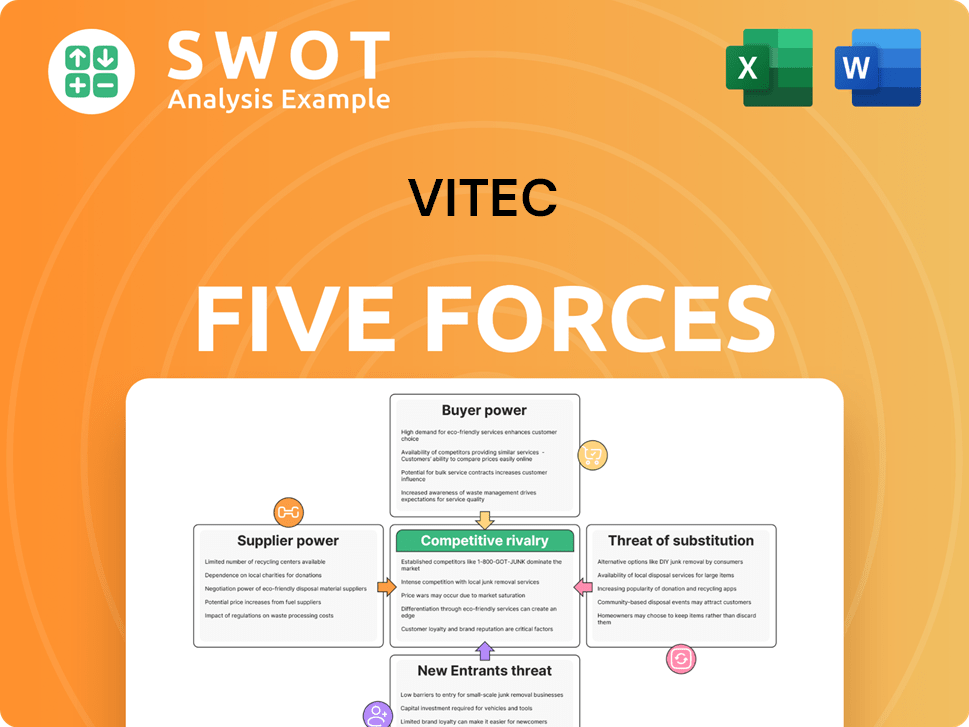
Vitec Porter's Five Forces Analysis
- Covers All 5 Competitive Forces in Detail
- Structured for Consultants, Students, and Founders
- 100% Editable in Microsoft Word & Excel
- Instant Digital Download – Use Immediately
- Compatible with Mac & PC – Fully Unlocked
Related Blogs

- What is Competitive Landscape of Vitec Company?
- What is Growth Strategy and Future Prospects of Vitec Company?
- How Does Vitec Company Work?
- What is Sales and Marketing Strategy of Vitec Company?
- What is Brief History of Vitec Company?
- Who Owns Vitec Company?
- What is Customer Demographics and Target Market of Vitec Company?
Disclaimer
All information, articles, and product details provided on this website are for general informational and educational purposes only. We do not claim any ownership over, nor do we intend to infringe upon, any trademarks, copyrights, logos, brand names, or other intellectual property mentioned or depicted on this site. Such intellectual property remains the property of its respective owners, and any references here are made solely for identification or informational purposes, without implying any affiliation, endorsement, or partnership.
We make no representations or warranties, express or implied, regarding the accuracy, completeness, or suitability of any content or products presented. Nothing on this website should be construed as legal, tax, investment, financial, medical, or other professional advice. In addition, no part of this site—including articles or product references—constitutes a solicitation, recommendation, endorsement, advertisement, or offer to buy or sell any securities, franchises, or other financial instruments, particularly in jurisdictions where such activity would be unlawful.
All content is of a general nature and may not address the specific circumstances of any individual or entity. It is not a substitute for professional advice or services. Any actions you take based on the information provided here are strictly at your own risk. You accept full responsibility for any decisions or outcomes arising from your use of this website and agree to release us from any liability in connection with your use of, or reliance upon, the content or products found herein.