

Ultralife Bundle

What's the Story Behind Ultralife?
Ever wondered how a company becomes a powerhouse in critical industries? Ultralife Corporation's journey, starting in 1991, is a compelling tale of innovation and strategic growth. From its roots as a battery division of Eastman Kodak, Ultralife has evolved into a global provider of power and communication solutions. This Ultralife SWOT Analysis helps to understand the company's position.

This brief history of Ultralife company explores its transformation from Ultralife Batteries, Inc. to a leading provider of specialized solutions. Understanding Ultralife's history, including its early focus on Ultralife batteries and subsequent Ultralife product development, provides valuable insights. Furthermore, the company's financial history, including its recent sales figures, highlights its current status and market share within the industry.
What is the Ultralife Founding Story?
The story of the Ultralife Corporation began in 1990. Initially known as Ultralife Batteries, Inc., the company was established as a Delaware corporation. This marked the beginning of a journey that would see Ultralife evolve and make its mark in the battery and power solutions industry.
Key individuals, including Arthur M. Liberman, Bruce Jagid, and Carl H. Rosner, played crucial roles in the founding of the company. Their vision set the stage for Ultralife's early focus on advanced battery technology. The company's early years were marked by significant developments and challenges.
The foundation of Ultralife's business was laid with the acquisition of technology and assets from Eastman Kodak Company in March 1991. This acquisition involved a 9-volt lithium manganese dioxide non-rechargeable battery. This strategic move provided Ultralife with the core technology to develop and manufacture superior lithium batteries.

Ultralife's Founding and Early Challenges
Ultralife's initial focus was on developing and manufacturing advanced lithium batteries. The company aimed to offer products with significant advantages over existing non-rechargeable battery technologies.
- Lighter weight
- Longer operating time
- Extended shelf life
- Wider operating temperature range
Ultralife quickly sought public funding, achieving an Initial Public Offering (IPO) in December 1992. The company's shares were listed on NASDAQ. This early financial success was a crucial step in Ultralife's growth. The company's Newark facility faced two fires in August 1991 and again a year later, highlighting the challenges faced during its early establishment.
The company's early focus on lithium batteries positioned it to capitalize on the growing demand for reliable power solutions. The Target Market of Ultralife has evolved over time, reflecting the company's adaptation to market needs and technological advancements. The company's initial success and subsequent growth demonstrate its ability to navigate the complexities of the battery industry.
Ultralife SWOT Analysis
- Complete SWOT Breakdown
- Fully Customizable
- Editable in Excel & Word
- Professional Formatting
- Investor-Ready Format

What Drove the Early Growth of Ultralife?
The early growth of the Ultralife company centered on refining its battery technology and expanding its market presence. This involved strategic acquisitions and facility expansions to broaden its product offerings and reach new customers. The company's focus shifted over time, moving from consumer batteries to specialized applications in the military, medical, and industrial sectors.
 Early European Expansion
In May 1994, Ultralife corporation acquired polymer technology assets from Dowty Group plc, leading to the formation of Ultralife Batteries (UK) Ltd. This established a foothold in Europe. By 1996, an improved 9-volt lithium battery was introduced, showcasing early product development efforts.
Key Partnerships and Product Advancements
A significant milestone occurred in 1997 when a telephone manufacturer provided funding and over $300,000 for initial mass-produced battery shipments. This partnership was crucial for scaling up production. The company's focus on Ultralife products and battery technology continued to evolve.
Strategic Acquisitions and Market Expansion
Ultralife company expanded through strategic acquisitions. In May 2006, the acquisition of ABLE New Energy Co., Ltd. in China added lithium-thionyl chloride and lithium-manganese batteries to its portfolio. This broadened its consumer market reach. The company's growth strategy included expanding its product range.
Growth in Military and Defense Markets
The acquisition of McDowell Research, Ltd. in July 2006, enhanced Ultralife's presence in military communications. This strengthened its position in the global defense market. The Waco, Texas, facility operations were later relocated to Virginia Beach, Virginia, for operational efficiencies. For more details, you can check Revenue Streams & Business Model of Ultralife.
Financial and Operational Highlights
In March 2009, the company acquired the tactical communications products business of Science Applications International Corporation. In 2002, an expansion program at the Newark facility was announced in response to increased demand from the United States Army. As of Q1 2025, Ultralife reported consolidated revenues of $50.7 million, a 21.0% increase from Q1 2024.
Recent Performance and Strategy
Battery & Energy Products sales increased by 32.4% to $46.3 million in Q1 2025. New product development costs increased by 24.0% in Q1 2025 compared to Q1 2024, reflecting continued investment in innovation. These financial results highlight the company's strategic shift towards specialized markets.
Ultralife PESTLE Analysis
- Covers All 6 PESTLE Categories
- No Research Needed – Save Hours of Work
- Built by Experts, Trusted by Consultants
- Instant Download, Ready to Use
- 100% Editable, Fully Customizable

What are the key Milestones in Ultralife history?
The Ultralife Corporation has a rich history marked by significant milestones in the battery and energy solutions sector, including strategic acquisitions and innovative product launches. The company has consistently adapted to market dynamics, demonstrating resilience and a forward-thinking approach to business.
| Year | Milestone |
|---|---|
| 1996 | Introduction of an improved 9-volt lithium battery. |
| 2024 | Acquisition of Electrochem Solutions, Inc. on October 31 for $50.0 million in cash. |
| 2025 | Battery & Energy Products sales increased significantly in Q1. |
Ultralife's innovations include the development of high-performance lithium batteries. These

HiRate Cylindrical Batteries
These batteries are designed for high-drain applications, providing reliable power in demanding environments. They are often used in military radios and other critical communication devices.
ThinCell Lithium Batteries
These batteries are known for their compact design, making them ideal for portable medical devices and emergency beacons. Their form factor allows for integration into space-constrained applications.
Lithium Manganese Dioxide Batteries
These batteries offer a balance of high energy density and safety, making them suitable for a wide range of industrial applications. They are known for their long shelf life and reliable performance.
Lithium Manganese Dioxide Carbon Monofluoride Hybrid Batteries
These hybrid batteries combine the benefits of multiple chemistries, offering enhanced performance characteristics. They are designed to meet the specific needs of various applications.
Lithium Thionyl Chloride Batteries
These batteries are known for their high energy density and ability to operate in extreme temperatures. They are often used in military and industrial applications where reliability is critical.
Ultracapacitor Cells and Battery Packs
Ultralife's expansion into ultracapacitor technology through the acquisition of Electrochem Solutions, Inc. has broadened its product offerings. This technology provides rapid energy storage and discharge capabilities.
Despite its successes,
Market Fluctuations
The company experienced a 55.1% decrease in Communications Systems sales in Q4 2024 compared to Q4 2023. This volatility highlights the need for diversification and adaptability in the market.
Supply Chain Disruptions
The implementation of tariff mitigation plans reflects the company's efforts to manage operational impacts across its supply chains. These plans involve tariff surcharges and inventory adjustments.
Acquisition Integration
Integrating Electrochem Solutions, Inc. involved streamlining operations and aligning strategic goals. This integration is expected to boost manufacturing efficiencies and U.S.-based vertical integration savings.
Early Challenges
The early years saw the Newark facility facing challenges, including two fires in 1991 and 1992. These events prompted the company to improve safety and operational resilience.
Sales Segment Performance
In Q1 2025, while Battery & Energy Products sales increased significantly, Communications Systems revenue declined by 36.2%. This illustrates the importance of managing diverse product portfolios.
Order Dynamics
Delays in expected larger orders for the Communications Systems segment and customer requests to push orders into 2025 for the Battery & Energy Products segment impacted 2024 results. This highlights the importance of managing customer expectations.
Ultralife Business Model Canvas
- Complete 9-Block Business Model Canvas
- Effortlessly Communicate Your Business Strategy
- Investor-Ready BMC Format
- 100% Editable and Customizable
- Clear and Structured Layout

What is the Timeline of Key Events for Ultralife?
The Ultralife company has a rich history marked by strategic acquisitions, technological advancements, and a focus on growth. From its formation in 1990 to its recent acquisitions and product launches, the company has continuously adapted to meet the evolving demands of its markets. The following table provides a chronological overview of key milestones in
| Year | Key Event |
|---|---|
| 1990 | Ultralife was established as a Delaware corporation. |
| 1991 | Acquired technology and assets from Eastman Kodak Company related to 9-volt lithium manganese dioxide non-rechargeable batteries, and experienced two fires at the Newark facility. |
| 1992 | Completed its initial public offering (IPO) and was listed on NASDAQ. |
| 1994 | Acquired polymer technology from Dowty Group plc and formed Ultralife Batteries (UK) Ltd. |
| 1996 | Introduced an improved 9-volt lithium battery. |
| 1999 | Kavazanjian took leadership, aiming to make Ultralife profitable. |
| 2002 | Announced an expansion program at the Newark facility, creating 100 new jobs due to increased demand from the U.S. Army. |
| 2004 | Acquired McDowell Research, expanding into military communications systems. |
| 2006 | Acquired ABLE New Energy Co., Ltd. in China and finalized the acquisition of McDowell Research, Ltd. |
| 2009 | Acquired the tactical communications products business from Science Applications International Corporation. |
| 2019 | Acquired Southwest Electronic Energy Group. |
| October 31, 2024 | Completed the acquisition of Electrochem Solutions, Inc. for $50.0 million. |
| January 6, 2025 | Expanded the leadership team with a new Chief Marketing Officer and Senior VP – Sales & Business Development, Battery & Energy Products. |
| January 21-24, 2025 | Exhibited at the SHOT Show to showcase battery packs, cells, and communications systems. |
| February 20-22, 2024 | Exhibited at Subsea Expo, showcasing battery technologies for subsea and oil and gas industries. |
| March 11, 2025 | Reported Q4 2024 results, with sales of $43.9 million for the quarter and $164.5 million for the full year 2024. |
| May 9, 2025 | Reported Q1 2025 results, with consolidated revenues of $50.7 million. |
| June 2024 | Secured a contract for the development of advanced thermal batteries for specialized military equipment. |
Financial Performance in 2024 and Early 2025
In Q4 2024, Ultralife reported sales of $43.9 million, contributing to a full-year 2024 total of $164.5 million. The company's Q1 2025 results showed consolidated revenues of $50.7 million, indicating a strong start to the year. These results demonstrate Ultralife's ability to maintain and grow its revenue streams.
Strategic Acquisitions and Expansion
The acquisition of Electrochem Solutions, Inc. for $50.0 million in October 2024 highlights Ultralife's commitment to strategic growth. This acquisition is expected to enhance manufacturing efficiencies and vertical integration. The company continues to broaden its product line and expand into high-growth markets.
Market Outlook and Growth Strategy
Ultralife is focused on delivering profitable growth and incremental cash flow in 2025. The company entered 2025 with a healthy backlog of $102.2 million exiting 2024, and $95.0 million exiting Q1 2025. They are expanding their product lines and strengthening their presence in international military markets.
Product Development and Innovation
Ultralife is launching new products and anticipating a recovery in medical battery sales in the latter half of 2025. The company's focus on innovation and product development, including securing contracts for advanced thermal batteries, positions it well for future growth. This includes the development of new products and technologies.
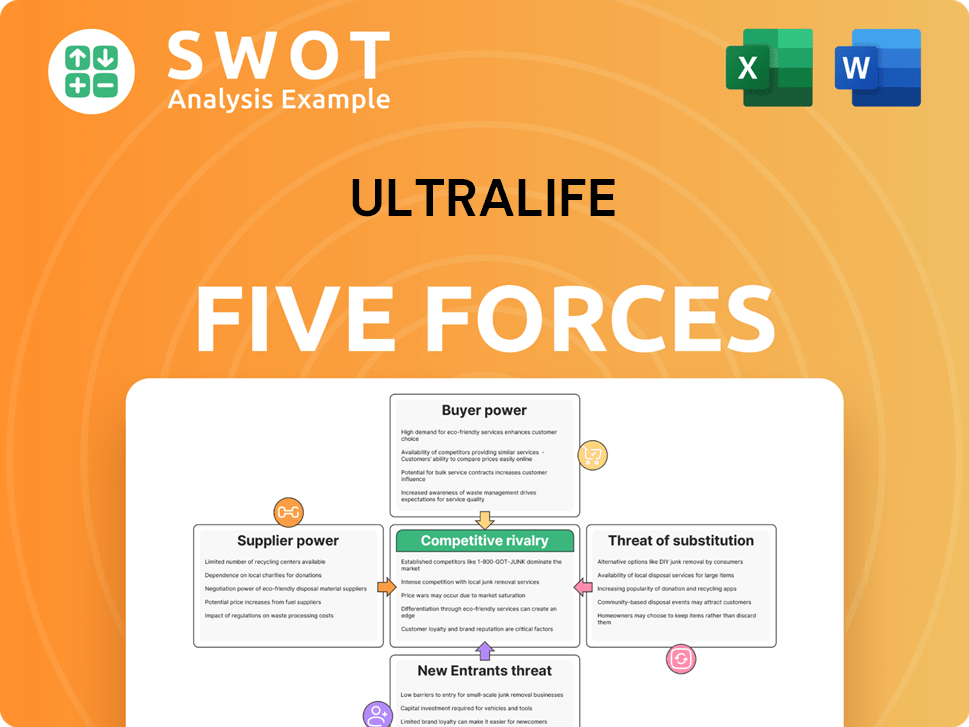
Ultralife Porter's Five Forces Analysis
- Covers All 5 Competitive Forces in Detail
- Structured for Consultants, Students, and Founders
- 100% Editable in Microsoft Word & Excel
- Instant Digital Download – Use Immediately
- Compatible with Mac & PC – Fully Unlocked
Related Blogs

- What is Competitive Landscape of Ultralife Company?
- What is Growth Strategy and Future Prospects of Ultralife Company?
- How Does Ultralife Company Work?
- What is Sales and Marketing Strategy of Ultralife Company?
- What is Brief History of Ultralife Company?
- Who Owns Ultralife Company?
- What is Customer Demographics and Target Market of Ultralife Company?
Disclaimer
All information, articles, and product details provided on this website are for general informational and educational purposes only. We do not claim any ownership over, nor do we intend to infringe upon, any trademarks, copyrights, logos, brand names, or other intellectual property mentioned or depicted on this site. Such intellectual property remains the property of its respective owners, and any references here are made solely for identification or informational purposes, without implying any affiliation, endorsement, or partnership.
We make no representations or warranties, express or implied, regarding the accuracy, completeness, or suitability of any content or products presented. Nothing on this website should be construed as legal, tax, investment, financial, medical, or other professional advice. In addition, no part of this site—including articles or product references—constitutes a solicitation, recommendation, endorsement, advertisement, or offer to buy or sell any securities, franchises, or other financial instruments, particularly in jurisdictions where such activity would be unlawful.
All content is of a general nature and may not address the specific circumstances of any individual or entity. It is not a substitute for professional advice or services. Any actions you take based on the information provided here are strictly at your own risk. You accept full responsibility for any decisions or outcomes arising from your use of this website and agree to release us from any liability in connection with your use of, or reliance upon, the content or products found herein.