

Truist Financial Bundle

What's the Story Behind Truist Financial?
Ever wondered how Truist Financial, a banking powerhouse, came to be? The story begins with a pivotal merger in late 2019, uniting BB&T and SunTrust Banks to create a financial services giant. This union reshaped the banking landscape, forging a company with a mission to build better lives and communities. Uncover the Truist Financial SWOT Analysis to gain insights into its strategic positioning.

Truist Financial's formation, a result of the Truist merger, was a strategic move designed to enhance its market presence and service offerings. With a focus on comprehensive financial solutions, from retail banking to investment services, Truist quickly established itself as a major player. Understanding the Truist history, including the BB&T and SunTrust merger date, is key to grasping its current operational strategies and future trajectory. This exploration of the Truist company will delve into its foundational elements and ongoing evolution.
What is the Truist Financial Founding Story?
The story of Truist Financial Corporation begins on December 6, 2019. This was the official formation date resulting from a 'merger of equals' between BB&T Corporation and SunTrust Banks, Inc. While Truist is a relatively new entity, its roots are deeply embedded in the histories of its predecessor companies.
The aim of the merger was to create a financial services company with increased scale and a broader range of offerings. This was intended to enhance its ability to compete in the evolving financial services landscape. The merger, valued at approximately $66 billion, was a significant event in the banking industry.
The name 'Truist' was chosen to reflect a commitment to trust and optimism. It was designed to convey a sense of genuine partnership with clients. The integration process involved extensive strategic planning to combine operations, technology platforms, and corporate cultures. The formation of Truist was influenced by the broader economic context of increasing consolidation in the financial industry.

Truist Financial: Founding Story
Truist Financial Corporation was created on December 6, 2019, through the merger of BB&T and SunTrust. The merger aimed to create a larger, more competitive financial institution. The name 'Truist' reflects the company's values of trust and optimism.
- BB&T, originally Branch Banking and Trust Company, was founded in 1872 in Wilson, North Carolina.
- SunTrust Banks originated in 1891 with the founding of the Trust Company of Georgia in Atlanta.
- The merger was valued at approximately $66 billion.
- The combined entity sought to deliver secure and successful client experiences.
The initial vision behind the formation of Truist was to establish a purpose-driven financial services company committed to inspiring and building better lives and communities. This guiding principle was intended to shape its business model. This model encompasses a wide array of wholesale and consumer businesses including consumer and small business banking, commercial and corporate banking, investment banking and capital markets, wealth management, payments, and specialized lending businesses. The combined entity sought to leverage the strengths of both legacy institutions to deliver distinctive, secure, and successful client experiences through a blend of 'touch and technology.'
The merger was a strategic move to enhance efficiency and technological capabilities. This was done to better serve a diverse and digitally-savvy customer base. The formation of Truist was influenced by the need for banks to adapt to changing market dynamics. This included greater efficiency and technological advancements.
As of 2024, Truist has a substantial presence in the financial sector. It serves millions of clients across various financial needs. The company's commitment to its core values is evident in its operations and community involvement. Truist's commitment to its mission is further detailed in Mission, Vision & Core Values of Truist Financial.
Truist Financial SWOT Analysis
- Complete SWOT Breakdown
- Fully Customizable
- Editable in Excel & Word
- Professional Formatting
- Investor-Ready Format

What Drove the Early Growth of Truist Financial?
The early growth and expansion of Truist Financial since its formation in December 2019 have been marked by strategic integration and a focus on leveraging its combined strengths. As a newly merged entity, the initial phase involved consolidating operations, technology, and branding from the legacy BB&T and SunTrust banks. Truist's early years prioritized enhancing its digital offerings and customer experience.
 Digital Transformation and Customer Experience
By the end of the fourth quarter of 2024, the bank had over 5 million active mobile app users, representing a 1% increase from the prior quarter, with users averaging 18 log-ins per month. Digital account production also saw a significant increase of 13% year-over-year. New household acquisition grew by 31%, with Generation Z clients accounting for a 68% year-over-year increase in consumer checking accounts.
Product and Service Launches
In 2022, Truist introduced new accounts with no overdraft fees, aiming to provide a simpler checking experience. The company also debuted its Innovation and Technology Center in Charlotte in June 2022, emphasizing its commitment to technological advancements and client-centered solutions. Truist continued to strengthen its team, particularly in wholesale banking, and focused on expanding in high-growth markets across the country.
Competitive Landscape and Strategic Initiatives
The competitive landscape for Truist includes traditional financial institutions and non-bank entities, including fintechs. To maintain market share and client loyalty, Truist has focused on strategic investments in technology and agility in rolling out new products and services. The company's growth efforts have also included strategic divestitures.
Divestitures and Financial Focus
The sale of its remaining stake in Truist Insurance Holdings in May 2024, which valued the business at $15.5 billion, was a key strategic move. This divestiture aimed at streamlining operations, bolstering liquidity, and allowing Truist to focus on its core banking activities. This strategic shift is expected to free up capital for high-return opportunities in lending and advisory services.
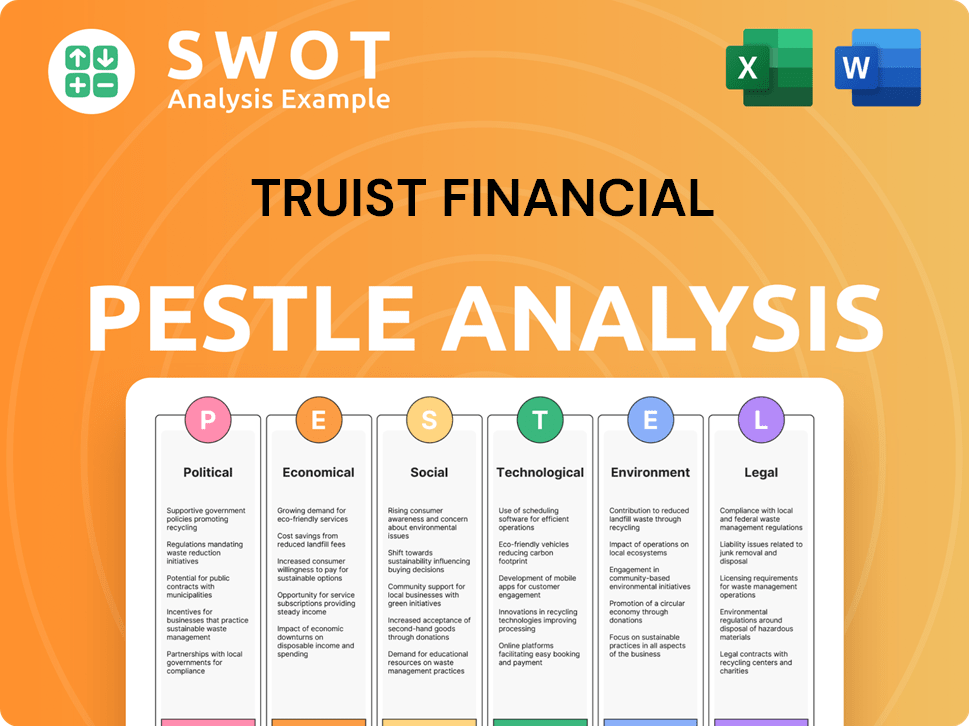
Truist Financial PESTLE Analysis
- Covers All 6 PESTLE Categories
- No Research Needed – Save Hours of Work
- Built by Experts, Trusted by Consultants
- Instant Download, Ready to Use
- 100% Editable, Fully Customizable
What are the key Milestones in Truist Financial history?
The formation of Truist Financial marked a significant moment in financial history, with the merger of BB&T and SunTrust creating a major player in the banking sector. Since its inception, Truist has achieved several milestones, including strategic acquisitions and internal developments aimed at enhancing its market position and service offerings.
| Year | Milestone |
|---|---|
| 2019 | BB&T and SunTrust Banks merged to form Truist Financial Corporation. |
| 2022 | Truist increased its minimum wage to $22, and launched new accounts with no overdraft fees. |
| 2022 | The Innovation and Technology Center opened in Charlotte. |
| 2024 | Truist received an 'Outstanding' Community Reinvestment Act rating. |
Truist has focused on innovation to improve client experiences and operational efficiency. A key area of advancement involves integrating technology to streamline services.

Digital Enhancements
In January 2025, Truist enhanced its digital offerings for wholesale banking clients with 'Truist One View'. This consolidated web and mobile app simplifies user experiences and provides actionable insights.
Alias-Based Bill Payment
In April 2025, Truist announced the successful initial testing of an alias-based bill payment solution using The Clearing House’s RTP network. This positions Truist as the first financial institution to send and receive such alias-based requests for real-time payment and settlement.
Despite its achievements, Truist has faced challenges common to the banking sector, including market volatility and competitive pressures. These factors have influenced its financial performance and strategic decisions.
Market Volatility
In the first quarter of 2025, Truist's stock underperformed the broader market, dropping 17% year-to-date, reflecting lingering headwinds for regional banks.
Revenue Outlook Revision
In April 2025, Truist revised down its full-year 2025 revenue outlook from 3.0%-3.5% growth to 1.5%-2.5%, primarily due to a lower outlook for investment banking activity, increased volatility in sales and trading results, and lower wealth management income.
Strategic Divestitures
In May 2024, Truist sold its remaining stake in Truist Insurance Holdings for $15.5 billion, a move aimed at streamlining operations and focusing on core banking activities.
Expense Management
Truist achieved a year-over-year reduction in adjusted expenses by 0.4% in 2024 and anticipates a 2% reduction in pre-provision net revenue (PPNR) guidance for 2025, highlighting its commitment to operational efficiency.
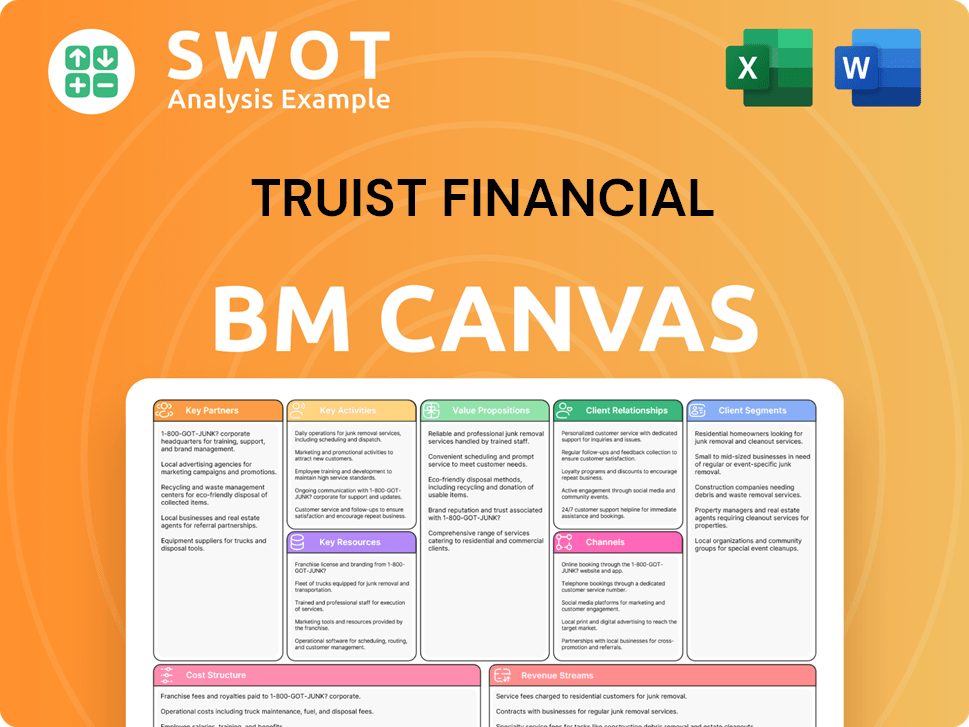
Truist Financial Business Model Canvas
- Complete 9-Block Business Model Canvas
- Effortlessly Communicate Your Business Strategy
- Investor-Ready BMC Format
- 100% Editable and Customizable
- Clear and Structured Layout
What is the Timeline of Key Events for Truist Financial?
The history of Truist Financial Corporation, also known as Truist Financial, is marked by significant milestones. The company's formation, built upon the merger of BB&T and SunTrust Banks, has led to various strategic initiatives and technological advancements. This timeline highlights key moments in the evolution of the Truist history, including its commitment to ESG, digital innovation, and financial performance.
| Year | Key Event |
|---|---|
| December 6, 2019 | Truist Financial Corporation was officially formed through the merger of BB&T and SunTrust Banks, marking a significant Truist merger. |
| Second Quarter 2020 | The Board of Directors approved interim capital operating targets to support clients during the COVID-19 pandemic. |
| March 2, 2021 | Truist issued its first social bond, emphasizing its environmental, social, and governance (ESG) focus. |
| June 21, 2022 | Truist unveiled its new client-centered Innovation and Technology Center in Charlotte. |
| July 18, 2022 | Truist launched new accounts with no overdraft fees. |
| September 15, 2022 | Truist Assist, an AI-enhanced digital virtual assistant, was launched. |
| March 16, 2023 | Truist, along with other major U.S. banks, invested $30 billion in uninsured deposits into First Republic Bank. |
| May 2024 | Truist completed the sale of its remaining stake in Truist Insurance Holdings, valuing the business at $15.5 billion. |
| October 18, 2024 | Truist unveiled a comprehensive Electronic Bill Presentment and Payment solution. |
| December 11, 2024 | Truist received an 'Outstanding' Community Reinvestment Act rating. |
| January 17, 2025 | Truist reported its fourth-quarter 2024 financial results, with total assets of $531 billion as of December 31, 2024. |
| April 17, 2025 | Truist reported its first-quarter 2025 financial results, with total assets of $536 billion as of March 31, 2025, and revised its 2025 adjusted revenue outlook. |
| April 25, 2025 | Truist announced the successful initial testing phase of an alias-based bill payment solution leveraging the RTP network. |
Financial Performance
Truist aims for positive operating leverage and an expanded Net Interest Margin (NIM) in 2025. The company is focused on controlling expenses, with a projected 4% decrease in costs. This strategic approach is designed to improve profitability and operational efficiency. The company is also positioned to benefit from potential interest rate cuts.
Strategic Initiatives
The company plans to continue share buybacks and dividends, aiming to return almost 100% of earnings to shareholders. Truist is expanding in high-growth markets, particularly in the Southeast United States. Continued investment in technology and digital innovation is also a priority.
Future Projections
Analysts project an EPS of $3.94 annually for 2025. Full-year revenue is expected to reach $20.46 billion. The leadership, including Chairman and CEO Bill Rogers, expresses optimism for 2025 and beyond. The focus is on client growth and increased profitability.
Company Vision
Truist remains committed to its founding purpose of inspiring and building better lives and communities. This commitment guides its strategic decisions and operational focus. The emphasis is on sustainable growth and delivering value to clients and shareholders.
Truist Financial Porter's Five Forces Analysis
- Covers All 5 Competitive Forces in Detail
- Structured for Consultants, Students, and Founders
- 100% Editable in Microsoft Word & Excel
- Instant Digital Download – Use Immediately
- Compatible with Mac & PC – Fully Unlocked

Related Blogs

- What is Competitive Landscape of Truist Financial Company?
- What is Growth Strategy and Future Prospects of Truist Financial Company?
- How Does Truist Financial Company Work?
- What is Sales and Marketing Strategy of Truist Financial Company?
- What is Brief History of Truist Financial Company?
- Who Owns Truist Financial Company?
- What is Customer Demographics and Target Market of Truist Financial Company?
Disclaimer
All information, articles, and product details provided on this website are for general informational and educational purposes only. We do not claim any ownership over, nor do we intend to infringe upon, any trademarks, copyrights, logos, brand names, or other intellectual property mentioned or depicted on this site. Such intellectual property remains the property of its respective owners, and any references here are made solely for identification or informational purposes, without implying any affiliation, endorsement, or partnership.
We make no representations or warranties, express or implied, regarding the accuracy, completeness, or suitability of any content or products presented. Nothing on this website should be construed as legal, tax, investment, financial, medical, or other professional advice. In addition, no part of this site—including articles or product references—constitutes a solicitation, recommendation, endorsement, advertisement, or offer to buy or sell any securities, franchises, or other financial instruments, particularly in jurisdictions where such activity would be unlawful.
All content is of a general nature and may not address the specific circumstances of any individual or entity. It is not a substitute for professional advice or services. Any actions you take based on the information provided here are strictly at your own risk. You accept full responsibility for any decisions or outcomes arising from your use of this website and agree to release us from any liability in connection with your use of, or reliance upon, the content or products found herein.