

Novonesis A/S Bundle

What's the Story Behind Novonesis A/S?
Ever wondered how a company can reshape industries with the power of biology? Novonesis A/S, a global biotechnology leader, has a fascinating history rooted in innovation and a commitment to sustainability. From its humble beginnings to its current global influence, the company's journey is a testament to the transformative potential of Novonesis A/S SWOT Analysis. The company's story is one of continuous evolution and groundbreaking advancements in the field of enzymes and microorganisms.

Delving into the Novonesis history reveals a company that started with insulin production and evolved into a biosolutions powerhouse. Understanding the Novonesis company background provides valuable insights into its market dominance and its impact on various sectors. Its close ties with Novo Nordisk and its pioneering work in Biotechnology have solidified its position in the market. The following sections will explore the key milestones and strategic decisions that shaped Novonesis A/S into the industry leader it is today.
What is the Novonesis A/S Founding Story?
The story of Novonesis A/S, a global leader in biosolutions, began in 1925. Brothers Harald and Thorvald Pedersen founded Novo Terapeutisk Laboratorium in Denmark. This marked the start of a journey in biotechnology and protein-based treatments, initially focusing on insulin production.
The company's evolution reflects a strategic vision and a commitment to innovation. From its early days producing insulin, the company expanded into enzyme production, a move that would define its future. The merger with Nordisk Insulinlaboratorium in 1989, creating Novo Nordisk A/S, and the subsequent spin-out of Novozymes in 2000, further shaped its trajectory.
This brief history of Novonesis A/S company highlights its transformation and growth. The company's focus on industrial enzymes, microorganisms, and biopharmaceutical ingredients has positioned it as a key player in addressing global challenges.

Founding and Early Years
The roots of Novonesis (formerly Novozymes) trace back to 1925. Novo Terapeutisk Laboratorium was established by Harald and Thorvald Pedersen.
- The initial focus was on insulin production.
- Thorvald Pedersen expanded the business into enzyme production in 1939.
- The company launched its first enzyme, trypsin, in 1941.
- The company's predecessor and Nordisk Insulinlaboratorium merged in 1989 to form Novo Nordisk A/S.
Key Milestones
Several milestones shaped Novonesis's history and its impact on biotechnology. These events demonstrate the company's evolution and commitment to innovation.
- In the 1950s, the company pioneered enzyme production through fermentation.
- Lipolase, the world's first fat-splitting enzyme for detergents, was developed in the late 1980s.
- In 2000, Novozymes was spun out from Novo Nordisk.
- The spin-out allowed a dedicated focus on industrial enzymes, microorganisms, and biopharmaceutical ingredients.
Impact and Legacy
Novonesis's history reflects its impact on the biotechnology industry. The company's innovations have addressed industrial and environmental challenges.
- The company's focus has shifted from insulin to broader applications of enzymes and microorganisms.
- The company has become a key player in sustainable solutions.
- Novonesis's legacy includes pioneering enzyme production and biotechnology advancements.
- This brief history of Novonesis A/S company shows its significance.
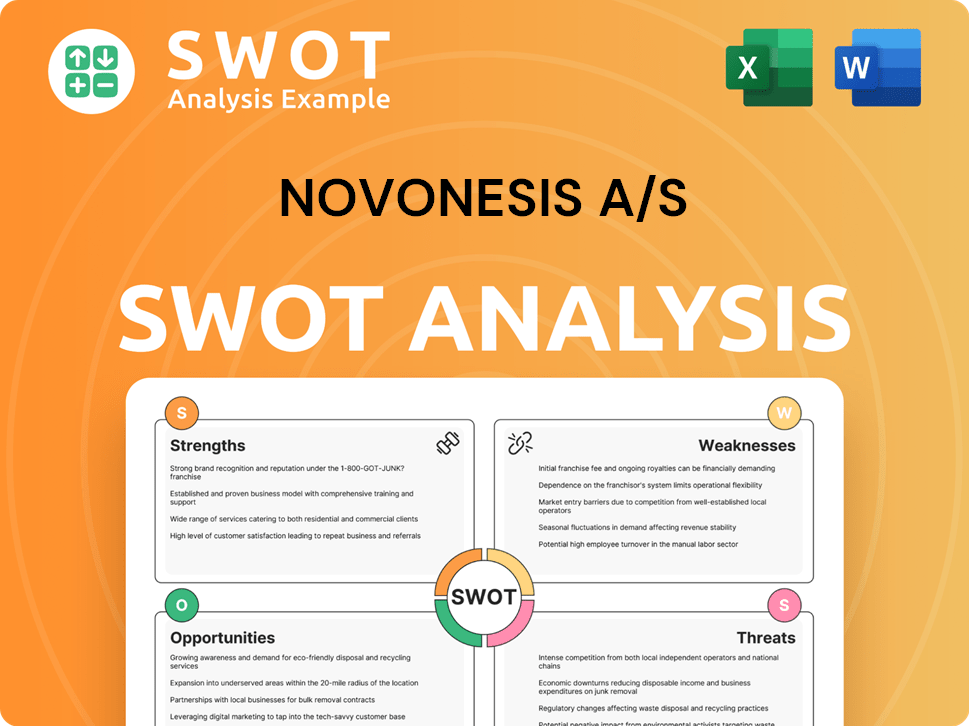
Novonesis A/S SWOT Analysis
- Complete SWOT Breakdown
- Fully Customizable
- Editable in Excel & Word
- Professional Formatting
- Investor-Ready Format
What Drove the Early Growth of Novonesis A/S?
The early growth of the company, now known as Novonesis A/S, was marked by significant expansion and innovation following its spin-out from Novo Nordisk in 2000. This period saw the company rapidly embracing digital advancements and expanding its product offerings, particularly in the enzymes sector. Despite facing challenges, including media scrutiny, the company continued to innovate and grow its global footprint.
 Digital Advancements and Early Acquisitions
Immediately after separating from Novo Nordisk, the company launched its website, enabling customers to purchase enzymes online. Strategic acquisitions helped in expanding beyond its core enzyme business. The company focused on launching new and improved enzyme products, with the starch industry emerging as a key customer.
Challenges and Global Expansion
The company faced challenges, such as negative media attention following a British medical journal article questioning enzyme safety in detergents in 1969, which led to a sales drop. Despite this, the company continued to innovate and expand its global footprint. In 2013, the company and Monsanto formed 'The BioAg Alliance' to develop sustainable bio-agricultural solutions.
Strategic Initiatives and Product Launches
In 2019, the company announced its 'Better Business with Biology' strategy and opened an Innovation Campus in Lyngby, Denmark. Several new products were launched, including Fortiva®, Innova® Force, and Fiberlife®. In 2020, Ester Baiget was appointed President and CEO. The company acquired PrecisionBiotics to advance its human health business.
Sustainability and Renewable Energy
A significant milestone in 2020 was the Kalundborg enzyme fermentation plant, built in 1969, switching to 100% renewable energy. This demonstrated the company's commitment to sustainability. The company's focus on renewable energy marked a key step in its environmental strategy.
Merger and Formation of Novonesis
The most significant expansion came with the merger of the company and Chr. Hansen, forming Novonesis in January 2024. This merger created a global leader in biosolutions, combining expertise in enzymes and microbial solutions. The merger was a pivotal moment in the company's history.
Global Presence and Financial Performance (Q1 2025)
Novonesis now has a global network of over 23 manufacturing sites and nearly 40 R&D and application centers, employing approximately 10,000 people worldwide. The combined entity operates in over 30 industries across 130 markets. In Q1 2025, Novonesis reported an 11% organic sales increase, with emerging markets growing by 15% and developed markets by 9%. Organic growth rates by geography in Q1 2025 were 14% in Europe, Middle East & Africa, 7% in North America, 9% in Asia Pacific, and 18% in Latin America. The company's pro forma sales amounted to EUR 3,945.5 million in 2024, an increase of 5% (organic +8%).
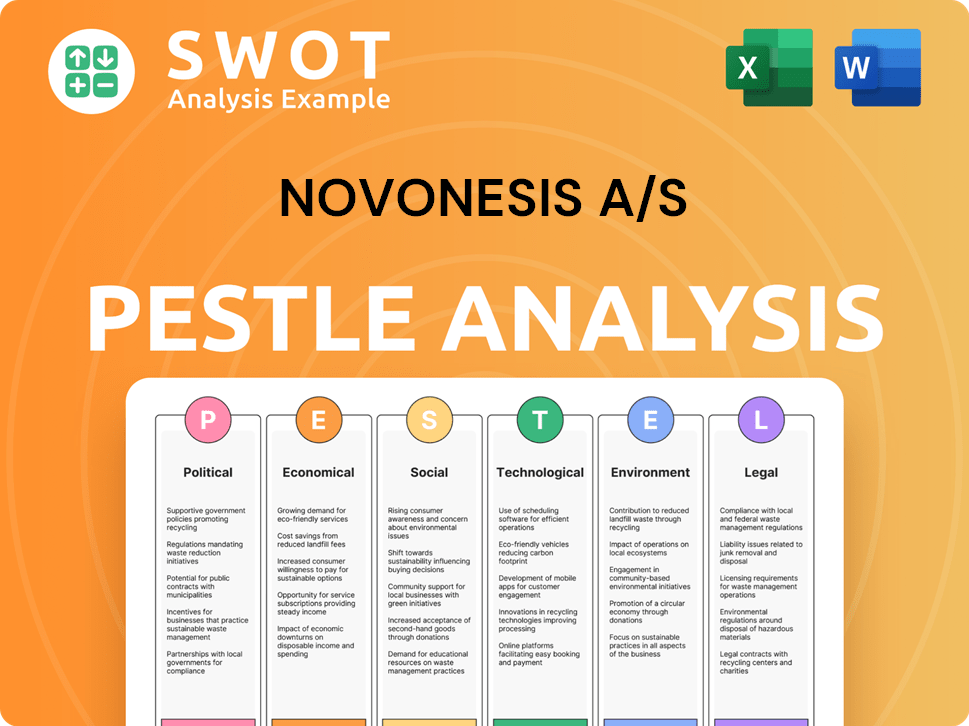
Novonesis A/S PESTLE Analysis
- Covers All 6 PESTLE Categories
- No Research Needed – Save Hours of Work
- Built by Experts, Trusted by Consultants
- Instant Download, Ready to Use
- 100% Editable, Fully Customizable
What are the key Milestones in Novonesis A/S history?
The Owners & Shareholders of Novonesis A/S company, with its rich history, has achieved several significant milestones, shaping its position in the biotechnology sector. These achievements reflect its growth and impact on the industry.
| Year | Milestone |
|---|---|
| 1950s | Pioneered enzyme production by fermentation using bacteria, a foundational innovation in the company's history. |
| 1980s | Introduced Lipolase, the world's first fat-splitting enzyme for detergents produced with genetically engineered microorganisms. |
| 2013 | Formed 'The BioAg Alliance' with Monsanto to develop sustainable agricultural solutions. |
| 2019 | Named the most innovative company in Denmark by the European Patent Office. |
| 2021 | Launched new corporate strategy, 'Unlocking growth – powered by biotech,' and awarded the Terra Carta Seal for sustainability. |
| 2024 | Merger of Novozymes and Chr. Hansen, creating Novonesis and establishing it as a global leader. |
| 2025 | Acquisition of dsm-firmenich's share of the Feed Enzyme Alliance. |
The company has been at the forefront of innovation, particularly in the field of Enzymes and Biotechnology. A key innovation was the introduction of Lipolase, a groundbreaking enzyme for detergents.

Enzyme Production
The company's early innovation in the 1950s involved pioneering enzyme production through fermentation using bacteria, setting a foundational precedent. This technique has been crucial in the development of various products and solutions.
Lipolase
The introduction of Lipolase in the late 1980s marked a significant advancement, being the world's first fat-splitting enzyme for detergents. This innovation showcased the power of biotechnology.
Sustainable Solutions
The BioAg Alliance with Monsanto demonstrated a commitment to developing sustainable agricultural solutions. This partnership aimed to leverage biotechnology for environmental benefits.
New Innovations
In 2024, Novonesis launched 45 new innovations, highlighting its continued commitment to research and development. This demonstrates a robust pipeline of new products and services.
Feed Enzyme Alliance
The 2025 acquisition of dsm-firmenich's share of the Feed Enzyme Alliance is expected to accelerate sales growth in animal biosolutions by a low-single-digit CAGR above market growth. This strategic move strengthens its market position.
The company has faced challenges, including market downturns and competitive pressures. The negative attention surrounding enzymes in detergents in the late 1960s led to a sales drop.
Market Downturns
Market fluctuations and economic downturns have posed challenges, affecting sales and profitability. These external factors require strategic adaptation and resilience.
Competitive Threats
The company faces competition from other players in the biotechnology industry, which can impact market share and pricing. Continuous innovation is vital to stay ahead.
Product Development Risks
Unexpected developments in product development can lead to delays and increased costs. Managing these risks requires robust research and development processes.
Economic Conditions
Global economic conditions, including currency exchange rates and interest rates, can impact financial performance. These factors require careful financial planning and risk management.
Industry Consolidation
Industry consolidation and the emergence of competing technologies present ongoing challenges. Adapting to these changes requires strategic agility and investment in new technologies.
Financial Performance
Despite these challenges, Novonesis reported strong financial performance in 2024, with an 8% organic pro forma sales growth and a 36.1% adjusted EBITDA margin, demonstrating resilience and the ability to leverage opportunities. This showcases the company's ability to adapt and succeed.
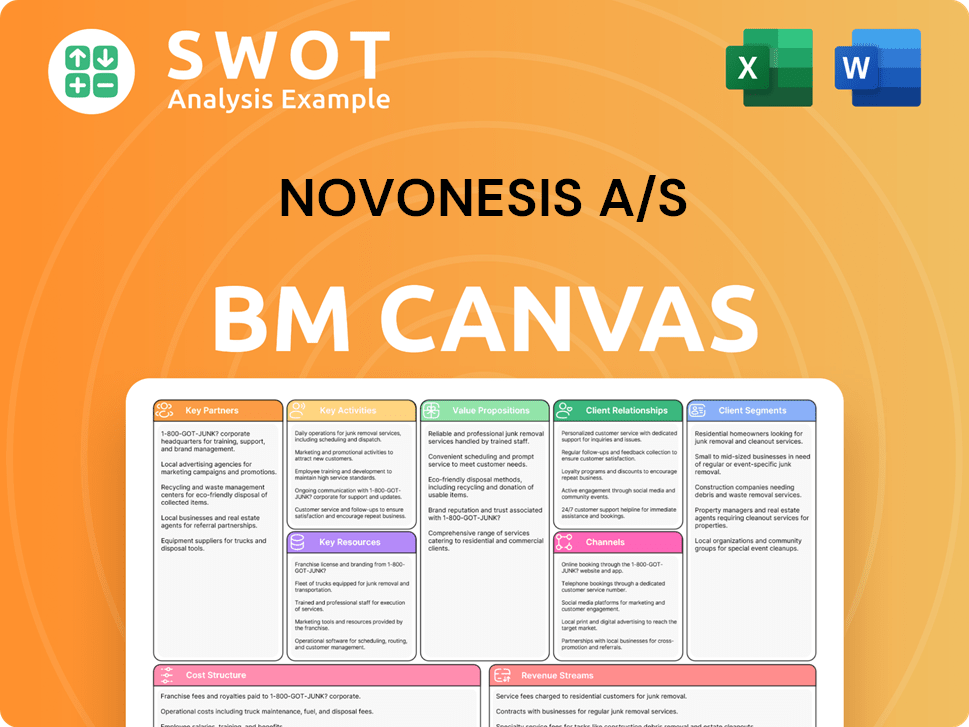
Novonesis A/S Business Model Canvas
- Complete 9-Block Business Model Canvas
- Effortlessly Communicate Your Business Strategy
- Investor-Ready BMC Format
- 100% Editable and Customizable
- Clear and Structured Layout
What is the Timeline of Key Events for Novonesis A/S?
The Novonesis A/S company has a rich history, evolving from its roots in insulin production to become a global leader in biosolutions. The company's journey is marked by significant milestones, including pioneering work in enzyme production, strategic mergers, and a strong focus on sustainable solutions. The merger of Novozymes and Chr. Hansen in January 2024 formed the current Novonesis, marking a new chapter in the company's evolution.
| Year | Key Event |
|---|---|
| 1925 | Novo Terapeutisk Laboratorium, a predecessor to Novonesis, is founded in Denmark to produce insulin. |
| 1939 | Thorvald Pedersen expands the business into enzyme production. |
| 1941 | The company launches its first enzyme, trypsin. |
| 1950s | Pioneers the production of enzymes by fermentation using bacteria. |
| 1969 | The large-scale enzyme fermentation plant in Kalundborg, Denmark, opens. |
| 1989 | Novo Terapeutisk Laboratorium merges with Nordisk Insulinlaboratorium to form Novo Nordisk A/S. |
| 2000 | Novozymes A/S is spun out from Novo Nordisk A/S, focusing on industrial enzymes and microorganisms. |
| 2013 | Novozymes and Monsanto form 'The BioAg Alliance.' |
| 2019 | Novozymes opens its Innovation Campus in Lyngby, Denmark, and announces 'Better Business with Biology' strategy. |
| 2020 | Ester Baiget is appointed President and CEO; Kalundborg plant switches to 100% renewable energy. |
| 2021 | Launches 'Unlocking growth – powered by biotech' strategy. |
| January 2024 | Novozymes and Chr. Hansen complete their merger, forming Novonesis. |
| February 2025 | Novonesis announces the acquisition of dsm-firmenich's share of the Feed Enzyme Alliance for EUR 1.5 billion. |
| May 2025 | Novonesis reports strong Q1 2025 results with 11% organic growth and confirms full-year outlook. |
Future Outlook: Growth Projections
Novonesis anticipates strong performance in the coming years. The 2025 outlook projects pro forma organic sales growth of 5-8% (or 6-9% excluding certain countries). The adjusted EBITDA margin is expected to be 37-38%. The company is investing significantly in growth and anticipates sales synergies.
Strategic Initiatives
Novonesis is focused on leveraging its diversified portfolio of sustainable biosolutions. The company plans to continue addressing opportunities across various industries. The acquisition of the Feed Enzyme Alliance is expected to accelerate sales growth in animal biosolutions and improve the adjusted EBITDA margin.
Sustainability Goals
Novonesis is committed to carbon neutrality by 2050. The company has ambitious targets for reducing CO2 emissions in operations (75% by 2030 for Scope 1 and 2) and supply chains (35% by 2030 for Scope 3). The company also aims for a 45-45% gender balance across all professionals and senior management by 2030.
Analyst Forecasts
Analysts forecast Novonesis's earnings to grow by 26.9% and revenue by 7.8% per annum. The company's focus on biotechnology and enzyme production positions it well for future growth. Novonesis is dedicated to solving global challenges through biological solutions.
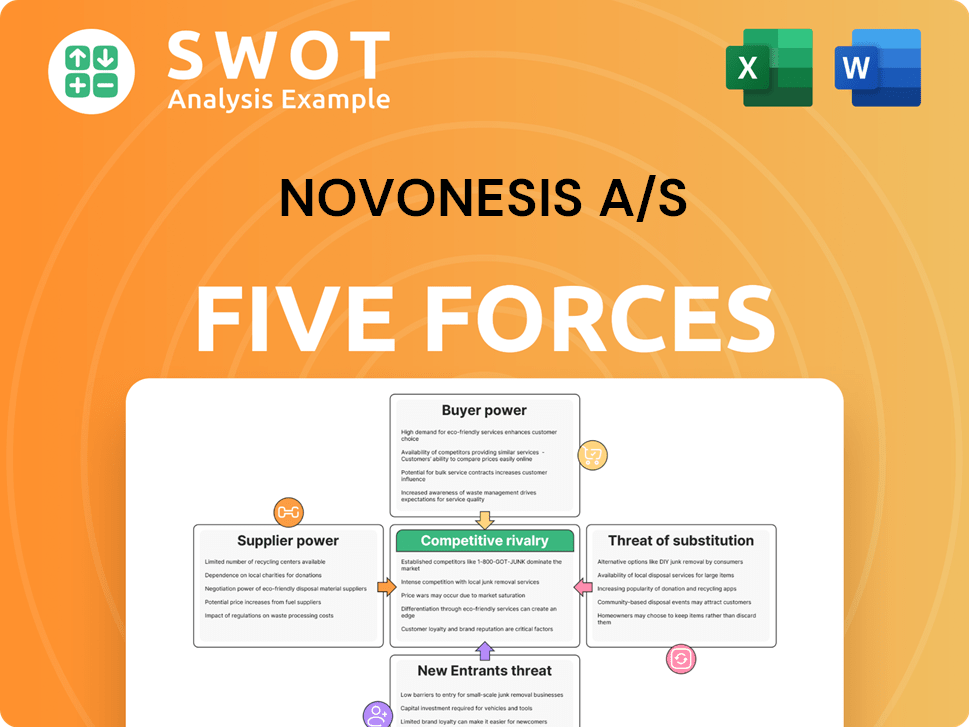
Novonesis A/S Porter's Five Forces Analysis
- Covers All 5 Competitive Forces in Detail
- Structured for Consultants, Students, and Founders
- 100% Editable in Microsoft Word & Excel
- Instant Digital Download – Use Immediately
- Compatible with Mac & PC – Fully Unlocked
Related Blogs

- What is Competitive Landscape of Novonesis A/S Company?
- What is Growth Strategy and Future Prospects of Novonesis A/S Company?
- How Does Novonesis A/S Company Work?
- What is Sales and Marketing Strategy of Novonesis A/S Company?
- What is Brief History of Novonesis A/S Company?
- Who Owns Novonesis A/S Company?
- What is Customer Demographics and Target Market of Novonesis A/S Company?
Disclaimer
All information, articles, and product details provided on this website are for general informational and educational purposes only. We do not claim any ownership over, nor do we intend to infringe upon, any trademarks, copyrights, logos, brand names, or other intellectual property mentioned or depicted on this site. Such intellectual property remains the property of its respective owners, and any references here are made solely for identification or informational purposes, without implying any affiliation, endorsement, or partnership.
We make no representations or warranties, express or implied, regarding the accuracy, completeness, or suitability of any content or products presented. Nothing on this website should be construed as legal, tax, investment, financial, medical, or other professional advice. In addition, no part of this site—including articles or product references—constitutes a solicitation, recommendation, endorsement, advertisement, or offer to buy or sell any securities, franchises, or other financial instruments, particularly in jurisdictions where such activity would be unlawful.
All content is of a general nature and may not address the specific circumstances of any individual or entity. It is not a substitute for professional advice or services. Any actions you take based on the information provided here are strictly at your own risk. You accept full responsibility for any decisions or outcomes arising from your use of this website and agree to release us from any liability in connection with your use of, or reliance upon, the content or products found herein.