

Northeast Grocery Bundle

What's the Story Behind Northeast Grocery Company's Rise?
Delve into the compelling Northeast Grocery SWOT Analysis and uncover the fascinating journey of Northeast Grocery Company, a major player in the New England grocery scene. From its inception through strategic mergers, this Grocery Company History reflects a dynamic adaptation to the ever-changing retail landscape. Discover the pivotal moments that shaped this prominent grocery store chain.

The Northeast Grocery Company, formed in 2021, brought together Price Chopper/Market 32 and Tops Markets, creating a powerhouse with nearly 300 stores across six states. This consolidation aimed to boost operational effectiveness and solidify its market presence. Understanding the Brief history of Northeast Grocery Company provides valuable insights into the competitive strategies of this significant player in the Northeast grocery market, including its relationship with Price Rite stores.
What is the Northeast Grocery Founding Story?
The story of Northeast Grocery Company (NGC) is a tale of mergers and strategic alliances, rooted in the histories of two prominent regional grocery chains. Formed on February 8, 2021, NGC emerged from the union of Tops Markets Corp. and The Golub Corporation, creating a stronger entity in the competitive Northeast grocery market.
While NGC is a recent creation, its roots trace back to the early 20th century. The merger aimed to leverage the combined strengths of its predecessors, including their supply chains and customer bases. This strategic move was designed to enhance their ability to compete effectively in the evolving grocery landscape.
The formation of NGC was a significant event, reshaping the grocery market in the Northeast. The merger of these two established chains created a stronger regional player. The resulting company has a rich history, drawing from the legacies of Price Chopper and Tops Friendly Markets.

Founding Story
The Golub Corporation, the parent company of Price Chopper, was founded in 1932 by William and Bernard Golub in Schenectady, New York. Tops Markets' origins date back to the early 1920s when Ferrante Castellani opened his first grocery store in Niagara Falls, NY. The merger in 2021 created Northeast Grocery Company.
- The Golub Corporation, the original parent company of Price Chopper, was founded in 1932.
- Tops Markets' story began in the early 1920s with Ferrante Castellani.
- The merger of Tops Markets Corp. and The Golub Corporation formed Northeast Grocery Company on February 8, 2021.
- The Federal Trade Commission (FTC) required the combined company to divest 12 stores.
The Golub Corporation, the original parent company of Price Chopper, was established in 1932 in Schenectady, New York, by William and Bernard Golub. Initially named Central Market, their objective was to offer a diverse range of products to customers. The name was changed to Price Chopper in 1973.
Tops Markets' history began earlier, in the early 1920s, when Ferrante Castellani opened his first grocery store in Niagara Falls, NY. His sons, Armand and Alfred, later took over, operating stores under the 'Great Bear Market' name. In the 1950s, Armand Castellani partnered with Thomas Buscaglia, owner of T.A. Buscaglia Equipment Company, forming Niagara Frontier Services. In 1962, they opened their first modern supermarket in Niagara Falls, NY, and Alfonso DiMino suggested the name 'Tops,' aiming to provide customers with the best possible shopping experience. Tops Markets was subsequently launched as a franchise system for supermarkets in 1962.
The merger in 2021 was driven by the opportunity to create a more competitive regional grocer in the Northeast. Both Price Chopper and Tops Friendly Markets had a long tradition of innovation in food merchandising and customer service. The combined company aimed to leverage their collective strengths, supply chains, and customer bases to better navigate an increasingly competitive grocery market. The Price Chopper and Tops businesses maintained their main offices in Schenectady and Williamsville, respectively, and continued to be managed locally by their existing leadership. The Federal Trade Commission (FTC) required the combined company to divest 12 stores, which were sold to C&S Wholesale Grocers and mostly rebranded as Grand Union.
As of 2024, the grocery industry continues to evolve, with companies like Northeast Grocery Company adapting to changing consumer preferences and market dynamics. For a deeper understanding of the competitive environment, consider reviewing the Competitors Landscape of Northeast Grocery.
Northeast Grocery SWOT Analysis
- Complete SWOT Breakdown
- Fully Customizable
- Editable in Excel & Word
- Professional Formatting
- Investor-Ready Format

What Drove the Early Growth of Northeast Grocery?
The early growth and expansion of Northeast Grocery Inc. is best understood by examining the trajectories of its founding companies, Price Chopper/Market 32 and Tops Markets. This strategic growth allowed the chain to establish a strong regional presence across New York, Vermont, Connecticut, Massachusetts, New Hampshire, and Pennsylvania. The 2021 merger of these two entities created a combined force with nearly 300 supermarkets and over 30,000 employees across six states.
 Price Chopper's Early Expansion
Price Chopper, originally Central Market, began expanding in New York's Capital District after its 1932 founding. Throughout the 1980s and 1990s, Price Chopper focused on store modernization and expansion, entering new markets in New England. Key developments included the introduction of the Market 32 banner and continuous investment in store remodels. This Mission, Vision & Core Values of Northeast Grocery is a good example of their values.
Tops Markets' Growth Trajectory
Tops Markets, with roots in the 1920s, saw significant growth after opening its first modern supermarket in 1962. Tops expanded throughout Western New York in the 1970s and entered Pennsylvania in the 1980s. A pivotal moment was the 1991 acquisition by Ahold, leading to larger 'International Super Centers' and further expansion. In 2007, Tops returned to local operation after being sold by Ahold to Morgan Stanley Private Equity.
Merger and Post-Merger Strategy
The 2021 merger of Price Chopper/Market 32 and Tops Markets formed Northeast Grocery Inc., aiming for post-merger synergies and enhanced profitability. The company has faced margin pressure in fiscal year 2024 due to reduced SNAP benefits, competition from discount stores, and inflation. Northeast Grocery Inc. is investing in capital expenditure, with a projected spending of about $70 million in fiscal year 2025.
Future Investments and Expansion
Capital expenditure is primarily for store remodels and conversions of Price Chopper locations to the Market 32 banner, and remodeling existing Tops stores to drive customer traffic. These efforts are expected to improve cash flow in 2025. The company's focus remains on strengthening its regional presence and adapting to market challenges.
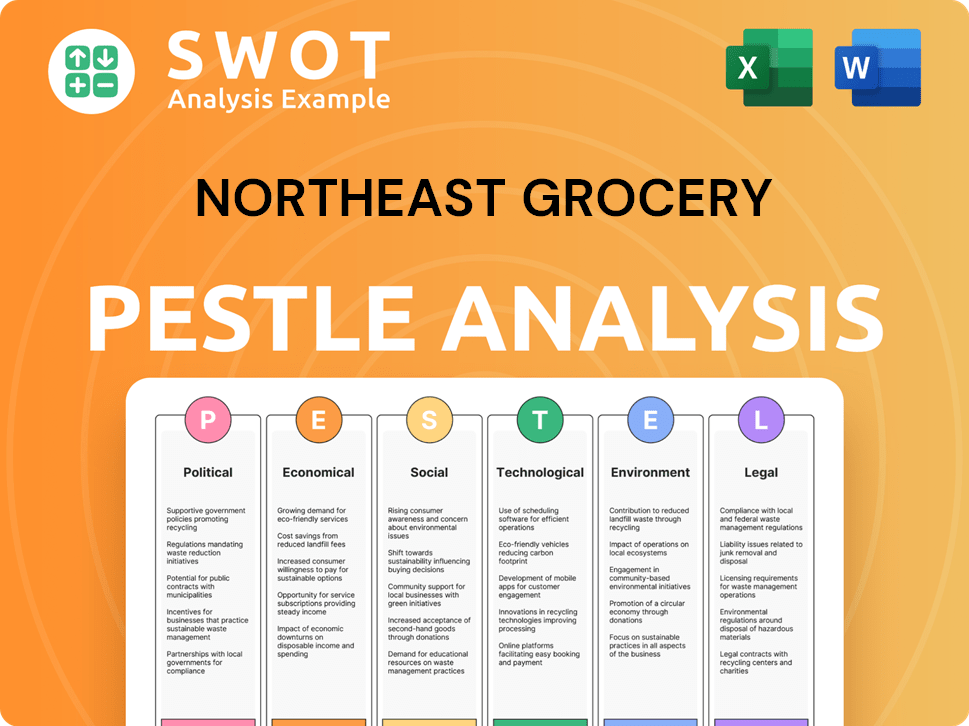
Northeast Grocery PESTLE Analysis
- Covers All 6 PESTLE Categories
- No Research Needed – Save Hours of Work
- Built by Experts, Trusted by Consultants
- Instant Download, Ready to Use
- 100% Editable, Fully Customizable
What are the key Milestones in Northeast Grocery history?
The Northeast Grocery Company has a rich history marked by strategic moves and adaptations within the competitive grocery store chain landscape. This journey includes significant acquisitions, expansions, and a commitment to innovation, all while navigating the challenges of the market. Understanding the Grocery Company History is crucial to appreciating its current position and future prospects.
| Year | Milestone |
|---|---|
| 2018 | Tops Markets successfully emerged from Chapter 11 bankruptcy. |
| 2024 | Northeast Grocery Inc. partnered with Google Cloud to migrate its IT infrastructure and applications to the cloud. |
| 2024 | A pilot program featuring the Tally robot by Simbe Robotics was launched in select stores. |
| 2025 | Northeast Grocery Inc. partnered with Grocery TV to power digital screens in nearly 300 stores. |
The company has embraced technological advancements to enhance its operations and customer experience. A notable innovation is the partnership with Google Cloud, which aims to modernize the IT infrastructure. Additionally, the pilot program with Tally robots demonstrates a commitment to leveraging technology for improved inventory management and pricing accuracy.

Cloud Migration
In November 2024, Northeast Grocery partnered with Google Cloud to migrate its IT infrastructure and applications. This move is designed to enhance scalability, disaster recovery, and cost efficiency.
Robotics in Inventory Management
Starting in September 2024 and running through January 2025, a pilot program using Tally robots by Simbe Robotics was implemented. This program aims to improve inventory management by identifying out-of-stock items and pricing discrepancies.
Digital Screens for Promotions
In April 2025, Northeast Grocery partnered with Grocery TV to power digital screens in nearly 300 stores. This initiative enhances in-store promotions and customer engagement.
Despite these advancements, Northeast Grocery has faced several challenges, including margin declines and increased competition. The company's financial performance in fiscal year 2024 reflected these pressures, with a decrease in S&P Global Ratings-adjusted EBITDA. The company's strategic responses, such as store remodels and conversions, highlight its efforts to adapt to market dynamics.
Margin Decline
In fiscal year 2024, the company experienced a margin decline due to factors such as reduced SNAP benefits and a challenging consumer environment. Competition from discount stores and inflation also contributed to these pressures.
Financial Metrics
S&P Global Ratings-adjusted EBITDA decreased to $387 million in fiscal year 2024, from $421 million the previous year. This led to an increase in S&P Global Ratings-adjusted leverage to 4.4x from 3.8x.
Strategic Investments
The company has undertaken aggressive capital expenditures to remodel existing stores and convert Price Chopper locations to Market 32 stores. These investments are part of a broader strategy to adapt to market conditions.
Northeast Grocery Business Model Canvas
- Complete 9-Block Business Model Canvas
- Effortlessly Communicate Your Business Strategy
- Investor-Ready BMC Format
- 100% Editable and Customizable
- Clear and Structured Layout

What is the Timeline of Key Events for Northeast Grocery?
The Growth Strategy of Northeast Grocery Company (Northeast Grocery) has a rich history. It is a result of mergers between long-standing grocery chains. It started with Ferrante Castellani's first grocery store in the 1920s. Later, William and Bernard Golub founded Central Market in 1932. The official launch of Tops Friendly Markets as a franchise system was in 1962. Central Market later became Price Chopper in 1973. This sets the stage for the company's current structure.
| Year | Key Event |
|---|---|
| 1920s | Ferrante Castellani opens his first grocery store in Niagara Falls, NY, the foundation for Tops Markets. |
| 1932 | William and Bernard Golub found Central Market in Schenectady, NY, which would later become Price Chopper. |
| 1962 | Tops Friendly Markets is launched as a franchise system, opening its first modern supermarket in Niagara Falls, NY. |
| 1973 | Central Market rebrands as Price Chopper. |
| 1991 | Ahold acquires Tops Friendly Markets. |
| 2007 | Ahold sells Tops Markets to Morgan Stanley Private Equity. |
| 2013 | Six members of Tops' executive team purchase the company from Morgan Stanley Private Equity. |
| 2021 (February 8) | Price Chopper and Tops Markets announce plans to merge. |
| 2021 (November) | The merger of Price Chopper and Tops Markets is completed, forming Northeast Grocery Inc. |
| 2022 (February) | Scott Grimmett retires as CEO of Northeast Grocery Inc., succeeded by Frank Curci. |
| 2023 (June) | John Persons becomes COO of Northeast Grocery Inc., overseeing both Price Chopper/Market 32 and Tops Markets operations. |
| 2024 (January 23) | Frank Curci announces his retirement as CEO, with John Persons named as his successor, effective February 26. |
| 2024 (September) | Northeast Grocery Inc. launches a pilot program with Simbe Robotics for Tally robots in 10 stores, running through January 2025. |
| 2024 (November) | Northeast Grocery Inc. partners with Google Cloud to migrate its IT infrastructure to the cloud. |
| 2025 (April 9) | Northeast Grocery Inc. partners with Grocery TV to implement digital signage across its stores. |
| 2025 (May 22) | Northeast Grocery Inc. becomes available on DoorDash. |
Future Outlook
Northeast Grocery anticipates continued operating challenges in fiscal years 2025 and 2026, including elevated leverage and margin pressure. This is due to reduced SNAP benefits and intense competition. However, cash flow is projected to improve in 2025.
Strategic Initiatives
The company plans to continue investing in store remodels and converting Price Chopper locations to the Market 32 banner. Approximately $70 million in capital expenditure is projected for fiscal 2025, and $85 million for the following year. These conversions aim to attract younger consumers.
Technology and Innovation
Northeast Grocery is adopting advanced technology, such as the Google Cloud migration. It also uses the Tally robot pilot program. These initiatives underscore its commitment to operational efficiency and an enhanced customer experience. The partnership with Grocery TV is also a focus.
Industry Trends
The grocery retail industry is expected to see further integration of online and offline shopping experiences. There will be a continued emphasis on local brands, fresh produce, and community engagement in the Northeast. Northeast Grocery aims to sustain its leading position.
Northeast Grocery Porter's Five Forces Analysis
- Covers All 5 Competitive Forces in Detail
- Structured for Consultants, Students, and Founders
- 100% Editable in Microsoft Word & Excel
- Instant Digital Download – Use Immediately
- Compatible with Mac & PC – Fully Unlocked

Related Blogs

- What is Competitive Landscape of Northeast Grocery Company?
- What is Growth Strategy and Future Prospects of Northeast Grocery Company?
- How Does Northeast Grocery Company Work?
- What is Sales and Marketing Strategy of Northeast Grocery Company?
- What is Brief History of Northeast Grocery Company?
- Who Owns Northeast Grocery Company?
- What is Customer Demographics and Target Market of Northeast Grocery Company?
Disclaimer
All information, articles, and product details provided on this website are for general informational and educational purposes only. We do not claim any ownership over, nor do we intend to infringe upon, any trademarks, copyrights, logos, brand names, or other intellectual property mentioned or depicted on this site. Such intellectual property remains the property of its respective owners, and any references here are made solely for identification or informational purposes, without implying any affiliation, endorsement, or partnership.
We make no representations or warranties, express or implied, regarding the accuracy, completeness, or suitability of any content or products presented. Nothing on this website should be construed as legal, tax, investment, financial, medical, or other professional advice. In addition, no part of this site—including articles or product references—constitutes a solicitation, recommendation, endorsement, advertisement, or offer to buy or sell any securities, franchises, or other financial instruments, particularly in jurisdictions where such activity would be unlawful.
All content is of a general nature and may not address the specific circumstances of any individual or entity. It is not a substitute for professional advice or services. Any actions you take based on the information provided here are strictly at your own risk. You accept full responsibility for any decisions or outcomes arising from your use of this website and agree to release us from any liability in connection with your use of, or reliance upon, the content or products found herein.