

Mitsui & Co Bundle

How did Mitsui & Co. rise to become a global powerhouse?
Journey back in time to explore the fascinating Mitsui & Co SWOT Analysis! From its humble beginnings in 1876, this Japanese trading company has shaped global commerce. Discover the pivotal moments that transformed a small enterprise into a diversified global conglomerate.

The brief history of Mitsui & Co. reveals a story of resilience and strategic foresight. Tracing the history of Mitsui & Co. offers insights into the evolution of a "sogo shosha" and its impact on the Japanese economy. Understanding the early days of Mitsui & Co. provides a crucial context for appreciating its current global presence and diverse business activities within the Mitsui Group.
What is the Mitsui & Co Founding Story?
The story of Mitsui & Co, a prominent Japanese trading company, begins with the broader Mitsui Group. This group's roots go back to the 17th century and the merchant Hachirobei Takatoshi Mitsui. The formal establishment of the trading company, the former Mitsui & Co, marked a significant milestone in its journey.
The Mitsui & Co founding took place in 1876. The company started with a team of 16 members, including key figures like Takashi Masuda and Tatsuzo Minakami. Their primary goal was to facilitate trade between Japan and the global market. This initial focus involved exporting commodities such as rice and coal.
In the same year, Mitsui Bank, Japan's first private bank, was founded. This bank provided crucial financial support for Mitsui's early operations. The strategic foresight to establish a financial foundation alongside the trading business highlights the company's comprehensive approach from the start.

Early Days and Key Figures
The early success of Mitsui & Co was significantly influenced by key figures and strategic decisions.
- Rizaemon Minomura played a pivotal role, despite Hachiroemon Mitsui often receiving credit.
- Minomura's skills in navigating financial challenges, such as securing a government remittance, were crucial.
- The company's initial business model focused on international trading activities.
- Enterprise investments and financing were integrated into its business development.
The company's early success was not solely attributable to the Mitsui family. Rizaemon Minomura, a talented executive, played a vital role. He had strong government contacts and was instrumental in navigating financial challenges. One example was securing a government remittance when Mitsui had to lend a substantial amount to the struggling Tokugawa government. This demonstrates the importance of strategic relationships and astute management from its inception. The company's initial business model revolved around facilitating international trading activities. This expanded into enterprise investments and offering financing as an integral part of its business development.
The company's organizational structure and focus on competence allowed it to thrive. This approach helped Mitsui succeed where other wealthy families of the era faced collapse. This comprehensive approach, combined with a well-organized structure and a focus on competence over family ties, allowed Mitsui to thrive where other wealthy families of the era faced collapse. To learn more about the company's business model, you can read this article: Revenue Streams & Business Model of Mitsui & Co.
Mitsui & Co SWOT Analysis
- Complete SWOT Breakdown
- Fully Customizable
- Editable in Excel & Word
- Professional Formatting
- Investor-Ready Format

What Drove the Early Growth of Mitsui & Co?
The early growth of Mitsui & Co, a prominent Japanese trading company, was marked by rapid diversification and global expansion. Following its establishment in 1876, the company quickly became the largest textile trader in the 19th century. This initial success set the stage for further growth and influence in the global market. Learn more about the Mission, Vision & Core Values of Mitsui & Co.
 Textile Dominance
Mitsui & Co initially thrived as a leading textile trader. This early focus on textiles was crucial during a period when textiles were central to Japan's economy. This success provided a solid foundation for the company's future diversification and expansion into other sectors.
Diversification and Influence
The company broadened its scope to include raw materials, machinery, and arms. This diversification significantly increased its economic and political influence. The import of cotton-spinning machinery from Great Britain in 1883 was a key development, contributing to Japan's transformation from a cotton yarn importer to an exporter by 1906, with Mitsui handling over half of the outbound shipments.
Global Expansion
Geographical expansion was a priority for Mitsui. By the turn of the 20th century, the company had established offices in major international hubs such as Shanghai, Paris, Hong Kong, New York, and London. This global network was essential for facilitating international trade and identifying new business opportunities, solidifying its role as a sogo shosha.
Post-War Re-establishment
In the post-World War II era, the company was re-established in 1947 as Daiichi Bussan Kaisha, Ltd. A significant milestone was the 'great amalgamation' in 1959, when Daiichi Bussan Kaisha, Ltd. merged with several other trading companies, officially reverting its name to Mitsui & Co., Ltd. Further expansion included the establishment of Mitsui & Co. (U.S.A.), Inc. in 1966 and Mitsui & Co. Europe PLC in 1988, strengthening its international presence.
Mitsui & Co PESTLE Analysis
- Covers All 6 PESTLE Categories
- No Research Needed – Save Hours of Work
- Built by Experts, Trusted by Consultants
- Instant Download, Ready to Use
- 100% Editable, Fully Customizable

What are the key Milestones in Mitsui & Co history?
The history of Mitsui & Co is marked by significant achievements that have shaped its evolution into a global trading and investment powerhouse. From its early ventures in chemical operations to its strategic expansions, the company has consistently adapted to the changing global landscape, establishing itself as a key player in international trade and investment.
| Year | Milestone |
|---|---|
| 1912 | Mitsui Coal Mine starts full-scale chemical operations in Omuta. |
| 1915 | Production of Japan's first synthetic dye, alizarin, begins. |
| 1947 | Re-established as Daiichi Bussan Kaisha, Ltd., after being split up post-World War II. |
| 1959 | Regained the Mitsui & Co. name through mergers. |
| 2000 | Embarks on a global IT strategy, adopting systems like SAP R/3® to enhance business operations. |
| 2005 | Invests in Quintiles Transnational Japan K.K. to accelerate growth in pharmaceuticals, biotechnology, and healthcare. |
| 2024 | Launched several key businesses and initiatives, demonstrating resilience amid global uncertainties. |
Mitsui & Co. has consistently demonstrated a commitment to innovation. The company's early adoption of chemical operations and production of synthetic dyes showcased its dedication to technological advancement and domestic production.

Chemical Operations
Mitsui's early foray into chemical operations, starting with the Mitsui Coal Mine in 1912, marked a significant innovation. This led to the production of Japan's first synthetic dye, alizarin, by 1915.
IT Strategy
In 2000, Mitsui & Co. implemented a global IT strategy to enhance its business operations. This included adopting systems like SAP R/3® to improve productivity and integrate business processes worldwide.
Strategic Investments
Mitsui has made strategic investments in various sectors, including a 2005 investment in Quintiles Transnational Japan K.K. This investment aimed to accelerate growth in pharmaceuticals, biotechnology, and healthcare.
Business Initiatives
In 2024, despite global challenges, Mitsui launched several key businesses and initiatives. This demonstrates the company's ability to adapt and innovate in a changing market.
Adaptation
The company has consistently adapted to global uncertainties and challenges, such as regional conflicts and economic shifts. This has allowed Mitsui to maintain its position as a leading Sogo shosha.
Resilience
Mitsui's resilience is evident in its ability to manage risks and improve existing businesses. The company achieved a profit of JPY 1 trillion during the first year of its Medium-term Management Plan 2026.
The Mitsui Group has faced various challenges throughout its history. The dissolution of major zaibatsu after World War II led to the company's temporary split.
Post-War Dissolution
The dissolution of major zaibatsu, including Mitsui, in the aftermath of World War II, led to the company being split up. This period presented significant organizational and operational challenges.
Iranian Petroleum Interests
The loss of its Iranian petroleum interests following the Iranian Revolution in 1979 was a major setback. This allowed a competitor, Mitsubishi, to gain a leading position in the Japanese trading house sector.
Market Conditions
In May 2024, the company reported a decrease in profit for the fiscal year ending March 2025. This was primarily due to lower commodity prices and foreign exchange rates, reflecting the impact of global economic factors.
Competition
The competitive landscape within the Japanese trading company sector has always been challenging. Mitsui has consistently faced pressure from its competitors, requiring continuous adaptation and strategic innovation.
Global Uncertainties
Mitsui operates in a global environment subject to various uncertainties, including regional conflicts and economic shifts. These factors can significantly impact the company's performance and strategic planning.
Financial Performance
Despite the challenges, Mitsui achieved a profit of JPY 1 trillion during the first year of its Medium-term Management Plan 2026. This demonstrates the company's ability to manage risks and improve existing businesses.
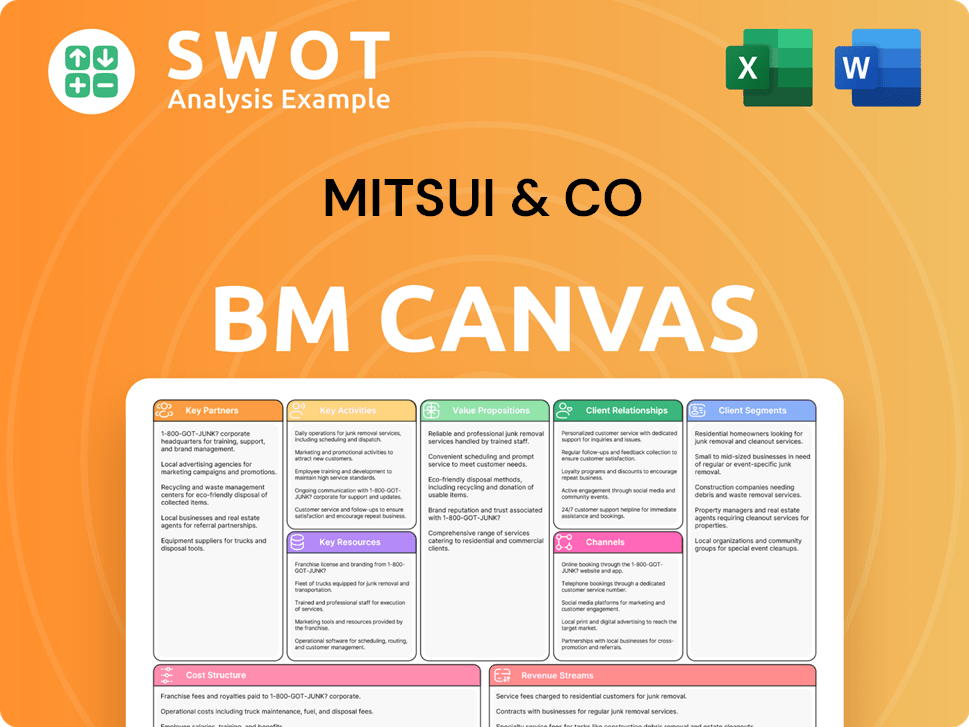
Mitsui & Co Business Model Canvas
- Complete 9-Block Business Model Canvas
- Effortlessly Communicate Your Business Strategy
- Investor-Ready BMC Format
- 100% Editable and Customizable
- Clear and Structured Layout
What is the Timeline of Key Events for Mitsui & Co?
The history of Mitsui & Co, a prominent Japanese trading company, is marked by significant milestones that have shaped its global presence. From its origins in 1876 with Takashi Masuda, the company has evolved through various phases, adapting to the changing global landscape. This evolution includes expanding its business activities, navigating economic shifts, and strategically positioning itself for future growth. The Mitsui Group's journey reflects a commitment to innovation, diversification, and sustainable business practices.
| Year | Key Event |
|---|---|
| 1876 | The former Mitsui & Co. is established with Takashi Masuda. |
| 1883 | The company imports cotton-spinning machinery from Great Britain. |
| 1912 | Mitsui Coal Mine begins full-scale chemical operations in Omuta. |
| 1915 | Production of alizarin, Japan's first synthetic dye, commences. |
| 1947 | Daiichi Bussan Kaisha, Ltd. is established following the dissolution of the former Mitsui & Co. |
| 1959 | Daiichi Bussan Kaisha, Ltd. merges with other trading companies and changes its name back to Mitsui & Co., Ltd. |
| 1966 | Mitsui & Co. (U.S.A.), Inc. is established. |
| 1979 | Loss of Iranian petroleum interests impacts Mitsui's leading position. |
| 1988 | Mitsui & Co. Europe PLC is established. |
| 2000 | Mitsui & Co. begins implementing a global IT strategy. |
| 2001 | Japan Alternative Investment Co., Ltd. (later Mitsui & Co. Alternative Investments, Ltd.) is founded as a wholly owned subsidiary. |
| 2020 | New Otemachi Head Office building completed. |
| 2024 | The company reports a profit of JPY 1 trillion in the first year of its Medium-term Management Plan 2026. |
| April 2025 | Mitsui & Co. forms a joint venture with JERA Co. and CF Industries Holdings to build a low-carbon ammonia plant. |
| May 2025 | Mitsui & Co. announces additional investment in aircraft engine-related business. |
Medium-term Management Plan 2026
Mitsui & Co. is focused on strengthening its core businesses and pursuing strategic growth initiatives under its Medium-term Management Plan, which extends to 2026. The company aims to achieve high profitability through differentiation and by creating new markets.
Strategic Growth Areas
Key growth drivers include energy transition, mobility, healthcare, and protein. Mitsui is committed to a global transition to low-carbon and renewable energy, including stable supplies of natural gas and LNG as transition fuels, and developing next-generation fuels like ammonia and methanol.
Expansion in Healthcare
The company is expanding its presence in the healthcare sector, particularly in the Asian market, and exploring the creation of a pharmaceutical business leveraging healthcare data.
Investment and Vision
Mitsui & Co. anticipates continued growth through the expansion of its business portfolio, with plans to invest JPY 1.8 trillion in strategic initiatives. The company's vision for 2050 includes achieving net-zero emissions, with a 30% reduction in GHG emissions by 2030 compared to 2020.
Mitsui & Co Porter's Five Forces Analysis
- Covers All 5 Competitive Forces in Detail
- Structured for Consultants, Students, and Founders
- 100% Editable in Microsoft Word & Excel
- Instant Digital Download – Use Immediately
- Compatible with Mac & PC – Fully Unlocked

Related Blogs

- What is Competitive Landscape of Mitsui & Co Company?
- What is Growth Strategy and Future Prospects of Mitsui & Co Company?
- How Does Mitsui & Co Company Work?
- What is Sales and Marketing Strategy of Mitsui & Co Company?
- What is Brief History of Mitsui & Co Company?
- Who Owns Mitsui & Co Company?
- What is Customer Demographics and Target Market of Mitsui & Co Company?
Disclaimer
All information, articles, and product details provided on this website are for general informational and educational purposes only. We do not claim any ownership over, nor do we intend to infringe upon, any trademarks, copyrights, logos, brand names, or other intellectual property mentioned or depicted on this site. Such intellectual property remains the property of its respective owners, and any references here are made solely for identification or informational purposes, without implying any affiliation, endorsement, or partnership.
We make no representations or warranties, express or implied, regarding the accuracy, completeness, or suitability of any content or products presented. Nothing on this website should be construed as legal, tax, investment, financial, medical, or other professional advice. In addition, no part of this site—including articles or product references—constitutes a solicitation, recommendation, endorsement, advertisement, or offer to buy or sell any securities, franchises, or other financial instruments, particularly in jurisdictions where such activity would be unlawful.
All content is of a general nature and may not address the specific circumstances of any individual or entity. It is not a substitute for professional advice or services. Any actions you take based on the information provided here are strictly at your own risk. You accept full responsibility for any decisions or outcomes arising from your use of this website and agree to release us from any liability in connection with your use of, or reliance upon, the content or products found herein.