

Idemitsu Kosan Bundle

How Did Idemitsu Kosan Become a Japanese Energy Powerhouse?
Journey back in time to uncover the compelling Idemitsu Kosan SWOT Analysis and the remarkable rise of Idemitsu Kosan, a leading Japanese oil company. From its humble beginnings in the early 20th century, this company has navigated turbulent markets and pivotal moments. Discover the fascinating Idemitsu history and the key milestones that shaped this energy giant.

The story of Idemitsu Kosan, a prominent player in the Japanese energy sector, is a testament to visionary leadership and strategic adaptability. Understanding the Idemitsu founder's initial vision provides critical context for appreciating its current operations. Exploring the Idemitsu timeline reveals how the company evolved from a regional distributor to a global force, impacting the oil industry and the broader economy.
What is the Idemitsu Kosan Founding Story?
The story of Idemitsu Kosan began on June 20, 1911. Sazō Idemitsu established the company, initially known as Idemitsu & Co. (Idemitsu Shokai). It all started in Moji, located in northern Kyushu, Japan.
Sazō Idemitsu began his journey by selling lubricants as an agent for Nippon Sekiyu (Nippon Oil Co. Ltd.). He saw a chance in the growing energy market. His focus was on distributing fuel and lubricating oils. This early focus set the stage for what the company would become.
The initial business model was centered around selling lubricant oil and later expanding to fuel oil for fishing boats in Shimonoseki. In 1923, Idemitsu revolutionized fuel distribution for fishing boats. He introduced small tanker vessels equipped with fuel meters. This was a significant move away from the less efficient canned fuel distribution. This early focus on distribution and customer service set a precedent for the company's future operations.

Early Innovations and Expansion
Idemitsu's innovative approach to fuel distribution and customer service set the stage for its future growth. The company's early operations were influenced by Japan's industrial growth.
- Sazō Idemitsu's vision was key to the company's early success.
- The company's expansion was fueled by the growing demand for energy in Japan.
- The introduction of tanker vessels with fuel meters was a major innovation in the industry.
- The company's initial focus was on supplying fuel to fishing boats.
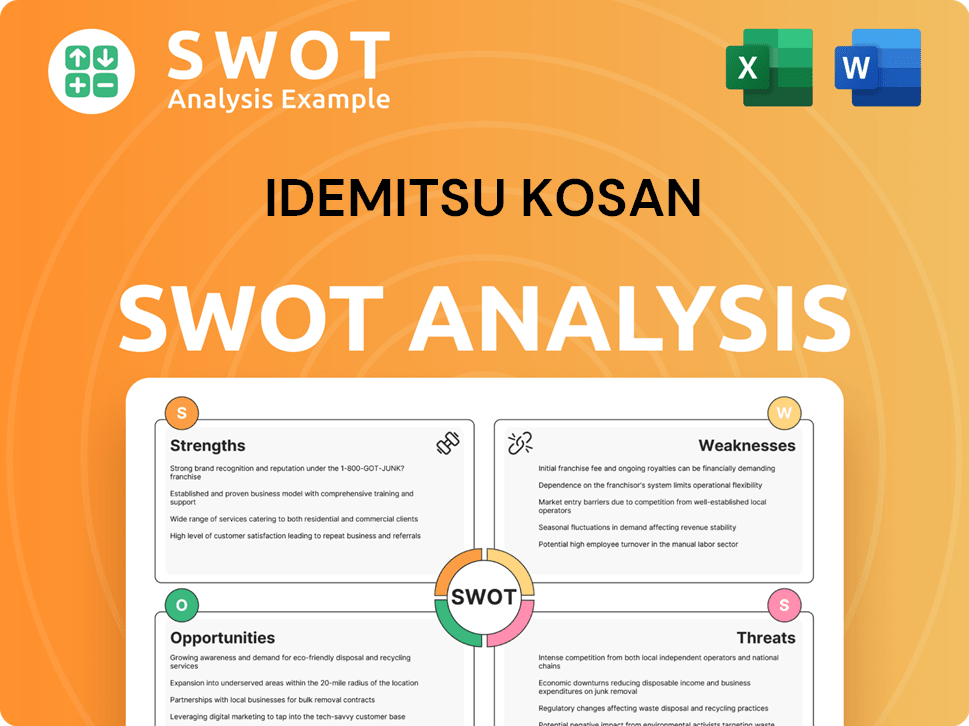
Idemitsu Kosan SWOT Analysis
- Complete SWOT Breakdown
- Fully Customizable
- Editable in Excel & Word
- Professional Formatting
- Investor-Ready Format
What Drove the Early Growth of Idemitsu Kosan?
The early growth of the Japanese oil company, Idemitsu Kosan, was marked by rapid expansion and strategic initiatives. Following its establishment, the company quickly diversified its offerings. This period saw significant moves both domestically and internationally, shaping the foundation for its future in the Japanese energy sector.
 Early Diversification
In 1913, Idemitsu Kosan began selling fuel oil for fishing boats, expanding beyond lubricants. This move opened up nationwide marketing opportunities, showing the company's early adaptability. This diversification was a key step in its early development and market penetration, setting the stage for future growth.
International Expansion
Idemitsu & Co. ventured into Manchuria (China) in 1914, and later expanded its sales network to North China, Korea, and Taiwan. This international push was an attempt to compete with Western companies like Standard Oil. Despite the postwar recession, the company continued to grow, although it later closed some foreign branches.
Operational Developments
A key development was the launch of its first oil tanker in 1938. The headquarters was relocated to Tokyo, and Idemitsu Kosan K.K. was established in 1940. These moves were crucial for streamlining operations and positioning the company strategically within Japan.
Post-War Strategy
After World War II, Idemitsu Kosan secured distribution rights under the Allied occupation in 1949. This led to a focus on marketing and distribution within Japan, including a tanker fleet and depots. The launch of the 'Apollo' brand gasoline in 1951 and importing high-octane gasoline from California further solidified its presence. To learn more about the company's target market, consider reading Target Market of Idemitsu Kosan.
Refining and Petrochemicals
A significant milestone was the completion of the first Tokuyama Refinery in 1957, Japan's first grassroots petroleum refinery. This was followed by the construction of additional refineries, including Chiba (1963), Hyogo (1970), Hokkaido (1973), and Aichi (1975), significantly expanding its refining capacity. Idemitsu Petrochemical Co. Ltd. was established in 1964, entering new production fields.
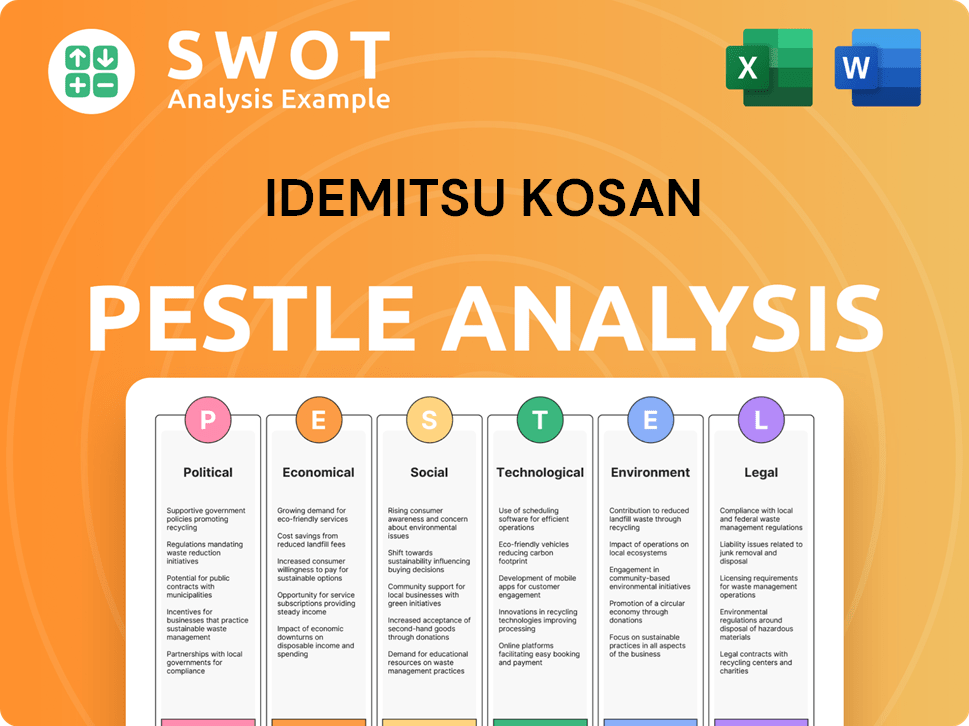
Idemitsu Kosan PESTLE Analysis
- Covers All 6 PESTLE Categories
- No Research Needed – Save Hours of Work
- Built by Experts, Trusted by Consultants
- Instant Download, Ready to Use
- 100% Editable, Fully Customizable
What are the key Milestones in Idemitsu Kosan history?
The Idemitsu history is a story of resilience, innovation, and adaptation within the Japanese energy sector. From its founding to its current operations, the company has consistently evolved to meet the changing demands of the market and the global energy landscape. This commitment to progress is evident in its milestones, innovations, and the challenges it has overcome.
| Year | Milestone |
|---|---|
| 1962 | Idemitsu opposed the Oil Industry Law, viewing it as a restriction on business freedom. |
| 1977 | Idemitsu initiated full-scale efforts in coal and geothermal energy following the 1973 Oil Crisis. |
| 1994 | Idemitsu established mass production technology for lithium sulfide, a key raw material for solid electrolytes. |
| 1997 | Idemitsu developed the world's first OLED display. |
| 2025 | Idemitsu was recognized for its next-generation agrivoltaic system. |
Idemitsu Kosan has consistently pushed the boundaries of technology and materials science. The development of the world's first OLED display in 1997 showcased its early commitment to cutting-edge innovation. More recently, the company is actively partnering with Toyota Motor to commercialize next-generation batteries, aiming for commercialization in 2027-2028.

OLED Display
Idemitsu developed the world's first OLED display in 1997, demonstrating its early commitment to advanced technologies. This innovation highlighted the company's focus on pioneering new display technologies.
Lithium Sulfide Production
In 1994, Idemitsu established mass production technology for lithium sulfide, a crucial raw material for solid-state batteries. This positions the company at the forefront of battery technology.
Next-Generation Batteries
Idemitsu is partnering with Toyota Motor to commercialize next-generation batteries, targeting commercialization between 2027 and 2028. This collaboration underscores its commitment to future energy solutions.
Agrivoltaic System
In January 2025, Idemitsu's next-generation agrivoltaic system was recognized for balancing energy production with agricultural activities. This highlights the company's focus on sustainable and integrated solutions.
The Japanese oil company, Idemitsu Kosan, has faced significant challenges. In 1962, it opposed the Oil Industry Law, viewing it as a constraint on business. More recently, for the fiscal year ending March 31, 2025, the company reported a 53.2% year-on-year decrease in operating income.
Oil Industry Law Opposition
In 1962, Idemitsu opposed the Oil Industry Law, viewing it as a restriction on business freedom. This stance demonstrated the company's early commitment to independent business practices.
1973 Oil Crisis
The 1973 Oil Crisis prompted Idemitsu to pursue alternative energy sources. This led to full-scale efforts in coal and geothermal energy starting in 1977, showcasing its adaptability.
Market Downturn
The Japanese oil industry experienced a downturn and consolidation towards the end of the 1990s. Idemitsu Kosan remained one of the few major oil refining companies that had not merged.
Financial Performance Challenges
For the fiscal year ending March 31, 2025, Idemitsu reported a 53.2% year-on-year decrease in operating income. This was primarily due to the impact of declining crude oil prices, reduced production volume, and challenging market conditions.
Energy Transition
Idemitsu is actively addressing these challenges through strategic initiatives, including a focus on energy transition. This involves expanding into new business areas like next-generation energy and advanced materials.
idemitsu-R40 Solution
In May 2025, Idemitsu announced 'idemitsu-R40,' a new solution to support the carbon-neutral transition of coal boilers. This showcases its commitment to evolving with industry trends.
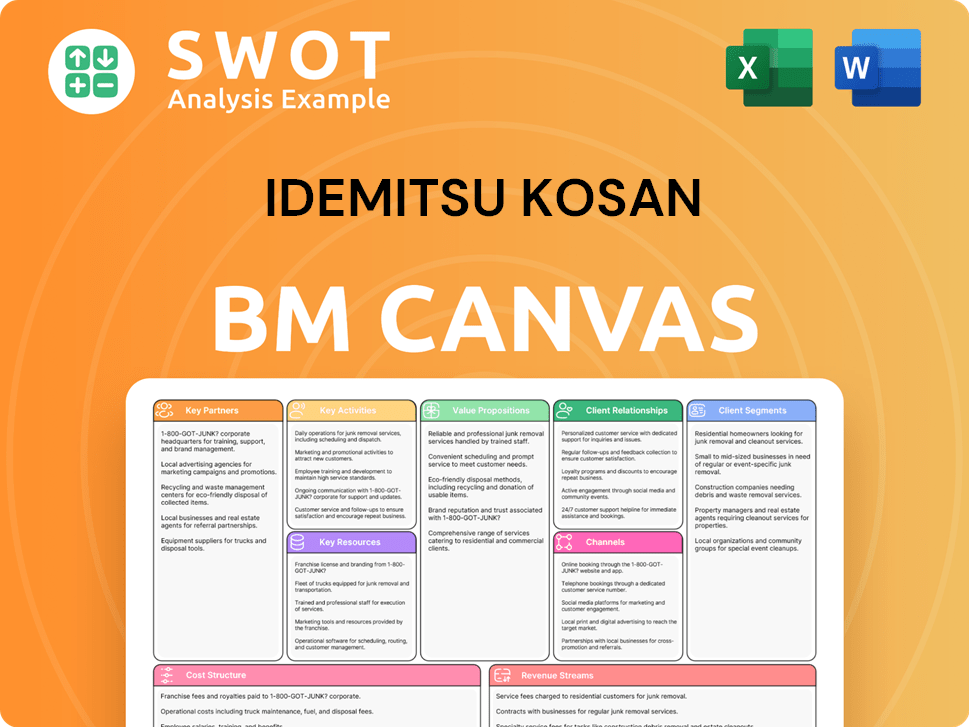
Idemitsu Kosan Business Model Canvas
- Complete 9-Block Business Model Canvas
- Effortlessly Communicate Your Business Strategy
- Investor-Ready BMC Format
- 100% Editable and Customizable
- Clear and Structured Layout
What is the Timeline of Key Events for Idemitsu Kosan?
This is a brief history of Idemitsu Kosan, a major player in the Japanese energy sector. The company's journey began in 1911 with Sazō Idemitsu, the Idemitsu founder, establishing an oil sales business. Over the years, Idemitsu Kosan has expanded its operations, adapted to changing energy demands, and embraced technological advancements, including pioneering work in solid-state batteries and sustainable aviation fuel. Its history reflects a commitment to innovation and a forward-looking approach to the energy landscape.
| Year | Key Event |
|---|---|
| 1911 | Sazō Idemitsu established Idemitsu & Co. (Idemitsu Shokai) in Moji, Kitakyushu, starting oil sales. |
| 1914 | The company expanded overseas, developing sales channels in Manchuria, Korea, and Taiwan. |
| 1938 | Idemitsu launched its first oil tanker. |
| 1940 | Headquarters relocated to Tokyo, and the company was reorganized as Idemitsu Kosan K.K. |
| 1957 | Completion of the Tokuyama Refinery, Japan's first grassroots petroleum refinery. |
| 1964 | Idemitsu Petrochemical Co. Ltd. was established. |
| 1977 | Full-scale efforts toward oil alternative energy, including coal and geothermal, began. |
| 1984 | Commercial oil and gas production began in the offshore Aga Field in Niigata Prefecture. |
| 1994 | Establishes mass production technology for lithium sulfide. |
| 1997 | Developed the world's first OLED display. |
| 2006 | Idemitsu Kosan became publicly traded on the Tokyo Stock Exchange. |
| 2019 | Merged with Showa Shell Sekiyu. |
| 2024 | Plans announced to transform the Yamaguchi refinery into a carbon-free energy hub. |
| 2025 | Expected final investment decision on a planned clean hydrogen and ammonia project in the US with Mitsubishi Corporation. |
| 2027-2028 | Aims to commercialize solid-state batteries with Toyota. |
Energy Transition Focus
Idemitsu Kosan is committed to achieving carbon neutrality by 2050. This involves strategic investments in renewable energy sources and low-carbon fuels. The company is actively pursuing opportunities in green hydrogen and ammonia production to reduce its carbon footprint and support the global energy transition.
Solid-State Battery Materials
Idemitsu is expanding its production capacity for lithium sulfide, a key material for solid-state batteries. A new facility, with a planned investment of ¥21.3 billion, is expected to be completed by June 2027. This expansion supports its partnership with Toyota and positions Idemitsu in the growing market for advanced battery technology.
Low-Carbon Ammonia Projects
The company is collaborating with Mitsubishi Corporation on a large-scale, low-carbon ammonia supply chain. A final investment decision is expected in 2025 for a project in Baytown, Texas, with production targeted for 2029. Idemitsu also aims to introduce over 1 million tons of ammonia by 2030 for fuel and raw materials.
Sustainable Aviation Fuel (SAF)
Idemitsu is investing in SAF production, with a goal to supply 500,000 kl/year by 2030. This includes a plant at its Tokuyama petrochemical complex. The company's focus on SAF aligns with the global push for sustainable aviation, contributing to the reduction of carbon emissions in the aviation industry.
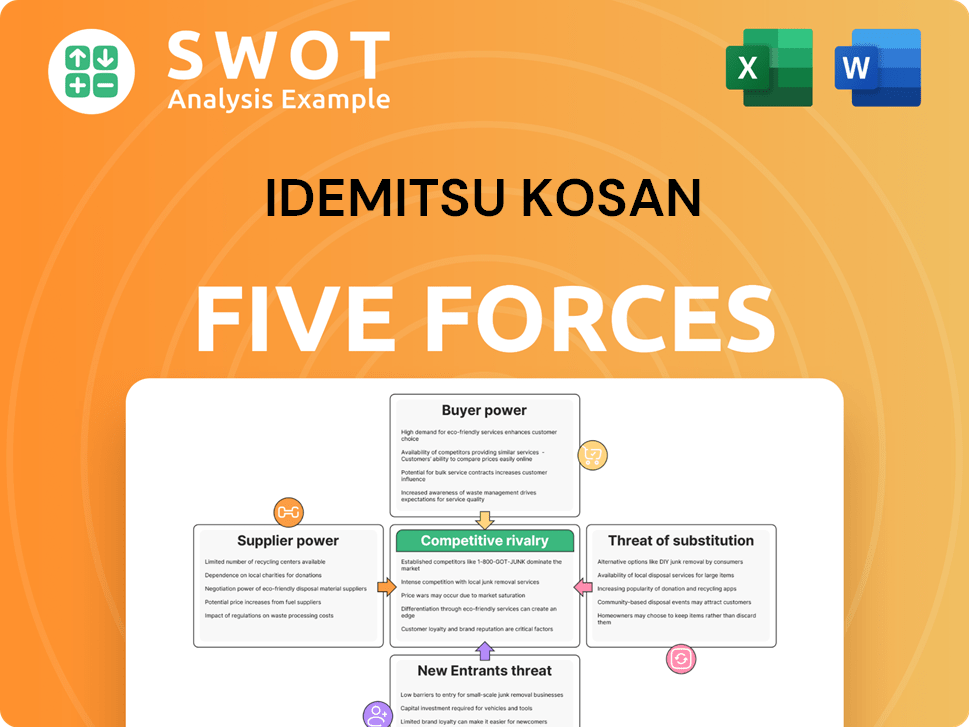
Idemitsu Kosan Porter's Five Forces Analysis
- Covers All 5 Competitive Forces in Detail
- Structured for Consultants, Students, and Founders
- 100% Editable in Microsoft Word & Excel
- Instant Digital Download – Use Immediately
- Compatible with Mac & PC – Fully Unlocked
Related Blogs

- What is Competitive Landscape of Idemitsu Kosan Company?
- What is Growth Strategy and Future Prospects of Idemitsu Kosan Company?
- How Does Idemitsu Kosan Company Work?
- What is Sales and Marketing Strategy of Idemitsu Kosan Company?
- What is Brief History of Idemitsu Kosan Company?
- Who Owns Idemitsu Kosan Company?
- What is Customer Demographics and Target Market of Idemitsu Kosan Company?
Disclaimer
All information, articles, and product details provided on this website are for general informational and educational purposes only. We do not claim any ownership over, nor do we intend to infringe upon, any trademarks, copyrights, logos, brand names, or other intellectual property mentioned or depicted on this site. Such intellectual property remains the property of its respective owners, and any references here are made solely for identification or informational purposes, without implying any affiliation, endorsement, or partnership.
We make no representations or warranties, express or implied, regarding the accuracy, completeness, or suitability of any content or products presented. Nothing on this website should be construed as legal, tax, investment, financial, medical, or other professional advice. In addition, no part of this site—including articles or product references—constitutes a solicitation, recommendation, endorsement, advertisement, or offer to buy or sell any securities, franchises, or other financial instruments, particularly in jurisdictions where such activity would be unlawful.
All content is of a general nature and may not address the specific circumstances of any individual or entity. It is not a substitute for professional advice or services. Any actions you take based on the information provided here are strictly at your own risk. You accept full responsibility for any decisions or outcomes arising from your use of this website and agree to release us from any liability in connection with your use of, or reliance upon, the content or products found herein.