

Henkel Bundle

What's the Story Behind the Global Giant Henkel?
Dive into the captivating Henkel SWOT Analysis to uncover the secrets of a company that has shaped industries for nearly 150 years. From its humble beginnings in 1876, Henkel's journey is a testament to innovation and strategic growth. Discover how this German multinational transformed from a local venture into a global powerhouse, impacting consumer habits and industrial processes worldwide.

This deep dive into the Henkel history will explore the Henkel company's remarkable evolution, detailing its Henkel company founding, key milestones, and its impact on the Henkel timeline. Explore the Henkel brands and Henkel products that have become household names, and understand how Henkel continues to adapt and thrive in a dynamic global market. Uncover the Henkel company origins and its strategic moves.
What is the Henkel Founding Story?
The story of the Henkel company begins in 1876. Fritz Henkel, a young merchant with a scientific interest, saw an opportunity in the emerging market for household cleaning products. His vision was to create more effective and user-friendly detergents.
On September 26, 1876, Henkel & Cie was established in Aachen, Germany, by Fritz Henkel and two partners. Their initial focus was on a universal detergent based on sodium silicate. This marked the beginning of a company that would become a global leader in its industry.
The company's early success was built on innovation and a keen understanding of consumer needs. In 1878, Fritz Henkel bought out his partners, and the company launched 'Henkel's Bleich-Soda,' its first German brand-name detergent. This product, made from sodium silicate and soda, was a result of Fritz Henkel's own research. The soda was sourced from Matthes & Weber in Duisburg, a company that Henkel would later acquire in 1917.

Key Early Developments
The founding of Henkel marked a pivotal moment in the history of household products.
- Founded in 1876 in Aachen, Germany.
- Focused on developing convenient and effective cleaning solutions.
- 'Henkel's Bleich-Soda' was introduced in 1878.
- The company's name comes directly from its founder, Fritz Henkel.
Henkel SWOT Analysis
- Complete SWOT Breakdown
- Fully Customizable
- Editable in Excel & Word
- Professional Formatting
- Investor-Ready Format

What Drove the Early Growth of Henkel?
Following its founding, the Henkel company experienced rapid growth and expansion. This period saw strategic moves and product innovations that shaped its trajectory. From relocating its headquarters to introducing groundbreaking products, Henkel's early years were marked by significant developments that laid the foundation for its future success. Learn more about Revenue Streams & Business Model of Henkel.
 Relocation and Expansion
In 1878, Henkel relocated from Aachen to Düsseldorf, a move aimed at improving production capabilities. This new factory facilitated larger-scale production, contributing to the company's growth. This strategic decision was crucial in meeting the increasing demand for its products and expanding its market reach.
Early Product Diversification
Early product diversification included ventures like 'Henkel's Thee' in 1887 and 'Floral' fertilizer in 1902. While these were later discontinued, they demonstrated the company's willingness to explore different markets. These early forays into diverse product categories showcased Henkel's adaptability and its ambition to cater to a broader consumer base.
The Introduction of Persil
A pivotal moment was the 1907 introduction of Persil, the first 'self-acting laundry detergent.' This innovation revolutionized laundry practices for consumers. The launch of Persil marked a significant milestone in Henkel's history, setting the stage for its dominance in the detergent market.
Entry into Adhesives
In 1922, a glue shortage led Henkel to produce packaging adhesives for its own use, and by 1923, it began marketing these adhesives. This move was a turning point, eventually leading to its global leadership in the adhesives market. Today, the adhesives technologies business unit is a significant part of Henkel's portfolio.
Henkel PESTLE Analysis
- Covers All 6 PESTLE Categories
- No Research Needed – Save Hours of Work
- Built by Experts, Trusted by Consultants
- Instant Download, Ready to Use
- 100% Editable, Fully Customizable

What are the key Milestones in Henkel history?
The Henkel history is marked by significant milestones that have shaped its trajectory. From its early days to its current status as a global leader, the Henkel company has consistently adapted and innovated, leaving a lasting impact on various industries.
| Year | Milestone |
|---|---|
| 1907 | Launched Persil, the first self-acting laundry detergent, revolutionizing household cleaning. |
| 1956 | Acquired Loctite Corporation, expanding into the adhesives market with innovative products. |
| 2008 | Acquired National Starch's Adhesives and Electronic Materials businesses, solidifying its position in Adhesive Technologies. |
| 2022 | Merged Laundry & Home Care and Beauty Care business units into a new Consumer Brands unit. |
| 2024 | Acquired Vidal Sassoon in China, strengthening its market position. |
Henkel has consistently focused on innovation across its business segments. This includes customer-centric solutions and eco-friendly production processes, especially in Adhesive Technologies.

Sustainable Solutions
Henkel has been recognized for its advancements in sustainable solutions. In 2024, the company advanced eco-friendly production processes, introducing sustainable product lines.
Adhesive Technologies Innovation
Henkel continues to innovate in Adhesive Technologies, focusing on solutions that meet evolving customer needs. This includes the development of new adhesives for various industrial applications.
Consumer Brands Advancements
The Consumer Brands unit drives innovation in laundry and beauty care. This includes new product formulations and sustainable packaging solutions.
Digitalization and Smart Solutions
Henkel is investing in digitalization to improve its operations and customer experience. This includes smart solutions for industrial applications.
Eco-Friendly Production
Henkel focuses on eco-friendly production processes. This includes reducing waste, conserving resources, and using renewable energy sources.
Customer-Centric Solutions
The company prioritizes customer needs. Henkel develops solutions that address specific customer challenges and market demands.
Henkel faces challenges, including market volatility and competitive pressures. The macroeconomic environment poses risks to global supply chains and financial results, with currency fluctuations impacting performance.
Market Downturns
Henkel has to navigate market downturns and economic uncertainties. These situations require strategic agility and effective cost management.
Competitive Threats
The company faces competition in its key markets. This necessitates continuous innovation and a strong market position.
Automotive Sector Challenges
Challenges in the automotive sector, particularly in North America, impact Henkel's performance. The company focuses on adapting to changing market dynamics.
Market Saturation
Potential market saturation in key segments requires continuous innovation. Henkel aims to develop new products and expand into new markets.
Portfolio Management
Henkel actively manages its portfolio through divestments and acquisitions. These strategic moves aim to strengthen the company's market position.
Cost Savings
The company aims to realize significant cost savings. These efforts support operational efficiency and enhance competitiveness.
For more insights into the financial aspects of Henkel, consider exploring Owners & Shareholders of Henkel.
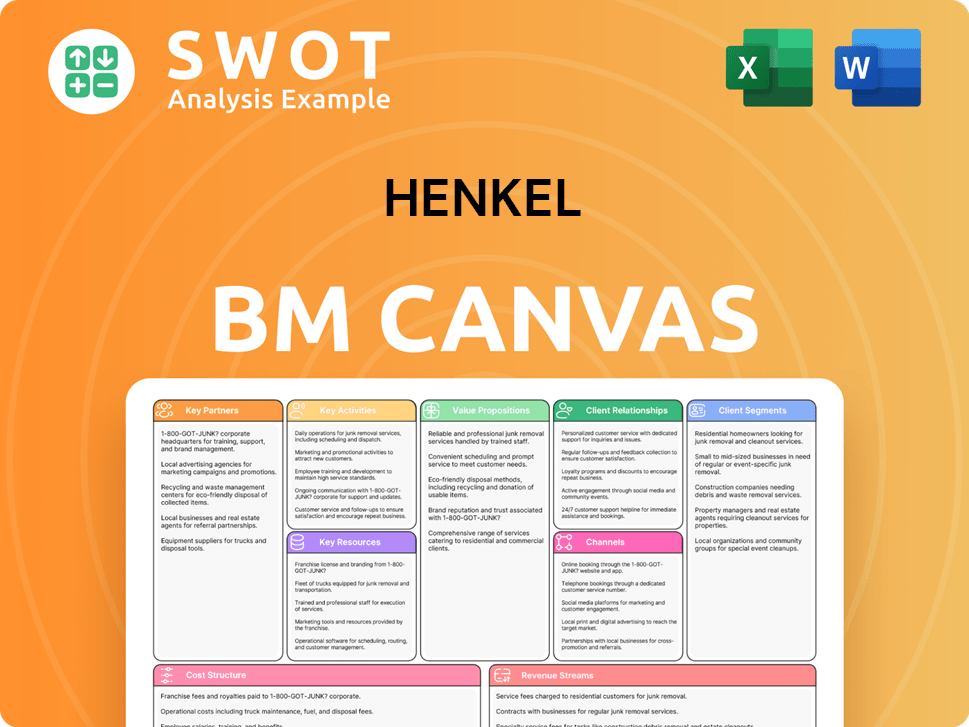
Henkel Business Model Canvas
- Complete 9-Block Business Model Canvas
- Effortlessly Communicate Your Business Strategy
- Investor-Ready BMC Format
- 100% Editable and Customizable
- Clear and Structured Layout
What is the Timeline of Key Events for Henkel?
The Henkel history spans nearly 150 years, marked by significant milestones and strategic shifts. From its origins in 1876 with the founding of Henkel & Cie to its evolution into a global company, Henkel has consistently adapted and expanded its portfolio. The company's journey includes pivotal acquisitions, product innovations, and a strong focus on sustainability, making it a leader in both consumer and industrial markets. The following table summarizes key events in the
| Year | Key Event |
|---|---|
| 1876 | Fritz Henkel founded Henkel & Cie in Aachen, Germany, launching its first universal detergent. |
| 1878 | Henkel moved to Düsseldorf, establishing larger production facilities and introducing 'Henkel's Bleich-Soda.' |
| 1907 | Introduction of Persil, the first 'self-acting laundry detergent.' |
| 1922 | Henkel began producing its own packaging adhesives, laying the groundwork for its Adhesive Technologies business. |
| 1956 | Acquisition of Loctite Corporation, a key step in expanding its adhesives portfolio. |
| 1995 | Acquisition of Hans Schwarzkopf GmbH, significantly boosting its Beauty Care business. |
| 1997 | Henkel fully acquired Loctite Corporation. |
| 2004 | Acquisition of The Dial Corporation, Henkel's largest acquisition at the time. |
| 2008 | Henkel acquired National Starch's Adhesives and Electronic Materials businesses, making Adhesive Technologies its largest business unit by sales. |
| 2014 | Acquisition of Spotless Group SAS, expanding its presence in laundry aid, insect control, and household care in Europe. |
| 2020 | Carsten Knobel became the new CEO. |
| 2022 | Merger of Laundry & Home Care and Beauty Care into the new Consumer Brands business unit. |
| 2024 | Reports strong fiscal results with sales of 21.6 billion euros and 2.6% organic growth. |
Financial Performance and Outlook
In 2024, the company reported sales of 21.6 billion euros and achieved 2.6% organic growth. Looking ahead to 2025, Henkel anticipates continued growth with projected organic sales growth between 1.5% and 3.5% across the group. The Adhesive Technologies segment is expected to grow between 2% and 4%, and Consumer Brands between 1% and 3%. The company aims for an adjusted EBIT margin between 14.0% and 15.5% in 2025.
Sustainability Initiatives
Sustainability is a core strategic pillar for Henkel. The company has ambitious targets validated by the Science Based Targets Initiative (SBTi). Henkel aims for net-zero emissions by 2045 and plans a 90% reduction in Scope 1, 2, and 3 greenhouse gas emissions compared to 2021. Short-term targets include a 42% reduction in absolute Scope 1 and 2 emissions and a 30% reduction in Scope 3 emissions by 2030, compared to 2021. By the end of 2024, Henkel reached 89% of its goal to achieve 100% recyclable or reusable packaging by 2025.
Strategic Initiatives
Henkel's strategic initiatives include a planned share buyback program of up to 1 billion euros by Q1 2026. The company is also focusing on innovation in personal care and hair care to drive future growth. These initiatives, along with a focus on innovation, are expected to contribute to the company's continued success. The company is optimistic about its future performance, driven by strategic initiatives and a focus on innovation.
Future Growth Areas
The 'Purposeful Growth' agenda guides Henkel, focusing on a winning portfolio, competitive edge in innovation, sustainability, and digitalization. The Adhesive Technologies segment and Consumer Brands are expected to drive significant growth. The company's focus on innovation in areas like personal care and hair care is set to fuel future expansion, ensuring the company remains competitive in the market.
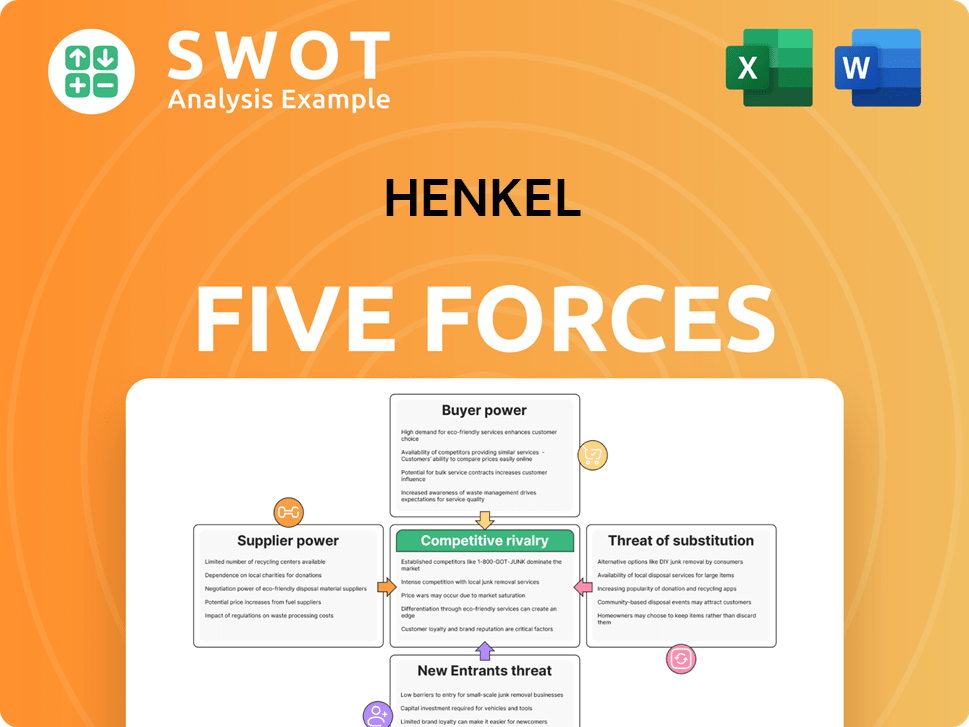
Henkel Porter's Five Forces Analysis
- Covers All 5 Competitive Forces in Detail
- Structured for Consultants, Students, and Founders
- 100% Editable in Microsoft Word & Excel
- Instant Digital Download – Use Immediately
- Compatible with Mac & PC – Fully Unlocked
Related Blogs

- What is Competitive Landscape of Henkel Company?
- What is Growth Strategy and Future Prospects of Henkel Company?
- How Does Henkel Company Work?
- What is Sales and Marketing Strategy of Henkel Company?
- What is Brief History of Henkel Company?
- Who Owns Henkel Company?
- What is Customer Demographics and Target Market of Henkel Company?
Disclaimer
All information, articles, and product details provided on this website are for general informational and educational purposes only. We do not claim any ownership over, nor do we intend to infringe upon, any trademarks, copyrights, logos, brand names, or other intellectual property mentioned or depicted on this site. Such intellectual property remains the property of its respective owners, and any references here are made solely for identification or informational purposes, without implying any affiliation, endorsement, or partnership.
We make no representations or warranties, express or implied, regarding the accuracy, completeness, or suitability of any content or products presented. Nothing on this website should be construed as legal, tax, investment, financial, medical, or other professional advice. In addition, no part of this site—including articles or product references—constitutes a solicitation, recommendation, endorsement, advertisement, or offer to buy or sell any securities, franchises, or other financial instruments, particularly in jurisdictions where such activity would be unlawful.
All content is of a general nature and may not address the specific circumstances of any individual or entity. It is not a substitute for professional advice or services. Any actions you take based on the information provided here are strictly at your own risk. You accept full responsibility for any decisions or outcomes arising from your use of this website and agree to release us from any liability in connection with your use of, or reliance upon, the content or products found herein.