

EQT Bundle

What's the Story Behind EQT Company's Rise?
Delve into the fascinating EQT SWOT Analysis to understand the company's strategic position. From its humble beginnings to its current stature, EQT Company has become a major force in the energy sector. Explore the key milestones and pivotal decisions that shaped this American energy giant.

Tracing the EQT history reveals a compelling narrative of growth and adaptation. Founded in 1888 as the Equitable Gas Company, EQT's journey reflects the evolution of the oil and gas industry. Understanding the EQT company timeline provides valuable insights into its strategic moves and its impact on the energy landscape. Learn about EQT's early years and the factors that contributed to its success.
What is the EQT Founding Story?
The EQT Company, a significant player in the energy sector, has a rich EQT history that began in the late 19th century. Its origins are deeply intertwined with the industrial growth of the United States and the increasing demand for natural gas.
The EQT story starts in 1888 with the Equitable Gas Company. This entity was a subsidiary of the Philadelphia Company, which was connected to George Westinghouse's energy projects. The primary goal was to provide natural gas to the Pittsburgh, Pennsylvania area, where the company first operated and continues to have a strong presence.
Unlike modern startups, the Equitable Gas Company was formed under the Philadelphia Company's financial backing. This early structure set the stage for its evolution into a major energy provider. The company's focus has shifted over time, from a utility to a natural gas producer.

Early Days of EQT
The Equitable Gas Company was established to meet the growing need for natural gas in the Pittsburgh area during the late 1800s.
- The Philadelphia Company, connected to George Westinghouse, provided the initial funding.
- The company's business model was initially centered on being a natural gas utility.
- The context of its founding was the rapid industrialization and rising energy demands of the era.
- The company's name changed to Equitable Resources, Inc. in 1984, and then to EQT Corporation in February 2009, showing its evolution.
The company's evolution reflects its adaptation to the changing energy landscape. The company's name changed to Equitable Resources, Inc. in 1984, and then to EQT Corporation in February 2009. This transition highlighted its shift from a utility to a natural gas producer. For more insights into the competitive landscape, you can explore the Competitors Landscape of EQT.
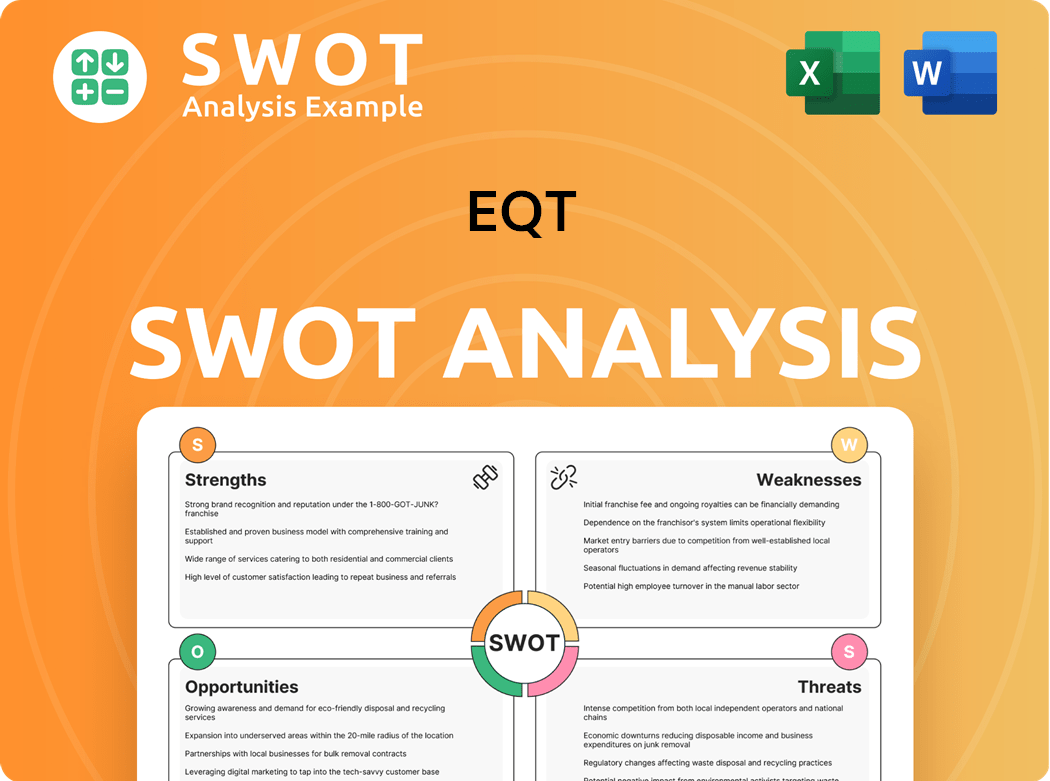
EQT SWOT Analysis
- Complete SWOT Breakdown
- Fully Customizable
- Editable in Excel & Word
- Professional Formatting
- Investor-Ready Format
What Drove the Early Growth of EQT?
The early growth and expansion of the EQT Company, a major player in the energy sector, is marked by strategic acquisitions and a shift towards natural gas production. This evolution began with its independence from the Philadelphia Company in 1950 and continued through significant investments in the 1990s. The company's focus on the Marcellus Shale in the 2000s, using hydraulic fracturing, was a pivotal move.
 Early Acquisitions and Strategic Shifts
In the late 1990s, EQT expanded through acquisitions, including Northeast Energy Services Co. (NORESCO) for $77 million and offshore oil and gas fields from Chevron Corporation for $80.6 million in 1997. The company acquired Appalachian wells and reserves from Statoil in 2000. A major strategic shift occurred in the 2000s when EQT began focusing on natural gas production in the Marcellus Shale, leveraging hydraulic fracturing technology.
Corporate Transformation and Leadership Changes
In February 2009, the company changed its name to EQT Corporation, reflecting its transition from a utility company to a leading natural gas producer. In July 2019, Toby Rice became the chief executive officer. Under Rice's leadership, EQT continued its expansion through major acquisitions.
Major Acquisitions and Expansion
EQT's expansion included the acquisition of Chevron's Appalachian assets in October 2020 for $735 million, Marcellus shale assets from Alta Resources Development in May 2021 for $2.9 billion, and the Marcellus shale holdings of THQ Appalachia I LLC in September 2022 for $5.2 billion. The 2022 acquisition added 95 miles of natural gas pipeline to EQT's portfolio.
Current Operations and Reserves
As of December 31, 2024, EQT reported total proved reserves of 26.3 Tcfe. These strategic moves and acquisitions have solidified EQT's position in the oil and gas industry. To understand more about EQT's target market, you can read about it in EQT's target market.
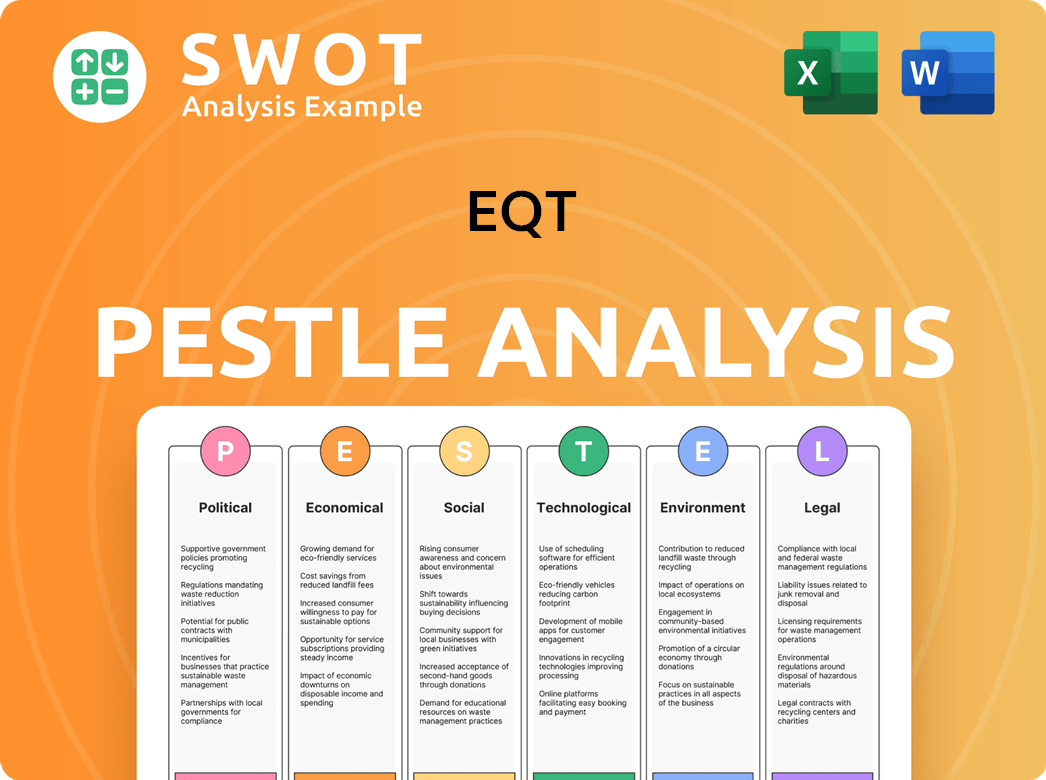
EQT PESTLE Analysis
- Covers All 6 PESTLE Categories
- No Research Needed – Save Hours of Work
- Built by Experts, Trusted by Consultants
- Instant Download, Ready to Use
- 100% Editable, Fully Customizable
What are the key Milestones in EQT history?
The EQT Company has a rich EQT history, marked by significant strategic shifts and achievements in the energy sector. From its early innovations to its current operations, EQT has navigated the complexities of the oil and gas industry, adapting to market changes and technological advancements.
| Year | Milestone |
|---|---|
| 1995 | Equitable Resources Inc., offered the first fixed-bill energy contract in the U.S., showcasing early innovation. |
| 2000s | Pioneered Marcellus Shale development, leveraging hydraulic fracturing to shift focus toward natural gas production. |
| 2008 | Added to the S&P 500 Index, reflecting its market presence (later removed in 2018). |
| 2013 | Sold its natural gas distribution business to Peoples Natural Gas for $740 million, streamlining operations. |
| 2024 | Net debt stood at $9.1 billion as of December 31, 2024. |
| 2025 | Aiming to exit 2025 with approximately $7 billion of net debt. |
EQT has demonstrated innovation by pioneering the development of the Marcellus Shale, which significantly boosted its natural gas production. Furthermore, the company's early adoption of fixed-bill energy contracts in 1995 highlights its commitment to customer-focused solutions.

Marcellus Shale Development
EQT was a pioneer in developing the Marcellus Shale, utilizing hydraulic fracturing to increase natural gas production. This strategic move reshaped the company's operational focus and significantly impacted its growth trajectory.
Fixed-Bill Energy Contracts
In 1995, the company introduced the first fixed-bill energy contract in the U.S., demonstrating an early commitment to innovative customer offerings. This initiative set a precedent for customer-focused energy solutions.
Vertical Integration Strategy
The acquisition of Equitrans Midstream represents a strategic move towards vertical integration. This integration is designed to create operational efficiencies and boost profitability.
EQT has faced challenges, including market downturns and the need to manage substantial debt. The company’s strategic pivot to focus on production and its ongoing efforts to reduce debt are indicative of its proactive approach to industry challenges.
Market Downturns and Competition
EQT has had to navigate periods of market volatility and intense competition within the oil and gas sector. These challenges have necessitated strategic adjustments to maintain a competitive edge.
Debt Management
Managing a substantial debt load, which reached $9.1 billion net debt as of December 31, 2024, has been a key challenge. The company aims to reduce its net debt to approximately $7 billion by the end of 2025.
Strategic Acquisitions
The acquisition of Equitrans Midstream is a strategic move to enhance operational efficiency. This integration is designed to create synergies and boost profitability.
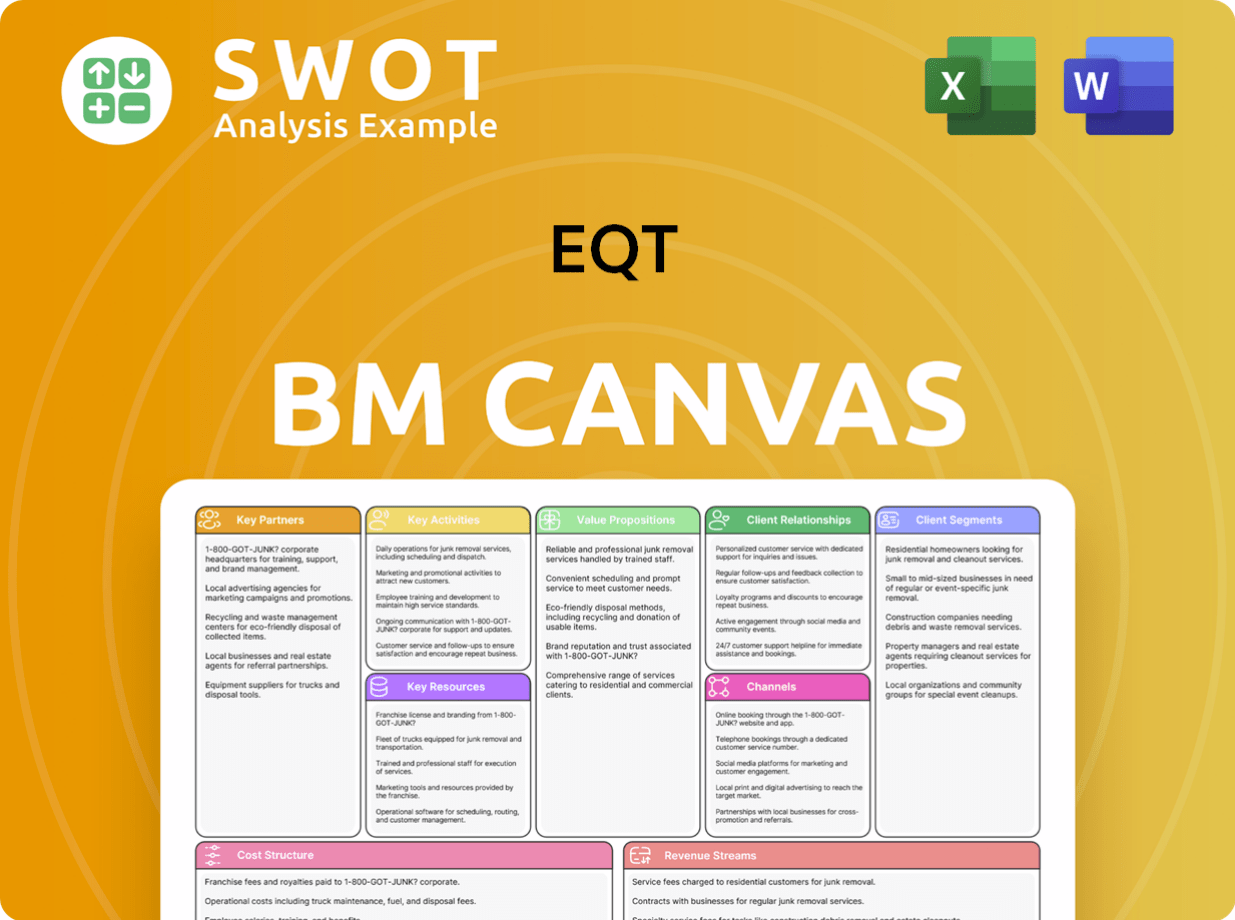
EQT Business Model Canvas
- Complete 9-Block Business Model Canvas
- Effortlessly Communicate Your Business Strategy
- Investor-Ready BMC Format
- 100% Editable and Customizable
- Clear and Structured Layout
What is the Timeline of Key Events for EQT?
The EQT Company, a significant player in the oil and gas sector, has a rich history marked by strategic shifts and expansions. Initially established as a subsidiary, it evolved into an independent entity, adapting to market dynamics and undergoing several name changes to reflect its evolving business focus. Key moments include pioneering fixed-bill energy contracts, strategic acquisitions, and the spin-off of its pipeline division, shaping its current structure and market position.
| Year | Key Event |
|---|---|
| 1888 | Equitable Gas Company is incorporated as a subsidiary of Philadelphia Company. |
| 1950 | Equitable Gas Company spins off from Philadelphia Company, becoming an independent, publicly traded natural gas utility. |
| 1984 | The company changes its corporate name to Equitable Resources, Inc. |
| 1995 | Equitable Resources offers the first fixed-bill energy contract in the U.S. |
| 1997 | Acquires Northeast Energy Services Co. (NORESCO) and offshore oil and gas fields from Chevron Corporation. |
| 2000 | Acquires Appalachian wells and reserves from Statoil. |
| 2008 | Added to the S&P 500 Index. |
| 2009 | Changes its name to EQT Corporation. |
| 2013 | Sells its natural gas distribution business to Peoples Natural Gas for $740 million. |
| 2018 | Spins off its pipeline division, Equitrans Midstream. |
| 2019 | Toby Rice becomes CEO. |
| 2020 | Acquires Chevron's Appalachian assets for $735 million. |
| 2021 | Acquires Marcellus shale assets from Alta Resources Development for $2.9 billion. |
| 2022 | Acquires Marcellus shale holdings of THQ Appalachia I LLC for $5.2 billion, including XcL Midstream. |
| 2025 (April) | Announces agreement to acquire upstream and midstream assets of Olympus Energy for $1.8 billion. |
2025 Sales Volume
For 2025, EQT Corporation projects a total sales volume between 2,175 and 2,275 Bcfe, with an updated guidance of 2,200-2,300 Bcfe as of April 2025. This indicates a strong production capacity and market presence for the energy company.
Strategic Capital Allocation
The company plans to allocate $350 million to $380 million towards strategic growth capital expenditures, targeting its pressure reduction program and opportunistic water infrastructure and land opportunities. This investment shows EQT's commitment to operational efficiency and future growth.
Financial Projections for 2025
EQT anticipates generating approximately $2.6 billion in free cash flow in 2025 and is projected to exit 2025 with approximately $7 billion of net debt, ahead of its $7.5 billion debt target. This financial health supports the company's strategic initiatives.
Analyst Ratings and Outlook
Analyst predictions for EQT's stock are moderately optimistic, with a 'Moderate Buy' rating overall among 23 analysts, and a mean price target of $57.13, indicating a potential upside of nearly 20.8% from current levels. This suggests a positive market sentiment towards EQT's future.
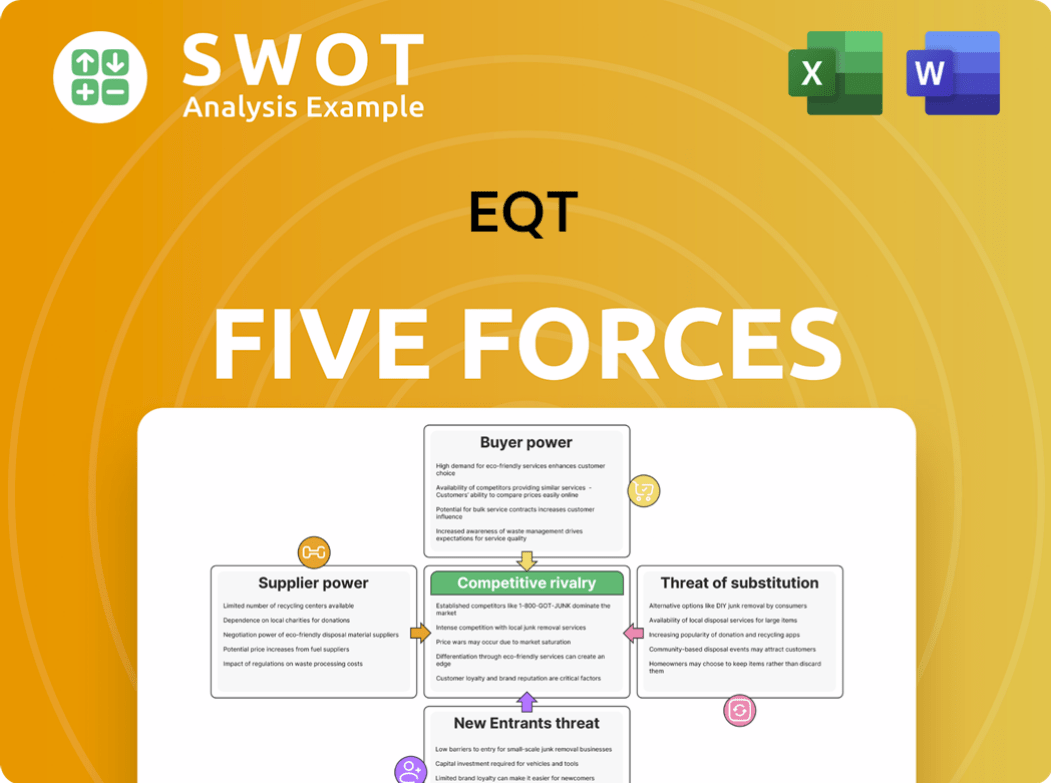
EQT Porter's Five Forces Analysis
- Covers All 5 Competitive Forces in Detail
- Structured for Consultants, Students, and Founders
- 100% Editable in Microsoft Word & Excel
- Instant Digital Download – Use Immediately
- Compatible with Mac & PC – Fully Unlocked
Related Blogs

- What is Competitive Landscape of EQT Company?
- What is Growth Strategy and Future Prospects of EQT Company?
- How Does EQT Company Work?
- What is Sales and Marketing Strategy of EQT Company?
- What is Brief History of EQT Company?
- Who Owns EQT Company?
- What is Customer Demographics and Target Market of EQT Company?
Disclaimer
All information, articles, and product details provided on this website are for general informational and educational purposes only. We do not claim any ownership over, nor do we intend to infringe upon, any trademarks, copyrights, logos, brand names, or other intellectual property mentioned or depicted on this site. Such intellectual property remains the property of its respective owners, and any references here are made solely for identification or informational purposes, without implying any affiliation, endorsement, or partnership.
We make no representations or warranties, express or implied, regarding the accuracy, completeness, or suitability of any content or products presented. Nothing on this website should be construed as legal, tax, investment, financial, medical, or other professional advice. In addition, no part of this site—including articles or product references—constitutes a solicitation, recommendation, endorsement, advertisement, or offer to buy or sell any securities, franchises, or other financial instruments, particularly in jurisdictions where such activity would be unlawful.
All content is of a general nature and may not address the specific circumstances of any individual or entity. It is not a substitute for professional advice or services. Any actions you take based on the information provided here are strictly at your own risk. You accept full responsibility for any decisions or outcomes arising from your use of this website and agree to release us from any liability in connection with your use of, or reliance upon, the content or products found herein.