

Cummins India Bundle

How did Cummins India rise to become an industry leader?
Delve into the Cummins India SWOT Analysis to understand the company's strategic position. This exploration will uncover the fascinating Cummins India history, tracing its evolution from a joint venture in 1962 to a powerhouse in the Indian manufacturing sector. Discover how Cummins India company has shaped the Indian industrial landscape.

The story of Cummins India is a testament to strategic vision and adaptation. From its early focus on Diesel engine technology to its expansion into power generation, the company's journey reflects India's industrial growth. Understanding Cummins Inc.'s impact on the Indian market provides invaluable insights for investors and business strategists alike, illustrating the dynamics of long-term success.
What is the Cummins India Founding Story?
The Cummins India story began on February 17, 1962, in Pune, India. It was incorporated as Kirloskar Cummins Limited, marking a significant step in the nation's industrial growth. This joint venture between Cummins Engine Company Inc. (USA) and Kirloskar Oil Engines Limited laid the foundation for a company that would become a key player in the Indian market.
The initial vision was to introduce advanced and reliable internal combustion engines to support India's developing sectors. The early focus was on manufacturing and selling diesel engines, addressing the critical need for power solutions in various industries. This strategic move set the stage for Cummins India to become a vital part of India's industrial landscape.
The early years saw the company establish its first manufacturing facility in Pune in 1973. This facility became a central hub for diesel engine production. The evolution of the company also included a name change, from Kirloskar Cummins Limited to Cummins India Limited on September 10, 1997, reflecting changes in ownership and strategic direction. This period was marked by a focus on industrialization and self-reliance, creating a favorable environment for companies like Cummins India.

Key Highlights of Cummins India's Founding
Cummins India was established in 1962 as a joint venture to meet India's growing need for reliable engines.
- Incorporated on February 17, 1962, as Kirloskar Cummins Limited.
- Joint venture between Cummins Engine Company Inc. (USA) and Kirloskar Oil Engines Limited.
- Initial ownership: Cummins Inc. (50%), Kirloskar Group (25.5%), and retail investors (24.5%).
- Focused on manufacturing and selling diesel engines for industrial and automotive sectors.
- The first manufacturing facility was established in Pune in 1973.
- Name changed to Cummins India Limited on September 10, 1997.
- Initial funding came from promoters and public share offerings.
The establishment of Cummins India occurred during a time when India was focused on industrialization and self-reliance. This created a strong demand for companies providing essential machinery and power solutions. The company's early success was closely tied to these broader economic and cultural trends. Understanding the Target Market of Cummins India is crucial to appreciating its strategic positioning.
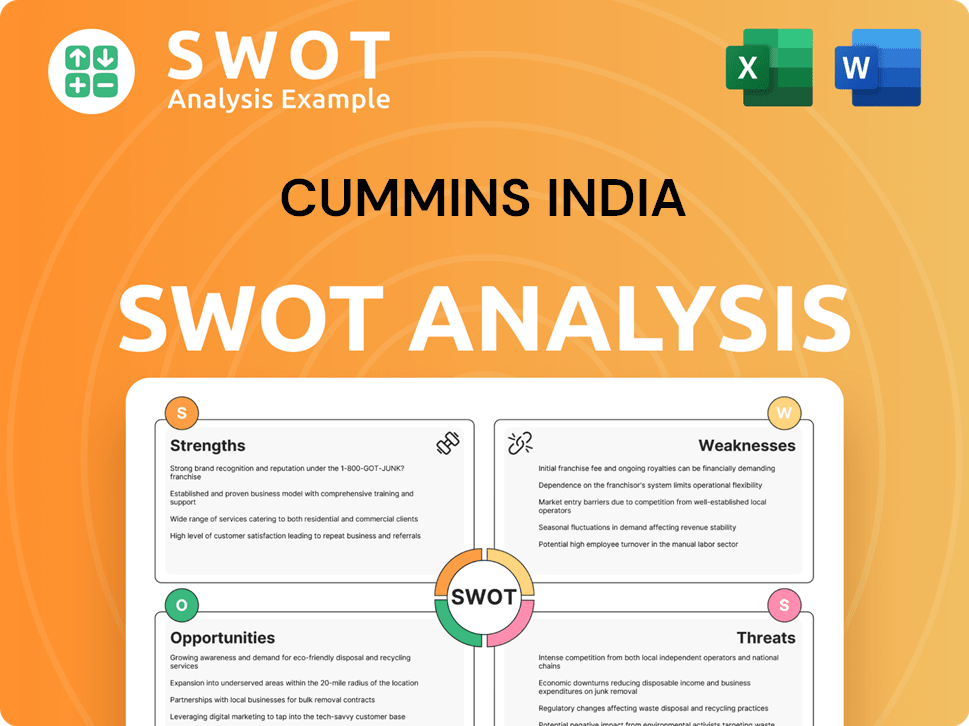
Cummins India SWOT Analysis
- Complete SWOT Breakdown
- Fully Customizable
- Editable in Excel & Word
- Professional Formatting
- Investor-Ready Format
What Drove the Early Growth of Cummins India?
The early years of Cummins India were marked by significant expansion in both its operational scope and product range. Following the establishment of its first manufacturing plant in Pune in 1973, the company quickly evolved, introducing new products and forming strategic partnerships. These moves were crucial in establishing Cummins India as a major player in the Indian market.
 Early Milestones
In 1983, Cummins India launched its BS (Bharat Stage) engines, aligning with evolving environmental standards. This marked a significant step in its product development. The company also diversified into generator sets and components, strengthening its position in the power generation sector, a key area for Cummins India's growth.
Key Partnerships and Joint Ventures
Strategic alliances were essential for Cummins India's early growth. The company formed joint ventures like Fleetguard Filters Pvt. Ltd. in 1987 and Tata Cummins Ltd. in 1993. These collaborations expanded manufacturing capabilities and market reach, helping Cummins India to penetrate various sectors of the Indian manufacturing industry.
Manufacturing Expansion and Financial Performance
A new facility was opened in Phaltan in 2011, increasing manufacturing capacity. By 2011, the combined sales of Cummins India in India reached approximately ₹10,500 crores. This expansion and financial growth highlight Cummins India's successful navigation of the competitive landscape.
Research and Development
Cummins India invested heavily in research and development, allocating around 5% of its revenue to innovate engine technology. This commitment to R&D was crucial in developing advanced technologies. This investment helped to solidify its position as a leading power solutions provider in India.
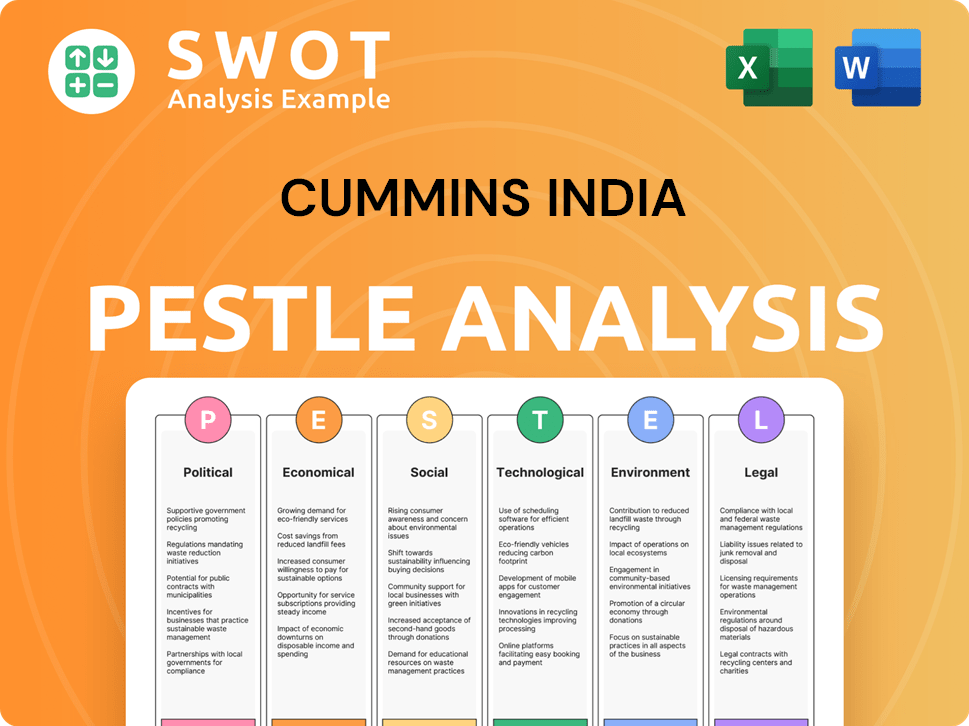
Cummins India PESTLE Analysis
- Covers All 6 PESTLE Categories
- No Research Needed – Save Hours of Work
- Built by Experts, Trusted by Consultants
- Instant Download, Ready to Use
- 100% Editable, Fully Customizable
What are the key Milestones in Cummins India history?
The journey of Cummins India, a significant player in the Indian manufacturing sector, is marked by strategic milestones and continuous evolution. From its inception, the company has demonstrated a commitment to technological advancements and adapting to market demands. This Cummins India history reflects its growth and impact on the Indian industry.
| Year | Milestone |
|---|---|
| 1983 | Launched BS (Bharat Stage) engines, showcasing early commitment to environmental compliance. |
| 2013 | Introduced a power generation product line compliant with new environmental norms. |
| 2016 | Introduced a new 250 kVA generator set based on the L9 engine platform, expanding its generator set range. |
| 2018 | Established a partnership with Tata Motors to supply engines for their commercial vehicle range. |
| 2023 | Delivered a 1 MW genset for Hindustan Shipyard Ltd. (HSL) Diving Support Vessel and launched Dual Fuel Kits and Retrofit Emission Control Kits (RECDs) in the Power Generation market. |
Cummins India has consistently focused on innovation to meet evolving market needs. The company has been at the forefront of meeting stringent emission standards, being among the first to receive regulatory approval for manufacturing CPCB IV+ compliant gensets.

Early Environmental Compliance
The introduction of BS engines in 1983 marked an early commitment to environmental standards. This initiative set a precedent for future innovations in emission control.
Expansion of Generator Sets
The launch of the 250 kVA generator set in 2016 expanded the company's range. This expansion catered to a wider range of power generation needs.
CPCB IV+ Compliant Gensets
Cummins India was among the first to receive regulatory approval for manufacturing CPCB IV+ compliant gensets. By Q3FY25, these accounted for approximately 40% of total genset sales.
Dual Fuel and Retrofit Kits
The launch of Dual Fuel Kits and Retrofit Emission Control Kits (RECDs) in 2023 further enhanced the company's offerings. These innovations aimed at improving efficiency and reducing emissions.
Partnership with Tata Motors
The 2018 partnership with Tata Motors to supply engines for their commercial vehicles was a strategic move. This partnership solidified its position in the automotive sector.
1 MW Genset for HSL
The delivery of a 1 MW genset for Hindustan Shipyard Ltd. (HSL) Diving Support Vessel in 2023 demonstrated its capability in specialized applications. This highlights the company's versatility.
Despite these achievements, Cummins India company has faced significant challenges. The company's operating margin for fiscal year 2023 was 12.5%, down from 15.3% in FY2022, due to increased costs. Cummins Inc. suspended its revenue guidance in May 2025 due to market uncertainties.
Market Downturns and Competition
Cummins India is susceptible to market downturns and competitive threats. Competition comes from both domestic and international players in the power generation segment.
Operational Costs
Operational costs have been a concern, with the operating margin decreasing in FY2023. Increased expenses in labor, raw materials, and logistics contributed to this decline.
Transition to Alternative Energy
The transition to alternative energy solutions has been a challenge. As of FY2023, less than 5% of its total product offerings focused on electric or hybrid technology.
Decline in Stock Performance
Recent financial reports indicated a decline in stock performance. The PowerGen business experienced an 11% drop in revenue for the March quarter compared to the previous year.
Revenue Guidance Suspension
Cummins Inc. suspended its revenue guidance for the full year in May 2025. This decision reflects broader market and geopolitical uncertainties.
Strategic Pivots
The company is investing in R&D for low-emission and zero-emission products. This is a response to evolving market demands and regulatory landscapes.
To understand more about the financial aspects of Cummins India, you can explore the Revenue Streams & Business Model of Cummins India.
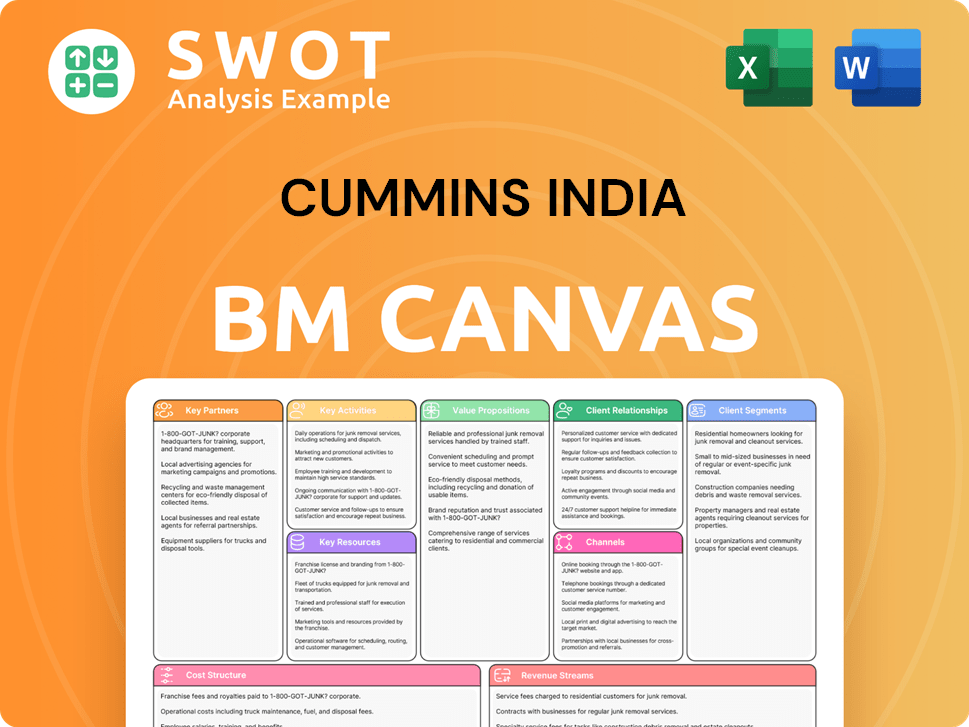
Cummins India Business Model Canvas
- Complete 9-Block Business Model Canvas
- Effortlessly Communicate Your Business Strategy
- Investor-Ready BMC Format
- 100% Editable and Customizable
- Clear and Structured Layout
What is the Timeline of Key Events for Cummins India?
The story of Cummins India's journey is a testament to its adaptability and commitment to the Indian market. Incorporated in 1962 as Kirloskar Cummins Limited, the company has evolved from a joint venture to a leading player in the power solutions sector. This evolution included significant milestones, such as the establishment of manufacturing facilities, strategic partnerships, and a shift in focus towards environmental sustainability. Today, with a strong emphasis on 'Destination Zero', Cummins India is strategically positioned for growth, focusing on innovation and sustainable solutions to meet the evolving demands of the energy sector.
| Year | Key Event |
|---|---|
| 1962 | Cummins India Limited, initially named Kirloskar Cummins Limited, is established in Pune as a joint venture. |
| 1967 | Cummins Diesel Sales & Service India Ltd. is formed, later integrating into Cummins India Ltd. |
| 1973 | The first manufacturing facility opens in Pune, marking a significant step in Indian manufacturing capabilities. |
| 1983 | Launches BS (Bharat Stage) engines, aligning with evolving environmental regulations. |
| 1987 | Forms Fleetguard Filters Pvt. Ltd., a joint venture focused on filter manufacturing. |
| 1989 | Partners with Crompton Greaves and Newage to manufacture alternators. |
| 1993 | Forms Tata Cummins Ltd. with Tata Motors Ltd. to produce mid-range engines. |
| 1997 | Kirloskar Cummins Ltd. is renamed Cummins India Ltd., with Cummins Inc. increasing its stake to 51%. |
| 2003 | Cummins Research and Technologies Incorporated is formed to provide engineering services. |
| 2011 | The Cummins Megasite is inaugurated, expanding manufacturing capabilities. |
| 2013 | Launches a power generation product line compliant with new environmental norms. |
| 2018 | Announces a significant partnership with Tata Motors to supply engines for their commercial vehicles. |
| 2023 | Delivers a 1 MW genset for Hindustan Shipyard Ltd. and launches Dual Fuel Kits and Retrofit Emission Control Kits. |
| 2024 (Q3FY25) | CPCB IV+ compliant gensets account for approximately 40% of total genset sales. |
| 2025 (January) | Unveils next-generation HELM (Higher Efficiency, Lower emissions, Multiple fuels) engine platforms and advanced Hydrogen Fuel Delivery System at Bharat Mobility Global Expo 2025. |
Future Growth
The company projects double-digit sales growth for FY25, aiming to grow at twice the rate of India's GDP, which could be around 13-14%. Strategic investments continue in research and development, focusing on lowering emissions and enhancing efficiency across all product lines. The expansion into new markets is supported by an extensive distribution network, comprising over 480 customer touchpoints and 120 retail touchpoints.
Strategic Initiatives
Cummins India is committed to 'Destination Zero', focusing on decarbonization and low-to-zero emission products. This includes the introduction of low-emission technologies and alternative fuel solutions, such as hydrogen technologies. The company is also actively expanding its presence and reach within the Indian manufacturing sector.
Challenges and Opportunities
The company faces challenges, including intense competition and the transition to alternative energy solutions. However, its leadership remains confident in its position and strategy. The focus on innovation and sustainability positions Cummins India to capitalize on the growing demand for cleaner and more efficient diesel engine and power solutions.
Product Innovation
The unveiling of next-generation HELM engine platforms and advanced Hydrogen Fuel Delivery Systems at the Bharat Mobility Global Expo 2025 highlights the company's commitment to technological advancement. These innovations are designed to meet evolving environmental standards and customer needs, reinforcing Cummins India's role in the power solutions sector.
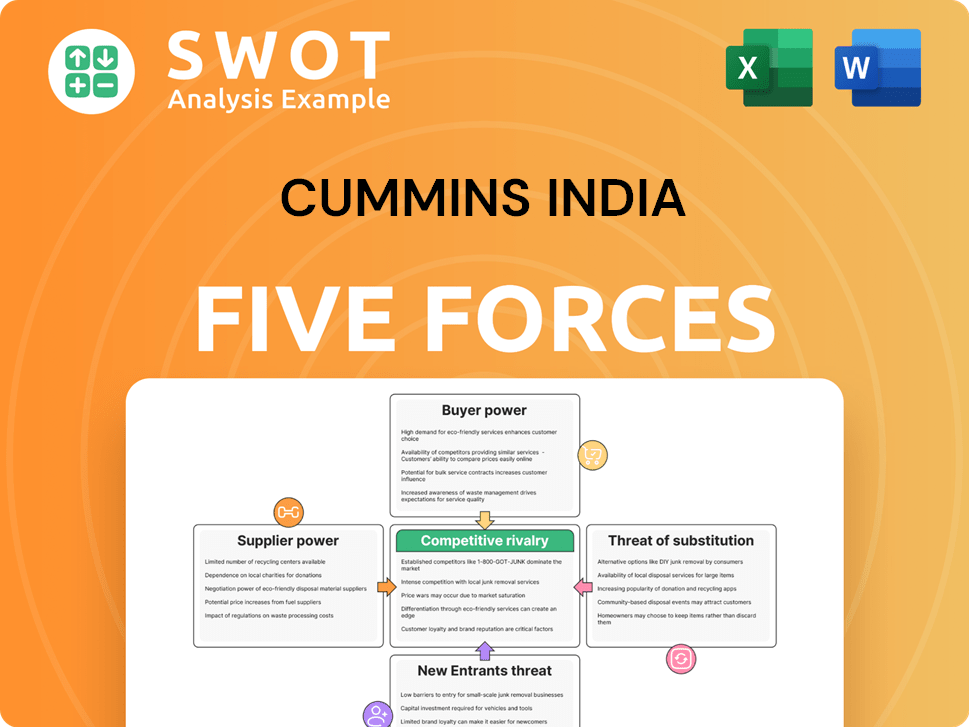
Cummins India Porter's Five Forces Analysis
- Covers All 5 Competitive Forces in Detail
- Structured for Consultants, Students, and Founders
- 100% Editable in Microsoft Word & Excel
- Instant Digital Download – Use Immediately
- Compatible with Mac & PC – Fully Unlocked
Related Blogs

- What is Competitive Landscape of Cummins India Company?
- What is Growth Strategy and Future Prospects of Cummins India Company?
- How Does Cummins India Company Work?
- What is Sales and Marketing Strategy of Cummins India Company?
- What is Brief History of Cummins India Company?
- Who Owns Cummins India Company?
- What is Customer Demographics and Target Market of Cummins India Company?
Disclaimer
All information, articles, and product details provided on this website are for general informational and educational purposes only. We do not claim any ownership over, nor do we intend to infringe upon, any trademarks, copyrights, logos, brand names, or other intellectual property mentioned or depicted on this site. Such intellectual property remains the property of its respective owners, and any references here are made solely for identification or informational purposes, without implying any affiliation, endorsement, or partnership.
We make no representations or warranties, express or implied, regarding the accuracy, completeness, or suitability of any content or products presented. Nothing on this website should be construed as legal, tax, investment, financial, medical, or other professional advice. In addition, no part of this site—including articles or product references—constitutes a solicitation, recommendation, endorsement, advertisement, or offer to buy or sell any securities, franchises, or other financial instruments, particularly in jurisdictions where such activity would be unlawful.
All content is of a general nature and may not address the specific circumstances of any individual or entity. It is not a substitute for professional advice or services. Any actions you take based on the information provided here are strictly at your own risk. You accept full responsibility for any decisions or outcomes arising from your use of this website and agree to release us from any liability in connection with your use of, or reliance upon, the content or products found herein.