

CN Bundle

How has Canadian National Railway Shaped North American Transportation?
Delve into the captivating CN SWOT Analysis and explore the remarkable journey of Canadian National Railway (CN), a cornerstone of North American commerce. From its humble beginnings as a government initiative to its current status as a transportation behemoth, CN's story is one of strategic evolution and enduring impact. Discover how CN Rail has navigated economic shifts and technological advancements to become the longest railway system on the continent.

This exploration of CN Company history will uncover the significant milestones that have shaped CN's trajectory, from its CN Company origins in 1919 to its present-day operations. We'll examine the key events in CN Company's history, including its privatization and major mergers, providing a comprehensive CN Company timeline. Understanding the evolution of CN Rail offers valuable insights for investors and strategists alike, highlighting the company's resilience and adaptability in the face of industry challenges.
What is the CN Founding Story?
The story of the CN Company, or Canadian National Railway (CN Rail), begins not with a single founder, but with a national crisis. Established on June 6, 1919, in Montreal, Quebec, CN's origins are rooted in the Canadian government's response to widespread financial instability within the railway sector. This strategic move aimed to stabilize critical transportation infrastructure and prevent the collapse of key services across the country.
The formation of CN was a direct result of the financial struggles of several railway companies in the years leading up to 1920. These companies faced severe difficulties, worsened by the economic downturn following World War I. The government's intervention was crucial to prevent defaults on significant loans, with liabilities totaling around CAD 1.3 billion. The goal was to consolidate and manage the existing railway assets under a single, nationalized entity.
The initial capital for CN came from the Canadian government, which assumed existing debts and assets from the failing railway companies. Key predecessors that formed the basis of CN included the Grand Trunk Railway, Canadian Northern Railway, Intercolonial Railway, and National Transcontinental Railway. The Grand Trunk Railway was officially absorbed into CN on January 30, 1923, after several years of arbitration, marking the completion of the initial amalgamation. This consolidation was a critical step in reshaping the railway landscape and ensuring the continuity of essential transportation services across Canada. For those interested in the current ownership structure, you can find more details at Owners & Shareholders of CN.
CN SWOT Analysis
- Complete SWOT Breakdown
- Fully Customizable
- Editable in Excel & Word
- Professional Formatting
- Investor-Ready Format

What Drove the Early Growth of CN?
Following its formal unification in 1919 and the full integration of the Grand Trunk Railway by 1923, the early growth and expansion of the CN Company history began. Under the leadership of Sir Henry Thornton, CN quickly became one of the largest railway networks globally. This phase included not only improvements to railway infrastructure but also diversification into various sectors, establishing itself as a key player in the transportation and logistics industry.
 Early Expansion and Diversification
Around 1923, under Sir Henry Thornton, CN expanded significantly. The company grew to operate over 22,000 miles of track. Diversification included express services, a telegraph company, hotels, and a steamship line. In 1923, CN launched the first radio network in Canada and North America for train travelers.
Development in Western Canada
CN played a vital role in the expansion into northern British Columbia and the Prairie provinces. This expansion facilitated transcontinental passenger service. The company opened up areas like Prince George and Prince Rupert, contributing significantly to the development of Western Canada.
Privatization and Strategic Acquisitions
In 1995, CN underwent privatization through an initial public offering (IPO). This IPO was the largest privatization in Canadian history at the time, raising CAD 2.26 billion. Post-privatization, CN pursued strategic acquisitions to expand its network. The acquisition of the Illinois Central Railroad in 1999 was a game-changer.
Further Acquisitions and Market Position
In the early 2000s, CN continued its expansion with acquisitions. These included Wisconsin Central Transportation Corporation in 2001. The company also acquired the rail and marine holdings of Great Lakes Transportation LLC and BC Rail Ltd. in 2004. These moves enhanced CN's ability to serve customers across North America.
CN PESTLE Analysis
- Covers All 6 PESTLE Categories
- No Research Needed – Save Hours of Work
- Built by Experts, Trusted by Consultants
- Instant Download, Ready to Use
- 100% Editable, Fully Customizable

What are the key Milestones in CN history?
The CN Company history is marked by significant achievements that have shaped its trajectory, including advancements in passenger service and infrastructure development. Key milestones reflect its evolution and impact on Canada's economic landscape.
| Year | Milestone |
|---|---|
| Early 20th Century | CN Company origins trace back to the early 20th century with the consolidation of several railway companies. |
| 1933 | The Canadian National–Canadian Pacific Act was enacted, mandating cooperation to eliminate service duplication. |
| 1976 | The CN Tower in Toronto opened, becoming the world's tallest freestanding structure until 2007. |
| 2024 | CN was recognized as a top performer in the transportation industry by the 2025 S&P Global Yearbook. |
One notable innovation was the introduction of the first streamlined diesel-electric passenger train in North America, showcasing a commitment to modernization. The company's focus on sustainability has also led to high ratings from organizations like CDP and MSCI in 2024.

Diesel-Electric Trains
CN introduced the first streamlined diesel-electric passenger train in North America, enhancing passenger service.
CN Tower Construction
The construction of Toronto's CN Tower, completed in 1976, showcased CN's ambition and became a cultural landmark.
Sustainability Initiatives
CN has consistently received high ratings for its sustainability practices, reflecting its commitment to environmental responsibility.
Technological Advancements
CN leverages technology, such as its fourth-generation Autonomous Track Inspection Program, to assess track conditions.
Operational Improvements
In 2024, CN invested over C$1 million to overhaul air cars, improving network reliability during colder months.
Strategic Initiatives
CN focuses on tight cost control and disciplined adherence to operational plans to mitigate volatile environments.
Despite these achievements, CN Rail has faced significant challenges throughout its history, including intense competition and operational disruptions. Recent labor and weather-related issues in 2024 led to a decrease in revenue and operating income.
Competitive Struggles
Historically, CN endured a fierce competitive struggle with Canadian Pacific Railway Ltd., impacting its market position.
Labor and Operational Disruptions
In 2024, strikes at major ports and extreme cold weather adversely affected CN's performance, leading to financial impacts.
Financial Impacts in 2024
Q4 2024 revenue decreased by 3% to C$4.36 billion, and operating income fell by 10% to C$1.63 billion, with diluted earnings per share dropping by 45% to C$1.82.
Increased Operating Ratio
The operating ratio increased to 62.6% in Q4 2024, indicating higher operational costs due to disruptions.
Market Share Challenges
CN struggled to regain its U.S. intermodal market share following disruptions, impacting its overall market position.
Headwinds in Shipments
CN faced headwinds in potash and forest product shipments, affecting its revenue streams and overall performance.
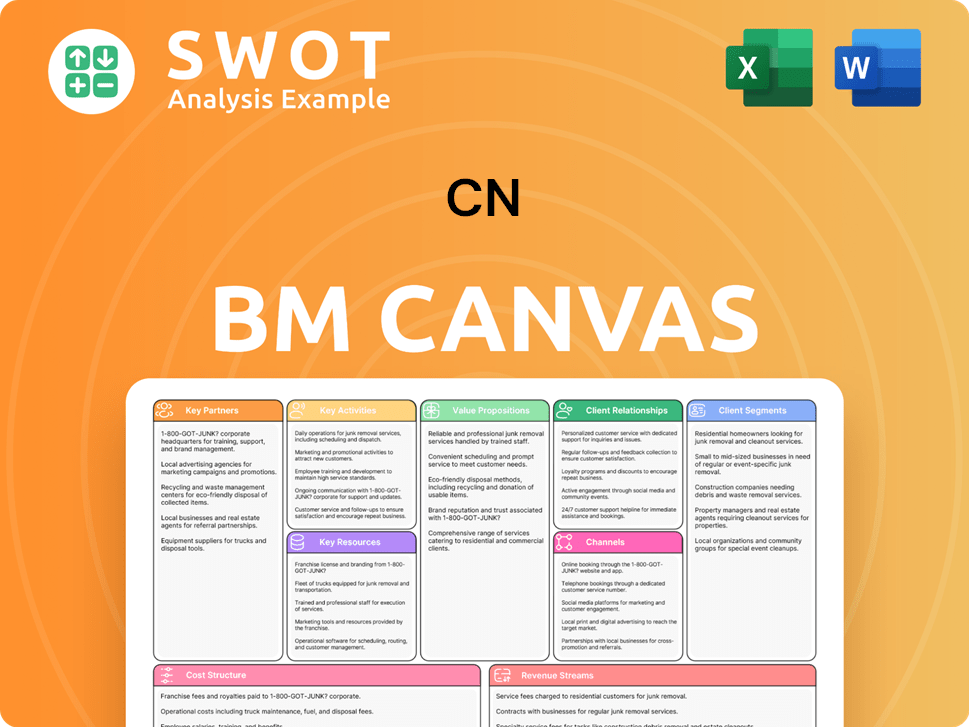
CN Business Model Canvas
- Complete 9-Block Business Model Canvas
- Effortlessly Communicate Your Business Strategy
- Investor-Ready BMC Format
- 100% Editable and Customizable
- Clear and Structured Layout
What is the Timeline of Key Events for CN?
The CN Company history is marked by significant milestones that have shaped its evolution into a major North American railway. From its origins in 1919 as Canadian National Railways (CNR) to its privatization and subsequent acquisitions, CN Rail has continually adapted and expanded its operations. Key events include the integration of the Grand Trunk Railway in 1923, the assumption of passenger services by VIA Rail Canada in 1978, and the pivotal privatization through an IPO in 1995, raising CAD $2.26 billion. Further expansion occurred with the acquisitions of Illinois Central Railroad in 1999 and Wisconsin Central Transportation Corporation in 2001, significantly broadening its network. More recently, in 2024, the company faced operational challenges but also received recognition for its sustainability efforts.
| Year | Key Event |
|---|---|
| 1919 | Canadian National Railways (CNR) formally incorporated in Montreal, marking the official start of CN Company origins. |
| 1923 | Grand Trunk Railway officially integrated into the CNR system, consolidating railway operations. |
| 1978 | CN's passenger services were assumed by VIA Rail Canada, focusing CN on freight transport. |
| 1995 | CN privatized through an initial public offering (IPO), raising CAD $2.26 billion, a key moment in CN Company's evolution. |
| 1999 | Acquisition of Illinois Central Railroad, expanding CN's network to the Gulf of Mexico. |
| 2001 | Acquisition of Wisconsin Central Transportation Corporation, further expanding CN's reach. |
| 2004 | Acquisitions of rail and marine holdings of Great Lakes Transportation LLC and BC Rail Ltd. |
| 2024 | Faced significant labor and operational disruptions, impacting financial performance, but also recognized for sustainability. |
| 2025 | Reported Q1 revenues of C$4,403 million (up 4%) and diluted EPS of C$1.85 (up 8%). |
Future Outlook
CN is optimistic about a strong recovery in 2025, despite economic uncertainties. The company aims for a 10%-15% adjusted diluted EPS growth for 2025. This growth is based on anticipated low to mid-single-digit Revenue Ton Miles (RTM) growth.
Strategic Initiatives
Strategic initiatives include enhancing cross-border intermodal services and expanding volumes through partnerships. CN plans to invest approximately C$3.4 billion in its capital program, with about $2.9 billion for maintenance and strategic infrastructure.
Financial Projections
CN expects volume growth in container shipments, petroleum, chemicals, and agricultural commodities in 2025. Analysts anticipate CN shares to appreciate by over 14% in the next 12 months, providing a total return of about 16% from current levels.
Capital Program
The capital program for 2025, totaling C$3.4 billion, will focus on strengthening network resilience, efficiency, and sustainability. Over $500 million is allocated to upgrade and expand its rolling stock to improve CN Rail operations.
CN Porter's Five Forces Analysis
- Covers All 5 Competitive Forces in Detail
- Structured for Consultants, Students, and Founders
- 100% Editable in Microsoft Word & Excel
- Instant Digital Download – Use Immediately
- Compatible with Mac & PC – Fully Unlocked

Related Blogs

Disclaimer
All information, articles, and product details provided on this website are for general informational and educational purposes only. We do not claim any ownership over, nor do we intend to infringe upon, any trademarks, copyrights, logos, brand names, or other intellectual property mentioned or depicted on this site. Such intellectual property remains the property of its respective owners, and any references here are made solely for identification or informational purposes, without implying any affiliation, endorsement, or partnership.
We make no representations or warranties, express or implied, regarding the accuracy, completeness, or suitability of any content or products presented. Nothing on this website should be construed as legal, tax, investment, financial, medical, or other professional advice. In addition, no part of this site—including articles or product references—constitutes a solicitation, recommendation, endorsement, advertisement, or offer to buy or sell any securities, franchises, or other financial instruments, particularly in jurisdictions where such activity would be unlawful.
All content is of a general nature and may not address the specific circumstances of any individual or entity. It is not a substitute for professional advice or services. Any actions you take based on the information provided here are strictly at your own risk. You accept full responsibility for any decisions or outcomes arising from your use of this website and agree to release us from any liability in connection with your use of, or reliance upon, the content or products found herein.