

Becton Dickinson Bundle

How has Becton Dickinson, a pioneer in medical technology, shaped healthcare as we know it?
Embark on a journey through time to uncover the fascinating Becton Dickinson SWOT Analysis and the remarkable

This exploration of
What is the Becton Dickinson Founding Story?
The story of Becton Dickinson (BD) began in 1897, a pivotal year that marked the genesis of a healthcare revolution. Founded by Maxwell Becton, a pharmacist, and Fairleigh S. Dickinson, an engineer, the company emerged with a clear mission: to transform the healthcare landscape. Their collaboration laid the groundwork for what would become a global leader in medical technology.
Initially established in New York City, the operations later shifted to New Jersey, where the company established its headquarters. This move was strategic, positioning the company closer to key markets and resources. From its inception, BD focused on producing medical devices and supplies, aiming to enhance patient care and improve healthcare outcomes. The company's early focus on innovation and quality set the stage for its future success and established it as a trusted partner in the healthcare sector.
One of the earliest and most impactful products introduced by the company in its founding year was the syringe. This innovation was a cornerstone of BD's early success, setting the standard for medical devices. The company's commitment to quality and innovation quickly earned it a strong reputation within the healthcare community. BD's incorporation under the laws of the State of New Jersey in November 1906, succeeded the New York business started in 1897, marking a significant step in its institutional development and solidifying its place in the history of medical device companies.

Early Years and Foundation
The early years of Becton Dickinson were marked by a commitment to innovation and quality. This dedication quickly established the company as a trusted partner in the healthcare industry. BD's initial products, like the syringe, set the stage for its future growth and impact.
- Founded in 1897 by Maxwell Becton and Fairleigh S. Dickinson.
- Initial operations in New York City, later moving to New Jersey.
- Focused on producing medical devices and supplies.
- Introduced the syringe in its founding year.
The early focus on medical devices and supplies laid the foundation for BD's future growth. The company's commitment to innovation and quality helped it to quickly gain a strong reputation. BD's early success set the stage for its expansion and impact on the healthcare industry. The company's history is a testament to the power of collaboration and a shared vision. Read more about the Mission, Vision & Core Values of Becton Dickinson.
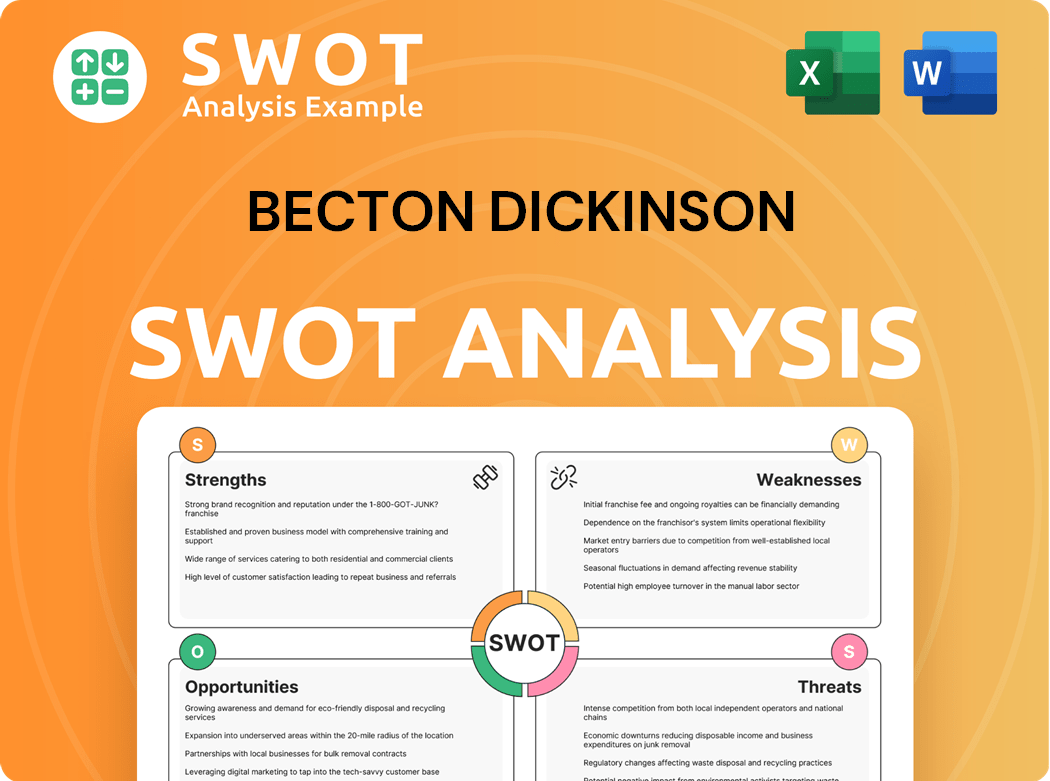
Becton Dickinson SWOT Analysis
- Complete SWOT Breakdown
- Fully Customizable
- Editable in Excel & Word
- Professional Formatting
- Investor-Ready Format
What Drove the Early Growth of Becton Dickinson?
The early years of BD Company focused on expanding its product offerings and building a reputation for quality within the medical field. This commitment to innovation, starting with its first syringe in 1897, laid the foundation for significant growth. From introducing the first disposable hypodermic needle in 1947 to international expansion, Becton Dickinson history is marked by strategic moves. This period set the stage for the company's evolution into a major player in medical technology.
 Product Innovation and Market Leadership
Becton Dickinson continued to innovate, introducing the first disposable hypodermic needle in 1947. In 1980, BD formed its VACUTAINER Systems Division (BDVS) to specialize in blood collection products. By the mid-1980s, BDVS had secured an estimated 80% market share in the U.S. blood testing products market, with sales reaching $90 million.
Global Expansion and Strategic Acquisitions
BD began its international expansion in 1956, establishing its first office in Mumbai, India. The company now operates in over 50 countries. Key acquisitions have been a significant driver of BD's expansion, including CareFusion in October 2014 for $12.2 billion and C.R. Bard in April 2017. For more insights into the company, you can read more about the Owners & Shareholders of Becton Dickinson.
Recent Acquisitions and Financial Investments
In September 2024, BD completed the acquisition of Edwards Lifesciences' Critical Care product group, now named BD Advanced Patient Monitoring, expected to add approximately $900 million to BD's annual revenue. In 2024, BD invested over $10 million to expand syringe, needle, and IV catheter production in its U.S. facilities, increasing domestic capacity by 40-50%.
Future Investments and Manufacturing Expansion
Becton Dickinson plans to invest an additional $30 million in 2025 for further IV catheter manufacturing expansion in Utah. These strategic investments reflect BD's commitment to maintaining a resilient supply chain and supporting healthcare needs. The company's focus on innovation and strategic investments has positioned it as a leader in the medical technology industry.
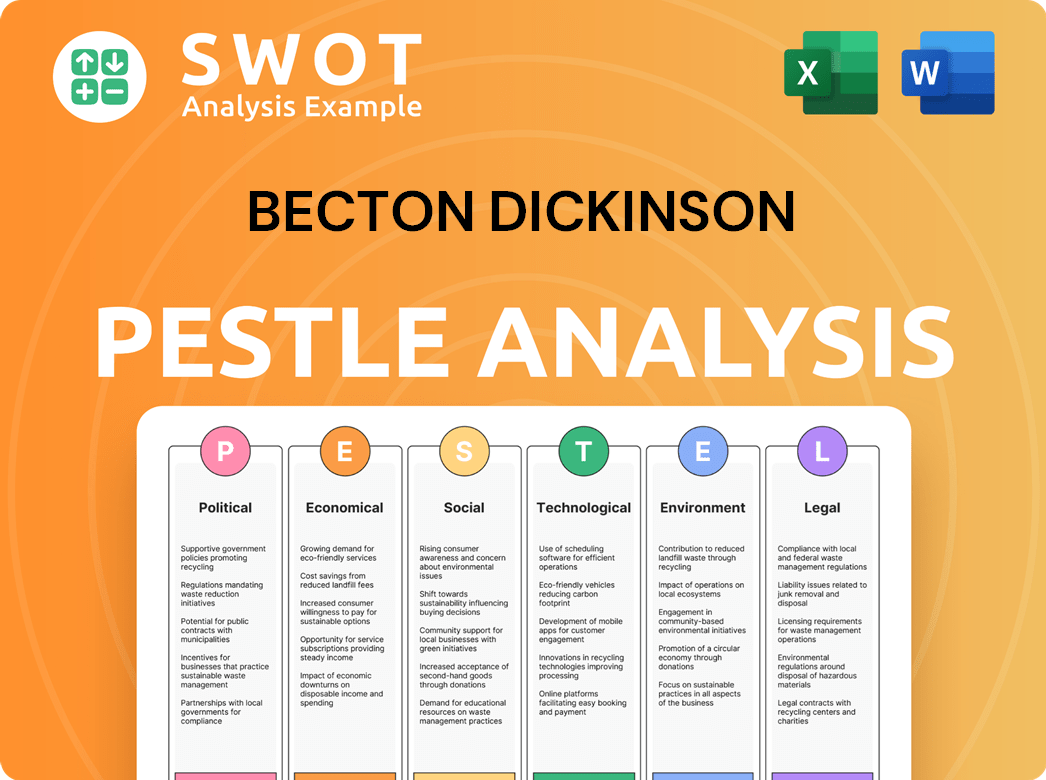
Becton Dickinson PESTLE Analysis
- Covers All 6 PESTLE Categories
- No Research Needed – Save Hours of Work
- Built by Experts, Trusted by Consultants
- Instant Download, Ready to Use
- 100% Editable, Fully Customizable
What are the key Milestones in Becton Dickinson history?
The Becton Dickinson (BD) Company's history is marked by significant milestones in medical technology. From its early innovations to its current strategic initiatives, BD has consistently shaped the healthcare landscape.
| Year | Milestone |
|---|---|
| 1897 | Introduction of the first syringe. |
| 1924 | The company introduced the first insulin syringe. |
| 1947 | Development of the first disposable hypodermic needle. |
| 1950 | Development of a sterile disposable blood-collection set. |
| 1975 | BD introduced prefilled syringes for injecting heparin. |
| 2022 | Divested its diabetes management segment, now known as Embecta. |
| 2025 | Announced intent to separate its Biosciences and Diagnostic Solutions segment. |
BD has consistently been at the forefront of medical technology innovation. Recent advancements include a Radio Frequency Identification (RFID)-based solution for prefillable syringes, BD iDFill™, aimed at enhancing efficiency and traceability in drug delivery, showcased at CPhI Milan in October 2024.

BD iDFill™
This RFID-based solution for prefillable syringes enhances efficiency and traceability in drug delivery.
Metaverse Technology
In Q1 2024, BD held five patents in metaverse technology, including a magnetic-based tracking system for ultrasound probes to create 3D visualizations.
Future of Work Patents
BD secured 143 patents in the 'future of work' theme during Q1 2024, including automated laboratory systems for processing biological samples.
New Product Launches
BD plans to launch over 100 new products by the end of fiscal year 2025 as part of its BD 2025 plan.
Despite its achievements, BD Company has faced various challenges, including market downturns and competitive pressures. The company is addressing these challenges through strategic initiatives like the BD2025 strategy, which includes divesting segments and exploring separations to unlock value.
Anti-Competitive Allegations
In 2004, the company agreed to pay $100 million to settle allegations of anti-competitive behavior.
COVID-19 Testing Revenue Decline
COVID-19 diagnostic testing revenue dropped from $1.95 billion in FY 2021 to $73 million in FY 2023.
Financial Performance
In Q2 fiscal year 2025, adjusted EPS beat estimates, but revenue of $5.27 billion fell short of the $5.35 billion forecast.
Strategic Repositioning
The company is exploring options for the separation of its Biosciences and Diagnostic Solutions segment, including a Reverse Morris Trust, spin-off, or outright sale.
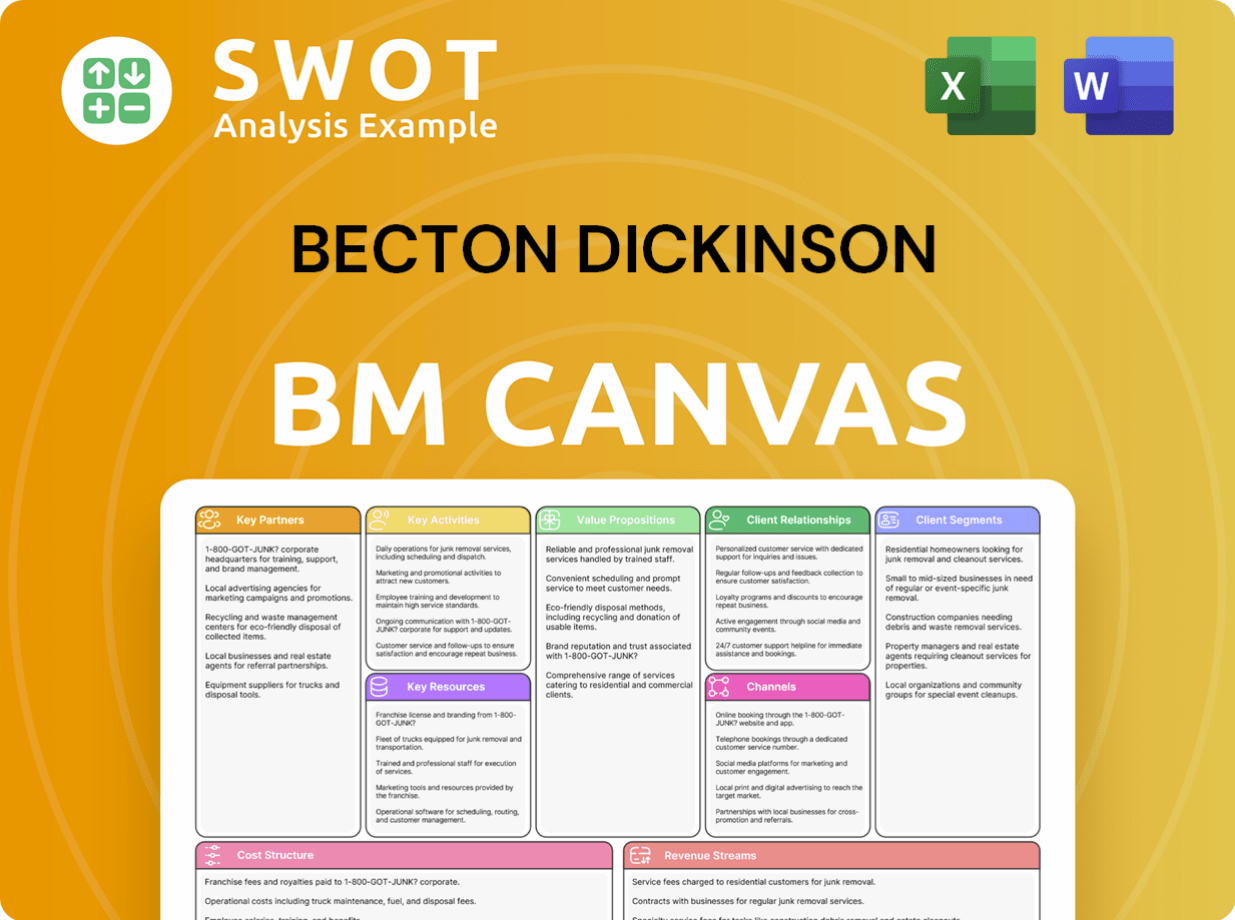
Becton Dickinson Business Model Canvas
- Complete 9-Block Business Model Canvas
- Effortlessly Communicate Your Business Strategy
- Investor-Ready BMC Format
- 100% Editable and Customizable
- Clear and Structured Layout
What is the Timeline of Key Events for Becton Dickinson?
The Becton Dickinson history is marked by significant innovations and strategic expansions. Founded in 1897 by Maxwell Becton and Fairleigh Dickinson, the company initially introduced the first syringe. Over the years, it has evolved into a leading medical technology company, with key milestones including the introduction of the first insulin syringe in 1924, the first disposable hypodermic needle in 1947, and the sterile disposable blood-collection set in 1950. The company expanded globally, entering the Indian market in 1956. Strategic moves like the formation of the VACUTAINER Systems Division in 1980 and acquisitions such as CareFusion in 2014 and C.R. Bard in 2017 have shaped its growth. More recently, the launch of the BD2025 strategy in 2020 and the divestiture of the diabetes management segment (Embecta) in 2022, along with the acquisition of Edwards Lifesciences' Critical Care product group in September 2024, highlight its ongoing transformation.
| Year | Key Event |
|---|---|
| 1897 | Maxwell Becton and Fairleigh Dickinson founded Becton Dickinson in New York City, introducing the first syringe. |
| 1906 | The company was incorporated in New Jersey. |
| 1924 | BD introduced the first insulin syringe. |
| 1947 | BD introduced the first disposable hypodermic needle. |
| 1950 | Development of a sterile disposable blood-collection set. |
| 1956 | BD entered the Indian market with its first office in Mumbai. |
| 1975 | Introduction of prefilled syringes for injecting heparin. |
| 1980 | Formation of the VACUTAINER Systems Division. |
| 2004 | BD paid $100 million to settle anti-competitive behavior allegations. |
| 2014 | Acquisition of CareFusion for $12.2 billion. |
| 2017 | Acquisition of C.R. Bard. |
| 2020 | Launch of the 5-year BD2025 strategy. |
| 2022 | Divestiture of the diabetes management segment (Embecta). |
| September 2024 | Acquisition of Edwards Lifesciences' Critical Care product group. |
| October 2024 | BD showcased new drug delivery innovations at CPhI Milan, including BD iDFill™. |
| November 2024 | BD reports full fiscal year 2024 revenue of $20.2 billion, a 4.2% increase from 2023. |
| January 2025 | BD announces over $10 million investment in 2024 to expand U.S. manufacturing of syringes, needles, and IV catheters, with an additional $30 million planned for 2025. |
| February 2025 | BD announces intent to separate its Biosciences and Diagnostic Solutions segment. |
| May 2025 | BD reports Q2 fiscal year 2025 results, with adjusted EPS of $3.35, and reaffirms fiscal 2025 revenue guidance between $21.8 billion and $21.9 billion. |
Strategic Focus
BD is concentrating on its core MedTech operations to drive sustained growth. The planned separation of its Biosciences and Diagnostic Solutions segments is a key step towards enhancing operational efficiency.
Financial Projections
Post-separation, the 'New BD' anticipates approximately $17.8 billion in FY2024 revenue, with a market growing at about 5%. Fiscal 2025 revenues are expected to be between $21.8 billion and $21.9 billion.
Innovation and Expansion
The company plans to launch over 100 new products by the end of fiscal 2025 under its BD 2025 plan. BD is also investing $2.5 billion in U.S. manufacturing capacity over the next five years.
Financial Performance
BD expects adjusted EPS between $14.06 and $14.34 for fiscal 2025, considering potential tariff impacts. The company is leveraging advancements in biologics, AI, and automation.
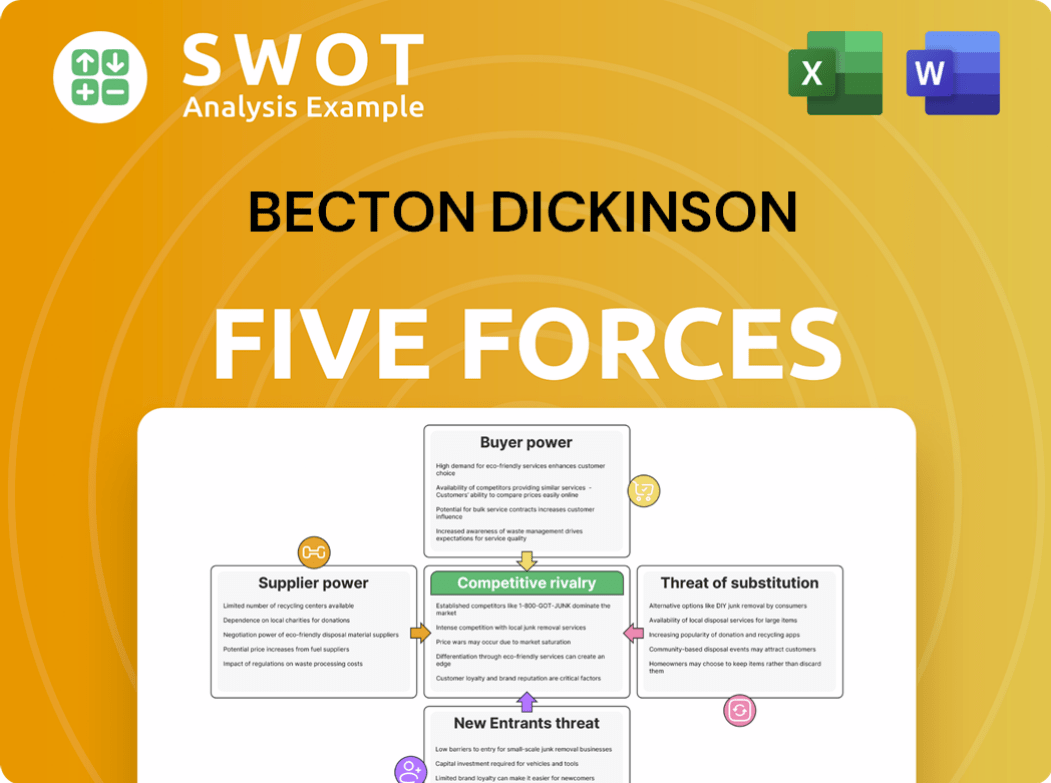
Becton Dickinson Porter's Five Forces Analysis
- Covers All 5 Competitive Forces in Detail
- Structured for Consultants, Students, and Founders
- 100% Editable in Microsoft Word & Excel
- Instant Digital Download – Use Immediately
- Compatible with Mac & PC – Fully Unlocked
Related Blogs

- What is Competitive Landscape of Becton Dickinson Company?
- What is Growth Strategy and Future Prospects of Becton Dickinson Company?
- How Does Becton Dickinson Company Work?
- What is Sales and Marketing Strategy of Becton Dickinson Company?
- What is Brief History of Becton Dickinson Company?
- Who Owns Becton Dickinson Company?
- What is Customer Demographics and Target Market of Becton Dickinson Company?
Disclaimer
All information, articles, and product details provided on this website are for general informational and educational purposes only. We do not claim any ownership over, nor do we intend to infringe upon, any trademarks, copyrights, logos, brand names, or other intellectual property mentioned or depicted on this site. Such intellectual property remains the property of its respective owners, and any references here are made solely for identification or informational purposes, without implying any affiliation, endorsement, or partnership.
We make no representations or warranties, express or implied, regarding the accuracy, completeness, or suitability of any content or products presented. Nothing on this website should be construed as legal, tax, investment, financial, medical, or other professional advice. In addition, no part of this site—including articles or product references—constitutes a solicitation, recommendation, endorsement, advertisement, or offer to buy or sell any securities, franchises, or other financial instruments, particularly in jurisdictions where such activity would be unlawful.
All content is of a general nature and may not address the specific circumstances of any individual or entity. It is not a substitute for professional advice or services. Any actions you take based on the information provided here are strictly at your own risk. You accept full responsibility for any decisions or outcomes arising from your use of this website and agree to release us from any liability in connection with your use of, or reliance upon, the content or products found herein.