

Astra Bundle

How did Astra Company rise to become Indonesia's economic titan?
From a small trading post in 1957 to a multi-sector powerhouse, Astra International's story is one of remarkable transformation. This journey showcases strategic foresight and adaptability, evolving into a dominant force across key Indonesian industries. Discover the pivotal moments that shaped the Astra Group and its lasting impact on the nation's economy.

Understanding the Astra SWOT Analysis is crucial to grasping its strategic evolution. The Astra Company's early years, marked by the vision of its founders, laid the groundwork for an extraordinary expansion. This brief history of Astra Company explores key milestones, major acquisitions, and the company's impressive financial performance, including a net revenue of Rp330.9 trillion in 2024.
What is the Astra Founding Story?
The story of the Astra Company, a major player in Indonesia's business landscape, began in Jakarta in 1957. Founded by brothers Tjia Kian Tie and William Soeryadjaya, along with E. Hardiman, the company's early years were marked by strategic pivots and significant partnerships that shaped its trajectory. Understanding the Astra Company history offers insights into the evolution of one of Indonesia's most successful conglomerates.
The founders, notably William Soeryadjaya, brought a wealth of experience and connections to the table. Their family's involvement in trading, dating back to the 1940s, provided a solid foundation. William's personal relationships, including ties with influential figures like Sumitro Djojohadikusumo, played a crucial role in the company's early development, setting the stage for future growth and expansion.
Initially, Astra aimed to secure an exclusive assembly and distribution deal with Chevrolet. However, when this plan fell through, the company quickly adapted. This flexibility was critical, leading Astra to partner with Toyota Motor Corporation, which was looking to enter the Indonesian market. This strategic move was a turning point, setting the stage for Astra's dominance in the automotive sector, a key aspect of the Astra Group.

Key Milestones in Astra Company History
The early funding for Astra came from the founders' existing trading business and private capital. The company's name changed to PT Astra International Tbk in 1990, coinciding with its initial public offering on the Indonesia Stock Exchange, under the ticker ASII.
- 1957: PT Astra International Incorporated was founded in Jakarta.
- 1990: The company went public on the Indonesia Stock Exchange.
- 1992: Ownership diversified due to a family business's bankruptcy.
- Current: The company continues to be a major player in the Indonesian market.
The initial funding came from the founders' trading business and private capital. The company's name change to PT Astra International Tbk in 1990 marked its initial public offering on the Indonesia Stock Exchange, trading under the ticker ASII. This transition from a family-owned enterprise to a publicly traded conglomerate was significant. Although the founding family maintained exclusive ownership until late 1992, a separate family business's bankruptcy led to ownership diversification, including Indonesian government financial institutions, domestic private capitalists, and foreign firms. For more information on the competitive landscape, see Competitors Landscape of Astra.
Astra SWOT Analysis
- Complete SWOT Breakdown
- Fully Customizable
- Editable in Excel & Word
- Professional Formatting
- Investor-Ready Format

What Drove the Early Growth of Astra?
The early growth of the Astra Company, a significant chapter in Astra Group's history, was marked by strategic moves and partnerships. This period saw the company establish itself in the automotive sector, diversifying into various other industries. Key milestones, including an initial public offering, fueled its expansion and solidified its position as a leading conglomerate.
 Automotive Sector Entry
Astra Company's journey began with a strategic entry into the automotive sector. A pivotal partnership with Toyota Motor Corporation in 1971, for car assembly in Indonesia, laid the foundation for its automotive dominance. This collaboration was a turning point, establishing Astra as a key player in the Indonesian machinery and automotive industry. The company's early years were defined by this strategic focus.
Diversification and Expansion
Beyond its automotive roots, Astra diversified into various sectors, showcasing the company's early expansion. The company built a strong presence in the automotive component sector through its subsidiary PT Astra Otoparts Tbk. Financial services also became a significant area, with net income increasing by 6% to Rp8.4 trillion by 2024, driven by consumer finance growth. This diversification was key to Astra's development.
Capital Raises and Strategic Shifts
Astra's initial public offering (IPO) in the 1990s was a major milestone, transforming it into a publicly owned entity. This allowed for greater access to capital, fueling further expansion. Strategic acquisitions and mergers were crucial for penetrating new markets. For example, the used car business, OLXmobbi, recorded sales of 27,300 units in 2024, demonstrating successful ventures into new segments. Learn more about the Owners & Shareholders of Astra.
Market Resilience and Adaptability
The company demonstrated resilience in the face of market volatility. Despite a 14% decline in car sales in 2024, Astra maintained a strong market share. This adaptability and the ability to navigate challenges highlight the company's robust growth strategies. These strategies have been key to the Astra Company's history and its continued success.
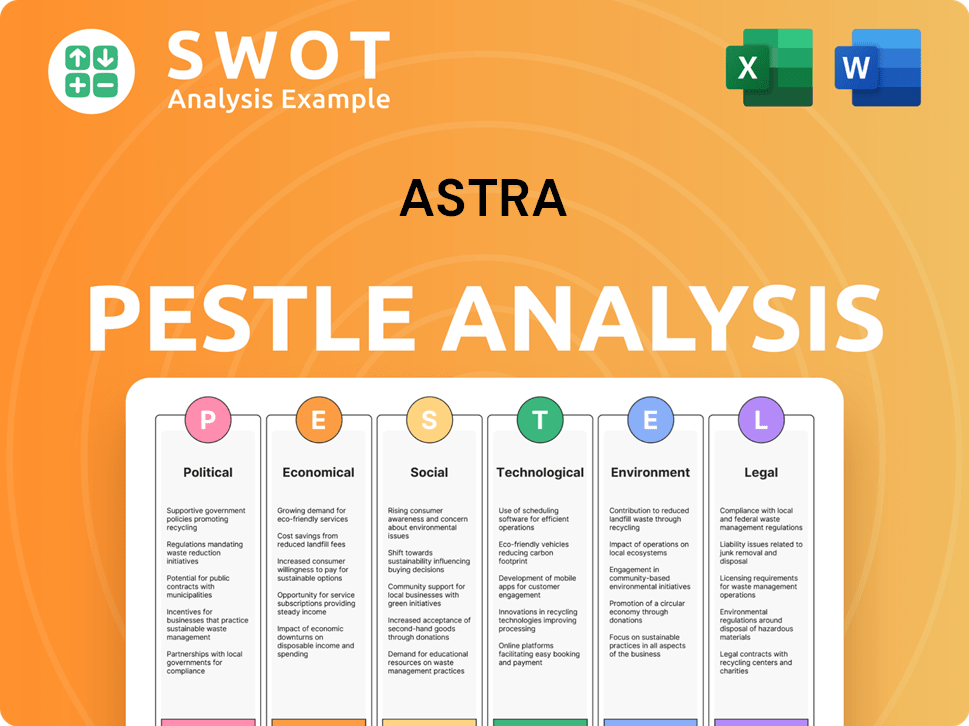
Astra PESTLE Analysis
- Covers All 6 PESTLE Categories
- No Research Needed – Save Hours of Work
- Built by Experts, Trusted by Consultants
- Instant Download, Ready to Use
- 100% Editable, Fully Customizable
What are the key Milestones in Astra history?
The Astra Company history is marked by significant achievements and strategic shifts, reflecting its adaptability and growth over time. The company has consistently expanded its operations and diversified its portfolio, responding to market dynamics and consumer demands.
| Year | Milestone |
|---|---|
| Early Years | The company was founded, marking the beginning of its journey in the automotive and diversified business sectors. |
| 2024 | Astra launched 13 new car models and 15 revamped ones, while Astra Honda Motor introduced 8 new motorcycle models and 7 revamped ones, maintaining a stable market share in the automotive sector. |
| 2024 | Astra invested Rp4.2 trillion in the healthcare sector, including the acquisition of Heartology Cardiovascular Hospital for Rp643 billion. |
Astra has been a frontrunner in innovation, particularly in the automotive industry, with a consistent introduction of new and revamped vehicle models to meet consumer demands. The company's strategic investments in diverse sectors, such as healthcare, also highlight its commitment to innovation and expansion beyond its core businesses.

New Vehicle Models
In 2024, Astra launched 13 new car models and 15 revamped models, showcasing its commitment to offering fresh options to consumers.
Motorcycle Model Launches
Astra Honda Motor introduced 8 new motorcycle models and 7 revamped ones in 2024, maintaining its strong presence in the motorcycle market.
Healthcare Investments
The company's strategic investment of Rp4.2 trillion in the healthcare sector, including the acquisition of Heartology Cardiovascular Hospital, reflects its diversification strategy.
EV Development
Astra is actively exploring electric vehicle (EV) development, with plans to introduce new Toyota BEV models over the next three years and seven new Honda electric motorcycles by 2030.
Financial Services Growth
The financial services division saw a 6% increase in net income to Rp8.4 trillion in 2024, driven by growth in consumer finance.
Market Share Maintenance
Astra maintained a strong market share of 56% in the automotive sector in 2024, despite a decline in car sales.
Despite its successes, Astra has faced challenges, including a decline in car sales and fluctuations in the heavy equipment sector. The company's ability to adapt to market changes and invest in new opportunities, such as EV development and healthcare, is crucial for its continued growth.
Automotive Sales Decline
The automotive division experienced a 14% decline in car sales, totaling 483,000 units in 2024, due to a weaker market.
Heavy Equipment Sector
The heavy equipment, mining, construction, and energy segment saw a 5% decline in net income to Rp12.0 trillion, impacted by lower coal prices.
Market Volatility
Astra has to navigate market dynamics and consumer preferences to drive future growth.
Strategic Repositioning
The company's strategic repositioning, along with a robust balance sheet, has allowed Astra to navigate uncertainties.
EV Transition
The shift towards electric vehicles presents both challenges and opportunities for Astra.
Competition
Astra faces competition in both the automotive and healthcare sectors.
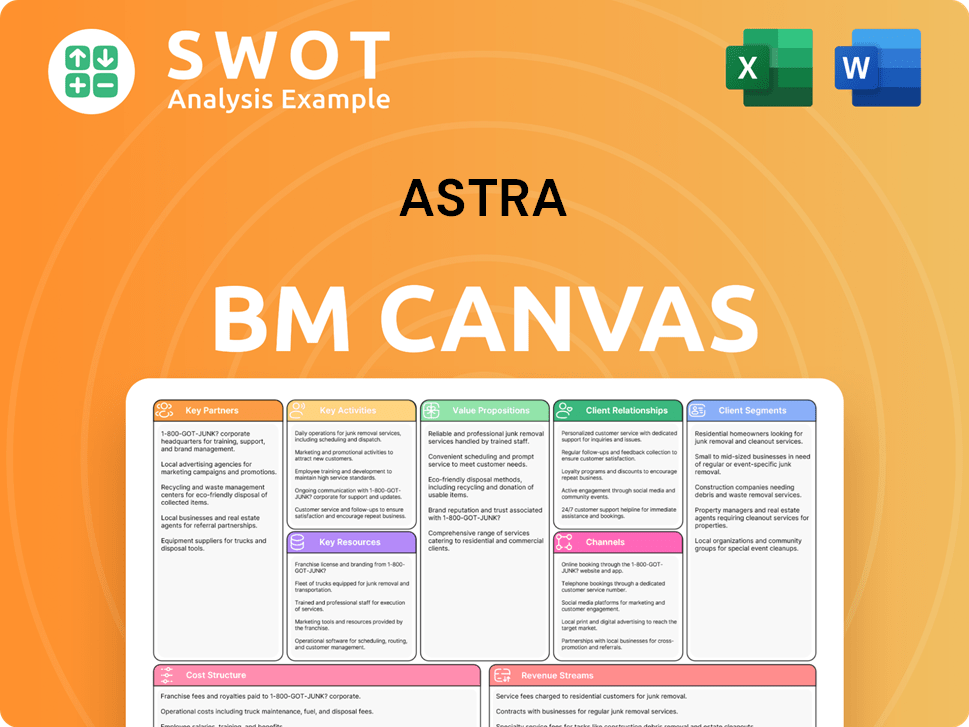
Astra Business Model Canvas
- Complete 9-Block Business Model Canvas
- Effortlessly Communicate Your Business Strategy
- Investor-Ready BMC Format
- 100% Editable and Customizable
- Clear and Structured Layout
What is the Timeline of Key Events for Astra?
The Astra Company history is a story of strategic growth and adaptation. Founded in 1957, it has evolved from its early days to become a major player in Indonesia's economy. The
| Year | Key Event |
|---|---|
| 1957 | Founded as PT Astra International Incorporated in Jakarta. |
| 1971 | Began assembling cars for Toyota Motor Corporation in Indonesia. |
| 1990 | Changed its name to PT Astra International Tbk and went public, listing on the Indonesia Stock Exchange (ASII). |
| 1992 | The founding family disposed of its shareholdings, leading to diversified ownership. |
| 2024 (January) | Domestic car sales reached 865,723 units, and motorcycle sales stood at 6.3 million units, with Astra holding a 56% market share in national car sales. |
| 2024 (First Half) | Astra's used car business, OLXmobbi, sold 12,000 units, a 40% year-on-year increase. |
| 2024 (August) | Management reaffirmed the automotive sector as the primary focus, contributing approximately 40% of 1H24 revenue and 33% of net profit. |
| 2024 (October 31) | Distributed an interim dividend of Rp98 per share. |
| 2024 (November) | Introduced two new electric motorcycles, the Honda ICON-e (Rp28 million) and Honda CUV-e (Rp54.45 million). |
| 2024 (December 31) | Reported consolidated net revenue of Rp330.9 trillion, a 5% increase over 2023, and net income of Rp34.1 trillion. |
| 2025 (Q1) | Car sales reached 110,812 units, with Astra holding a 54% market share. |
| 2025 (May) | Proposed a final dividend of Rp308 per share for the 2024 fiscal year. |
Future Growth in EVs
Astra plans to expand its electric vehicle (EV) lineup with three new Toyota BEV models over the next three years and seven new Honda electric motorcycles by 2030, recognizing the long-term potential of EVs in Indonesia. This strategic move aligns with the growing demand for sustainable transportation options.
Financial Outlook
Analysts predict Astra International's earnings and revenue to grow by 0.3% and 1.4% per annum, respectively, with a forecast return on equity of 13.7% in three years. The company anticipates further growth in net profit to Rp39,026 billion by 2026, demonstrating a positive financial trajectory.
Strategic Investments
Astra is exploring new opportunities and investing in strengthening its core businesses, backed by a strong balance sheet. The company's strategic investments in healthcare, totaling Rp4.2 trillion by November 2024, further demonstrate its commitment to diversification and long-term growth.
Market Impact
Astra expects to benefit from Indonesia's recent interest rate cuts, which are projected to positively influence car and motorcycle sales, as around 70% of these sales are financed. This positions the company to capitalize on favorable market conditions and boost sales.
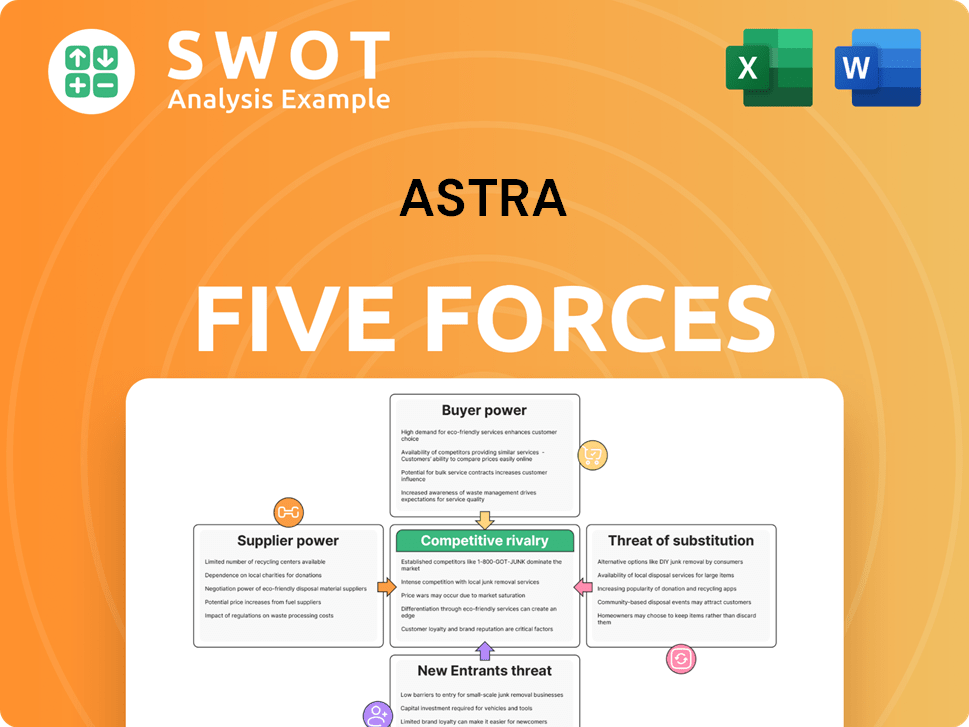
Astra Porter's Five Forces Analysis
- Covers All 5 Competitive Forces in Detail
- Structured for Consultants, Students, and Founders
- 100% Editable in Microsoft Word & Excel
- Instant Digital Download – Use Immediately
- Compatible with Mac & PC – Fully Unlocked
Related Blogs

- What is Competitive Landscape of Astra Company?
- What is Growth Strategy and Future Prospects of Astra Company?
- How Does Astra Company Work?
- What is Sales and Marketing Strategy of Astra Company?
- What is Brief History of Astra Company?
- Who Owns Astra Company?
- What is Customer Demographics and Target Market of Astra Company?
Disclaimer
All information, articles, and product details provided on this website are for general informational and educational purposes only. We do not claim any ownership over, nor do we intend to infringe upon, any trademarks, copyrights, logos, brand names, or other intellectual property mentioned or depicted on this site. Such intellectual property remains the property of its respective owners, and any references here are made solely for identification or informational purposes, without implying any affiliation, endorsement, or partnership.
We make no representations or warranties, express or implied, regarding the accuracy, completeness, or suitability of any content or products presented. Nothing on this website should be construed as legal, tax, investment, financial, medical, or other professional advice. In addition, no part of this site—including articles or product references—constitutes a solicitation, recommendation, endorsement, advertisement, or offer to buy or sell any securities, franchises, or other financial instruments, particularly in jurisdictions where such activity would be unlawful.
All content is of a general nature and may not address the specific circumstances of any individual or entity. It is not a substitute for professional advice or services. Any actions you take based on the information provided here are strictly at your own risk. You accept full responsibility for any decisions or outcomes arising from your use of this website and agree to release us from any liability in connection with your use of, or reliance upon, the content or products found herein.