

Armstrong World Industries Bundle

How Well Do You Know Armstrong World Industries?
Journey back over 160 years to uncover the captivating Armstrong World Industries SWOT Analysis. From its humble beginnings in Pittsburgh, Pennsylvania, Armstrong has evolved into a global leader in ceiling and wall solutions. Explore how a small cork-cutting shop transformed into an industry giant, shaping interior spaces and setting new standards.

Armstrong World Industries' story is one of resilience and innovation, marked by strategic expansions and a commitment to quality. Witness how this company navigated challenges, from its early days producing bottle stoppers to becoming a key player in ceiling tiles and beyond. Today, headquartered in Lancaster, Pennsylvania, Armstrong continues to thrive, demonstrating robust financial health and a strong market position.
What is the Armstrong World Industries Founding Story?
The story of Armstrong World Industries, a titan in the building materials industry, began in 1860. It started as a modest cork-cutting shop in Pittsburgh, Pennsylvania, and evolved into a global leader in flooring and ceiling systems. This Growth Strategy of Armstrong World Industries is a testament to its enduring legacy.
Thomas M. Armstrong, at the age of 24, teamed up with John D. Glass to establish their initial venture. Their primary focus was hand-carving cork bottle stoppers. The company's trajectory shifted significantly over the years, marked by innovation and strategic expansion.
By 1862, the company adopted machinery for cork cutting, enhancing its production capabilities. This early adaptation to technology set the stage for future growth. The company's evolution from a small workshop to a global enterprise is a compelling narrative of entrepreneurial spirit and strategic foresight.

Founding Story
In 1860, Thomas M. Armstrong and John D. Glass founded a cork-cutting shop in Pittsburgh, Pennsylvania. The company initially focused on hand-carving bottle stoppers. The company's name was changed to Armstrong, Brother & Company in 1864.
- The company's early success was boosted by fulfilling contracts for the Union Army during the Civil War.
- Thomas Armstrong emphasized branding and customer trust, stamping 'Armstrong' on each cork and offering quality guarantees.
- By the 1890s, Armstrong was the world's largest cork supplier, employing over 750 people.
- The company officially incorporated in 1891 as Armstrong, Brother & Company, Inc.
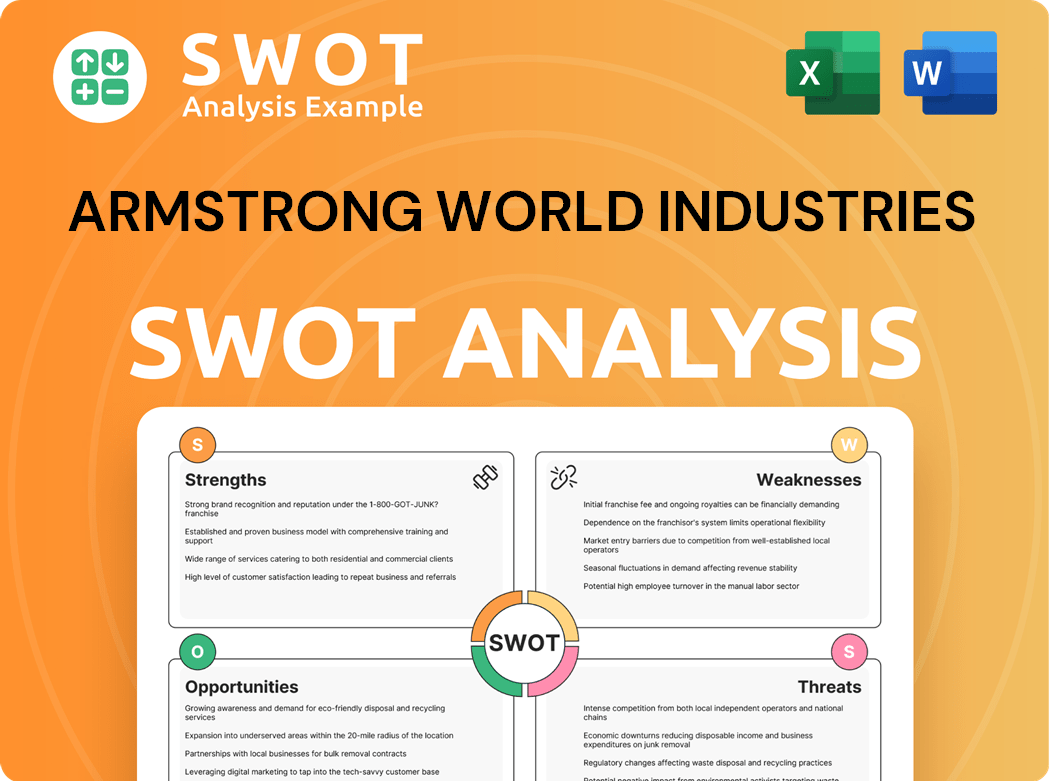
Armstrong World Industries SWOT Analysis
- Complete SWOT Breakdown
- Fully Customizable
- Editable in Excel & Word
- Professional Formatting
- Investor-Ready Format
What Drove the Early Growth of Armstrong World Industries?
The early growth of Armstrong World Industries, then known as Armstrong Cork Company, was marked by rapid diversification and strategic shifts. From its beginnings, the company expanded beyond cork stoppers, venturing into new product lines and international markets. This period set the stage for its future as a major player in the building materials industry.
 Diversification and Expansion
By the 1890s, Armstrong Cork Company diversified into cork insulation, cork-board, gaskets, and flexible machinery coverings. International expansion began with sales offices in Montreal and Toronto in 1895. These moves broadened the company's scope and market reach.
Strategic Leadership
Under Charles Dickey Armstrong, who became president in 1908, the company recognized the potential beyond cork. This led to the construction of a new factory in Lancaster, Pennsylvania, in 1906, specifically for linoleum production. This strategic move significantly impacted the Target Market of Armstrong World Industries.
Innovation and Employee Welfare
In 1909, Charles Armstrong established free dental service for employees, a rare benefit at the time. By 1917, Armstrong Cork launched its first national advertising campaign. These initiatives reflected the company's commitment to both its workforce and brand presence.
Navigating Challenges
During the Great Depression, Armstrong, under H.W. Prentis, restored dividends on common stock by 1935. The company achieved its most profitable year in 1936. During World War II, Armstrong shifted to war production, including munitions and aircraft components.
Armstrong World Industries PESTLE Analysis
- Covers All 6 PESTLE Categories
- No Research Needed – Save Hours of Work
- Built by Experts, Trusted by Consultants
- Instant Download, Ready to Use
- 100% Editable, Fully Customizable

What are the key Milestones in Armstrong World Industries history?
The history of Armstrong World Industries, or AWI, is marked by significant milestones that showcase its evolution and adaptation within the building materials industry. From its origins in cork manufacturing to its expansion into diverse product lines, the company has consistently demonstrated a capacity for innovation and strategic growth. The journey of Armstrong Company History reflects a commitment to sustainability, technological advancements, and overcoming major challenges, solidifying its position as a key player in the industry.
| Year | Milestone |
|---|---|
| Early 1860s | Thomas Armstrong transformed a 65% cork scrap rate into the production of linoleum. |
| 1950 | The company began constructing the Armstrong Research & Development Center in Lancaster, Pennsylvania. |
| 1980 | Armstrong Cork Company changed its name to Armstrong World Industries, reflecting its diversified business. |
| 1993 | Armstrong World Industries became a founding member of the U.S. Green Building Council, showcasing its early commitment to sustainability. |
| 1999 | The company launched its pioneering Ceilings Recycling Program. |
| 2006 | Armstrong emerged from Chapter 11 bankruptcy after resolving asbestos injury claims. |
| 2016 | Launched SUSTAIN, the industry's first portfolio of high-performing, sustainable ceiling solutions. |
| 2021 | Acquired Arktura, MOZ Designs, Inc., and TURF Design, Inc., expanding its Architectural Specialties portfolio. |
| 2024 | Acquired A. Zahner Company and 3form, LLC, further enhancing its Architectural Specialties segment. |
| 2024 | Launched Ultima Low Embodied Carbon ceiling panels and expanded its Templok Energy Saving Ceilings portfolio. |
Armstrong World Industries has consistently demonstrated a commitment to innovation. This is evident in its early adoption of sustainable practices and its development of products like linoleum, which turned waste into a valuable resource. The company's dedication to research and development, highlighted by the creation of its research center in Lancaster, Pennsylvania, has led to continuous improvements in ceiling tiles, flooring, and other building materials.

Linoleum Production
The transformation of cork waste into linoleum was a groundbreaking innovation, showcasing a commitment to resourcefulness.
Research and Development Center
The establishment of the research center in Lancaster, Pennsylvania, fueled continuous product innovation and improvement.
Ceilings Recycling Program
Armstrong World Industries launched a pioneering program to recycle ceiling tiles, demonstrating environmental leadership.
SUSTAIN Portfolio
The introduction of SUSTAIN marked a significant step towards sustainable building solutions.
Acquisitions of Innovative Companies
Strategic acquisitions, such as Arktura, MOZ Designs, Inc., TURF Design, Inc., A. Zahner Company, and 3form, LLC, have expanded the company's portfolio with metal, felt, and resin solutions.
Low Embodied Carbon Products
The launch of Ultima Low Embodied Carbon ceiling panels in 2024 demonstrates a commitment to reducing environmental impact, decreasing material-related carbon emissions by 43% compared to standard panels.
Armstrong World Industries has faced significant challenges throughout its history. The Chapter 11 bankruptcy filing in 2000, due to asbestos-related claims, was a major setback, but the company successfully emerged, demonstrating resilience. Despite facing 'choppy market conditions' and 'uneven market conditions' in 2024 and early 2025, the company has shown an ability to adapt and maintain a positive financial outlook.
Asbestos Litigation
The asbestos-related lawsuits led to a Chapter 11 filing, which was a major challenge for the company.
Market Volatility
Armstrong World Industries has navigated 'choppy market conditions' and 'uneven market conditions', which required strategic financial management.
Financial Resilience
Despite these challenges, the company reported record-setting financial results in 2024, with net sales reaching $1.4 billion, an increase of 12%.
Strategic Adaptations
The company's ability to drive margin expansion through cost controls and manufacturing productivity, alongside strategic acquisitions, has allowed it to maintain a positive outlook.
Sustainability Initiatives
The company continues to focus on sustainability, as seen with the launch of low embodied carbon products and its early commitment to the U.S. Green Building Council.
Product Innovation
Continuous innovation in ceiling tiles and other products has helped to differentiate Armstrong World Industries in the market.
For more insights into the company's values, you can explore Mission, Vision & Core Values of Armstrong World Industries.
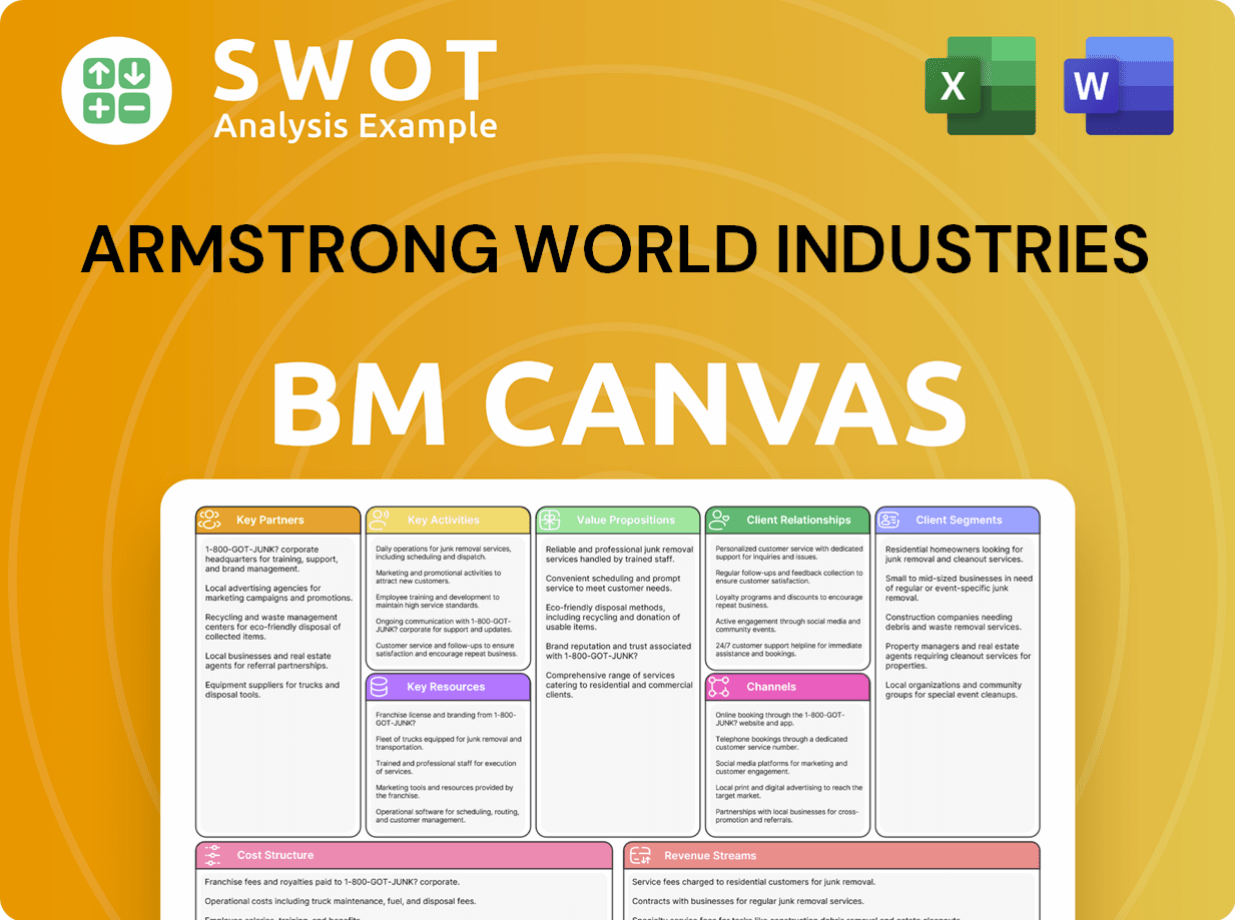
Armstrong World Industries Business Model Canvas
- Complete 9-Block Business Model Canvas
- Effortlessly Communicate Your Business Strategy
- Investor-Ready BMC Format
- 100% Editable and Customizable
- Clear and Structured Layout
What is the Timeline of Key Events for Armstrong World Industries?
The history of Armstrong World Industries, a company with a rich legacy, began in 1860 when Thomas M. Armstrong and John D. Glass established a cork-cutting shop in Pittsburgh, Pennsylvania, marking the inception of the Armstrong Cork Company. Over the years, the company evolved, expanding its product lines and market presence. From its early days focusing on corks, the company broadened its scope to include flooring and ceiling tiles, becoming a major player in the building materials industry. This journey is marked by significant milestones, including expansions, innovations, and strategic shifts, reflecting its adaptation to changing market demands and technological advancements. The company has a long history of manufacturing and innovation, with a strong focus on sustainability.
| Year | Key Event |
|---|---|
| 1860 | Thomas M. Armstrong and John D. Glass open a cork-cutting shop in Pittsburgh, Pennsylvania, founding Armstrong Cork Company. |
| 1864 | Thomas Armstrong begins branding corks and offers a written guarantee of quality, establishing the 'Let the Buyer Have Faith' philosophy. |
| 1891 | The company officially incorporates as Armstrong, Brother & Company, Inc. |
| 1906 | Construction begins on a new factory in Lancaster, Pennsylvania, for linoleum production. |
| 1909 | Armstrong introduces linoleum flooring to the market. |
| 1929 | Company headquarters relocate to Lancaster, Pennsylvania. |
| 1935 | Armstrong Cork Company's common stock is listed on the New York Stock Exchange (NYSE). |
| 1950 | Construction begins on the Armstrong Research & Development Center in Lancaster, Pennsylvania. |
| 1980 | Armstrong Cork Company changes its name to Armstrong World Industries. |
| 1993 | Becomes a founding member of the U.S. Green Building Council. |
| 1999 | Launches the Ceilings Recycling Program. |
| 2000 | Files for Chapter 11 reorganization due to asbestos injury claims. |
| 2006 | Emerges from Chapter 11 reorganization. |
| 2016 | Launches SUSTAIN, a portfolio of sustainable ceiling solutions. |
| 2024 | Reports record-setting net sales of $1.4 billion, an increase of 12% from the previous year. Acquires A. Zahner Company and 3form, LLC, expanding its Architectural Specialties segment. Launches Ultima Low Embodied Carbon ceiling panels. |
| 2025 | Reports strong first-quarter results with total net sales increasing by 17% to $382.7 million. Reaffirms full-year guidance, projecting 9-11% growth in total company net sales and 8-12% growth in adjusted EBITDA. Releases its 2025 Sustainability Report, highlighting achievements in decarbonization and circularity. |
Future Growth
Armstrong World Industries is focused on maintaining its growth trajectory in 2025 and beyond. The company plans to continue investing in innovation and digital initiatives to stay ahead of the curve. Despite anticipating a 'softer market environment in the second half of 2025,' Armstrong aims to drive margin expansion through cost controls.
Financial Projections
Analysts project that Armstrong World Industries will grow earnings and revenue by 9.3% and 6.7% per annum, respectively. Earnings per share (EPS) are expected to grow by 13.3% per annum. These projections suggest a positive outlook for the company's financial performance in the coming years.
Strategic Initiatives
The company's strategic inorganic efforts, including acquisitions and partnerships, are expected to fuel future growth. A disciplined capital allocation approach is also in place to reward shareholders. These initiatives are designed to strengthen Armstrong's market position and drive long-term value.
Sustainability Focus
Armstrong continues to prioritize sustainability, as highlighted in its 2025 Sustainability Report, which showcases initiatives in decarbonization, circularity, and community impact. This commitment reflects a broader industry trend toward environmentally responsible practices and products. The company's focus on sustainability is rooted in its founding vision of quality and trust.
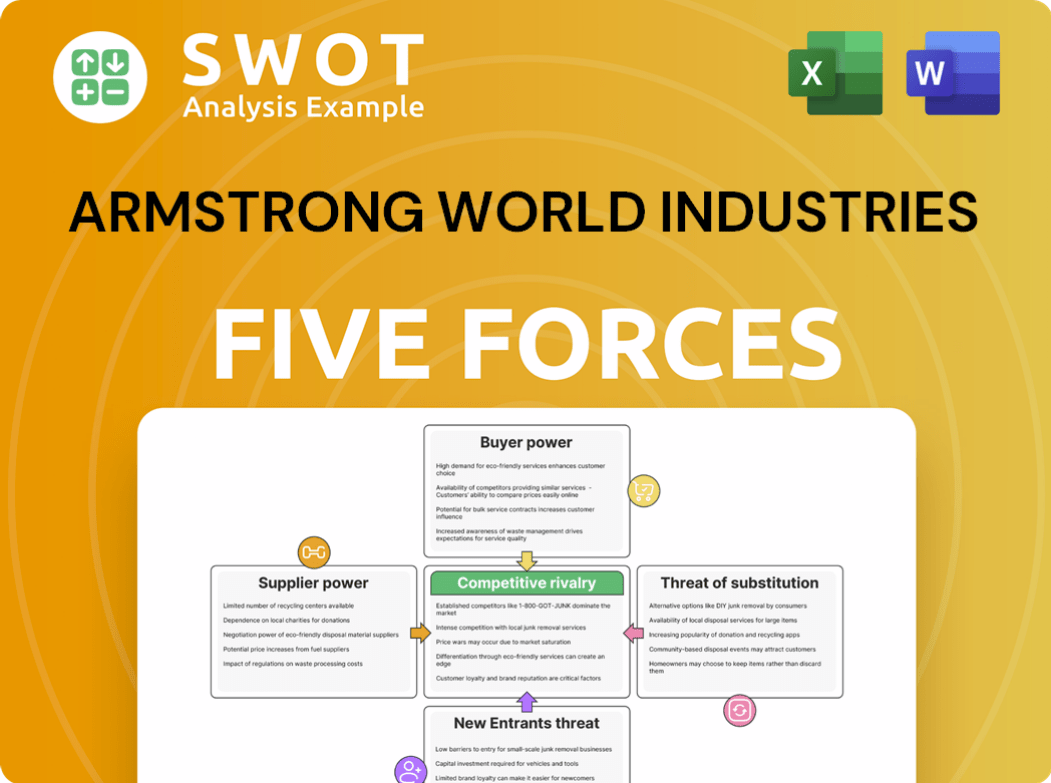
Armstrong World Industries Porter's Five Forces Analysis
- Covers All 5 Competitive Forces in Detail
- Structured for Consultants, Students, and Founders
- 100% Editable in Microsoft Word & Excel
- Instant Digital Download – Use Immediately
- Compatible with Mac & PC – Fully Unlocked
Related Blogs

- What is Competitive Landscape of Armstrong World Industries Company?
- What is Growth Strategy and Future Prospects of Armstrong World Industries Company?
- How Does Armstrong World Industries Company Work?
- What is Sales and Marketing Strategy of Armstrong World Industries Company?
- What is Brief History of Armstrong World Industries Company?
- Who Owns Armstrong World Industries Company?
- What is Customer Demographics and Target Market of Armstrong World Industries Company?
Disclaimer
All information, articles, and product details provided on this website are for general informational and educational purposes only. We do not claim any ownership over, nor do we intend to infringe upon, any trademarks, copyrights, logos, brand names, or other intellectual property mentioned or depicted on this site. Such intellectual property remains the property of its respective owners, and any references here are made solely for identification or informational purposes, without implying any affiliation, endorsement, or partnership.
We make no representations or warranties, express or implied, regarding the accuracy, completeness, or suitability of any content or products presented. Nothing on this website should be construed as legal, tax, investment, financial, medical, or other professional advice. In addition, no part of this site—including articles or product references—constitutes a solicitation, recommendation, endorsement, advertisement, or offer to buy or sell any securities, franchises, or other financial instruments, particularly in jurisdictions where such activity would be unlawful.
All content is of a general nature and may not address the specific circumstances of any individual or entity. It is not a substitute for professional advice or services. Any actions you take based on the information provided here are strictly at your own risk. You accept full responsibility for any decisions or outcomes arising from your use of this website and agree to release us from any liability in connection with your use of, or reliance upon, the content or products found herein.