

ABM Bundle

How did the ABM company transform from a cleaning service to a facility management giant?
Journey back in time to uncover the ABM SWOT Analysis and the fascinating Brief ABM history of ABM Industries. From its humble beginnings in 1909, ABM company has evolved into a Fortune 500 powerhouse. Discover the pivotal moments that shaped its growth and solidified its position in the facility management sector.

The Account-Based Marketing history of ABM is a testament to its adaptability and strategic vision. Understanding the early days of ABM companies and the evolution of ABM strategies provides valuable insights. Explore how ABM company navigated challenges and achieved remarkable growth, setting the stage for its continued success in the ever-changing business landscape, and how the ABM strategy has changed marketing.
What is the ABM Founding Story?
The founding story of the ABM company is a testament to entrepreneurial resilience and foresight. Morris Rosenberg established the company in San Francisco, California, in 1909. This marked the beginning of what would become a significant player in the facilities services industry.
Rosenberg's initial venture into the restaurant and hotel industry did not succeed. However, he recognized an opportunity in the demand for clean business environments. With a modest investment of $4.50 in cleaning supplies, he started offering window washing services to local businesses.
This simple yet effective business model quickly gained traction. The services expanded beyond window cleaning to include full janitorial services. Securing a contract with the Bank of Italy was a significant early achievement. In April 1913, the company officially became American Building and Maintenance Company, reflecting its broader operational scope.

Key Milestones in ABM's Early History
The early days of the ABM company were marked by strategic moves and significant contracts.
- Morris Rosenberg started the business in 1909 in San Francisco.
- The company secured a contract to clean Stanford University in 1921, a first for a major college campus.
- Following Morris Rosenberg's death in 1935, his sons, Theodore 'Ted' Rosenberg and Sydney Rosenberg, took over the business.
- The company's evolution reflects the broader trends in B2B marketing and service provision.
A notable early achievement was securing a contract to clean Stanford University in 1921. This made the ABM company the first janitorial contractor in America to clean a major college campus. This milestone highlighted the company's growing reputation and capabilities.
Following Morris Rosenberg's death in 1935, his sons, Theodore 'Ted' Rosenberg and Sydney Rosenberg, took over the business. They continued the company's growth and diversification. This transition ensured the company's longevity and adaptation to changing market demands.
The early success of the ABM company highlights the importance of identifying and capitalizing on market needs. The company's history provides valuable insights into the evolution of business strategies. Understanding the Account-Based Marketing history can offer insights into the growth of similar companies. Learn more about the Target Market of ABM.
ABM SWOT Analysis
- Complete SWOT Breakdown
- Fully Customizable
- Editable in Excel & Word
- Professional Formatting
- Investor-Ready Format

What Drove the Early Growth of ABM?
The early growth of the ABM company, a key player in the Account-Based Marketing history, began on the West Coast, focusing on annual cleaning contracts during the 1920s and 1930s. This initial strategy laid the foundation for its future expansion. By the end of World War II, the company had already established a significant presence across the U.S. and Canada.
 Expansion and Milestones
The post-war era fueled further expansion for the ABM company. By the end of the 1950s, it had offices in 45 cities across North America, employing approximately 6,000 people. The company's growth trajectory continued with a public listing in 1962, marking a significant milestone in its brief ABM history.
Going Public and Service Diversification
In 1962, the ABM company went public, trading over-the-counter, with Ted Rosenberg as chairman and Sydney Rosenberg as CEO. In 1965, the company was listed on the NYSE American. Strategic acquisitions in the late 1960s expanded ABM's services to include parking, mechanical, and lighting services, demonstrating its evolving ABM strategy.
Financial Growth and Stock Exchange Listing
By 1970, the company's annual revenue reached $75 million, and in 1971, ABM debuted on the New York Stock Exchange under the ticker symbol ABM. Revenue surpassed $100 million for the first time in 1974. The company's financial performance reflected its successful adaptation and growth within the B2B marketing landscape.
Organizational Restructuring and Continued Expansion
The 1980s saw ABM structuring its activities into three main groups: Janitorial Services, Public Services, and Amtech (energy-related). By 1999, ABM employed over 55,000 people and reported annual sales revenue exceeding $1.6 billion. You can read more about the Mission, Vision & Core Values of ABM.
ABM PESTLE Analysis
- Covers All 6 PESTLE Categories
- No Research Needed – Save Hours of Work
- Built by Experts, Trusted by Consultants
- Instant Download, Ready to Use
- 100% Editable, Fully Customizable

What are the key Milestones in ABM history?
The ABM company has a rich history marked by significant milestones that have shaped its growth and influence in the industry. From its early beginnings to its current status, the company has consistently adapted and expanded its operations, achieving notable successes along the way.
| Year | Milestone |
|---|---|
| 1921 | Became the first janitorial contractor to clean a major college campus, Stanford University. |
| 1971 | Listed on the NYSE, marking a key financial achievement for the company. |
| 2017 | Acquired GCA Services Group for $1.25 billion, the largest acquisition in its history, expanding its reach in education and commercial markets. |
| 2021 | Acquired Able Services, further expanding its scale and capabilities. |
| 2025 | Launched a new brand platform emphasizing its transformation into a tech-enabled solutions provider. |
Throughout its history, the ABM company has embraced innovations to stay ahead in the market. The company's focus on technology and sustainability is evident in its recent initiatives, reflecting a commitment to adapting to evolving industry trends and client needs. This approach has positioned the company as a leader in providing tech-enabled solutions.

Tech-Enabled Solutions
The company is transforming into a tech-enabled solutions provider, integrating technology into its service offerings to enhance efficiency and client experience. This shift reflects a proactive approach to meet the demands of modern clients and the changing market landscape.
Sustainability Initiatives
The company has been recognized for its sustainability efforts, demonstrating a commitment to environmental responsibility. Being named among the 100 Most Sustainable Companies by Barron's in 2024 highlights its dedication to sustainable practices.
Strategic Acquisitions
Strategic acquisitions, such as the purchase of GCA Services Group and Able Services, have expanded the company's service offerings and market presence. These moves have allowed the company to increase its scale and capabilities, broadening its reach in key markets.
Brand Platform Launch
The launch of a new brand platform in 2025 underscores the company's commitment to innovation and its evolution into a tech-enabled solutions provider. This platform aims to communicate the company's new direction and enhance its market position.
Service Diversification
The company has diversified its service offerings to meet the changing needs of its clients, including enhanced cleaning protocols and specialized services. This diversification helps the company remain competitive and relevant in the market.
Technology Integration
Integration of technology into its operations has improved efficiency and client service, including the use of data analytics and automation. This integration allows the company to optimize its services and provide better outcomes for its clients.
The ABM company has faced several challenges throughout its history, including market downturns and competitive pressures. The company has demonstrated resilience by adapting to crises and implementing strategic initiatives to drive growth and address evolving client needs. Understanding the Growth Strategy of ABM is key to navigating these challenges effectively.
Market Downturns
Economic downturns have presented challenges, requiring the company to adjust its strategies and operations to maintain profitability. The company has shown the ability to weather these storms through strategic financial planning and operational efficiency.
Competitive Pressures
Intense competition in the market necessitates continuous innovation and differentiation to attract and retain clients. The company has focused on providing superior service quality and leveraging technology to stay ahead of its competitors.
Evolving Client Needs
Adapting to changing client requirements, including the need for specialized services and tech-enabled solutions, has been a constant challenge. The company has responded by diversifying its service offerings and investing in technology to meet these evolving needs.
COVID-19 Pandemic
The COVID-19 pandemic presented significant operational and financial challenges, requiring the development of new service offerings and protocols. The company's response demonstrated its ability to adapt to crises and support its clients during difficult times.
Strategic Restructuring
Strategic initiatives, such as the '2020 Vision' and the current 'ELEVATE' strategy, aim to address challenges and drive future growth. These initiatives involve restructuring, investments in client and team member experience, and leveraging technology.
Operational Efficiency
Focusing on operational efficiency and cost management has been crucial for maintaining profitability during challenging times. The company continually seeks ways to streamline its processes and reduce expenses.
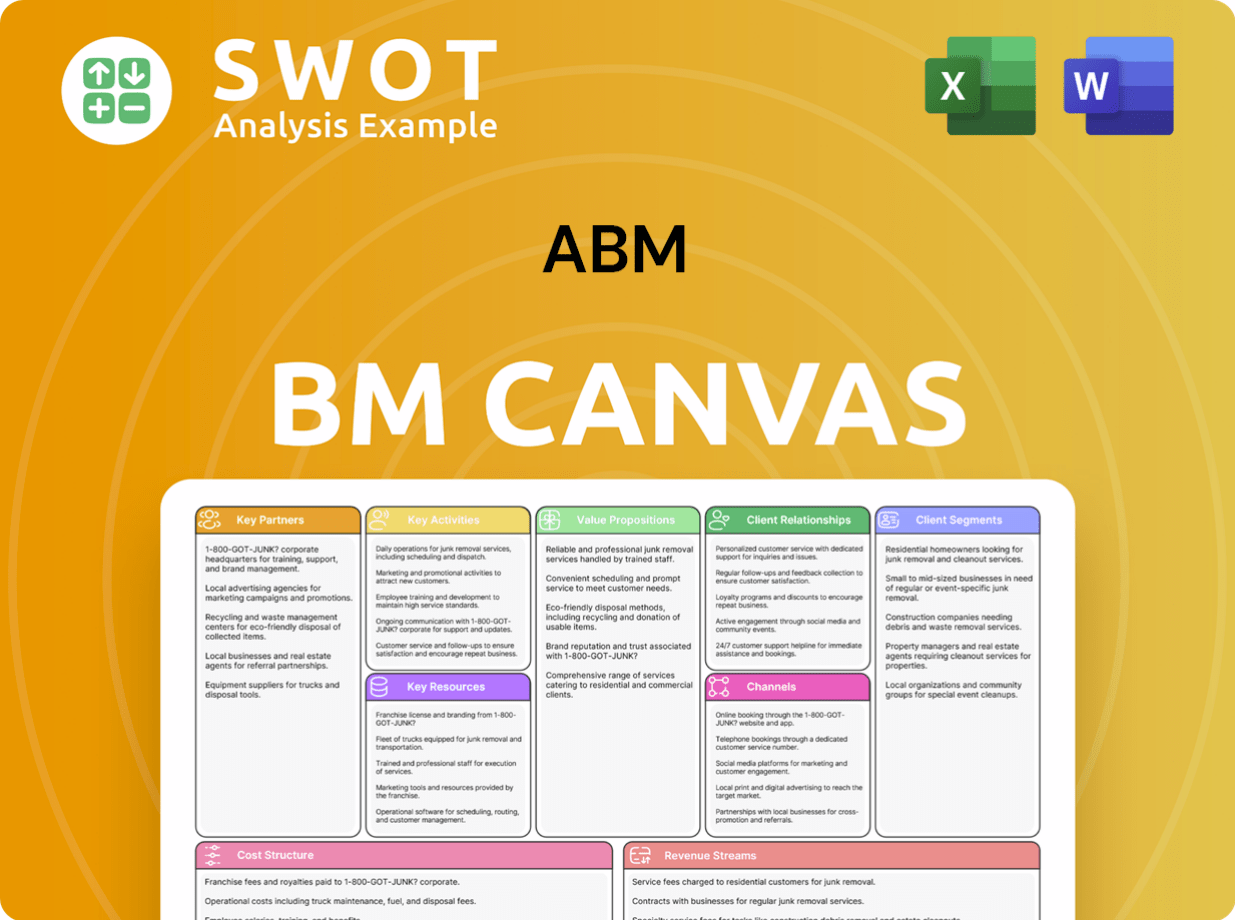
ABM Business Model Canvas
- Complete 9-Block Business Model Canvas
- Effortlessly Communicate Your Business Strategy
- Investor-Ready BMC Format
- 100% Editable and Customizable
- Clear and Structured Layout
What is the Timeline of Key Events for ABM?
The Revenue Streams & Business Model of ABM, or American Building and Maintenance Company, has a rich history that began in 1909 with Morris Rosenberg's window cleaning business in San Francisco. Over the years, the company has evolved and adapted, marking significant milestones that shaped its identity and growth in the B2B marketing landscape.
| Year | Key Event |
|---|---|
| 1909 | Morris Rosenberg establishes the company as a window cleaning business. |
| 1913 | The company is named American Building and Maintenance Company. |
| 1921 | Secures a contract to clean Stanford University. |
| 1962 | Goes public on the over-the-counter market. |
| 1965 | Listed on the NYSE American. |
| 1971 | Debuts on the New York Stock Exchange (NYSE) under ticker symbol ABM. |
| 1994 | Officially changes its name to ABM Industries Incorporated. |
| 2011 | Celebrates its 100th anniversary. |
| 2015 | Launches the '2020 Vision' strategic transformation. |
| 2017 | Acquires GCA Services Group for $1.25 billion. |
| 2021 | Acquires Able Services and launches the ELEVATE strategy. |
| 2024 | Named among Barron's 100 Most Sustainable Companies and reports fiscal year revenue of $8.4 billion. |
| 2025 | Announces Q1 fiscal year results with revenue of $2.1 billion. Provides fiscal year 2025 adjusted EPS outlook between $3.65 and $3.80. |
ELEVATE Strategy
The ELEVATE strategy is a key focus for ABM, emphasizing client and team member experience. This strategy is also heavily focused on the use of technology and data to improve operations. This approach aims to drive efficiency and enhance service delivery.
Growth in Key Segments
ABM anticipates continued growth in key segments, such as Technical Solutions and Aviation. The company is strategically positioned to capitalize on opportunities in these sectors. This growth is expected to contribute significantly to overall revenue.
Market Challenges and Outlook
While macroeconomic pressures, particularly in commercial real estate, pose challenges, ABM is confident in a return to growth. The company is adapting to market dynamics. The focus remains on long-term sustainable growth.
Investment in Emerging Areas
ABM is investing in areas like EV charging infrastructure and microgrid systems. These investments align with trends in sustainability and energy efficiency. This strategic move positions the company for future growth.
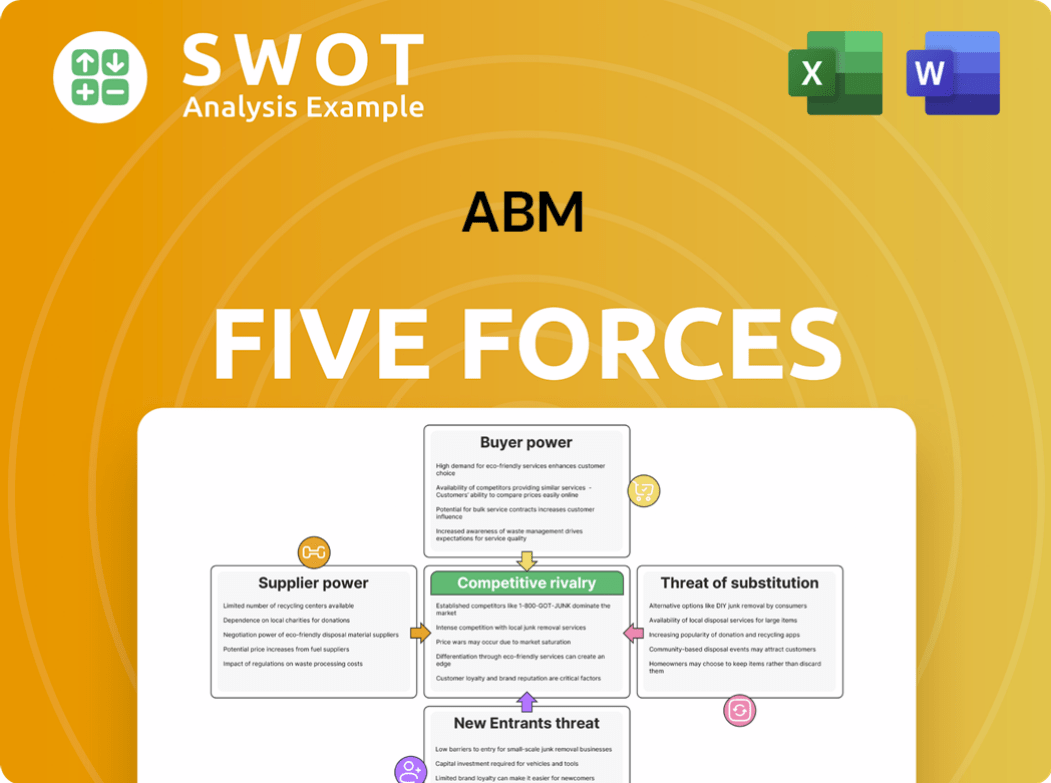
ABM Porter's Five Forces Analysis
- Covers All 5 Competitive Forces in Detail
- Structured for Consultants, Students, and Founders
- 100% Editable in Microsoft Word & Excel
- Instant Digital Download – Use Immediately
- Compatible with Mac & PC – Fully Unlocked
Related Blogs

- What is Competitive Landscape of ABM Company?
- What is Growth Strategy and Future Prospects of ABM Company?
- How Does ABM Company Work?
- What is Sales and Marketing Strategy of ABM Company?
- What is Brief History of ABM Company?
- Who Owns ABM Company?
- What is Customer Demographics and Target Market of ABM Company?
Disclaimer
All information, articles, and product details provided on this website are for general informational and educational purposes only. We do not claim any ownership over, nor do we intend to infringe upon, any trademarks, copyrights, logos, brand names, or other intellectual property mentioned or depicted on this site. Such intellectual property remains the property of its respective owners, and any references here are made solely for identification or informational purposes, without implying any affiliation, endorsement, or partnership.
We make no representations or warranties, express or implied, regarding the accuracy, completeness, or suitability of any content or products presented. Nothing on this website should be construed as legal, tax, investment, financial, medical, or other professional advice. In addition, no part of this site—including articles or product references—constitutes a solicitation, recommendation, endorsement, advertisement, or offer to buy or sell any securities, franchises, or other financial instruments, particularly in jurisdictions where such activity would be unlawful.
All content is of a general nature and may not address the specific circumstances of any individual or entity. It is not a substitute for professional advice or services. Any actions you take based on the information provided here are strictly at your own risk. You accept full responsibility for any decisions or outcomes arising from your use of this website and agree to release us from any liability in connection with your use of, or reliance upon, the content or products found herein.